Peter Schiff Says The Bitcoin ‘Good News’ Era Is Over In 2026

bitcoinistPublished on 2026-01-03Last updated on 2026-01-03

Abstract

Peter Schiff begins 2026 with a stark warning for Bitcoin investors, declaring the era of "good news" over. He argues that despite a year filled with pro-crypto narratives in 2025—including a "Bitcoin president," corporate buying, and ETF growth—BTC underperformed, falling over 7.5% while stocks and precious metals surged. Schiff claims that if an asset fails to rise on positive news, it indicates the news is already priced in, and a downturn is likely. He highlights the significant decline of leveraged Bitcoin proxy Strategy, down 47.5% for the year, as evidence of eroding structural demand. Schiff predicts a challenging 2026 macro environment of weak growth and persistent inflation, urging investors to sell Bitcoin above $87,000 and rotate into gold and silver.

Peter Schiff is starting 2026 with a blunt message for Bitcoin holders: in his view, the trade is crowded, the “good news” is exhausted, and the unwind is already visible in the vehicles built to maximize BTC exposure.

Schiff’s Bitcoin Prediction For 2026

In a Jan. 1 “Year-End Special” episode outlining his 2026 market forecasts, the renowned Bitcoin-critic argued that the cryptocurrency spent 2025 doing the one thing it wasn’t supposed to do in a year packed with pro-crypto narratives: fall. He framed that underperformance as the tell for what comes next.

Schiff contrasted BTC’s year against both risk assets and his preferred macro hedges. Stocks finished 2025 higher, he cited the Dow up 13%, the S&P 500 up 16.4%, and the Nasdaq up 20.4%, while gold rose 64% and silver more than doubled. Bitcoin, he said, was the outlier on the wrong side.

“Everybody on CNBC was pounding the table on when the year began was Bitcoin,” Schiff said, describing a narrative mix that included “a Bitcoin president,” “a Bitcoin strategic reserve,” heavy corporate buying, and the growth of ETFs. “Bitcoin was one of the only things that was down on the year.”

He pointed to ETF performance to ground that claim, saying he checked where Bitcoin ETFs “closed [...] because they’re done for the year,” and that they were “down just over 7.5% on the year,” even as the Nasdaq and gold posted large gains.

Then he delivered the core of his setup: “If something doesn’t go up when everybody thinks it’s going to go up, that’s a pretty good indication that it’s going to go down,” he said. “If a market can’t go up on good news, that means all that good news is already priced into the market [...] and that means all that it can do is go down.”

Strategy As The “Poster Boy” Stress Test

Schiff also used Strategy, the market’s most visible leveraged Bitcoin proxy, as his preferred diagnostic for sentiment and structural demand.

He said Strategy finished 2025 at a new 52-week low and was “down 47.5% on the year” and “67% below its peak 52-week high,” calling it “the poster boy” for maximum BTC leverage. Schiff’s argument was not that Strategy failed to buy BTC but that the equity market was already pricing the downsides of the model.

Schiff went further, claiming Strategy’s five-year average BTC cost basis sits around $75,000, implying only a modest gain with Bitcoin near $87,000. “That’s about a 16% gain, 3% a year over 5 years,” he said, arguing it undercut the pitch that the trade is a one-way compounding machine. He also claimed Strategy could not realistically exit at its average price without slippage, framing the “profit” as fragile in a liquidation scenario.

From there, Schiff extended the thesis into 2026 market structure: if Strategy slows or stops buying, and if ETF flows flip decisively negative, marginal demand may not be there when it’s needed. “The ETFs are selling now,” he said. “They’ve gone from big Bitcoin buyers to consistent Bitcoin sellers.”

While Schiff refrained from naming a BTC price target for 2026 in the video, the gold bug set a downside “minimum target” of about $50,000 mid-December 2025. He argued that Strategy could not fall as much as he expected without Bitcoin also taking a major leg lower.

The Macro Backdrop

Schiff’s broader 2026 macro call was a mix of weaker growth, stickier inflation, and intensifying political pressure on monetary policy, conditions he expects to support precious metals and pressure Bitcoin.

He argued the Fed is already effectively back in easing mode: “it just went back to quantitative easing, even though it hasn’t officially acknowledged that that’s what it’s doing” and expects further rate cuts alongside a weakening dollar. He also tied tariffs to higher consumer prices and margin pressure, forecasting a 2026 environment where “the economy is going to be weak” while “inflation is going to be strong,” a combination he called “toxic.”

Schiff’s practical conclusion for crypto listeners was direct: he urged viewers to “get rid of your Bitcoin above $87,000,” while reiterating that he expects capital to rotate toward gold and silver as “the bloom comes off that crypto [...] tulip.”

At press time, BTC traded at $89,517.
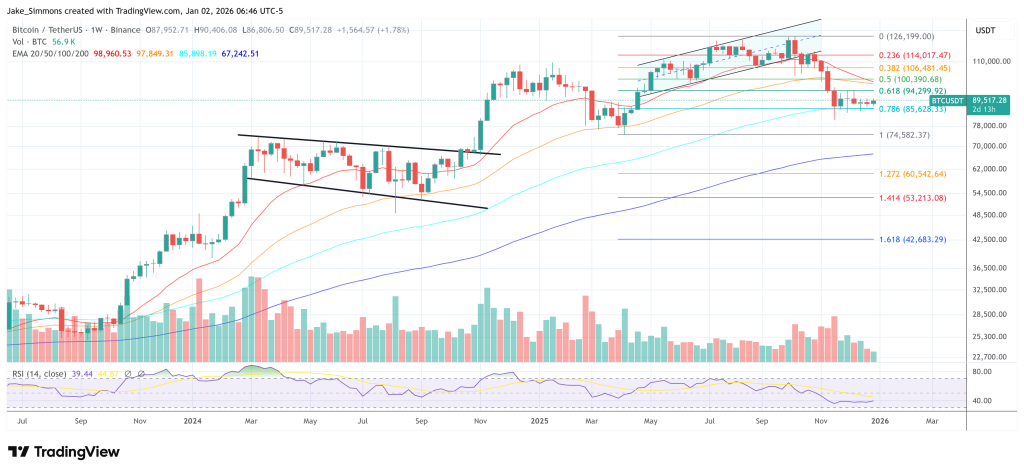
Bitcoin remains stuck between the 0.618 and 0.786 Fib, 1-week chart | Source: BTCUSDT on TradingView.com

Related Questions

QWhat is Peter Schiff's main argument about Bitcoin's performance in 2025 and his prediction for 2026?

APeter Schiff argues that Bitcoin underperformed in 2025 despite numerous positive narratives, and he believes this indicates the 'good news' is already priced in. He predicts that Bitcoin will decline in 2026, citing factors like exhausted demand, ETF selling, and a fragile market structure.

QHow did Bitcoin's performance in 2025 compare to other assets like stocks and precious metals according to Schiff?

AAccording to Schiff, Bitcoin was the outlier that declined in 2025, while the Dow rose 13%, the S&P 500 gained 16.4%, the Nasdaq increased 20.4%, gold rose 64%, and silver more than doubled.

QWhat role does Schiff assign to Strategy in his Bitcoin analysis?

ASchiff uses Strategy, a leveraged Bitcoin proxy, as a diagnostic tool for sentiment and structural demand. He notes it hit a new 52-week low, fell 47.5% in 2025, and is 67% below its peak, arguing it reflects the downsides of maximum BTC leverage and fragile profits.

QWhat is Schiff's broader macroeconomic outlook for 2026, and how does it relate to Bitcoin?

ASchiff expects weaker growth, stickier inflation, and political pressure on monetary policy in 2026. He believes these conditions will support precious metals like gold and silver while pressuring Bitcoin, as the Fed continues easing and the economy faces a 'toxic' mix of weak growth and strong inflation.

QWhat practical advice does Schiff give to cryptocurrency listeners regarding Bitcoin?

ASchiff urges viewers to 'get rid of your Bitcoin above $87,000' and expects capital to rotate toward gold and silver as the appeal of cryptocurrency diminishes, referring to it as a 'tulip' in decline.

Related Reads

How Many Tokens Away Is Yang Zhilin from the 'Moon Chasing the Light'?

The article explores the intense competition between two leading Chinese AI companies, DeepSeek and Kimi (Moon Dark Side), and the mounting pressure on Yang Zhilin, the founder of Kimi. While DeepSeek re-emerged after 15 months of silence with its powerful V4 model—boasting 1.6 trillion parameters and low-cost, long-context capabilities—Kimi has been focusing on long-context processing and multi-agent systems with its K2.6 model. Yang faces a threefold challenge: technological rivalry, commercialization pressure, and investor expectations. Despite Kimi’s high valuation (reaching $18 billion), its revenue heavily relies on a single product with low paid conversion rates, while DeepSeek’s strategic silence and open-source influence have strengthened its market position and valuation prospects, now targeting over $20 billion. Both companies reflect broader trends in China’s AI ecosystem: Kimi aims for global influence through open-source contributions and agent-based advancements, while DeepSeek prioritizes foundational innovation and hardware independence, notably shifting to Huawei’s chips. Their competition is seen as vital for China’s AI progress, with the gap between top Chinese and U.S. models narrowing to just 2.7% on the Elo rating scale. Ultimately, the article argues that this rivalry, though anxiety-inducing for leaders like Zhilin, is essential for driving innovation and solidifying China’s role in the global AI landscape.

marsbit8h ago

How Many Tokens Away Is Yang Zhilin from the 'Moon Chasing the Light'?

marsbit8h ago

Trading

Spot
Futures

Hot Articles

What is $BITCOIN

DIGITAL GOLD ($BITCOIN): A Comprehensive Analysis Introduction to DIGITAL GOLD ($BITCOIN) DIGITAL GOLD ($BITCOIN) is a blockchain-based project operating on the Solana network, which aims to combine the characteristics of traditional precious metals with the innovation of decentralized technologies. While it shares a name with Bitcoin, often referred to as “digital gold” due to its perception as a store of value, DIGITAL GOLD is a separate token designed to create a unique ecosystem within the Web3 landscape. Its goal is to position itself as a viable alternative digital asset, although specifics regarding its applications and functionalities are still developing. What is DIGITAL GOLD ($BITCOIN)? DIGITAL GOLD ($BITCOIN) is a cryptocurrency token explicitly designed for use on the Solana blockchain. In contrast to Bitcoin, which provides a widely recognized value storage role, this token appears to focus on broader applications and characteristics. Notable aspects include: Blockchain Infrastructure: The token is built on the Solana blockchain, known for its capacity to handle high-speed and low-cost transactions. Supply Dynamics: DIGITAL GOLD has a maximum supply capped at 100 quadrillion tokens (100P $BITCOIN), although details regarding its circulating supply are currently undisclosed. Utility: While precise functionalities are not explicitly outlined, there are indications that the token could be utilized for various applications, potentially involving decentralized applications (dApps) or asset tokenization strategies. Who is the Creator of DIGITAL GOLD ($BITCOIN)? At present, the identity of the creators and development team behind DIGITAL GOLD ($BITCOIN) remains unknown. This situation is typical among many innovative projects within the blockchain space, particularly those aligning with decentralized finance and meme coin phenomena. While such anonymity may foster a community-driven culture, it intensifies concerns about governance and accountability. Who are the Investors of DIGITAL GOLD ($BITCOIN)? The available information indicates that DIGITAL GOLD ($BITCOIN) does not have any known institutional backers or prominent venture capital investments. The project seems to operate on a peer-to-peer model focused on community support and adoption rather than traditional funding routes. Its activity and liquidity are primarily situated on decentralized exchanges (DEXs), such as PumpSwap, rather than established centralized trading platforms, further highlighting its grassroots approach. How DIGITAL GOLD ($BITCOIN) Works The operational mechanics of DIGITAL GOLD ($BITCOIN) can be elaborated on based on its blockchain design and network attributes: Consensus Mechanism: By leveraging Solana’s unique proof-of-history (PoH) combined with a proof-of-stake (PoS) model, the project ensures efficient transaction validation contributing to the network's high performance. Tokenomics: While specific deflationary mechanisms have not been extensively detailed, the vast maximum token supply implies that it may cater to microtransactions or niche use cases that are still to be defined. Interoperability: There exists the potential for integration with Solana’s broader ecosystem, including various decentralized finance (DeFi) platforms. However, the details regarding specific integrations remain unspecified. Timeline of Key Events Here is a timeline that highlights significant milestones concerning DIGITAL GOLD ($BITCOIN): 2023: The initial deployment of the token occurs on the Solana blockchain, marked by its contract address. 2024: DIGITAL GOLD gains visibility as it becomes available for trading on decentralized exchanges like PumpSwap, allowing users to trade it against SOL. 2025: The project witnesses sporadic trading activity and potential interest in community-led engagements, although no noteworthy partnerships or technical advancements have been documented as of yet. Critical Analysis Strengths Scalability: The underlying Solana infrastructure supports high transaction volumes, which could enhance the utility of $BITCOIN in various transaction scenarios. Accessibility: The potential low trading price per token could attract retail investors, facilitating wider participation due to fractional ownership opportunities. Risks Lack of Transparency: The absence of publicly known backers, developers, or an audit process may yield skepticism regarding the project's sustainability and trustworthiness. Market Volatility: The trading activity is heavily reliant on speculative behavior, which can result in significant price volatility and uncertainty for investors. Conclusion DIGITAL GOLD ($BITCOIN) emerges as an intriguing yet ambiguous project within the rapidly evolving Solana ecosystem. While it attempts to leverage the “digital gold” narrative, its departure from Bitcoin's established role as a store of value underscores the need for a clearer differentiation of its intended utility and governance structure. Future acceptance and adoption will likely depend on addressing the current opacity and defining its operational and economic strategies more explicitly. Note: This report encompasses synthesised information available as of October 2023, and developments may have transpired beyond the research period.

363 Total ViewsPublished 2025.05.13Updated 2025.05.13

What is $BITCOIN

Discussions

Welcome to the HTX Community. Here, you can stay informed about the latest platform developments and gain access to professional market insights. Users' opinions on the price of BTC (BTC) are presented below.

活动图片















