NodeStrategy: The First Ordinals DAT Project, Bringing the Strategy Treasury Narrative to NFTs

marsbitPublished on 2026-05-25Last updated on 2026-05-25

Abstract

**Summary: The Fundamental Flaws of NodeStrategy, the 'First Ordinals DAT'** NodeStrategy presents itself as the first Ordinals Digital Asset Treasury (DAT) on Bitcoin. Its model mirrors MicroStrategy's treasury narrative but for NFTs, specifically targeting the NodeMonkes collection (not officially affiliated). The project's core mechanism is a four-step flywheel: a 10% fee on all trades (90% to treasury, 10% to radFi/Bound marketplace) is used to buy NodeMonkes. These NFTs are then listed for sale on Satflow, with 100% of the sale proceeds used to buy back and burn the project's token, NODESTRAT, aiming to create a perpetual value cycle. However, the design contains critical, self-defeating flaws: 1. **Platform Lock-In:** As a Bitcoin Rune, NODESTRAT lacks smart contract functionality and cannot natively enforce the 10% fee. The fee can only be collected on the radFi/Bound marketplace itself. This makes the entire flywheel dependent on a single platform. If liquidity moves elsewhere, fee revenue drops to zero, halting the mechanism. 2. **Self-Suffocating Economics:** The 10% fee acts both as the flywheel's fuel and a major drag on demand. A buy/sell roundtrip incurs a 20% cost, creating a massive hurdle for traders. This strangles the very trading volume needed to generate fees. 3. **Ineffective Value Support:** The flywheel is starved. Low daily volume (~$9K) generates minimal fees for NFT purchases. The NFT "ladder" sales are slow and unpredictable (only 39 total ...

Author: 798.eth

NodeStrategy claims to be the first Ordinals DAT project on Bitcoin. It transplants MicroStrategy's treasury narrative onto NFTs: treasury buys monkeys, buys back and burns, number go up—it sounds smooth. But it's currently at a 0.46x depth discount, and the price is stagnant. The problem lies in the design itself. The fuel that feeds this machine and the cage that locks it are the same thing: that 10% transaction fee. Let's break it down step by step.

First, what is NodeStrategy? It's a Bitcoin Rune token called NODESTRAT, with a total supply of 1 billion. It calls itself The Perpetual Monke Machine, the first Ordinals digital asset treasury on Bitcoin L1. The treasury's underlying assets are NodeMonkes, a blue-chip Ordinals NFT series. Note that it is not affiliated with the official NodeMonkes. The trading venue is radFi, which is now Bound.

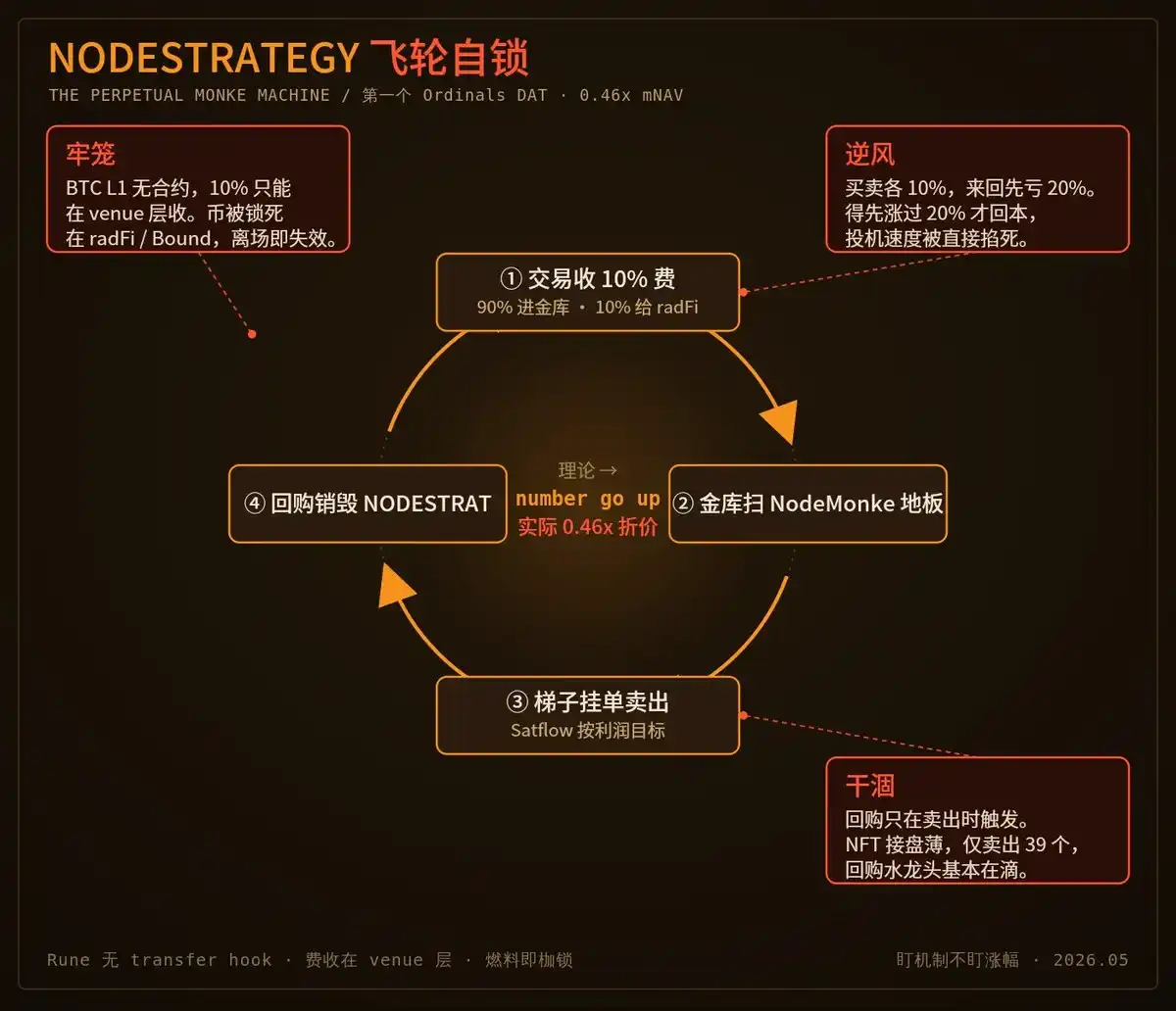
Next, how does the flywheel turn? The story it paints is a four-step closed loop. A 10% fee is charged on each transaction, with 90% going to the treasury and 10% to radFi. The treasury uses this fee to sweep the floor of NodeMonkes. The purchased monkeys are listed in a ladder on Satflow, for sale at different profit targets. The BTC from sold monkeys is 100% used to buy back and burn NODESTRAT. Reduced supply leads to price increases, attracting more traders, which in turn generates more fees. It claims to become more valuable the more it spins. There's only one script, and it sounds self-consistent. But it's not spinning. Here's why.

Point one: Why NODESTRAT can only be traded on radFi / Bound.

First, recognize its lifeline. The entire flywheel—sweeping, selling, buyback and burn—relies entirely on that 10% fee for sustenance. Without this fee, the treasury has no money, and the machine stops instantly.

So who collects this 10%, and at which layer? On Ethereum or Solana, this is simple; the token's contract itself can collect it. ERC20 can implement fee-on-transfer, and Solana's Token-2022 has TransferFee. With each transfer, the token's own code deducts the tax; you can trade it anywhere, and the tax follows the token.

But NODESTRAT is a Rune on Bitcoin. Bitcoin L1 does not have smart contracts. A Rune is just a balance entry on the Runes protocol ledger, etched as a number. It has no code, no transfer hooks, no executable logic whatsoever. You cannot create a Rune that automatically collects taxes. Transferring a Rune is simply a regular Bitcoin transaction moving a balance from one place to another; nothing in between can intercept it and take 10%.

Therefore, this 10% cannot be attached to the token itself; it can only be attached to the trading venue. It's radFi / Bound's liquidity pool that deducts the 10% at the moment you trade NODESTRAT, when constructing the transaction. The tax is collected at the platform layer; the token itself cannot deduct a single satoshi.

The corollary is clear. This 10% fee only exists when trading on radFi / Bound. If you transfer NODESTRAT as a regular Rune peer-to-peer to a friend, or sell it on another Ordinals marketplace, there is no 10% fee, because no place outside of Bound knows about this rule, let alone can enforce it.

Thus, the project is left with only one path to survive: locking all trading strictly within radFi / Bound. This is the only place in the world where this toll fee can be collected. If liquidity flows elsewhere, fee income drops to zero, the treasury stops sweeping, and the flywheel dies immediately.

This also explains that portion of the 10% allocated to radFi. radFi is the toll booth, and NodeStrategy is responsible for directing all traffic onto this road. This token is almost literally Bound by its name; it's honest naming. Its entire value mechanism is held hostage, like a pawn, on a single platform. This fragility is written into its design.

Point two: Why the price isn't rising, and where the root cause lies.

Its script is number go up, so why is it flat? The real issue is that the very fuel for this machine is poisoning its own demand.

First, the machine is out of gas. The flywheel burns on trading volume, and the volume is basically dead—$9K per day. A 10% cut is $900; 90% goes to the treasury, $810, which buys less than 0.01 BTC per day. No volume means no fees, no fees mean no sweeping, no sweeping means no monkeys on the ladder to sell, no sales mean no buybacks, no buybacks mean no burns—resulting in nothing happening to the price. The entire chain is spinning idly.

An even more critical point. That 10% is not just fuel; it is simultaneously a headwind pressing down on its own price. Buying incurs a 10% fee, selling incurs another 10%—a round trip loses 20% upfront. This token needs to rise over 20% just for a trader to break even. You're essentially inviting people to buy something that charges 10% on entry and another 10% on exit, directly strangling speculative velocity. On one side is the tailwind from buybacks and burns, and on the other side is the 20% round-trip tax acting as a headwind—both blowing on the same token. It's fighting itself.

The buyback pipe itself is already tightly screwed. Buybacks only trigger when a NodeMonke is actually sold from the ladder; only the money from sold monkeys goes towards buybacks. But the NFT market has thin order books, sells slowly, and is uncertain. It has only sold 39 monkeys in total, with 15 in the short bucket, and 0 in the medium and long buckets. The buyback faucet is basically dripping. The 30.77% that has been burned so far...

Burning itself does not create demand. Reducing supply can push up the price, but only if demand still exists. There's no volume, and entering the market gets hit with a 10% fee. Burning 30% of the supply results in a smaller, yet equally illiquid, market with no one bidding. Price is about supply and demand at the margin; it's aggressively attacking the denominator while the demand on the numerator side is locked down by the tax and dead volume.

That 0.46x discount is a self-locking trap. The token price is only half of NAV. A normal DAT, when at a premium, can issue more tokens to buy more assets, compounding and growing thicker—that's the real leverage for number go up. The only remaining lever to push the price is buybacks, which are starved by the earlier point. The path to premium is blocked, the path via buybacks is sluggish, and the discount just hangs there, with no mechanism to close it.

Finally, NAV is double the market cap; why isn't the price converging towards NAV?

Holding NODESTRAT offers no redemption channel; you cannot exchange the token for its implied 0.46x worth of NodeMonkes. Your only exit is to sell it to the next bidder on radFi, paying another 10%. That NAV is a marketing number, not a floor price. The market naturally doesn't recognize it, pricing it solely based on cash flow.

That 10% fee was meant to feed the flywheel. Instead, on one hand, it tax-strangles the very demand and volume the flywheel needs most; on the other hand, it can only collect it by locking the token onto a single platform, thereby limiting liquidity. Add to that the fact that the backing is non-redeemable and non-realizable, so NAV cannot anchor the price. This machine's design lets its own fuel source restrict its own demand.

This is not an assessment of price movements, just the mechanism.

Are there any good solutions to get this otherwise well-conceived flywheel spinning again?
Related Questions

QWhat is NodeStrategy and what is its primary function as described in the article?

ANodeStrategy is the first Ordinals DAT (Digital Asset Treasury) project on Bitcoin. Its primary function is to serve as a 'Perpetual Monke Machine'—a digital asset treasury for NodeMonkes NFTs on Bitcoin L1. The project aims to mirror the MicroStrategy treasury model on the Ordinals/NFT ecosystem.

QWhat is the four-step flywheel mechanism designed for NodeStrategy, and why does it fail to operate as intended?

AThe four-step flywheel is: 1) Collect a 10% fee on every NODESTRAT trade. 2) Use 90% of that fee to buy NodeMonkes NFTs from the floor. 3) List the purchased NFTs on Satflow at different profit targets. 4) Use 100% of the proceeds from NFT sales to repurchase and burn NODESTRAT. It fails because the 10% fee, which is its fuel, simultaneously chokes the trading volume and liquidity it needs to function, and the tax is only enforceable on the Bound (radFi) platform.

QWhy is the NODESTRAT token effectively locked to trading on the radFi/Bound platform?

ANODESTRAT is a Rune token on Bitcoin, which lacks smart contract functionality. Therefore, the 10% trading fee cannot be programmed into the token itself and can only be enforced by the trading platform (Bound) when constructing transactions on its order book. If the token trades elsewhere, no fee is collected, starving the treasury and stopping the flywheel.

QWhat are the two main contradictions or self-defeating aspects of the 10% trading fee mechanism?

AFirst, the fee suppresses the very trading volume it relies on for fuel. A round-trip trade incurs a 20% cost, killing speculative demand. Second, the mechanism relies on locking all liquidity to a single platform (Bound) to enforce the fee, creating fragility and limiting market access.

QWhy does the NODESTRAT token trade at a significant discount to its Net Asset Value (NAV) according to the article?

AThe NAV is not actionable for holders. There is no redemption mechanism to exchange NODESTRAT for its underlying NodeMonkes NFTs. The only exit is to sell on the open market (with another 10% fee), so the price is set purely by trading demand and liquidity, which are weak. The NAV is thus a marketing metric, not a functional price floor.

Related Reads

Female Crypto Mogul Survived Mining Crackdown and Market Plunge, but Paid a $60 Million Tuition to a U.S.-Style 'Pig-Butchering' Scam

An 80s-born Chinese entrepreneur, Fiona Lyu (also known as Lv Yongshuang), CEO of the mining firm Chengdu Valarhash Technology, was defrauded of over $9.4 million (approx. RMB 60 million) in the US, according to a Caixin report. Lyu's company once operated the 1THash and Bytepool mining pools, which collectively controlled about 9% of the global Bitcoin hash rate at their peak in early 2020. The scam began in 2021 after China's crackdown on crypto mining forced Lyu to seek overseas relocation for her operations. She was introduced to Zubair Al Zubair, who posed as an "UAE royal family member" with connections to Middle Eastern capital and US local government resources. He and his brother, who impersonated a hedge fund manager, orchestrated a fake contract signing for a mining facility in Ohio, witnessed by local officials. Lyu transferred millions in contract payments. The brothers, both US citizens with fabricated backgrounds, later fraudulently sold 1,067 of her miners for $6.17 million. The scheme involved bribing a mayor's chief of staff for legitimacy. In May 2026, US courts sentenced Zubair to 24 years in prison, his brother to 23 years, and the official to 8 years. Simultaneously, Lyu faced a separate legal battle in China. A subsidiary of listed company ST Zhongchang sued her firm, seeking refunds for a 2021 contract involving Bitcoin mining equipment. Chinese courts ruled the mining contract invalid and ordered a refund of nearly RMB 19.3 million. This dual blow marked a stark downturn for the once-prominent figure in the crypto mining industry.

Foresight News11m ago

Female Crypto Mogul Survived Mining Crackdown and Market Plunge, but Paid a $60 Million Tuition to a U.S.-Style 'Pig-Butchering' Scam

Foresight News11m ago

Trade.xyz Pricing Controversy Exposes Fatal Weakness of Pre-IPO Perpetual Contracts

The Trade.xyz pricing controversy surrounding its SPCX (SpaceX) pre-IPO perpetual contract on Hyperliquid has exposed a critical vulnerability in decentralized finance (DeFi) platforms offering such instruments. The dispute erupted after SpaceX's updated filing revealed its total shares outstanding were approximately 10% higher than market estimates. While centralized exchanges (CEXs) paused trading and repriced contracts based on the new data, Trade.xyz maintained its position that its "IPOP" contract tracks market expectations for the per-share price, not the company's fundamental valuation or share count. This discrepancy triggered cross-platform arbitrage and led to significant losses for leveraged long positions on Trade.xyz, as the contract price gaped down without a value-neutral adjustment mechanism. The incident highlights the absence of a "Rebase" function—a mechanism that proportionally adjusts contract prices and user positions to reflect corporate actions like share count changes—within many decentralized perpetual exchanges (Perp DEXs). Unlike CEXs, which can centrally execute such adjustments, implementing Rebase on-chain involves significant technical complexity, gas costs, and potential security risks. Trade.xyz's architecture, which allows independent market deployment, further complicates platform-wide Rebase implementation. The controversy underscores broader challenges for Perp DEXs venturing into real-world assets (RWA) like pre-IPO shares. It raises questions about pricing reliability, transparent rule disclosure, and the ability to handle corporate events, testing user trust and the long-term viability of these synthetic markets for price discovery before official listings.

链捕手27m ago

Trade.xyz Pricing Controversy Exposes Fatal Weakness of Pre-IPO Perpetual Contracts

链捕手27m ago

When AI Traffic Surpasses Humans, How Do You Prove You're Human?

As AI-generated web traffic now surpasses human activity, the internet's foundational business models—built on human attention, browsing, and advertising—face severe disruption. AI agents crawl websites at immense scale without generating ad revenue, while AI summaries divert traffic from original content sites. In response, over 2.5 million sites are blocking AI crawlers, and protections like Cloudflare's "honeypot" traps have emerged, though advanced AI can bypass these. The collapse of traditional CAPTCHAs, which assumed machines were weaker than humans, has led to a shift toward behavioral biometrics for human verification. Companies like IBM and BioCatch now analyze unique human patterns—cursor movements, typing rhythms, keystroke dynamics, and even cognitive delays like the Stroop effect—to distinguish real users from bots. These biometric signatures are difficult to fake or alter, offering a new layer of security but raising significant privacy concerns. Two competing visions for a reliable human verification system are emerging. One, exemplified by Sam Altman’s World (formerly Worldcoin), uses centralized iris scanning to generate unique credentials, though it faces bans and criticism over unauthorized data collection. The other employs cryptographic zero-knowledge proofs, allowing users to prove they are human without revealing identity or biometric data, as advocated by Vitalik Buterin. However, decentralized approaches risk exploitation through identity renting in economically unequal regions. The central dilemma is between a scalable but privacy-invasive centralized system that permanently controls users' biometric data, and a privacy-preserving cryptographic system vulnerable to real-world economic manipulation. The author expresses a preference for the cryptographic path, arguing that despite its flaws, it avoids the irreversible biometric surveillance inherent in centralized alternatives.

Foresight News35m ago

When AI Traffic Surpasses Humans, How Do You Prove You're Human?

Foresight News35m ago

Crypto Primary Market Investment and Financing Forward-Looking Weekly Report | Stablecoin Regulation Nears Implementation, ETF Funds Continue to Withdraw, Capital Begins Betting on Payment and Cash Flow

Crypto Market Weekly Report (Jun 1-7, 2026): Capital Shifts Focus to Payments & Cash Flow Market data indicates a significant divergence: while traditional institutional funds continue exiting via BTC and ETH ETFs (recording net outflows of $1.72B and $168M this week, respectively), stablecoin supply continues growing. This suggests capital is shifting from speculative asset allocation toward defensive positioning within on-chain liquidity, awaiting new, concrete opportunities. This trend is reflected in venture capital focus. Weekly fundraising fell 27% to $302M, with investments concentrating on infrastructure with tangible revenue potential: 1. **Stablecoin Infrastructure (28% of funding):** Projects like M0 Protocol ($35M raise) are gaining attention as regulatory clarity (e.g., the GENIUS Act) nears, shifting the focus from legitimacy to building payment and settlement networks. 2. **AI Agent Infrastructure (26%):** Investments are moving from conceptual AI Agents towards the execution and economic layers required for a functional "Agent economy." Key raises include OpenRouter ($40M) and Halliday ($20M). 3. **Real World Assets (RWA) (18%):** The search for on-chain yield and cash flow drives continued interest in RWA platforms like Ondo Finance. Security threats are evolving from smart contract exploits toward key management failures, permission control issues, and regulatory execution risks (e.g., court-ordered asset freezes). **Key Takeaways:** The investment thesis is shifting from narrative-driven bets to revenue and cash-flow-generating protocols. Future attention should be on the progression of stablecoin regulations, the commercial validation of AI Agent economies, and the performance of high-revenue protocols like derivatives platforms.

marsbit43m ago

Crypto Primary Market Investment and Financing Forward-Looking Weekly Report | Stablecoin Regulation Nears Implementation, ETF Funds Continue to Withdraw, Capital Begins Betting on Payment and Cash Flow

marsbit43m ago

Trading

Spot
Futures
活动图片