Moutai Moment: When Liquidity Dries Up, Everyone Huddles Around HYPE and ZEC

marsbitPublished on 2026-05-21Last updated on 2026-05-21

Abstract

In May 2026, a notable sentiment shift is occurring in the crypto market, symbolized by prominent Ethereum advocate David Hoffman selling his remaining ETH. While major assets like ETH and SOL struggle—ETH is down over 50% from its 2025 high—two assets, HYPE and ZEC, are rallying strongly. This divergence mirrors the "core asset crowding" phenomenon seen in traditional markets during liquidity crunches, where capital concentrates in few perceived safe havens. The market faces liquidity pressure, partly due to Bitcoin ETF outflows and stalled narratives for major Layer 1s. In contrast, Hyperliquid (HYPE) attracts capital due to its strong fundamentals as a leading decentralized perp exchange with substantial protocol revenue and a share of USDC reserve yields. Its tokenomics, heavily favoring users, add to its appeal. Meanwhile, Zcash (ZEC) surges as a "privacy beta" play, driven by growing fears over AI-driven deanonymization and quantum computing threats. Endorsements from figures like Arthur Hayes and Multicoin Capital's Tushar Jain, alongside regulatory clarity and ETF expectations, fuel its rise. This crowding poses risks. Similar to the A股白酒 rally that ended when liquidity returned, the current crypto crowding could unravel if macro conditions improve or if positions become too concentrated, leading to a sharp correction. The article concludes by questioning whether investors hold assets out of conviction or inertia and prompts consideration of what the next crowded tr...

Author: Deep Tide TechFlow

David Hoffman tweeted at dawn on May 21, 2026.

Just one sentence: "Has the vibe on Crypto Twitter genuinely shifted over the last two weeks, or have I just sold my last ETH?"
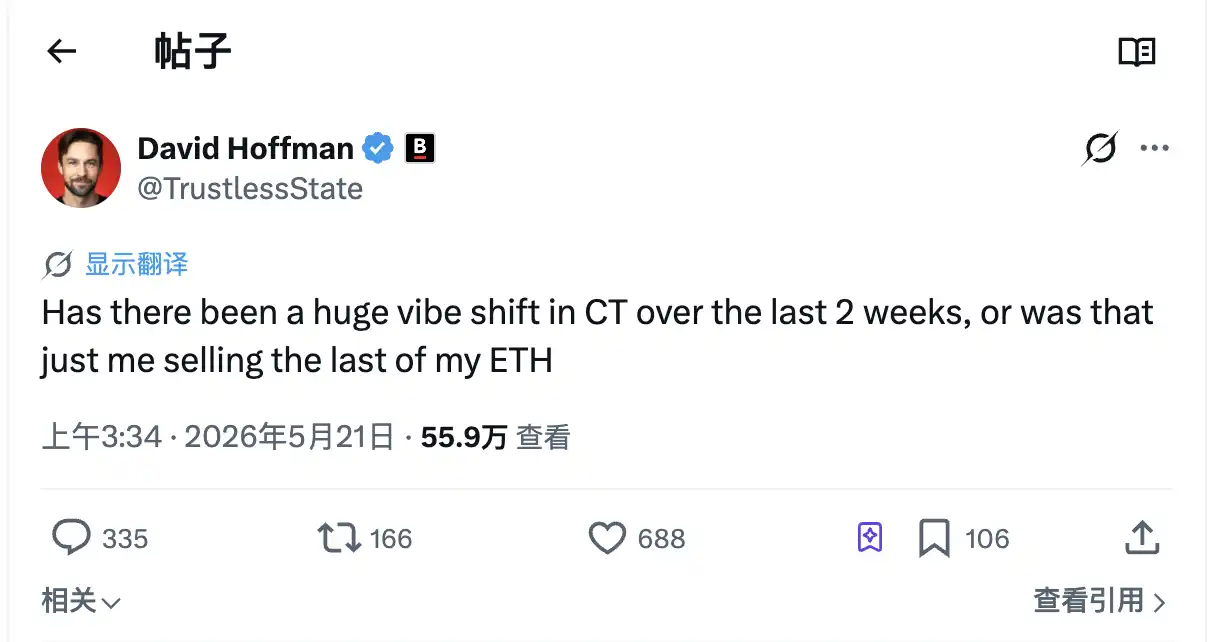
David Hoffman is the co-founder of Bankless, one of Ethereum's biggest public evangelists over the past six years. He once wrote on his personal page, "99% of wealth isn't in banks, it's on Ethereum." This is the man who authored "Ether: The Triple Point Asset" and was a core missionary in the narrative that defined ETH as "ultrasound money."

Now, he has cleared his position.

If last year some still viewed ETH as "the bond of the future world" and SOL as "a high-speed Nasdaq," by May 2026, the market had voted with its prices to complete a thorough de-faithing. ETH is currently struggling around $2,100, halved from its peak of $4,946 in August 2025.

Yet, in the very same market, HYPE is just one step away from its all-time high of $59.39, up 15% in the past seven days; ZEC has more than doubled in the past month, with a year-to-date increase of over 1400%, and its market cap has already squeezed into the top 20.

One market, two different climates.

The Former Baijiu

This isn't the first time such a split has appeared in the crypto world. But you need to temporarily look away from the screen and return to the A-share market in 2020.

From the second half of 2020 to early 2021, A-share liquidity peaked and receded, forcing mutual funds to make a choice: either spread their positions evenly across over 3,000 stocks and accept mediocre beta returns, or concentrate their ammunition on a handful of core assets with clear future cash flow stories. Everyone ultimately chose the latter. The result was that Moutai and Wuliangye were lifted to the sky, while the rest of the stocks were thrown into "garbage time" by the market.

That year, there was a very precise term called "core asset huddling." Its essence wasn't fund managers colluding, but an inevitable reaction in an environment of contracting liquidity. When the water in the pool shrinks, all the fish swim to the deepest corner.

The crypto market is now swimming towards that deepest corner.

What happened in the past year? Bitcoin ETFs absorbed roughly $70 billion in funds from 2024-2025, turning Bitcoin into an "asset priced by Wall Street." But this also means Bitcoin's marginal buying power began to be constrained by macro interest rates and stock market risk appetite. Q1 2026 inflation data exceeded expectations, coupled with a single-week net outflow of $1 billion from ETFs, causing the entire market to tremble.

What's more critical is the collapse of the narrative side. Citi cut its 12-month target price for ETH from $4,304 to $3,175 at the beginning of 2026, citing "stalled market structure legislation and weakening on-chain activity"; JPMorgan stated more bluntly in a May 19 report, "ETH needs stronger network growth and DeFi adoption to reverse its weakness relative to Bitcoin." The short-selling research firm Culper Research even publicly shorted ETH and released a report claiming that the Fusaka upgrade weakened the burn mechanism of EIP-1559, stripping ETH of its previous deflationary properties.

Solana is caught in another dilemma. It remains the best chain for DePIN, meme coins, and on-chain transaction experience, but when the market enters a risk-averse period, its greatest asset in the past, "high beta," ironically becomes a liability. Tushar Jain from Multicoin, the man who once carried Solana out of the ruins, publicly announced at Consensus Miami in May that Multicoin had taken a significant long position in Zcash.

This is a landmark moment. Solana's earliest and largest financial backer began shifting faith to another chain.

Huddling Around HYPE and ZEC

So, where did the money go?

The answer is surprisingly consistent: HYPE and ZEC.

The story of Hyperliquid was actually foreshadowed from the almost perfect airdrop in November 2024. The team, led by Harvard alumni Jeff and Iliensinc with backgrounds from Caltech/MIT/Citadel/Hudson River Trading, did something almost no one in crypto had managed in the past decade: distributing 76% of the tokens to users, with zero VC allocation.

If you only see this, you only see its "morality story." What truly propelled HYPE to rise against the trend during the liquidity drought of 2026 is its "cash flow story."

HYPE is not a traditional "narrative token." It is a complete chain, more accurately, a high-speed on-chain ATM in operation: as the largest decentralized perpetual contract exchange, it generates over $1.2 billion in annual protocol revenue; it has an agreement with Circle to share 90% of the USDC reserve yield, a stream alone contributing $135 to $160 million annually to token buybacks; this week (May 19), Bitwise announced adding HYPE to its balance sheet and launched an ETF product based on HYPE.

HYPE's contract open interest currently stands at $2.1 billion, and the funding rate has turned positive, indicating that new long-side capital is continuously entering, not a false prosperity from short squeezes.

The story of ZEC belongs to a completely different dimension. It's not a "cash flow story"; it's a "fear story."

Arthur Hayes wrote directly in his January essay, "This year's dominant narrative is privacy, and ZEC will be the privacy beta. To outperform Bitcoin and Ethereum, I will sell BTC to fund my privacy positions." His fund, Maelstrom, started building positions from Q3 2025.

Then, in early May, Multicoin Capital's Tushar Jain publicly doubled down at Consensus. CoinDesk's March research labeled ZEC with the tag "encryption supremacy," meaning privacy networks have become a dominant infrastructure. The underlying logic chain is the simultaneous convergence of three factors: AI gaining the ability to deanonymize users en masse on transparent blockchains, the threat of quantum computing creating long-term uncertainty for existing wallet encryption systems, and on-chain quarterly trading volume surpassing $100 billion for the first time, turning "wealth visible to the entire network" into a real fear.

The proportion of ZEC supply locked in shielded addresses has reached 30%, a historical high, meaning real privacy demand has quantifiable evidence on-chain, no longer just a literary narrative. The SEC officially closed its over-two-year investigation into the Zcash Foundation on May 20 without proposing any enforcement action. Robinhood has already listed ZEC, and expectations for a Grayscale ZEC ETF are being pushed to the forefront.

Hayes predicts ZEC's market cap will eventually reach 10% of Bitcoin's, corresponding to a token price 15-20 times above current levels.

Will the Huddle Dissolve?

When will the huddle break?

The A-share baijiu huddle broke after the Lunar New Year in 2021. The trigger wasn't deteriorating fundamentals, but a shift in central bank policy, turning the market from a zero-sum game back to a game of incremental funds. When the water in the pool starts to rise, all the fish no longer need to cram into the deepest corner.

When will the crypto world's pool expand? That depends on when the Fed cuts rates, when ETF funds flow back in, when stablecoin market cap hits new highs, and when traditional finance moves more money on-chain.

But one must also be wary of another possibility: the huddle could collapse under its own weight from becoming "too tight." ZEC's contract open interest surged 40% in the past 24 hours to $1.3 billion. This concentration itself is a risk signal. Hayes, Multicoin, retail traders, Robinhood users—everyone crowding into the same trade means the exit of any marginal buyer could trigger a chain reaction of long liquidations. HYPE's funding rate has turned positive and continues to rise, building up financing costs.

The endgame of a huddle is either a rising tide lifts all boats, and everyone takes profits together; or a stampede for the exit, with the last person in taking all the chips.

At which stage are we now? No one can give a definitive answer. But one question is worth asking for everyone reading this article:

If even David Hoffman has sold, the ETH still in your wallet—do you hold it because you believe in it, or because you forgot it was there?

The next question is more practical: When a market has only two names left to huddle around, what will the third name be? Aave? Maker? Some undiscovered privacy L2? Some high-performance chain yet to issue a token?

The person who figures this out will be the first to join the next huddle.

The person who doesn't will be the last to hold the bag when the next huddle breaks.

Related Questions

QWhy is the crypto market showing such a split performance between assets like ETH and HYPE/ZEC?

AThe crypto market is experiencing a significant liquidity contraction. As Bitcoin ETFs have absorbed massive inflows and traditional finance factors now influence its price, broader market liquidity has dried up. In such an environment, capital tends to 'huddle' towards a few select assets with the strongest narratives or fundamentals. HYPE offers a strong cash flow story through its protocol revenue and tokenomics, while ZEC is seen as a prime 'privacy beta' hedge against increasing surveillance and AI-driven de-anonymization threats on transparent blockchains. This creates a two-tier market where money flows only to the perceived safest or highest-conviction bets, leaving former leaders like ETH behind.

QWhat are the main reasons for HYPE's (Hyperliquid) strong performance during the market downturn?

AHYPE's strength is driven by its dual narrative of 'moral legitimacy' and a robust 'cash flow story.' Firstly, its token distribution, with 76% allocated to users and no VC allocation, builds strong community trust. More importantly, it functions as a cash-generating machine: it's the largest decentralized perpetual exchange, generating over $1.2B in annual protocol revenue. A key revenue stream is its agreement with Circle, sharing 90% of the USDC reserve yield, which contributes $135-160M annually for token buybacks. Its recent inclusion in Bitwise's balance sheet and the launch of an HYPE-based ETF further solidify its status as a 'quality asset' in a risk-off environment.

QWhat is the core narrative driving the massive surge in ZEC's price?

AThe surge in ZEC is driven by a 'fear narrative' centered on privacy becoming a critical infrastructure need. Key catalysts include the growing capability of AI to de-anonymize users on transparent blockchains, the long-term threat of quantum computing to existing cryptographic security, and the psychological impact of managing increasingly large, publicly visible on-chain wealth. Figures like Arthur Hayes and funds like Multicoin Capital have publicly endorsed ZEC as the premier 'privacy beta' play. Tangible evidence includes a record 30% of ZEC's supply being locked in shielded addresses, indicating real usage. Furthermore, the SEC's closure of its investigation into the Zcash Foundation without action removed a regulatory overhang, boosting confidence.

QWhat historical market phenomenon does the article compare the current crypto market situation to?

AThe article compares the current situation in crypto to the 'core asset huddle' (or '抱团') seen in China's A-share market in 2020-2021. During that period, as market liquidity peaked and began to recede, mutual funds concentrated their capital into a handful of 'core assets' like Kweichow Moutai (茅台) and Wuliangye (五粮液) that had clear future cash flow stories, while neglecting the broader market. The article uses the metaphor: 'When the water in the pond decreases, all the fish swim to the deepest corner.' This mirrors the current crypto environment where shrinking liquidity is forcing capital to concentrate in assets like HYPE and ZEC.

QAccording to the article, what are the potential outcomes for the current market 'huddle' around HYPE and ZEC?

AThe article outlines two potential outcomes for the current 'huddle.' The first is a positive scenario where 'the tide lifts all boats'—increased overall market liquidity from factors like Fed rate cuts, ETF inflows, or stablecoin growth allows everyone in the trade to profitably exit. The second is a negative, self-destructive scenario where the huddle becomes too crowded and collapses. Warning signs include ZEC's open interest surging 40% in 24 hours and HYPE's funding rate turning positive and rising, indicating high leverage and concentrated positions. A single shift in marginal buying pressure could trigger a cascade of liquidations, leaving the last entrants holding the bag ('the last person to enter takes all the chips').

Related Reads

When Hyperliquid Takes Away Solana's "Internet Capital Markets" Script

The article discusses how Solana's vision of becoming the "Internet Capital Markets" is being challenged, primarily by the rise of Hyperliquid. While Solana positioned itself as a high-performance blockchain for tokenizing all global assets, its native token SOL has significantly underperformed, and its core narrative faces pressure. Hyperliquid, initially a perpetual contracts platform, has evolved into a specialized Layer 1 financial network. Its focused, trading-optimized design is attracting users and capital, suggesting a vertical L1 may be better suited for a core capital market than a general-purpose chain like Solana. This external competition was compounded by an internal $200M+ exploit on Solana's key derivatives protocol, Drift, creating a strategic vacuum. In response, Solana founder Anatoly Yakovenko heavily promoted the Phoenix protocol as a decentralized, composable alternative. However, Phoenix's trading volume remains far behind leading platforms. Solana supporters also launched critiques against Hyperliquid's decentralization, citing its limited validators and closed-source code. Critics countered that Solana's own decentralization metrics have weakened, and the foundation's overt backing of Phoenix caused friction with other ecosystem builders. The piece concludes that Solana risks losing the "Internet Capital Markets" race if it cannot regain dominance in derivatives, potentially remaining a meme coin hub rather than achieving its grand ambition of hosting all global assets.

marsbit1h ago

When Hyperliquid Takes Away Solana's "Internet Capital Markets" Script

marsbit1h ago

Trump Signs Executive Order, Kraken, Coinbase and Others May Gain Access to Fed Payment Channels

President Trump has signed an executive order, "Incorporating Financial Technology Innovation into the Regulatory Framework," pressuring the Federal Reserve to reassess its rules on granting non-bank financial companies—including crypto and fintech firms—access to its payment systems, specifically master accounts that connect to the Fedwire settlement system. Currently, such accounts are primarily reserved for depository institutions. The order mandates a review to determine if broader access is permissible and to establish an application process. This move, supported by figures like Senator Cynthia Lummis, aims to reduce barriers to innovation and lower public payment costs by fostering fairer competition. It does not grant immediate access but could pave the way for companies like Kraken, Coinbase, Ripple, and Circle to reduce reliance on intermediary banks, lowering costs and speeding up settlements. A key precedent is the Kansas City Fed granting Kraken's parent company a restricted master account in March, offering limited payment services without interest or credit privileges. This model is seen as a potential template for allowing controlled access while mitigating systemic risk. Other firms like Anchorage, Paxos, and BitGo, which hold specialized banking charters, are also well-positioned to apply. The banking industry, represented by the American Bankers Association, opposes easing access, arguing any institution handling bank-like payments must meet the same stringent regulatory, consumer protection, and risk-management standards as traditional banks. Their core concerns include potential systemic risks, compliance gaps in areas like anti-money laundering, and the diversion of liquidity from the traditional banking system. The outcome of the Fed's review will be crucial in determining whether and how crypto and fintech firms can integrate more directly into the core U.S. financial infrastructure, balancing innovation with financial stability.

marsbit1h ago

Trump Signs Executive Order, Kraken, Coinbase and Others May Gain Access to Fed Payment Channels

marsbit1h ago

The First Large-Scale Strike in the AI Era Comes from the Factories That Build AI

The article describes a potential large-scale strike at Samsung Electronics, narrowly averted in May 2026 after a temporary agreement. The strike, planned by the company's union, would have been the first major labor action in the AI era targeting a core AI supply chain player. Samsung, alongside SK Hynix, produces roughly two-thirds of the world's memory chips, critical components for AI training and data centers like HBM. An 18-day strike could have disrupted global supply, affecting prices and production for tech companies and cloud providers. For South Korea, where semiconductors constitute about 35% of exports and Samsung represents a quarter of the stock market's value, such an action threatens national economic stability. The union's demands include a 7% base wage increase and, crucially, a clear, substantial profit-sharing model. They want 15% of annual operating profit as an employee bonus pool and the removal of the existing cap (about 50% of annual salary). This frustration is amplified by seeing rival SK Hynix successfully negotiate a deal granting employees 10% of operating profit as bonuses, with reports suggesting some workers could receive bonuses equivalent to hundreds of thousands of dollars. The conflict stems from deeper issues in South Korea's chaebol (conglomerate) system, where rapid national industrialization often prioritized corporate growth over labor rights. Samsung long maintained a "no union" policy until a 2020 apology from its leader. The article argues this strike highlights a fundamental tension in the AI age: as technology advances and corporate profits soar—often driven by AI—the workers who build the infrastructure are demanding a fair share and dignity, rejecting the notion that they are mere expendable components in a machine that "must not stop." The piece concludes that the true test of the AI era isn't just computational power, but whether the people who build the future can secure a stable and valued place within it.

marsbit2h ago

The First Large-Scale Strike in the AI Era Comes from the Factories That Build AI

marsbit2h ago

Ripple’s Fed Master Account Bid Gains Momentum After Trump Order

President Donald Trump has signed an executive order directing financial regulators and the Federal Reserve to review expanding fintech and crypto firms' access to core payment infrastructure. This order significantly advances the industry's push for direct Fed connectivity, a central issue for Ripple. The company has been seeking a Federal Reserve master account as part of its strategy for its RLUSD stablecoin, which would allow it to hold reserves directly with the central bank and access its payment rails. The order, titled "Integrating Financial Technology Innovation into Regulatory Frameworks," mandates a Fed review within 120 days on allowing access for entities like uninsured depository institutions and non-bank financial companies, including those in digital assets. This creates a formal policy timeline for resolving whether crypto payment firms must rely on traditional bank intermediaries. Ripple's application for a national bank charter and a master account is part of this broader landscape. The issue gained precedent when Kraken Financial received a limited-purpose master account, while Custodia Bank's application was denied after a legal battle. The Fed has also proposed a more restricted "payment account" option. Trump's order does not guarantee approval for Ripple but forces a high-level examination of the regulatory barriers, bringing the company's long-running effort to the forefront of Washington's financial policy agenda.

bitcoinist2h ago

Ripple’s Fed Master Account Bid Gains Momentum After Trump Order

bitcoinist2h ago

Trading

Spot
Futures

Hot Articles

How to Buy HYPE

Welcome to HTX.com! We've made purchasing Hyperliquid (HYPE) simple and convenient. Follow our step-by-step guide to embark on your crypto journey.Step 1: Create Your HTX AccountUse your email or phone number to sign up for a free account on HTX. Experience a hassle-free registration journey and unlock all features.Get My AccountStep 2: Go to Buy Crypto and Choose Your Payment MethodCredit/Debit Card: Use your Visa or Mastercard to buy Hyperliquid (HYPE) instantly.Balance: Use funds from your HTX account balance to trade seamlessly.Third Parties: We've added popular payment methods such as Google Pay and Apple Pay to enhance convenience.P2P: Trade directly with other users on HTX.Over-the-Counter (OTC): We offer tailor-made services and competitive exchange rates for traders.Step 3: Store Your Hyperliquid (HYPE)After purchasing your Hyperliquid (HYPE), store it in your HTX account. Alternatively, you can send it elsewhere via blockchain transfer or use it to trade other cryptocurrencies.Step 4: Trade Hyperliquid (HYPE)Easily trade Hyperliquid (HYPE) on HTX's spot market. Simply access your account, select your trading pair, execute your trades, and monitor in real-time. We offer a user-friendly experience for both beginners and seasoned traders.

3.1k Total ViewsPublished 2024.03.29Updated 2026.02.20

How to Buy HYPE

Discussions

Welcome to the HTX Community. Here, you can stay informed about the latest platform developments and gain access to professional market insights. Users' opinions on the price of HYPE (HYPE) are presented below.

活动图片