For those who haven't been following the BIP-110 debate: essentially, it's a proposed rule change for Bitcoin that would limit the amount of non-financial data, such as images or files, users can embed into the blockchain. Proponents argue this cap would curb so-called 'spam' that takes up block space and return the protocol to its original purpose—money transfer.
So far, support remains minimal: there are less than 50 blocks left until mandatory signaling begins at block 961632, and less than eight hours until that point: signaling is scheduled to start Saturday at 9:00 AM Eastern Time (EDT). As of publication, the support level is just 2.6%. The most accurate way to check this firsthand is to run Bitcoin Core alongside an RDTS-supporting Knots version and observe if their chains diverge after block 961632 appears. However, not everyone has the hardware or technical capability to run full nodes, and the nodes themselves do not disclose the percentage of miner support.
Where to Watch the Events
The following websites provide observers with the ability to follow events in real-time by tracking miner signals and individual node chains, allowing observers to spot a potential chain split the moment it happens. A blockchain split can occur if miners start producing blocks that BIP-110 rejects after block 961632, causing Bitcoin Core nodes to accept blocks that RDTS-supporting Knots nodes will refuse.
Fork.observer
The Fork.observer web portal is one of the primary resources for tracking Bitcoin blockchain forking in real-time. The site monitors the Bitcoin blockchain in real-time for chain splits and competing blocks, displaying the main chain alongside any side branches or forks that suddenly diverge. The Fork.observer developer prepared a dashboard for today's test, noting that the site:
"Is connected to over 50 nodes: Bitcoin Core, Knots, BIP-11O, btcd, floresta, electrum, and mempool-space. Also shows which block over 20 mining pools are working on."
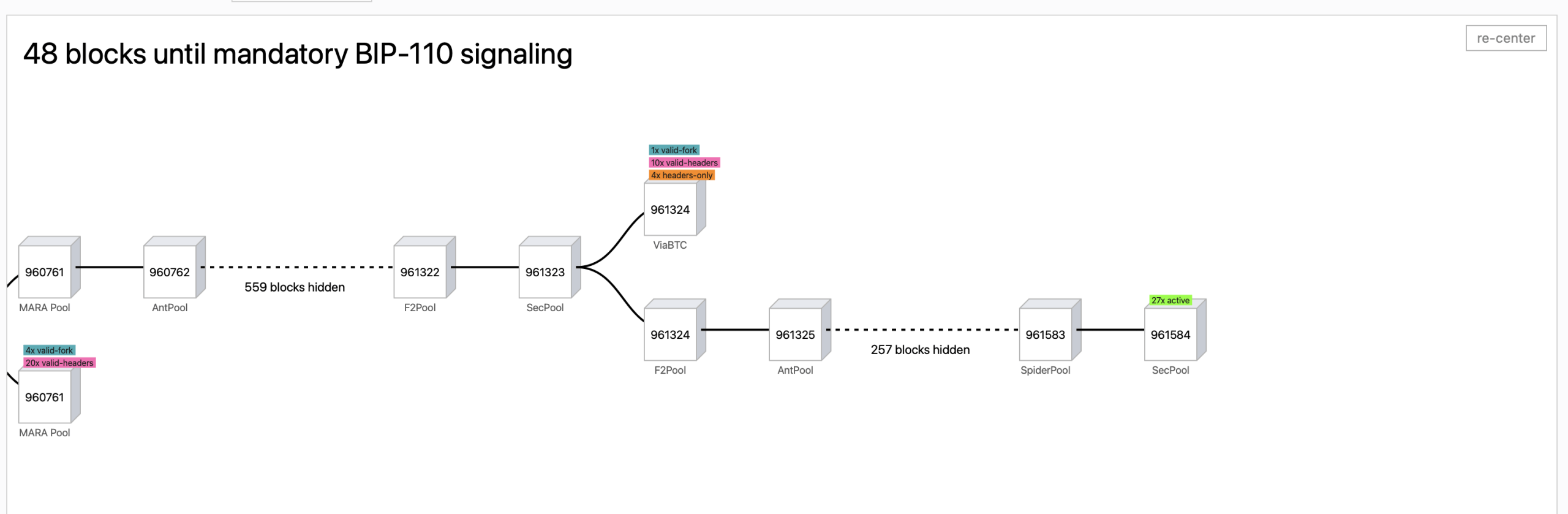
BIP110.org/monitor
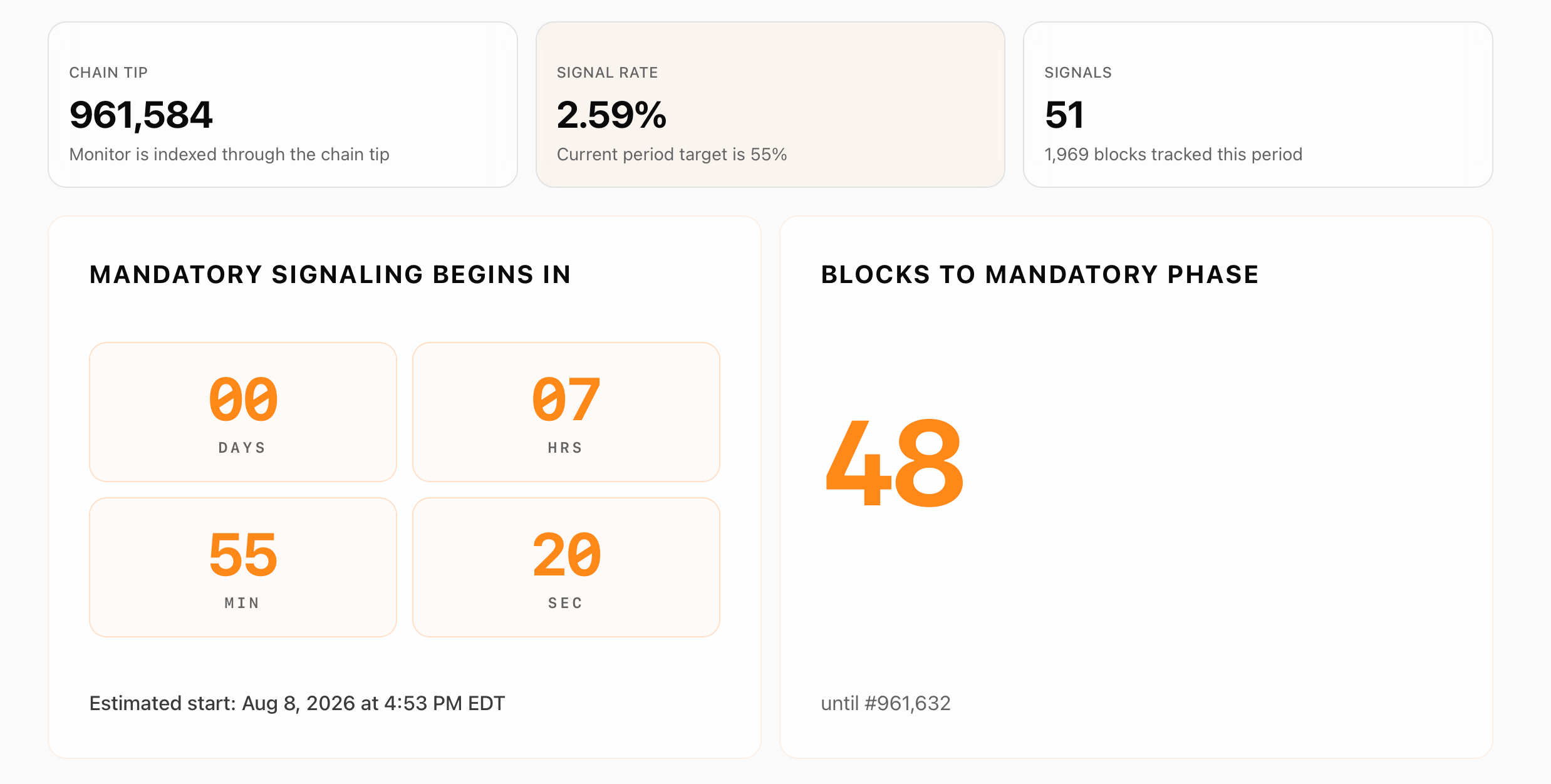
BIP110.org/monitor is the official real-time monitoring dashboard tied to the BIP-110 proposal's website. It tracks in real-time miner signaling for the BIP-110 version bit 4, displaying the current difficulty period, percentage of signaling, number of blocks remaining until mandatory signaling begins at block 961632, and a visual grid of recent blocks. For anyone following the countdown, it's a convenient public tool to see if miners are truly supporting the temporary soft fork to limit data volume as the deadline approaches.
Forkwatch.tv
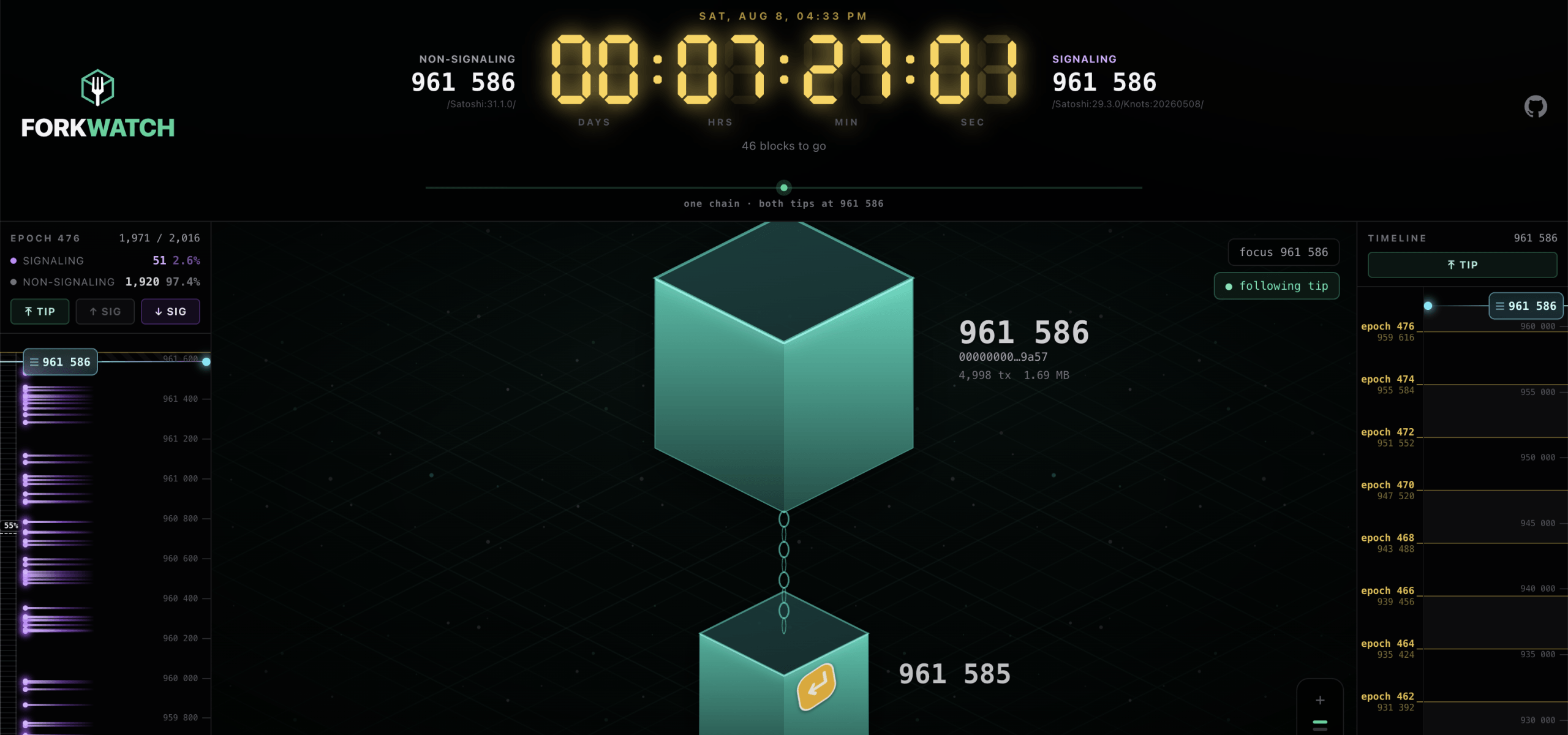
The next site, Forkwatch.tv, is specifically built to watch the BIP-110 unfolding in real-time. It tracks the current Bitcoin chain tip alongside any signaling and non-signaling branches that appear, displaying block height, the percentage of BIP-110 signaling over the current difficulty period, and the countdown to mandatory signaling. More importantly, the site highlights blocks containing transactions that BIP-110 participants would reject, making it easier to see where conflicts between competing rule sets might occur.
Mempool.kilombino.com
Mempool.kilombino.com is a modified clone of the familiar mempool.space interface, retooled to highlight miner signaling for BIP-110 via the version bit 4 and flag transactions or blocks that violate the proposed data limits, including outputs exceeding the allowed size, large data transfers, and certain Taproot functions.
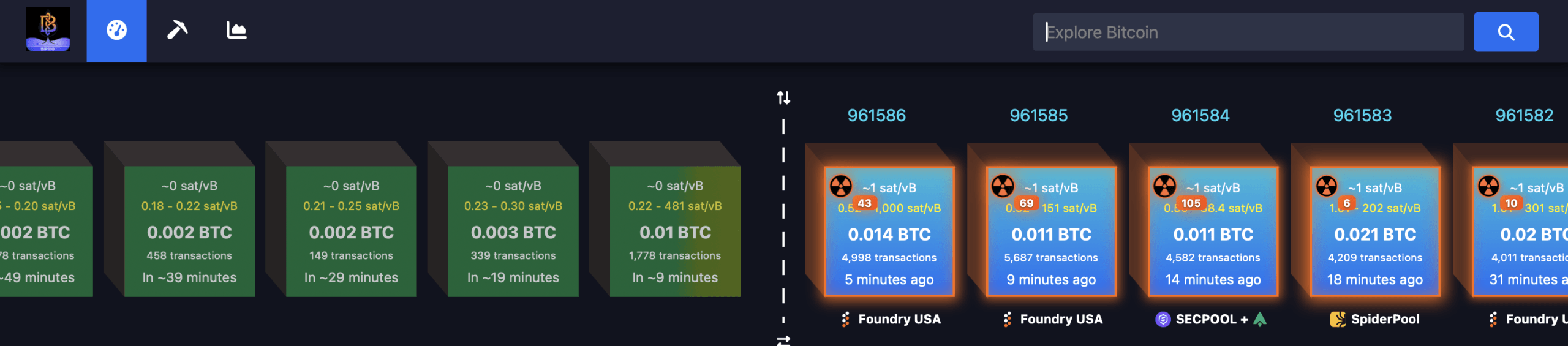
The dashboard allows observers to track the main Bitcoin chain alongside any potential BIP-110-enforcing chain, with visual alerts identifying rule violations and differences between node software as they emerge.
Forkmonitor.info
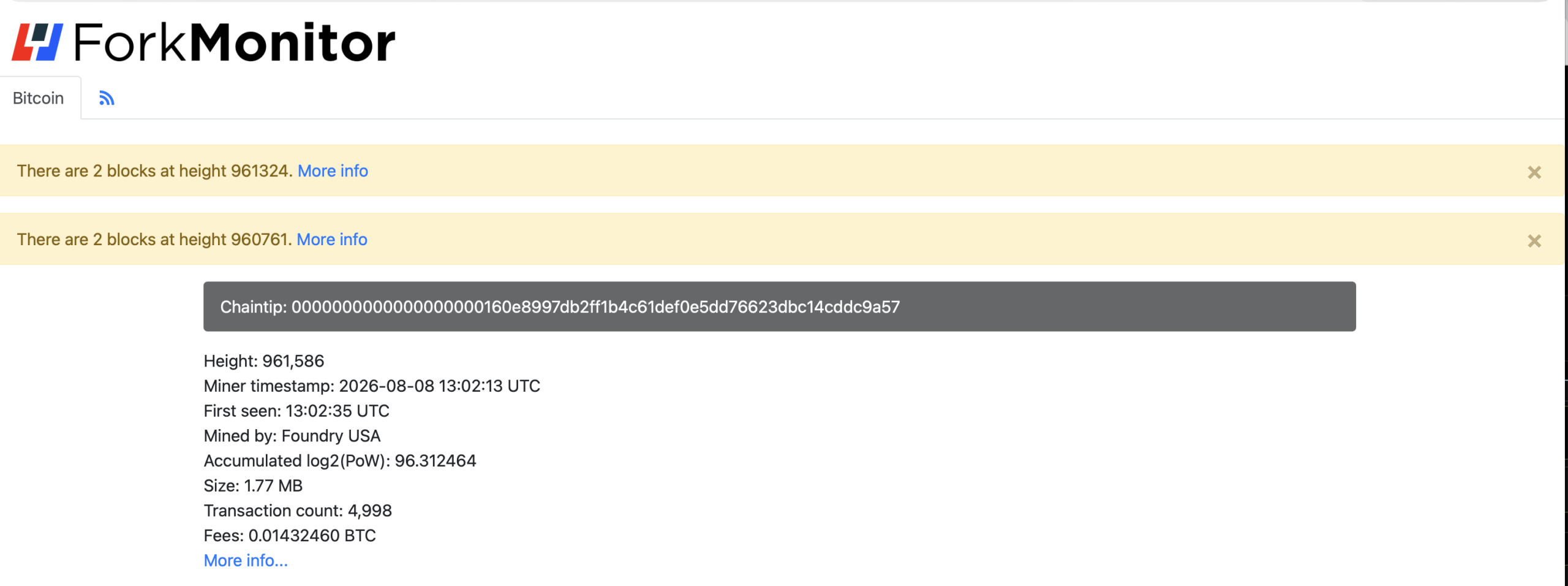
Forkmonitor.info is a long-standing public Bitcoin network monitoring site that tracks chain tips and potential forks/splits in real-time. Essentially, it connects to many Bitcoin nodes running different software versions (including several Bitcoin Knots builds supporting BIP-110) and displays their current chain height, synchronization status, and whether any nodes are following a different chain.
Miningpool.observer
Miningpool.observer meticulously analyzes Bitcoin mining pools, comparing high-fee block templates generated by a Bitcoin Core node against the blocks miners actually produce. This side-by-side comparison shows which transactions pools include, exclude, or treat as conflicting.
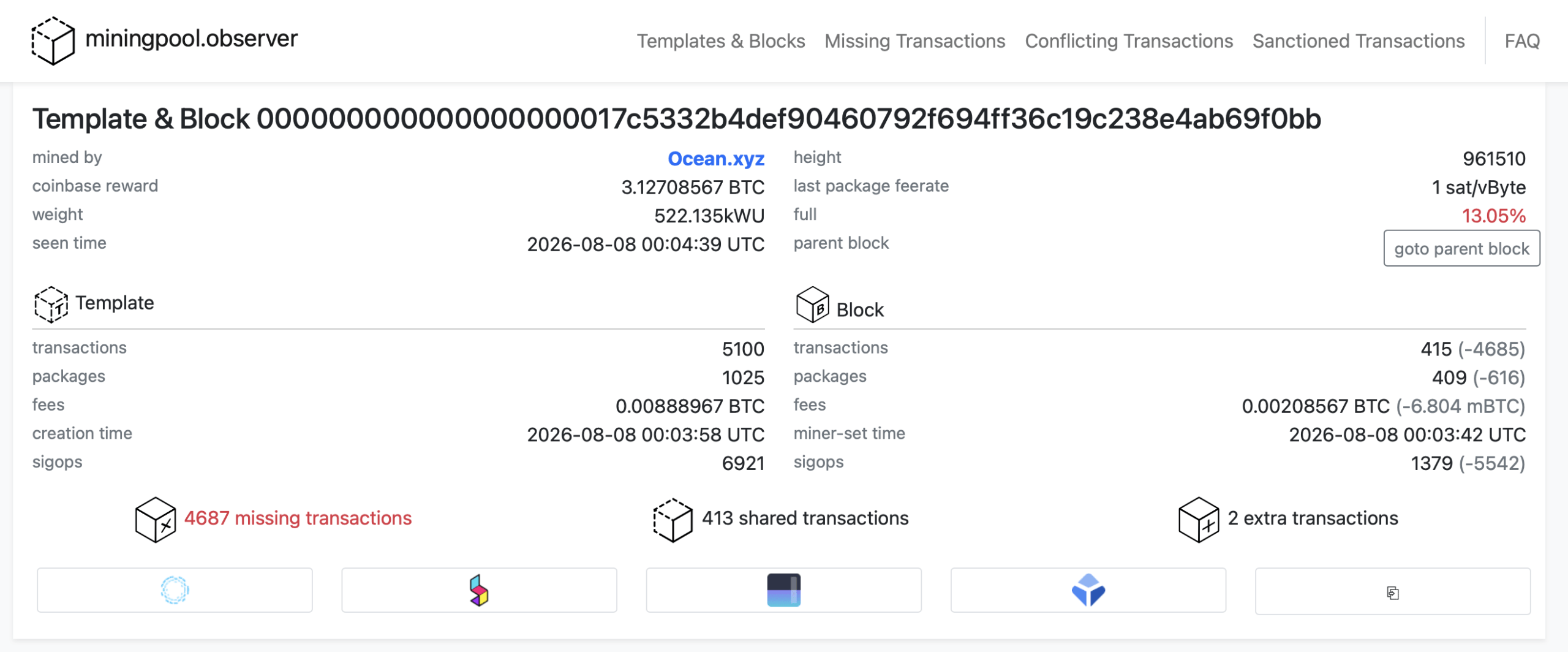
The site highlights missing and extra transactions, conflicts, and instances where pools appear to be deliberately filtering transactions. During events like BIP-110, it becomes especially useful for seeing what miners are actually doing, rather than what signals alone say, revealing transaction selection policy block-by-block.
Wickedsmartbitcoin.com/bip110_signaling
Wickedsmartbitcoin.com/bip110_signaling (also available via the short link bip110.rip) is a detailed BIP-110 signaling monitoring dashboard. It essentially tracks miner BIP-110 signaling over each 2,016-block difficulty period with clear charts, shows the current signaling percentage and estimated hash rate, and displays a countdown to the start of the mandatory signaling period.
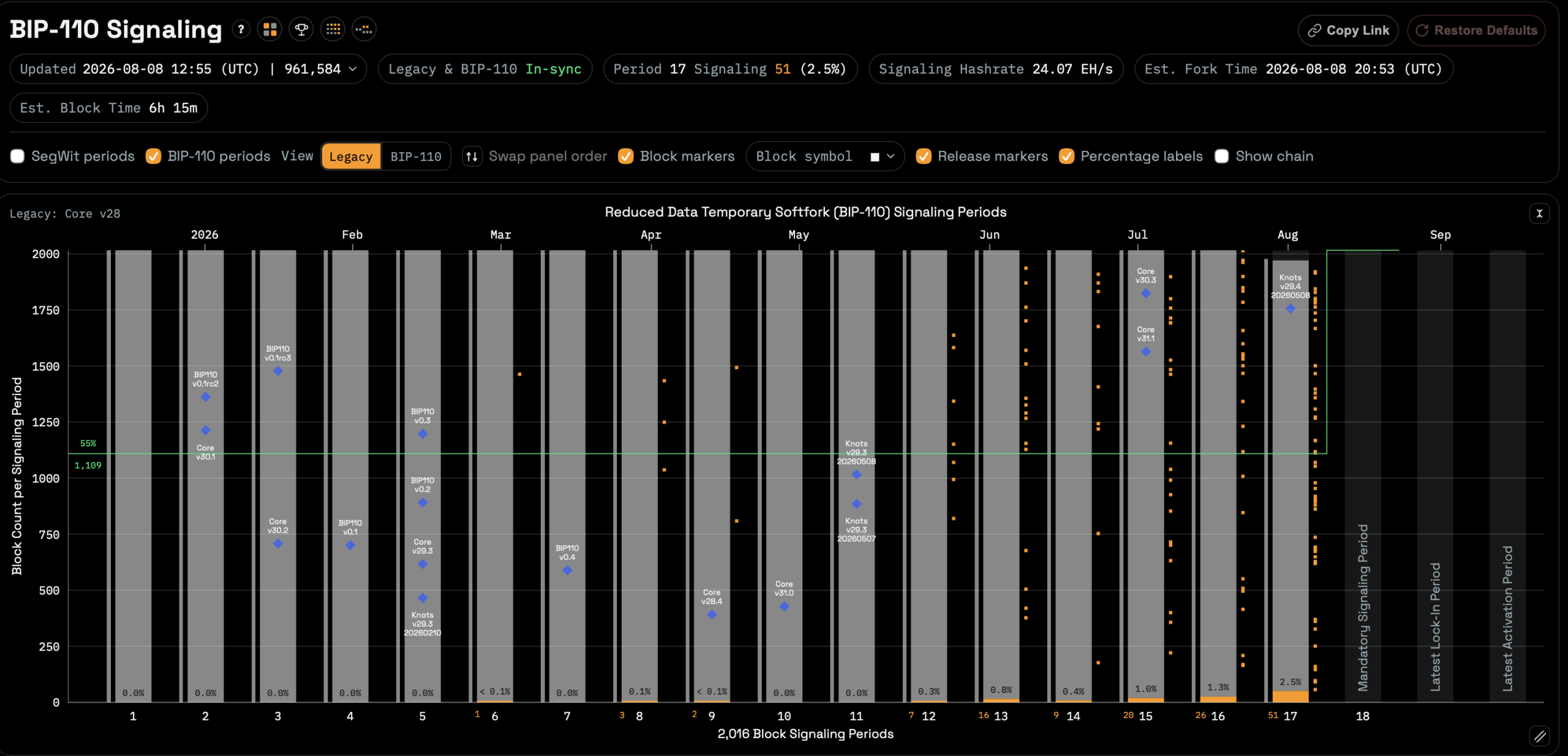
Key features include a real-time "Legacy vs BIP-110" chain comparison showing if both chains are synchronized or have begun diverging, miner and pool signaling rankings, and historical comparisons with earlier soft forks like SegWit. It's one of the community's most feature-rich tools for monitoring both signaling progress and potential chain split risk.
Tik-Tok, Next Block
Whatever happens at block 961632, the value of these tools extends beyond a single day. Bitcoin governance has always been based on rough consensus and running code, not formal votes, and BIP-110 turns that abstraction into a process people can watch in real-time. If the chain splits, these dashboards will be a record of when and where exactly it happened. If it doesn't, they'll still show how close the network came to testing itself under pressure.
The main lesson is in the tools themselves. Trying to follow a soft fork used to mean parsing raw block headers or trusting second-hand reports from mining pools. Now, anyone with a browser can watch chain tips diverge, compare miner behavior against expected patterns, and see signaling data update block by block.
All eyes are on the clock now. BIP-110 critic and Strategy founder Michael Saylor weighed in hours before mandatory signaling takes effect. Saylor emphasized: "With miner signaling at only 2.6%, BIP-110 has failed to garner broad miner support. Starting at block 961,632, its nodes will reject blocks without signals. After that, BIP-110 will either stall or fork itself into irrelevance, while Bitcoin continues operating as normal. Bitcoin is working as designed."