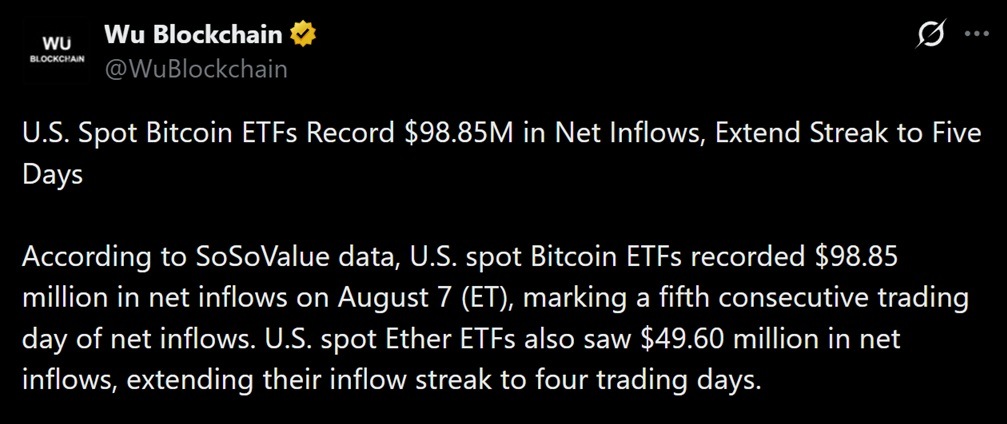
Recent data indicates a fifth consecutive trading day of net inflows into US spot Bitcoin ETFs and a fourth day for their Ether counterparts. The weekly inflow into Bitcoin ETFs has now surpassed $750 million—a pace that seemed unattainable just a month ago.
This series began on Monday, August 3rd, and continued through Friday without a single day of decline. This sharply contrasts with the volatile pattern of frequent pauses and resumptions that characterized Bitcoin ETF inflow dynamics for most of the year. For comparison, on August 7th, Solana and XRP ETFs recorded virtually no net change.
The main driver was Blackrock's IBIT: during the period from Monday to Wednesday that initiated the current series, IBIT alone accounted for $479 million of the total $626 million inflow into Bitcoin ETFs (approximately 76% of the entire incoming volume).
Fidelity's FBTC attracted $19.6 million over the same three days, ARK 21Shares' ARKB attracted $9.2 million, and Bitwise's BITB attracted $8.7 million. Finally, it's worth noting that Grayscale's older product, GBTC, has lost a cumulative $27.47 billion since its conversion to an ETF in early 2024.
Ether's Growth Dynamics Mirror Bitcoin's
The rise in Ether's price is following an almost identical pattern to Bitcoin's. On August 5th, spot Ether ETFs attracted a total of $60.86 million, with Blackrock's ETHA ETF alone pulling in $50.34 million of that amount (about 83%). Fidelity's FETH fund attracted just $2.87 million, while Bitwise's ETHW and 21Shares' TETH each attracted approximately $1.3 million. Blackrock's fund investing in staked Ether (ETHB) added another $4.94 million to the sum attracted by ETHA.
This uneven distribution means that the "four consecutive days" of Ether ETF inflows are, in practice, largely the story of Blackrock layered onto the Bitcoin story. Technically, smaller issuers are also participating in this series, but the dollar amounts are so minimal that one large placement by Blackrock on any given day could single-handedly determine whether the session ends in the plus or minus for that category.
What's Driving the Recovery
The recovery followed a difficult period when spot Bitcoin ETFs recorded a net outflow of $5.4 billion in the first half of 2026—their first negative half-year result since the products launched in early 2024. A seven-session inflow series in July, which briefly restored confidence, brought in nearly $1 billion, but was sharply interrupted on July 24th by a one-day outflow of $225.18 million (although buyers returned in the first week of August).
The renewed interest appears partly driven by regulatory factors, given that asset management firm Franklin Templeton pointed to the prospect of federal rules governing the structure of the crypto market as a potential turning point, positioning it as a shift that could ultimately open up access to bank balance sheet liquidity for this asset class for the first time.
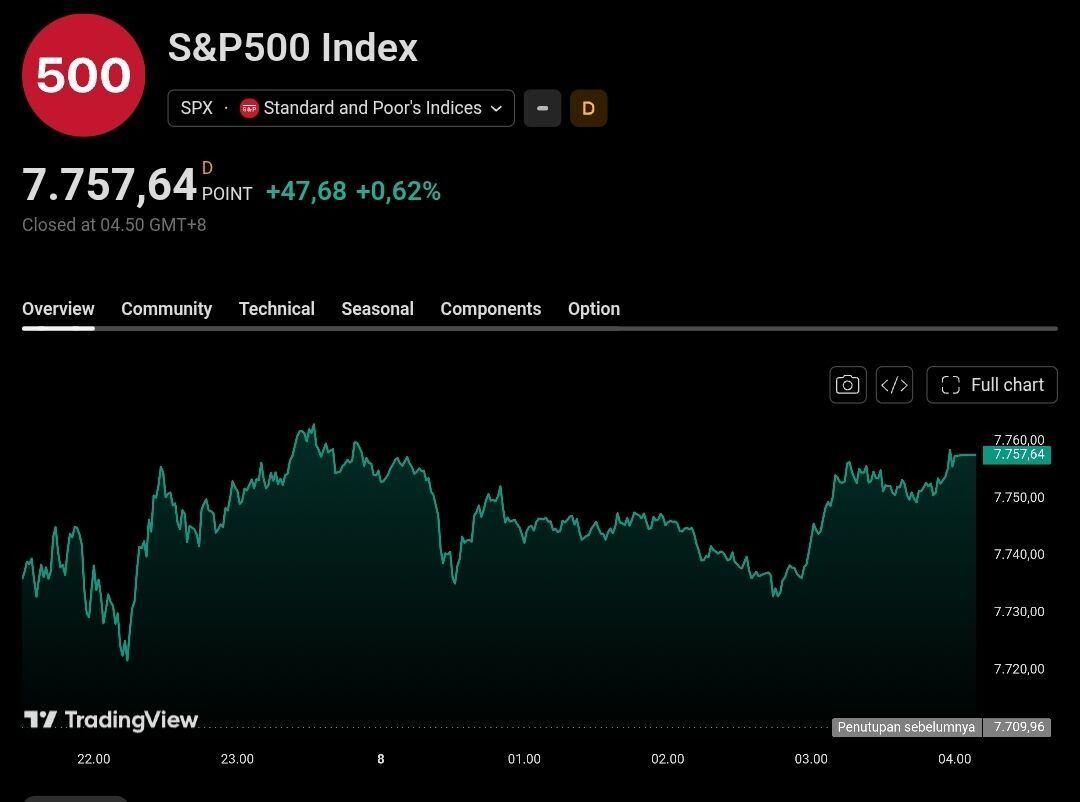
Weak US labor market data released this week also strengthened expectations for rate cuts, boosting risk appetite for both stocks and cryptocurrencies; the S&P 500 index closed the week at a record high amid the ETF recovery.