LATEST NEWS: Federal Reserve Consumer Price Index (PCE) Data, Used to Measure Inflation, Released! Here's Bitcoin's (BTC) First Reaction!

cryptonews.ruPublished on 2026-08-26Last updated on 2026-08-26

Abstract

Bitcoin maintained high levels ahead of the U.S. inflation data release, the Personal Consumption Expenditures (PCE) Price Index, a key metric for the Federal Reserve. BTC recently surged from around $62,000 to over $80,000, briefly surpassing $81,000 for a three-month high before a slight pullback. Market focus was intensely on the PCE report, as lower-than-expected figures could strengthen the case for looser Fed monetary policy, while higher figures could dampen rate cut expectations and pressure Bitcoin. The July PCE data was released as follows: Core PCE (YoY) at 3.3% (matching expectations), Core PCE (MoM) at 0.2% (matching expectations), Headline PCE (YoY) at 3.7% (slightly above 3.6% expected), and Headline PCE (MoM) at 0.2% (above the 0.1% expected).

The leading cryptocurrency, Bitcoin, is maintaining its high levels ahead of today's release of U.S. inflation data for Personal Consumption Expenditures (PCE).

As is known, Bitcoin rose from approximately $62,000 to over $80,000 in a very short period. Yesterday, $BTC even surpassed the $81,000 mark, reaching its highest level in the last three months.

Although the market subsequently retreated somewhat, its attention is now focused on the Consumer Price Index (PCE) data, one of the most closely watched inflation indicators by the Fed, as well as on expectations regarding the Fed's monetary policy.

A PCE report lower than expected could reinforce the perception of easing inflationary pressures, supporting expectations that the Fed may pursue a softer monetary policy. Conversely, a PCE report higher than expected could weaken expectations for interest rate cuts, creating short-term selling pressure on Bitcoin.

Thus, the U.S. consumer spending data is critically important for both interest rates and $BTC, and the July consumer spending data, considered a leading indicator of inflation, has been released.

Thus, the data for Personal Consumption Expenditures in July were as follows:

Core Personal Consumption Expenditures Price Index (annual) released: 3.3% – Expected: 3.3% – Previous: 3.3%

Core Personal Consumption Expenditures Price Index (monthly) released: 0.2% – Expected: 0.2% – Previous: 0.1%

Personal Consumption Expenditures Price Index (annual) announced: 3.7% – Expected: 3.6% – Previous: 3.7%

Personal Consumption Expenditures Price Index (monthly) announced: 0.2% – Expected: 0.1% – Previous: -0.1%

*This is not investment advice.

end-content

Trending Cryptos

Related Questions

QWhat is the key inflation index the Bitcoin (BTC) market is focused on, according to the article?

AAccording to the article, the Bitcoin market is intensely focused on the U.S. Personal Consumption Expenditures (PCE) index data, which is one of the inflation indicators most closely monitored by the Federal Reserve.

QHow might a PCE report lower than expectations potentially affect the U.S. Federal Reserve's monetary policy and Bitcoin?

AA PCE report lower than expectations could strengthen the perception of easing inflationary pressure, supporting expectations that the Fed could adopt a more accommodative monetary policy, which would likely be positive for Bitcoin.

QWhat were the announced monthly and annual core PCE index values for July?

AFor July, the announced core PCE index was 0.2% on a monthly basis and 3.3% on an annual basis.

QHow did the headline (overall) PCE price index for July compare to expectations?

AThe announced headline PCE price index for July was 3.7% on an annual basis, slightly higher than the expected 3.6%.

QWhat recent price milestone did Bitcoin (BTC) achieve according to the article?

AAccording to the article, Bitcoin recently surpassed $81,000, reaching its highest level in the last three months.

Related Reads

Is Bitcoin Price Lagging? Record Global M2 Money Supply Could Be a Springboard for BTC's Rise

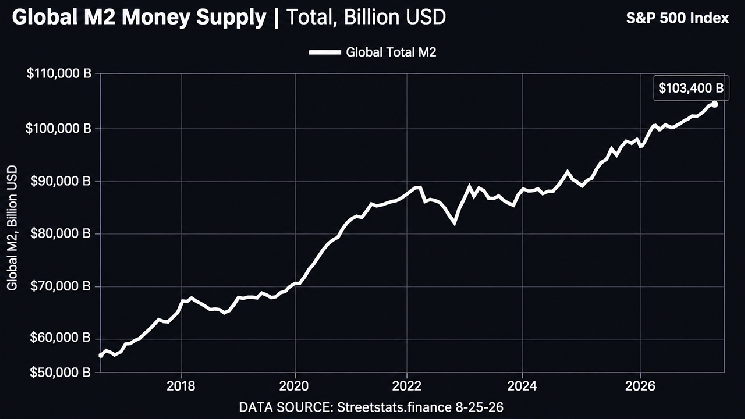
Bitcoin Price Lagging? Record Global Money Supply M2 Could Springboard BTC Growth The global money supply (M2) is expanding rapidly, similar to global debt. The US M2, representing all money circulating in its economy, has reached a record $23.16 trillion. Combined with figures from major economies like the Eurozone, China, and Japan, the global M2 is approximately $103 trillion. Some estimates, however, place it closer to $195 trillion. This surge in liquidity is significant because excess capital often seeks higher returns in assets like precious metals, stocks, and cryptocurrencies. Bitcoin's recent price surge above $81,000 has brought the global M2 metric back into focus. Following a sharp rise in early August after a US Treasury bond buyback announcement, BTC still trades about 37% below its October 2025 all-time high exceeding $126,000. This gap presents a potential "catch-up" trade thesis. Bitcoin's fixed supply of 21 million contrasts with governments' ability to print fiat currency, making scarce assets like BTC attractive if monetary expansion continues. Historically, Bitcoin's bull cycles in 2017-2018 and 2020-2021 coincided with M2 expansion and increased liquidity. Over the past year, the correlation seemed broken as M2 grew while Bitcoin's price fell sharply from its peak. Observers believe fresh dollars may have remained locked in cash-favorable investments. Some, like Ash Crypto, now suggest a long-awaited alignment between Bitcoin and M2 may be starting, especially as a weakening US Dollar Index this month has seen assets like gold and Bitcoin surge. A softer dollar pressures cash havens and prompts holders to act. While record M2 doesn't guarantee higher Bitcoin prices, a sustained influx of liquidity, a weak dollar, and capital flowing into alternative assets could trigger a catch-up rally sooner than expected. However, changes in these conditions could lead to the opposite outcome.

cryptonews.ru27m ago

Is Bitcoin Price Lagging? Record Global M2 Money Supply Could Be a Springboard for BTC's Rise

cryptonews.ru27m ago

Blockchain Capital Partner: Tokenization Will Reshape the Underlying Structure of Capital Markets

"Blockchain Capital partner Aleks Larsen argues that tokenization will fundamentally restructure capital markets by solving a costly 'packaging' problem in finance. Currently, assets like mortgages, private equity, and stocks exist in fragmented, incompatible systems, creating huge friction and slowing capital flow. Tokenization introduces a standardized, machine-readable interface for assets—akin to shipping containers for finance. Just as containerization standardized global trade, enabling massive efficiency gains and economic growth, tokens standardize financial rights. This allows platforms, lenders, and custodians to interact with assets directly on a shared network without rebuilding infrastructure for each one. Stablecoins demonstrate this potential, processing volumes rivaling Visa with far lower cost and faster settlement. Beyond payments, tokenization is expanding to assets like U.S. Treasuries, commodities, and private credit, now totaling nearly $400 billion on-chain. This shift changes financial service access: instead of depending on relationships with institutions, services become accessible based on the asset's tokenized properties themselves. DeFi protocols like Aave exemplify this, where assets meeting criteria can be used as collateral programmatically. Ultimately, tokenization will reorganize capital markets around open networks of specialized services, lowering barriers to entry and reducing costs. This could unlock global capital for currently underserved assets—small receivables, regional infrastructure, emerging market credit—integrating them into a seamless, programmable financial system. Combined with AI, tokenization promises to make capital allocation more efficient, transparent, and globally accessible, reshaping how economic value is created and distributed."

marsbit31m ago

Blockchain Capital Partner: Tokenization Will Reshape the Underlying Structure of Capital Markets

marsbit31m ago

Trading

Spot

Hot Articles

How to Buy DATA

Welcome to HTX.com! We've made purchasing DATA Network (DATA) simple and convenient. Follow our step-by-step guide to embark on your crypto journey.Step 1: Create Your HTX AccountUse your email or phone number to sign up for a free account on HTX. Experience a hassle-free registration journey and unlock all features.Get My AccountStep 2: Go to Buy Crypto and Choose Your Payment MethodCredit/Debit Card: Use your Visa or Mastercard to buy DATA Network (DATA) instantly.Balance: Use funds from your HTX account balance to trade seamlessly.Third Parties: We've added popular payment methods such as Google Pay and Apple Pay to enhance convenience.P2P: Trade directly with other users on HTX.Over-the-Counter (OTC): We offer tailor-made services and competitive exchange rates for traders.Step 3: Store Your DATA Network (DATA)After purchasing your DATA Network (DATA), store it in your HTX account. Alternatively, you can send it elsewhere via blockchain transfer or use it to trade other cryptocurrencies.Step 4: Trade DATA Network (DATA)Easily trade DATA Network (DATA) on HTX's spot market. Simply access your account, select your trading pair, execute your trades, and monitor in real-time. We offer a user-friendly experience for both beginners and seasoned traders.

1.9k Total ViewsPublished 2026.07.01Updated 2026.07.01

How to Buy DATA

Discussions

Welcome to the HTX Community. Here, you can stay informed about the latest platform developments and gain access to professional market insights. Users' opinions on the price of DATA (DATA) are presented below.

活动图片