Much like global debt, the money supply (M2) is growing at a tremendous pace. The M2 indicator in the United States, which essentially reflects the total volume of all money circulating in the American economy, has reached a record level of $23.16 trillion. If we sum up the indicators of all major countries and regions, including the USA, the Eurozone, China, and Japan, the global M2 figure stands at approximately $103 trillion.
Essentially, M2 equals cash plus funds in highly liquid accounts, and market observers track it because growth in the money supply can lead to various consequences. For example, excess capital can be directed into investments in precious metals, stocks, cryptocurrencies, and other assets that attract investors seeking higher returns. Some estimates of the M2 indicator are higher: for instance, Michael Howell from Crossborder Capital suggests this figure is closer to $195 trillion.
Bitcoin's Sharp Price Jump Once Again Brings Liquidity to the Forefront
The latest movement in Bitcoin's price has effectively brought the global M2 indicator back into the center of discussion. Having reached a weekly high above $81,000, $BTC has been trading in the range of $78,250 to $79,500 over the past 24 hours. In early August, the price of $BTC was in the range around $63,000 and sharply increased following the announcement of bond buybacks by the U.S. Treasury Department. Despite such an impressive rally, the Bitcoin price is still roughly 37% below the all-time high of over $126,000 from October 2025.
The gap between the global M2 indicator and the Bitcoin price could serve as a reason for 'catch-up' trading. This is explained by the fact that the supply of $BTC is fixed and limited to 21 million, while governments around the world can print fiat money at their discretion. The essence of the bet is that governments will continue to flood the financial system, and as a result, scarce assets like Bitcoin will come into focus. At the same time, Bitcoin's historical price cycles make this trade quite plausible.
The price of Bitcoin surged sharply in 2017–2018 and again in 2020–2021. These bull cycles coincided with the expansion of the M2 money supply and increased liquidity. At the same time, subsequent government tightening led to bear cycles. On the other hand, new capital can sit in bank deposits and money market funds for quite a long time. If the dollar strengthens with stable interest rates, preference is given to specific places for cash placement. Liquidity may remain constrained for some time before reaching assets like gold, stocks, or Bitcoin.
The Dollar Could Either Facilitate or Hinder Bitcoin's 'Catch-Up Growth'
Over the past year, many market observers believed the connection between Bitcoin and M2 had broken down. This is because the global M2 indicator continued to grow, while the Bitcoin price sharply declined after the October high. Essentially, liquidity increased while $BTC's growth momentum decreased, and it's safe to assume that fresh dollars remained locked in investments favorable for holding cash.
Some observers, including Ash Crypto on X, believe the long-awaited alignment of Bitcoin with M2 may finally be beginning to take shape. "Global M2 liquidity has reached an all-time high," wrote Ash Crypto on X. "The Bitcoin rally linked to alignment may have only just begun," he added. At the same time, the U.S. dollar gave $BTC a small breather. Data on the dollar shows that the U.S. Dollar Index dropped sharply this month, while assets like gold and Bitcoin surged.
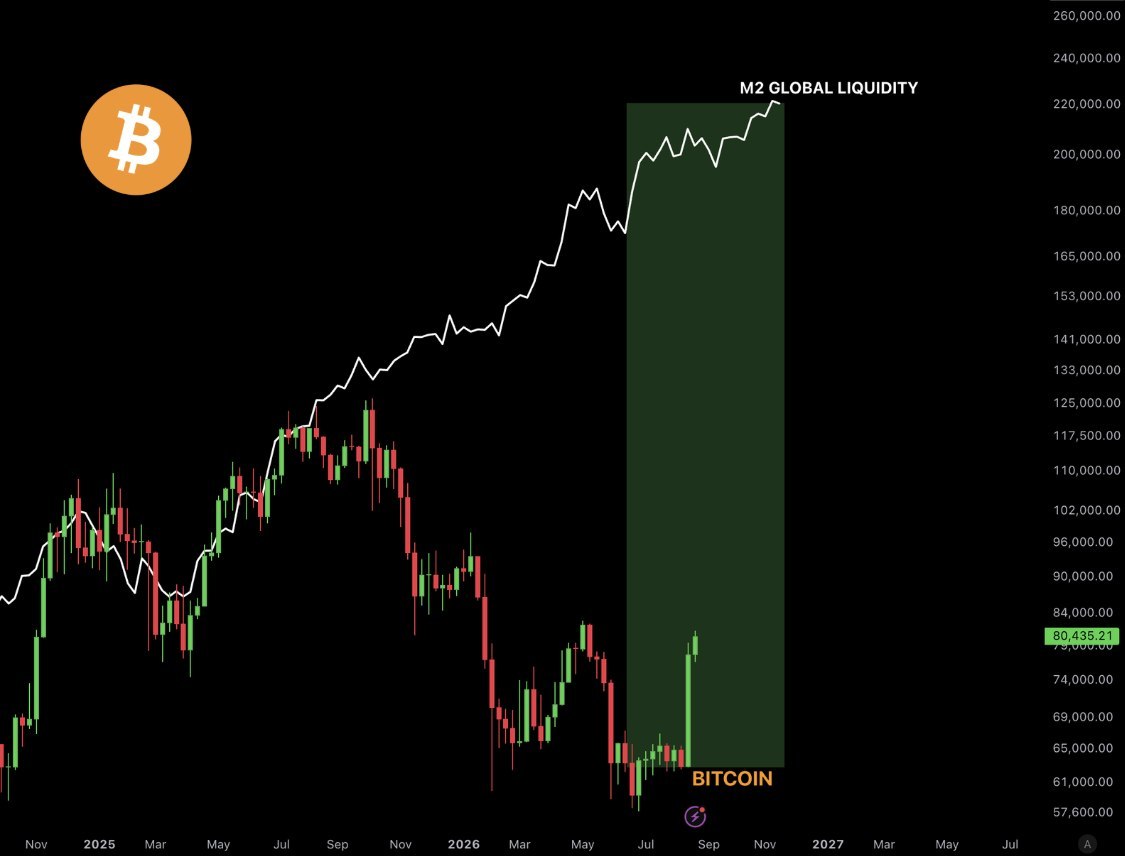
Essentially, a weakening dollar puts pressure on 'cash havens' and pushes holders into action. Against this backdrop, a real test lies ahead, as market observers will monitor U.S. M2 figures, global M2, and fund flows into specific funds. Treasury bond yields will also play their part, as liquidity trading may resume in the coming weeks or months.
The takeaway from all this is that, despite people's hopes, a record level of global M2 does not automatically mean higher Bitcoin price targets. However, if liquidity continues to rush into the financial system, the dollar remains weak, and capital flows into alternative assets like Bitcoin and precious metals, then the 'catch-up race' could start sooner than people think. A change in such conditions could lead to the opposite result.