Korea Tones Down 20% Crypto Exchange Stake Ban as Regulators Seek Governance ‘Middle Ground’

bitcoinistPublished on 2026-03-05Last updated on 2026-03-05

Abstract

South Korean regulators and the ruling party have agreed to impose a 20% ownership cap on major shareholders of cryptocurrency exchanges, following months of debate. The policy includes a three-year grace period for large platforms like Upbit and Bithumb, and up to six years for smaller exchanges. The cap, part of the broader Digital Asset Basic Act, aims to limit founder control while allowing limited exceptions for new businesses. Opposition from industry groups and some lawmakers may still affect the bill's final passage.

South Korean authorities and the ruling party agree on a 20% ownership ceiling for “major shareholders” in crypto and virtual assets exchanges, with a three‐year implementation delay.

From A Strict Proposal To Compromise

After months of friction, the Financial Services Commission (FSC) and the Democratic Party’s digital asset task force have finally converged on a 20% cap for major shareholders, the Korea Herald reports.

South Korea’s 20% cap is the culmination of a long‐running push by FSC, the top financial regulator, to curb founder control at the country’s biggest crypto exchanges. Regulators initially floated a stricter 15–20% range for major shareholders at the leading platforms, a proposal that sparked outrage and fierce opposition from the industry. The backlash was led by the Digital Asset Exchange Alliance (DAXA), a self‐regulatory body representing South Korea’s five major exchanges, including, of course, Upbit and Bithumb.

The Deal Terms

The agreement on a 20% cap and a generous grace period looks like an attempt to find middle ground and defuse tensions. The FSC and the ruling party have endorsed a three‐year grace period to enforce the major shareholder stake restriction, giving Upbit and Bithumb, which together command roughly 90% of the domestic market, some breathing room to start trimming their stakes to meet the new threshold.

Smaller exchanges that do not meet the estimated 20% market‐share bar, such as Coinone, Korbit and GOPAX, will get an even longer runway. South Korean authorities have agreed to grant them an additional three‐year grace period, giving these platforms up to six years in total to prepare for full enforcement of the cap.

Exceptions

The FSC has also carved out narrow exceptions via enforcement decree, allowing stakes of up to 34% only for new businesses, not for existing exchanges. According to The Korea Herald, this threshold appears to mirror the Commercial Act’s 33.3% veto line for general shareholders’ meetings, effectively giving qualified new investors blocking power without restoring full control

The Final Details On The Digital Asset Basic Act

The ruling party’s policy committee is expected to hammer out the final details after a closed‐door meeting with the Financial Services Commission on the morning of the 5th, according to Hankyung. The ownership cap will be folded into a broader Digital Assets Basic Act, an umbrella bill that packages a wide range of crypto policy measures, from stablecoin rules to crypto exchange‐traded funds.

However, the bill’s passage is far from guaranteed. The Korea Herald notes that not only is the opposition party pushing back, but some lawmakers also object to strict limits on major shareholder stakes, casting doubt over whether the cap will clear the National Assembly in its current form.
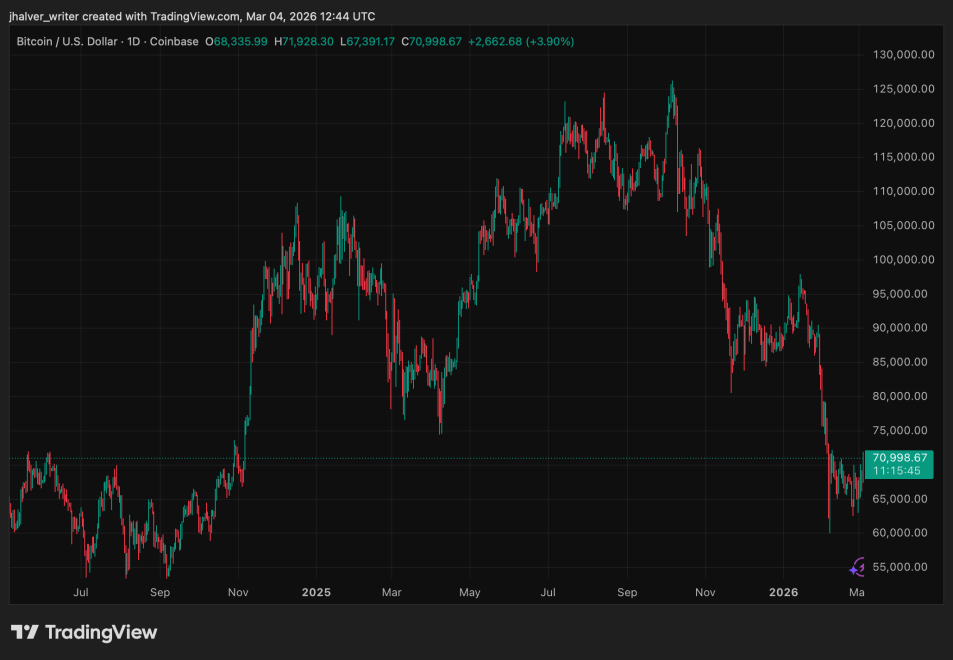
BTC's price trends to the downside on the daily chart. Source: BTCUSD on Tradingview

Cover image from ChatGPT, BTCUSD chart from Tradingview

Related Questions

QWhat is the new ownership cap for major shareholders in South Korean crypto exchanges, and what was the implementation delay agreed upon?

AThe new ownership cap for major shareholders in South Korean crypto exchanges is 20%, with a three-year implementation grace period.

QWhich two major South Korean crypto exchanges, which dominate the market, were given a three-year grace period to comply with the new stake limit?

AUpbit and Bithumb, which together command roughly 90% of the domestic market, were given a three-year grace period.

QHow does the grace period for smaller exchanges like Coinone and Korbit differ from that of the major ones?

ASmaller exchanges that do not meet the 20% market-share bar will be granted an additional three-year grace period, giving them up to six years in total to comply.

QWhat is the exception to the ownership cap, and what specific power does it grant to qualified new investors?

AAn exception allows stakes of up to 34% for new businesses (not existing exchanges), which mirrors the Commercial Act's 33.3% veto line, giving qualified new investors blocking power in shareholders' meetings.

QInto what larger legislative package will the ownership cap be incorporated, and what is a major obstacle to its passage?

AThe ownership cap will be folded into the broader Digital Assets Basic Act. A major obstacle to its passage is opposition from some lawmakers and the opposition party who object to the strict limits on major shareholder stakes.

Related Reads

SharpLink CEO: How to Understand Ethereum Developers Just Exceeded 1 Million?

SharpLink CEO reflects on the milestone of Ethereum surpassing 1 million historical developers, emphasizing that this figure represents the largest pool of technical talent ever assembled around an open, permissionless blockchain network. While approximately 232,000 developers remain active, the key question for the crypto industry is not which chain is fastest, but where the best builders choose to build long-term. Ethereum's advantage lies in a decade-long accumulation of infrastructure, standards, tools, liquidity, and a cohesive culture, making it the default operating system for programmable finance. This developer base is tackling complex challenges: the Glamsterdam upgrade aims to enhance scalability while preserving core principles; synchronous composability seeks to unify Rollup ecosystems; and significant efforts are underway for post-quantum security. Ethereum's deeper network effects stem from composability and shared standards (like the EVM and Solidity), creating a flywheel of more developers, tools, and liquidity. Three reinforcing strengths cement Ethereum's lead: credible neutrality (secured by ~900k validators), a modular architecture with interconnected Rollups, and a culture that attracts top researchers. The ecosystem is consolidating as the trusted coordination layer for internet-native finance, favored by large institutions valuing security and liquidity. The future of Ethereum is being built by this global community of founders and architects.

链捕手3m ago

SharpLink CEO: How to Understand Ethereum Developers Just Exceeded 1 Million?

链捕手3m ago

A Clod of Chinese Soil Chokes Two Japanese Giants

"Chinese Soil Chokes Japanese Giants" The production of a key electronic specialty gas, tungsten hexafluoride (WF6), vital for manufacturing AI chips, was halted by two leading Japanese producers—Kanto Denka and Central Glass. Their shutdown was not due to a technological failure but a sudden, critical shortage of a raw material they had long taken for granted: ultra-high-purity (6N-grade) tungsten powder, which is almost entirely sourced from China. Following a quiet Chinese export announcement in January 2026, tungsten powder shipments to Japan dropped to zero for months. Despite frantic efforts, Japanese companies found no viable alternative; imported powder was three times more expensive and lacked the required purity. Their existing stockpiles were exhausted by mid-2026. WF6 is essential for depositing tungsten into the microscopic contact holes of High Bandwidth Memory (HBM) chips, which are crucial for advanced processors like those from Nvidia. While Japanese firms had mastered producing ultra-pure WF6 gas, their entire supply chain relied on China's 6N tungsten powder—a dependency now revealed as a fatal vulnerability. China's dominance in this "soil" results from decades of painstaking R&D by companies like Xiamen Tungsten and China Tungsten & Hightech. They overcame immense technical hurdles, such as separating chemically similar molybdenum from tungsten, to achieve mass production of the world's purest tungsten powder. With their primary suppliers gone, Kanto Denka and Central Glass announced a permanent halt to WF6 production starting July 1, 2026. This immediately created a supply crisis for major semiconductor manufacturers like Samsung and SK Hynix, forcing them to urgently seek and certify new Chinese suppliers for WF6 itself. The reversal marks a dramatic shift: China has moved from exporting low-value raw materials to controlling the high-purity foundation of a critical global tech supply chain, upending a long-established industrial hierarchy.

marsbit34m ago

A Clod of Chinese Soil Chokes Two Japanese Giants

marsbit34m ago

Without Tencent, What's Left for Suiyuan?

The article centers on the crucial question posed in the title: what is Seyond Technology really worth if its dominant customer, Tencent, were to stop purchasing its AI chips? As the last of China's "Four AI Chip Dragons" to secure approval for a public listing, Seyond's IPO filing reveals a profound and controversial dependency. In 2025, 74.9% to over 80% of its revenue came from Tencent. The piece argues that this extreme customer concentration is not merely a vulnerability but a strategic outcome of China's AI industry evolution. It contrasts Seyond's path with its peers (Moore Thread, Biren Technology, and MetaX), noting that while others raced to market with ambitious stories, Seyond focused first on securing and delivering for a major client. Its explosive revenue growth—with Q1 2026 up 1474.85% year-on-year—is driven by concentrated orders from Tencent, which itself faces massive, escalating AI compute demands for products like its Yuanbao and Hunyuan models. The relationship is framed as a deliberate, symbiotic cultivation of a supply chain. As both a major shareholder (20.26%) and primary client, Tencent is actively fostering Seyond to build a controllable, stable alternative to NVIDIA, similar to how global tech giants historically nurtured key suppliers. The high switching costs—involving software stacks and deployed systems—create a deep "ecological moat" for Seyond within Tencent's ecosystem. The analysis positions the AI chip landscape in three tiers: NVIDIA as the global leader, Huawei's Ascend as the state-backed player, and commercial firms like Seyond competing for market orders. Seyond is increasingly seen as "Tencent's compute foundation," with its product roadmap closely aligned with the tech giant's needs. The conclusion is that the industry's metric for success is shifting from fundraising and technical specs to real orders, delivery capability, and ecosystem binding. Seyond's value, therefore, lies not just in its chips but in holding a massive, multi-year procurement order from China's largest internet company—a tangible asset arguably more telling than any technical whitepaper in the current climate. The core insight is that for domestic chips, the ultimate challenge isn't just catching up technologically with NVIDIA, but earning the trust, scenarios, and recurring orders from a major anchor client.

marsbit1h ago

Without Tencent, What's Left for Suiyuan?

marsbit1h ago

Trading

Spot
Futures

Hot Articles

How to Buy BAN

Welcome to HTX.com! We've made purchasing Comedian (BAN) simple and convenient. Follow our step-by-step guide to embark on your crypto journey.Step 1: Create Your HTX AccountUse your email or phone number to sign up for a free account on HTX. Experience a hassle-free registration journey and unlock all features.Get My AccountStep 2: Go to Buy Crypto and Choose Your Payment MethodCredit/Debit Card: Use your Visa or Mastercard to buy Comedian (BAN) instantly.Balance: Use funds from your HTX account balance to trade seamlessly.Third Parties: We've added popular payment methods such as Google Pay and Apple Pay to enhance convenience.P2P: Trade directly with other users on HTX.Over-the-Counter (OTC): We offer tailor-made services and competitive exchange rates for traders.Step 3: Store Your Comedian (BAN)After purchasing your Comedian (BAN), store it in your HTX account. Alternatively, you can send it elsewhere via blockchain transfer or use it to trade other cryptocurrencies.Step 4: Trade Comedian (BAN)Easily trade Comedian (BAN) on HTX's spot market. Simply access your account, select your trading pair, execute your trades, and monitor in real-time. We offer a user-friendly experience for both beginners and seasoned traders.

4.3k Total ViewsPublished 2024.10.27Updated 2026.06.02

How to Buy BAN

Discussions

Welcome to the HTX Community. Here, you can stay informed about the latest platform developments and gain access to professional market insights. Users' opinions on the price of BAN (BAN) are presented below.

活动图片













