Is DeFi Development Corp’s Solana bet finally paying off?

ambcryptoPublished on 2026-04-08Last updated on 2026-04-08

Abstract

DeFi Development Corp. (DFDV) experienced flat growth in a challenging March 2026 but significantly increased its Solana (SOL) holdings to 2.22 million SOL, valued at $185 million. This resulted in a SOL Per Share (SPS) metric of 0.0754. The firm highlighted Solana's substantial growth in 2025, which now represents nearly 3% of the circulating supply held by Digital Assets Treasuries (DATs). DFDV's 2025 annual results showed an impressive 442% revenue growth. Looking forward, the company explored how autonomous AI agents could generate significant structural demand for SOL, with projections ranging from $27 billion to $112.5 billion. Despite a recent price drop for both DFDV stock and SOL, on-chain data showed that user engagement on the Solana network remained high. However, declining social volume and a large holder realizing substantial losses indicated some market weakness. SOL DATs have demonstrated relative strength compared to their Ethereum counterparts.

March 2026 has been a tough month for the crypto industry, including Digital Assets Treasuries (DTAs). As expected, DeFi Development Corp’s growth was flat too, but it still managed to grab attention. Despite March being a slow month, the firm reportedly pursued avenues to increase its Solana [SOL] balance over time and, in turn, saw a surge in its SOL per Share (SPS).

According to its March 2026 recap report, DeFi Development Corp’s [DFDV] SOL holdings have reached 2,223,074 SOL worth $185 million. Meanwhile, its outstanding shares stood at 29,497,394, translating to 0.0754 SOL Per Share (SPS).
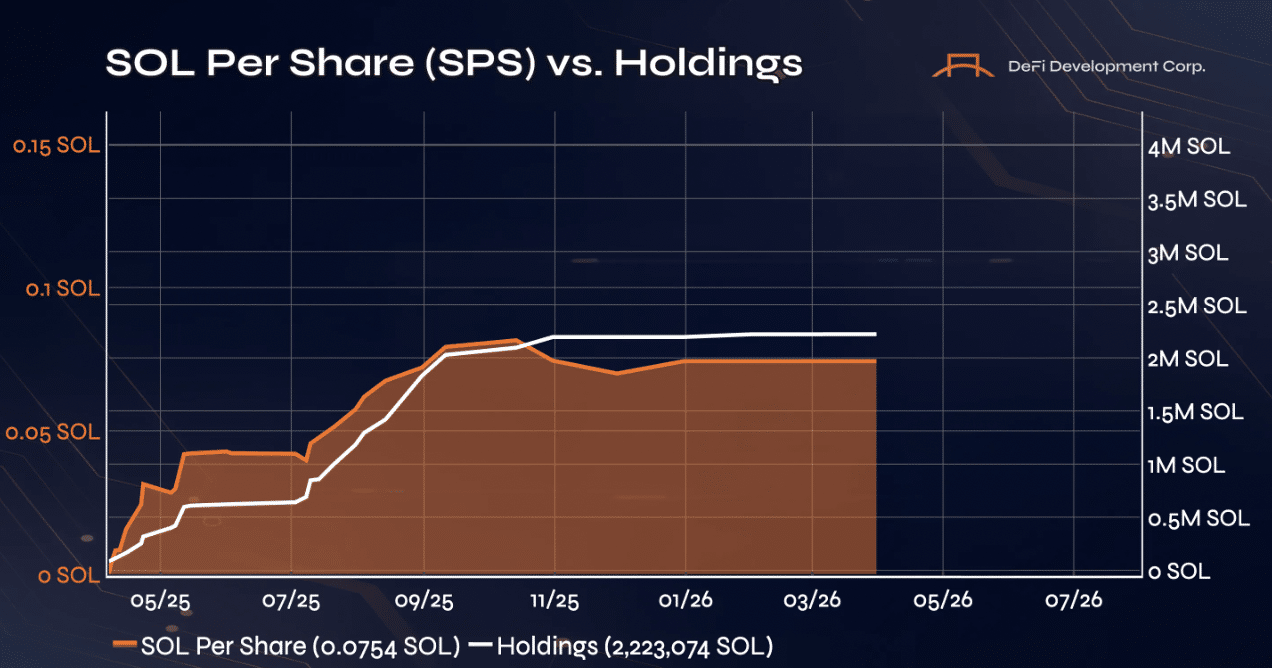
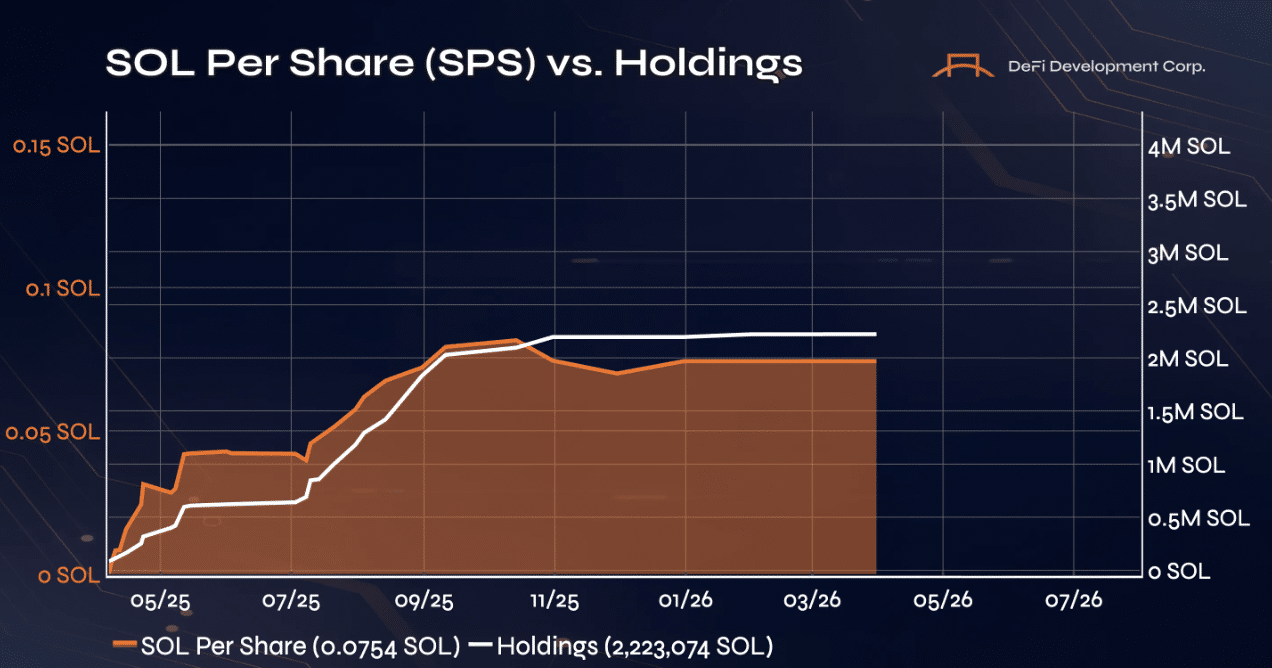
Source: March 2026 report/DeFi Development Corp.

DeFi Development Corp.’s growth in 2025

Additionally, in its shareholder letter, the firm emphasized how Solana’s multifold growth in 2025 now represents nearly 3% of the circulating SOL supply held by DATs.

Besides this, the firm also published its annual results for 2025, recording over 442% in revenue growth.
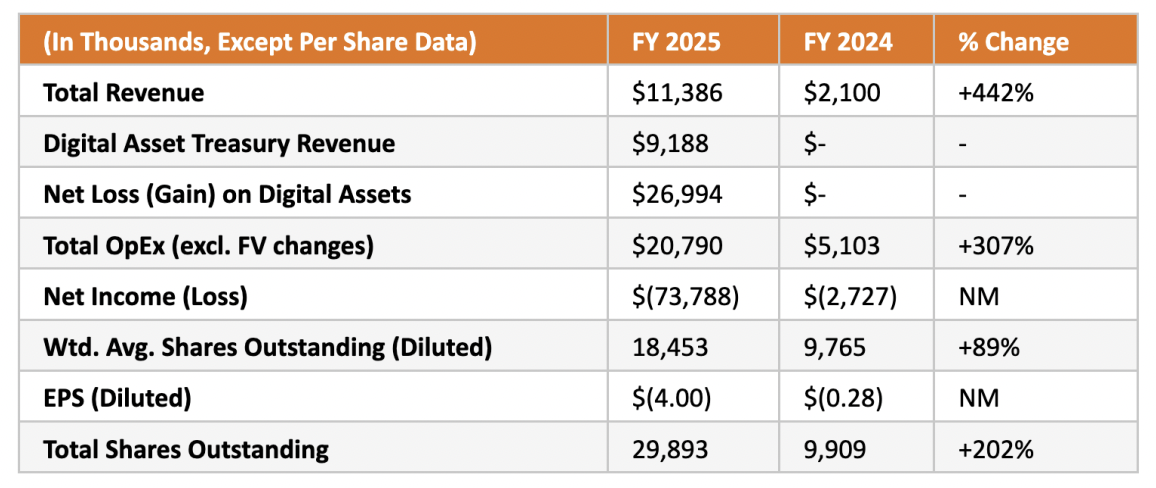
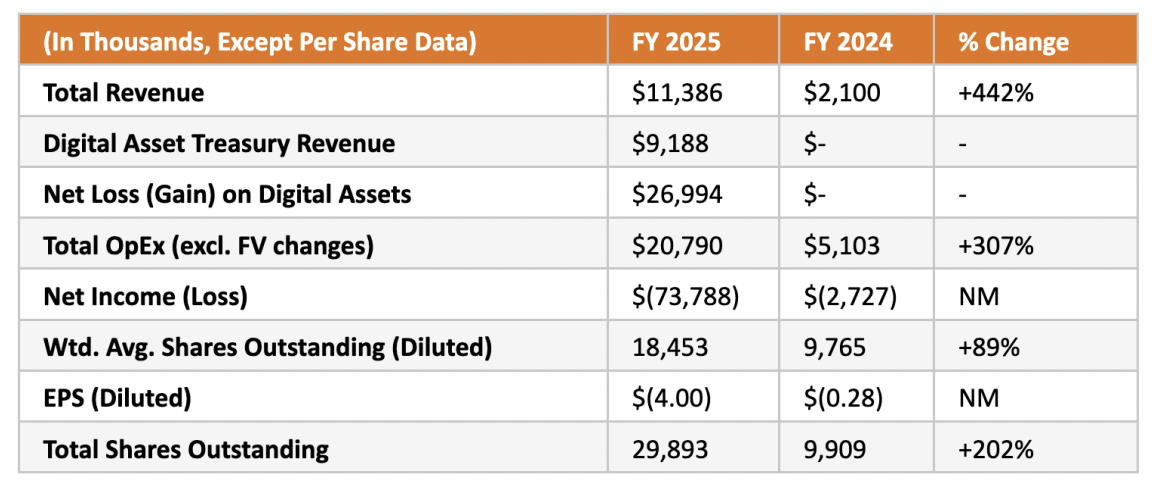
Source: Shareholder letter/DeFi Development Corp.

That being said, in March, DFDV also explored how autonomous AI agents could “create persistent and structural demand for SOL” in the long run.

The report outlined a base-case estimate of $27 billion in structural SOL demand driven solely by agentic AI, alongside a bull-case projection of $112.5 billion.

This, after DFDV’s stock price traded at $3.64 after dropping by 3.84%. On the contrary, Solana was changing hands at $79.12 at press time, falling by 3.88% in the last 24 hours.

Solana’s on-chain metrics paint a confusing picture

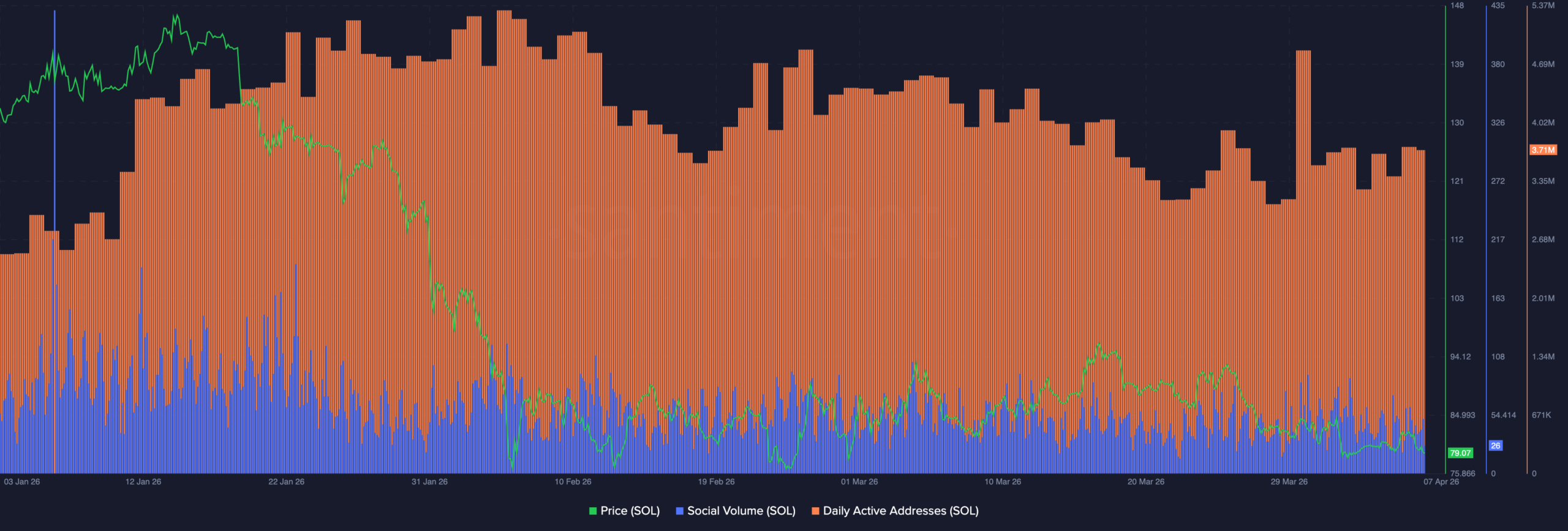
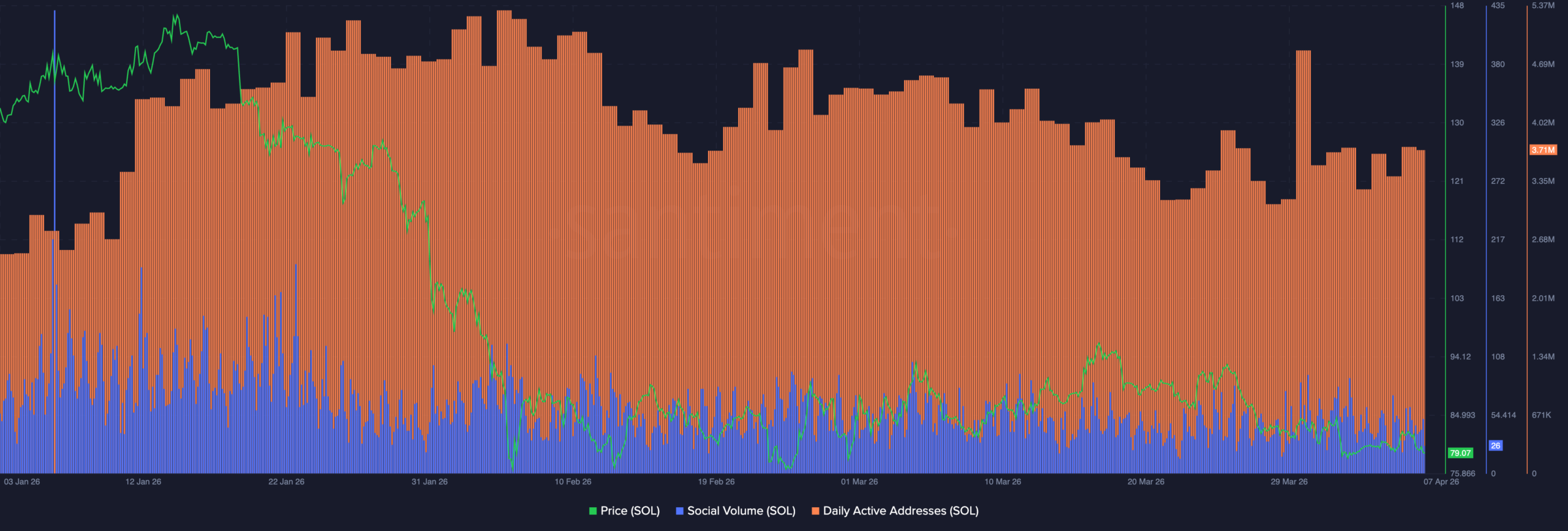
And yet, despite this price weakness, Solana’s high Daily Active Addresses suggested that user engagement has been intact even during bearish price sentiments.
Source: Santiment

However, not all metrics showed signs of strength. Especially since the drop in Social Volume metrics pointed to diminishing hype, compared to previous cycles. This, after a large SOL holder recently realized losses exceeding $4 million after selling 47,401 SOL. This, in turn, resulted in SOL’s price falling by 5.85%.

Additionally, when compared to others, SOL DATs have stood stronger against Ethereum [ETH] DATs. Owing to changing dynamics in and around the market, it remains to be seen what happens to Solana and to SOL DATs.


Final Summary

  • Defi Development Corp. saw over 442% in revenue growth in 2025, thanks to Solana’s performance in comparison to other chains.
  • Solana network activity suggested that user engagement has been high, despite the price drop and low social volume.


Related Questions

QWhat was the value of DeFi Development Corp's SOL holdings as of March 2026, and how many outstanding shares did it have?

AAs of March 2026, DeFi Development Corp's SOL holdings were 2,223,074 SOL, worth $185 million. The company had 29,497,394 outstanding shares.

QWhat significant growth did DeFi Development Corp achieve in 2025, and what was a key factor in this performance?

AIn 2025, DeFi Development Corp recorded over 442% in revenue growth. A key factor in this performance was Solana's multifold growth, which now represents nearly 3% of the circulating SOL supply held by Digital Assets Treasuries (DATs).

QAccording to the report, what long-term potential did DFDV explore for creating demand for SOL, and what were the estimated figures?

ADFDV explored how autonomous AI agents could 'create persistent and structural demand for SOL' in the long run. The report outlined a base-case estimate of $27 billion and a bull-case projection of $112.5 billion in structural SOL demand driven by agentic AI.

QDespite a price drop, what on-chain metric suggested that user engagement on the Solana network remained strong?

ADespite the price weakness, Solana's high Daily Active Addresses suggested that user engagement remained intact.

QWhat was the stock price of DFDV and the price of SOL at the time of the report, and what were their respective 24-hour changes?

AAt the time of the report, DFDV's stock price was $3.64 after dropping by 3.84%. Meanwhile, Solana (SOL) was trading at $79.12, falling by 3.88% in the last 24 hours.

Related Reads

Where Is the AI Infrastructure Industry Chain Stuck?

The AI infrastructure (AI Infra) industry chain is facing unprecedented systemic bottlenecks, despite the rapid emergence of applications like DeepSeek and Seedance 2.0. The surge in global computing demand has exposed critical constraints across multiple layers of the supply chain—from core manufacturing equipment and data center cabling to specialty materials and cleanroom facilities. Key challenges include four major "walls": - **Memory Wall**: High-bandwidth memory (HBM) and DRAM face structural shortages as AI inference demand outpaces training, with new capacity not expected until 2027. - **Bandwidth Wall**: Data transfer speeds lag behind computing power, causing multi-level bottlenecks in-chip, between chips, and across data centers. - **Compute Wall**: Advanced chip manufacturing, reliant on EUV lithography and monopolized by ASML, remains the fundamental constraint, with supply chain fragility affecting production. - **Power Wall**: While energy demand from data centers is rising, power supply is a solvable near-term challenge through diversified energy infrastructure. Expansion is further hindered by shortages in testing equipment, IC substrates (critical for GPUs and seeing price hikes over 30%), specialty materials like low-CTE glass fiber, and high-end cleanroom facilities. Connection technologies are evolving, with copper cables resurging for short-range links due to cost and latency advantages, while optical solutions dominate long-range scenarios. Innovations like hollow-core fiber and advanced PCB technologies (e.g., glass substrates, mSAP) are emerging to meet bandwidth needs. In summary, AI Infra bottlenecks are multidimensional, spanning compute, memory, bandwidth, power, and supply chain logistics. Advanced chip manufacturing remains the core constraint, while substrate, material, and equipment shortages present immediate challenges. The industry is moving toward hybrid copper-optical solutions and accelerated domestic supply chain development.

marsbit15m ago

Where Is the AI Infrastructure Industry Chain Stuck?

marsbit15m ago

Autonomy or Compatibility: The Choice Facing China's AI Ecosystem Behind the Delay of DeepSeek V4

DeepSeek V4's repeated delay in early 2026 has sparked global discussions on "de-CUDA-ization" in AI. The highly anticipated trillion-parameter open-source model is undergoing deep adaptation to Huawei’s Ascend chips using the CANN framework, representing China’s first systematic attempt to run a core AI model outside the CUDA ecosystem. This shift, however, comes with significant engineering challenges. While the model uses a MoE architecture to reduce computational load, it places extreme demands on memory bandwidth, chip interconnects, and system scheduling—areas where NVIDIA’s mature CUDA ecosystem currently excels. Migrating to Ascend introduces complexities in hardware topology, communication latency, and software optimization due to CANN’s relative immaturity compared to CUDA. The move highlights a broader strategic dilemma: short-term compatibility with CUDA offers practical benefits and faster adoption, as seen in CANN’s efforts to emulate CUDA interfaces. Yet, long-term over-reliance on compatibility risks inheriting CUDA’s limitations and stifling native innovation. If global AI shifts away from transformer-based architectures, strict compatibility could lead to technological obsolescence. Despite these challenges, DeepSeek V4’s eventual release could demonstrate the viability of a full domestic AI stack and accelerate CANN’s ecosystem growth. However, true technological independence will require building an original software-hardware paradigm beyond compatibility—a critical task for China’s AI ambitions in the next 3-5 years.

marsbit33m ago

Autonomy or Compatibility: The Choice Facing China's AI Ecosystem Behind the Delay of DeepSeek V4

marsbit33m ago

How Blockchain Fills the Identity, Payment, and Trust Gaps for AI Agents?

AI Agents are rapidly evolving into autonomous economic participants, but they face critical gaps in identity, payment, and trust infrastructure. They currently lack standardized ways to prove who they are, what they are authorized to do, and how they should be compensated across different environments. Blockchain technology is emerging as a solution to these challenges by providing a neutral coordination layer. Public ledgers offer auditable credentials, wallets enable portable identities, and stablecoins serve as a programmable settlement layer. A key bottleneck is the absence of a universal identity standard for non-human entities—akin to "Know Your Agent" (KYA)—which would allow Agents to operate with verifiable, cryptographically signed credentials. Without this, Agents remain fragmented and face barriers to interoperability. Additionally, as AI systems take on governance roles, there is a risk that centralized control over models could undermine decentralized governance in practice. Cryptographic guarantees on training data, prompts, and behavior logs are essential to ensure Agents act in users' interests. Stablecoins and crypto-native payment rails are becoming the default for Agent-to-Agent commerce, enabling seamless, low-cost transactions for AI-native services. These systems support permissionless, programmable payments without traditional merchant onboarding. Finally, as AI scales, human oversight becomes impractical. Trust must be built into system architecture through verifiable provenance, on-chain attestations, and decentralized identity systems. The future of Agent economies depends on cryptographically enforced accountability, allowing users to delegate tasks with clearly defined constraints and transparent operation logs.

marsbit1h ago

How Blockchain Fills the Identity, Payment, and Trust Gaps for AI Agents?

marsbit1h ago

Trading

Spot
Futures

Hot Articles

Discussions

Welcome to the HTX Community. Here, you can stay informed about the latest platform developments and gain access to professional market insights. Users' opinions on the price of S (S) are presented below.

活动图片