Interactive Brokers Opens 'Stablecoin Deposits': Why Is the Wall Street Giant Tearing Down the 'Payment Berlin Wall' at This Moment?

marsbitPublished on 2025-12-16Last updated on 2025-12-16

Abstract

Interactive Brokers (IBKR), a major global electronic brokerage, has announced a landmark update allowing clients to deposit funds using stablecoins—primarily USDC—to trade traditional assets like stocks, futures, and forex. This move effectively bridges a significant gap between crypto and traditional finance (TradFi), addressing long-standing inefficiencies in fiat payment channels. Traditionally, cross-border wire transfers via SWIFT are slow (taking 1-3 business days), costly, and limited to banking hours. By leveraging blockchain technology, IBKR enables near-instant, 24/7 settlements, drastically reducing friction and improving capital efficiency for traders. Behind the scenes, IBKR likely partners with regulated entities like Paxos or Circle to convert USDC to USD seamlessly, ensuring compliance while using the blockchain as a new settlement layer. This strategic shift aims to attract crypto-native high-net-worth clients and institutions holding significant wealth in stablecoins, offering them a secure, compliant path to invest in traditional markets. It also signals the evolution of stablecoins from mere trading instruments to a foundational global payment infrastructure. However, challenges remain, including stringent KYC/AML requirements, address screening, and enhanced tax transparency. Despite these hurdles, IBKR’s move is a decisive step toward erasing the boundaries between crypto wallets and securities accounts, setting a new standard for the industry.

Author: BlockWeeks

Between the cryptocurrency market and the traditional financial market (TradFi), there has long been an invisible wall: the friction cost of fiat currency channels.

Recently, the globally renowned electronic broker Interactive Brokers (IBKR) announced a milestone update: it now officially supports clients using stablecoins (primarily USDC) to deposit funds into their accounts for trading traditional assets such as stocks, futures, and foreign exchange.

At first glance, this might seem like a simple payment function update. But to observers well-versed in the transformation of financial infrastructure, this is a substantive acknowledgment of the "on-chain settlement network" by a top-tier Wall Street broker. When the US Dollar becomes USDC, and when SWIFT becomes ERC-20, it reflects a paradigm shift in the efficiency of global capital flow.
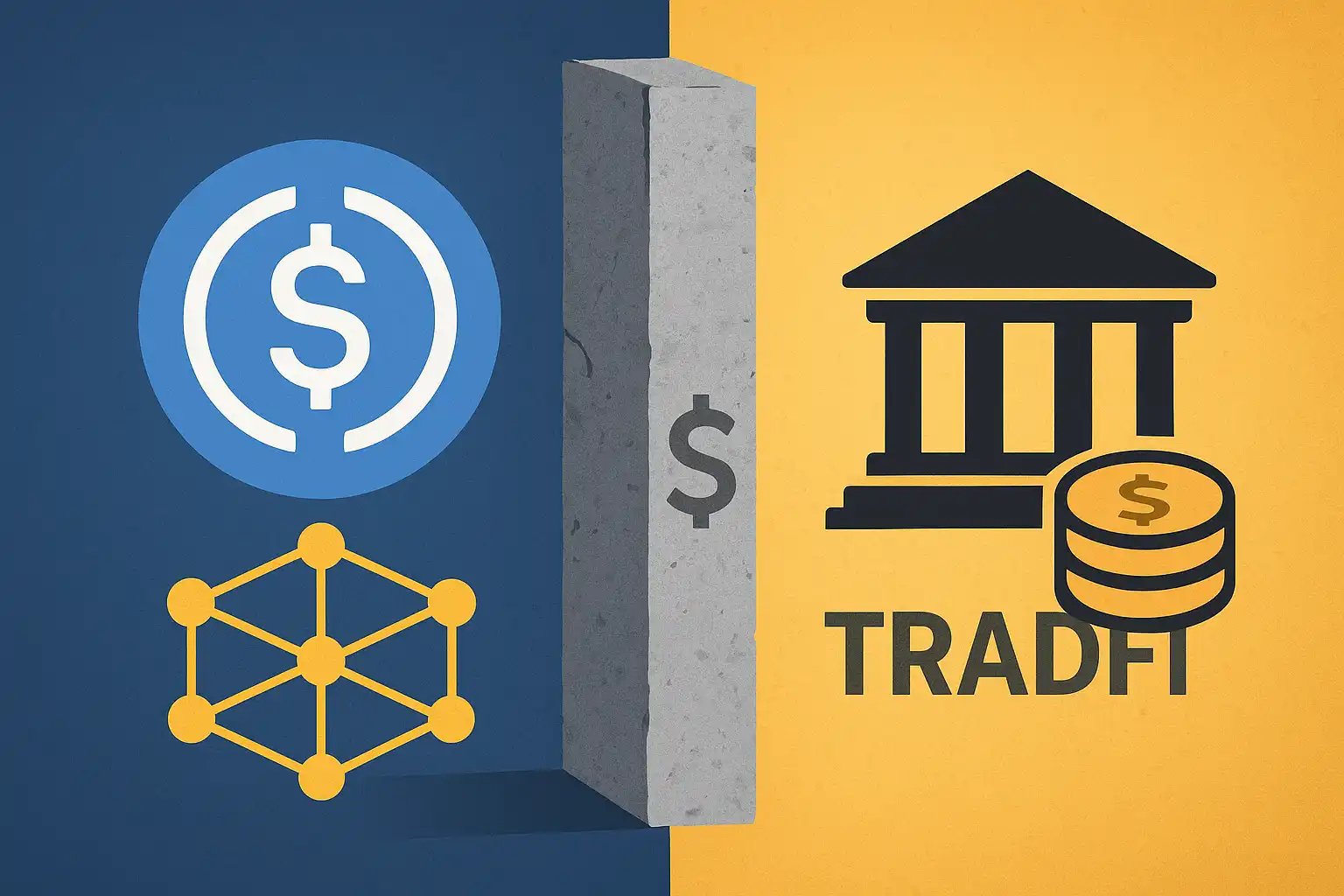
I. Breaking the Wall: A Dimensional Reduction Strike from "T+N" to "7×24"

For a long time, the biggest pain point for global investors (especially non-U.S. investors) using U.S. stock brokers has been depositing funds.

The traditional wire transfer path is: local bank foreign exchange purchase -> SWIFT cross-border transfer -> intermediary bank -> U.S. receiving bank -> broker account crediting. This process not only involves high fees (wire transfer fee + intermediary fee) but is also limited by bank working hours and the inefficiency of the SWIFT system, typically taking 1-3 business days.

Interactive Brokers' introduction of stablecoin deposits is essentially using blockchain as a "new clearing layer" to launch a dimensional reduction strike against traditional bank wire transfers:

  1. 24/7 Liquidity: On-chain transfers have no concept of "bank closing time." A deposit on Friday night no longer has to wait until Monday morning to be processed.

  2. Instant Settlement: Compared to the multi-layer confirmation of SWIFT, on-chain confirmation of USDC takes only seconds to minutes.

  3. Capital Efficiency Revolution: For high-frequency traders and cross-market arbitrageurs, the seamless transfer of funds between on-chain (Web3) and securities accounts (Web2) means a drastic reduction in capital occupancy costs.

Technical Black Box Revealed: It is important to clarify that Interactive Brokers does not directly "hold" these tokens for stock settlement. Its backend logic likely involves cooperation with compliant institutions like Paxos or Circle: users transfer in USDC -> the partner exchanges it 1:1 for USD -> instantly transfers it to the IBKR client's fiat balance. Superficially, it's coins; fundamentally, it's still money, but the channel has become the chain.

II. Open Strategy: Competing for the Asset Pricing Power of "Web3 Nouveau Riche"

Interactive Brokers is known for serving professional traders and institutions, with famously strict risk control. Why would such a conservative giant take the first step?

The answer lies in the competition for incremental wealth.

The past two bull markets have created a large number of "Crypto Natives" and Web3 institutions holding millions or even billions of dollars in assets. The wealth of this group primarily exists on-chain in the form of USDT/USDC or ETH.

In the past, if they wanted to allocate to U.S. stocks (such as buying NVIDIA or Coinbase stock), they had to go through a painful "off-ramp" process, facing not only the risk of bank risk control freezing their accounts but also enduring significant exchange rate losses.

Interactive Brokers' move is a typical "capital attraction open strategy":

  • For users: It is the safest "off-ramp channel." Depositing USDC into IBKR to buy U.S. Treasuries or the S&P 500 is currently the most compliant path for "traditionalizing crypto assets."

  • For IBKR: It directly locks in a group of high-net-worth clients with the most abundant liquidity and highest risk appetite globally. This is not just to earn commissions but also to accumulate huge amounts of client margin (Float).

III. Signal: Stablecoins Are Evolving into a "Supranational Version of SWIFT"

Zooming out, this event is a reverse mapping of the RWA (Real World Assets) narrative.

If RWA is about "moving" U.S. Treasuries onto the chain, then Interactive Brokers supporting stablecoin deposits is about "moving" liquidity from the chain back to traditional finance. This marks a qualitative change in the historical positioning of stablecoins (Stablecoin):

  • Era 1.0: Trading chips on exchanges.

  • Era 2.0: Safe-haven assets in DeFi protocols.

  • Era 3.0 (Now): A true global payment and settlement infrastructure.

When a Nasdaq-listed brokerage giant starts using a blockchain network instead of the SWIFT network to handle client funds, it indicates that the security, compliance, and efficiency of blockchain as a "payment pipeline" have passed the most stringent stress tests on Wall Street.

IV. Concerns and Games: The Sword of Damocles of Compliance

Despite the bright prospects, we cannot ignore the regulatory games involved.

  • KYC/AML Penetration Challenges: Interactive Brokers supporting stablecoin deposits will inevitably require extremely strict on-chain address reviews. Has the user's deposit address interacted with sanctioned entities (like Tornado Cash)? How to identify "black U"? This will test IBKR's compliance technology capabilities.

  • Tax Transparency: The opening of this channel also means a strong binding between on-chain assets and real-name securities accounts. For users hoping to avoid taxes through cryptocurrency, this channel is tantamount to "surrendering" to the tax authorities. This could be a double-edged sword.

Conclusion: The First Brick in Tearing Down the Berlin Wall

The small step taken by Interactive Brokers is a big step for financial integration.

It预示着 that within the next five years, the boundary between "securities accounts" and "crypto wallets" will completely blur. Future investors may not need to care whether they hold dollars in a bank ledger or USDC on the chain; they will only care about the appreciation of their assets.

For other brokers (such as Charles Schwab, Futu, etc.), the time left to follow suit is running out. In an era where liquidity is justice, whoever masters the stablecoin channel holds the key to the Web3 wealth vault.


Related Questions

QWhat is the significance of Interactive Brokers (IBKR) announcing support for stablecoin deposits?

AIt represents a major step in bridging the gap between crypto and traditional finance by allowing clients to use stablecoins like USDC for funding accounts to trade stocks, futures, and forex, leveraging blockchain for faster, cheaper, and more efficient settlements compared to traditional banking systems like SWIFT.

QHow does using stablecoins for deposits improve upon traditional wire transfers?

AStablecoin deposits offer near-instant settlement (seconds to minutes), 24/7 availability without banking hours restrictions, and lower transaction costs, eliminating the delays and fees associated with multi-day SWIFT transfers and intermediary banks.

QWhy is Interactive Brokers targeting crypto-native users with this feature?

ATo attract high-net-worth individuals and institutions from the Web3 space who hold significant wealth in stablecoins, providing them a compliant and efficient path to invest in traditional assets like stocks and bonds, thereby capturing new sources of liquidity and client assets.

QWhat does the move signal about the evolution of stablecoins?

AIt indicates that stablecoins are transitioning from being mere trading instruments or DeFi assets to becoming a global payment and settlement infrastructure, capable of handling cross-border transactions with efficiency that meets Wall Street's rigorous standards.

QWhat are the regulatory challenges associated with stablecoin deposits in traditional finance?

AKey challenges include ensuring robust KYC/AML compliance to prevent interactions with sanctioned addresses or illicit funds, and addressing tax transparency issues as stablecoin transactions linked to verified accounts increase visibility for tax authorities.

Related Reads

How to Do Research Well: Deliberately Practice the Real Skills That Matter

No one truly teaches you how to do research. You're often given a desk, a pre-selected problem, and vague instructions to "create something new." Consequently, many people reverse-engineer the job based on visible outputs—papers, posts, announcements—learning only how to *appear* like a researcher rather than how to *become* one. True research capability is built from stacking small, trainable skills, nearly all of which can be developed through deliberate practice. **Pick Your Own Problem:** Most researchers absorb problems from advisors or trends, lacking the underlying reasoning. Choosing a problem you genuinely care about, as John Schulman advises, leads to original work. Develop "taste" like a muscle: predict experiment outcomes, guess paper results from methods, and track which findings remain important over time. **Upgrade Your Inputs:** Relying on shared reading lists (arXiv hot lists, filtered group chats) leads to unoriginal conclusions. Undervalued old literature often holds crucial insights (e.g., MoE, LSTM, backpropagation). Richard Sutton's "The Bitter Lesson" or Claude Shannon's 1952 talk on creative thinking are more predictive than lengthy modern surveys. Breadth matters as much as depth: draw from neuroscience, mechanism design, hardware knowledge, and honest statistics. Read papers directly, especially appendices and limitations sections. **Write Everything Down:** As Paul Graham noted, writing exposes flaws in seemingly mature ideas. Writing is the cheapest defense against self-deception. Following Feynman's principle, Darwin programmatically wrote down facts contradicting his theory to combat memory bias. Maintain a detailed log of hypotheses, setups, predictions, results, and updated understandings. Reviewing past logs fosters essential humility.

marsbit50m ago

How to Do Research Well: Deliberately Practice the Real Skills That Matter

marsbit50m ago

Following US Ban on Fable 5, Zhipu AI's Stock Soars 47%

On June 15th, shares of Zhipu AI surged dramatically on the Hong Kong stock market, peaking at a 47.6% gain before closing 32.82% higher. This sharp increase was directly triggered by two recent industry events. On June 12th, Anthropic announced it was suspending global access to its latest flagship models, Claude Fable 5 and Claude Mythos 5, to comply with a U.S. government export control order. The next day, Zhipu AI announced it would open access to its latest open-source flagship model, GLM-5.2, under the permissive MIT license. The Anthropic incident highlighted a critical issue beyond raw model capability: the risk of sudden, unpredictable loss of access to advanced AI models, especially for developers and enterprises deeply integrated with them. This has shifted industry and market focus toward factors like stability, sustainable access, and controllability. Zhipu's move, promoting "frontier intelligence for all," positions its openly available model as a reliable and accessible alternative. The GLM-5.2 model emphasizes "Long Horizon Task" capabilities with a 1M context window, targeting complex, multi-step coding and engineering workflows where maintaining context is crucial. Analysts note this event exposes the risk of dependency on closed-source models subject to single jurisdictional controls, potentially accelerating a shift toward domestic base models and localized deployments. The market's reaction signals a new valuation dimension in AI: providers who can offer stable, long-term, and sustainably accessible AI capabilities are gaining strategic importance.

marsbit1h ago

Following US Ban on Fable 5, Zhipu AI's Stock Soars 47%

marsbit1h ago

Fully Entering the AI Era: Alipay Bets on Conversation, WeChat Holds Fast to Social

In May 2026, Alipay announced over 300 million AI payment transactions. Shortly after, WeChat opened its mini-programs for AI integration, sparking controversy by requiring developer source code access. This highlights their diverging approaches to AI integration. Alipay is testing "Project Treasure," an optional AI-native interface replacing traditional app grids with a conversational window. Users can command complex tasks (e.g., "book a ride and order coffee") handled end-to-end by AI. This shift follows an abandoned standalone AI app, focusing instead on enhancing its existing user base. For unmodified mini-programs, Alipay's AI uses "screen-reading" to simulate user interactions, bypassing the need for developer overhaul. It also introduced "Token Pay" for micro-transactions and "AI Wallets" for autonomous agent spending. WeChat, prioritizing its core social function, is taking an embedded approach. Its AI agent will operate within existing contexts like group chats and official accounts, assisting without a separate interface. To enable this, WeChat offers developers two paths: granting source code access for direct AI control ("Automatic Mode") or manually encapsulating services into standardized "Skills." Both place significant burden on developers. Key differences emerge in handling legacy services: WeChat demands developer cooperation (code or labor), while Alipay's screen-reading offers immediate, if potentially less stable, compatibility. Alipay's 3 billion AI transactions demonstrate user acceptance of AI-driven commercial actions. The divergent strategies may reshape mini-program ecosystems—Alipay passively "AI-fying" services, WeChat potentially favoring resource-rich developers—and set competing technical standards. Ultimately, the competition centers on where users entrust the command to "help me get things done."

marsbit1h ago

Fully Entering the AI Era: Alipay Bets on Conversation, WeChat Holds Fast to Social

marsbit1h ago

Trading

Spot
Futures
活动图片