Backpack Surges Over 150% in Half a Month

marsbitPublicado em 2026-06-15Última atualização em 2026-06-15

Resumo

BP, the token of the Backpack exchange, has surged over 150% since early June, driven by the platform's expansion into regulated US stock brokerage and asset tokenization services. On June 2nd, Backpack announced Backpack Securities, offering traditional stock trading and tokenization, causing BP's price to jump over 80%. Momentum continued on June 12th with the launch of SPCX, a tokenized product for SpaceX stock on Solana, facilitating seamless conversion between traditional securities and on-chain assets. This aligns with the RWA (Real World Assets) narrative, creating a bridge between traditional finance and Solana DeFi. The token's unique economics also support its growth. All 2.5 billion initially circulating tokens were airdropped to the community, with zero allocation to the team or investors at launch. A key feature allows users who stake BP for at least one year to gain the right to convert tokens into company equity upon an IPO or acquisition. Despite some initial community controversy over airdrop distribution, focus is shifting to BP's long-term utility and value alignment as real products launch.

Author: Ma He, Foresight News

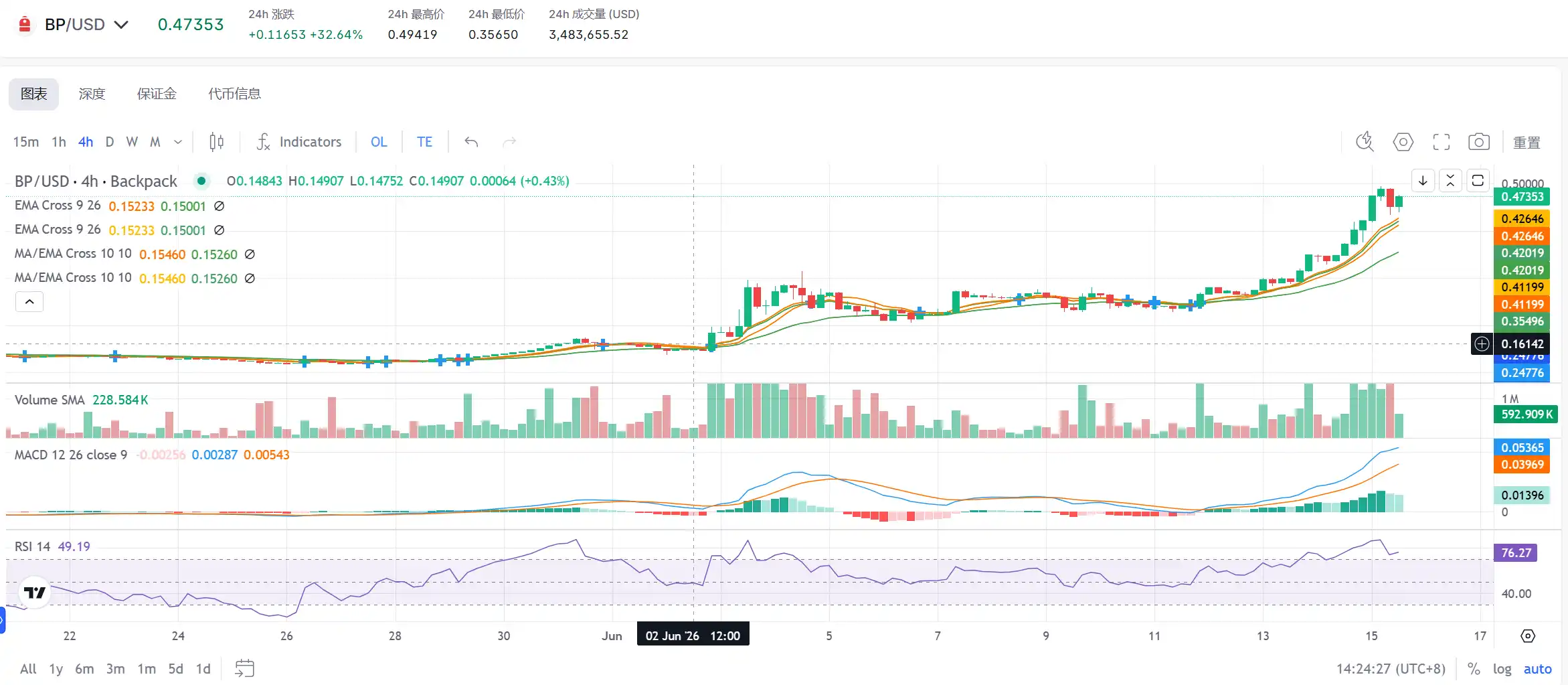
On June 15, the Backpack exchange token BP surged over 30% again within 24 hours, currently quoted at $0.475 with a market cap of $118.48 million and a fully diluted valuation (FDV) of $473.94 million. Since early June this year, BP has skyrocketed from around $0.16, breaking through a high of $0.48.

The direct catalyst for this market surge stems from the platform's latest breakthroughs in traditional U.S. stock brokerage and asset tokenization services.

Venturing into U.S. Stock Brokerage and Tokenization Business

In March 2026, BP completed its Token Generation Event (TGE) on Solana with a total supply of 1 billion tokens and an initial circulating supply of 250 million. After listing, the token price briefly touched a high point before rapidly declining, with a single-day drop exceeding 40% at its worst, as the market was once filled with profit-taking pressure. For several weeks thereafter, the price consolidated at lower levels until a turning point emerged in early June.

On June 2, Backpack announced the launch of the Backpack Securities platform, which will provide regulated U.S. stock brokerage services while also supporting the tokenization of traditional stocks for circulation on the blockchain, enabling seamless conversion between traditional securities and on-chain assets. The brokerage service is planned to launch gradually in June, with initial tokenized products rolled out in the Solana ecosystem through a partnership with Sunrise. BP skyrocketed over 80% in a single day, rapidly climbing from the $0.14-$0.15 range to around $0.27, with its market cap approaching $70 million at one point.

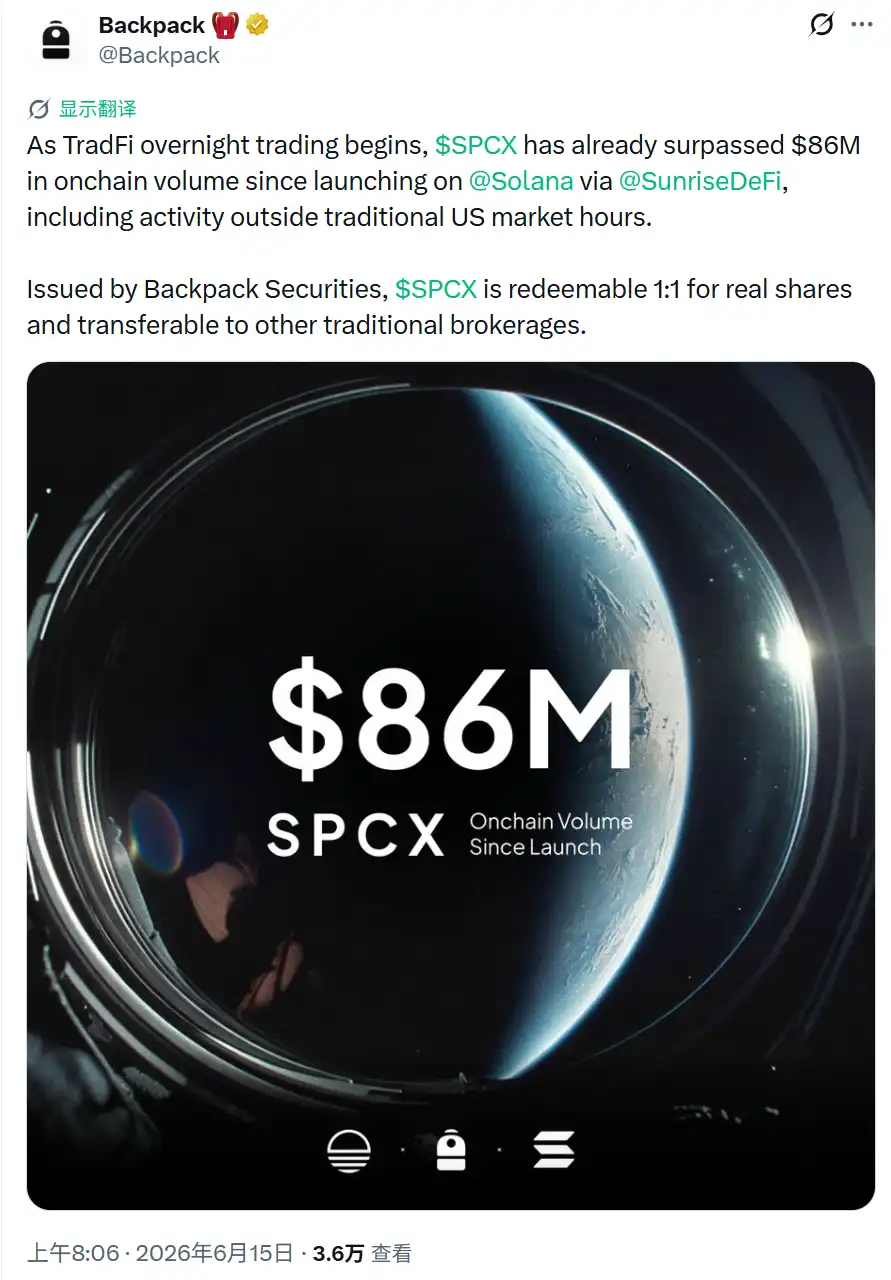
On June 12, coinciding with SpaceX's listing on NASDAQ, its tokenized product SPCX launched on Solana. In the subsequent 24 hours, BP rose approximately 27% further, pushing its price above $0.347. This token is pegged 1:1 to real SpaceX shares, supports 24/7 on-chain trading, and can be redeemed through a Backpack brokerage account into a traditional securities account, achieving interoperability between on-chain and off-chain assets. On its first day of launch, the product generated around $35-38 million in on-chain trading volume across DEXs like Jupiter and Raydium. According to the latest official data, the total on-chain SPCX trading volume exceeds $86 million.

Backpack is building a bridge between traditional U.S. stocks and Solana DeFi. Users can not only trade crypto assets within the platform but also access real stocks through the same account and tokenize portions of their assets for use, trading, or composition on-chain. This pathway aligns highly with the current RWA (Real World Assets) narrative and provides the BP token with clearer use cases and demand support.

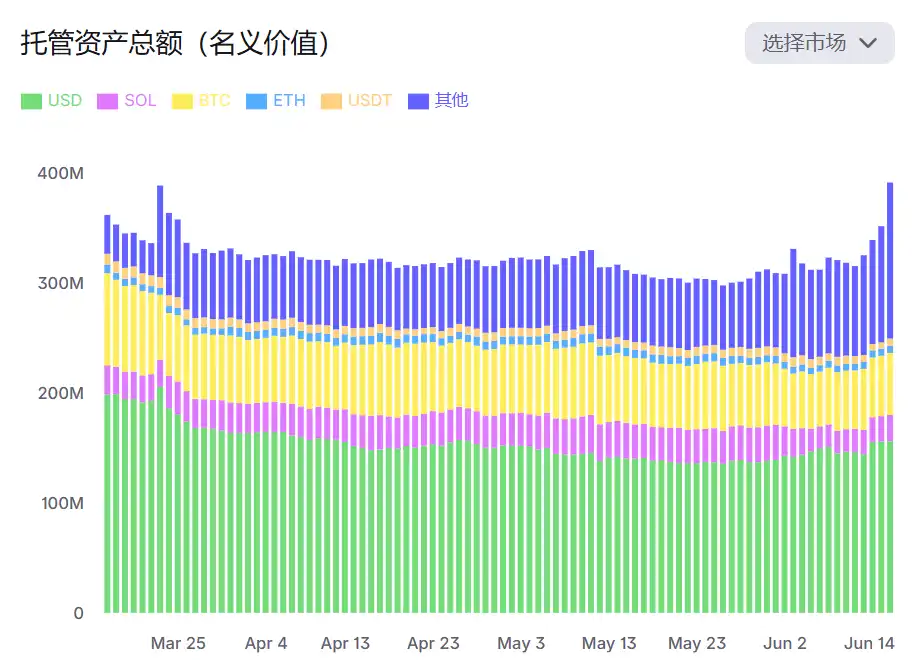
BP's recent surge stems more from substantial platform business expansion than short-term speculation. Currently, its official website shows that Backpack's total custodied assets (nominal value) have rebounded to $390 million.

No Tokens for the Team Unless the Company Goes Public

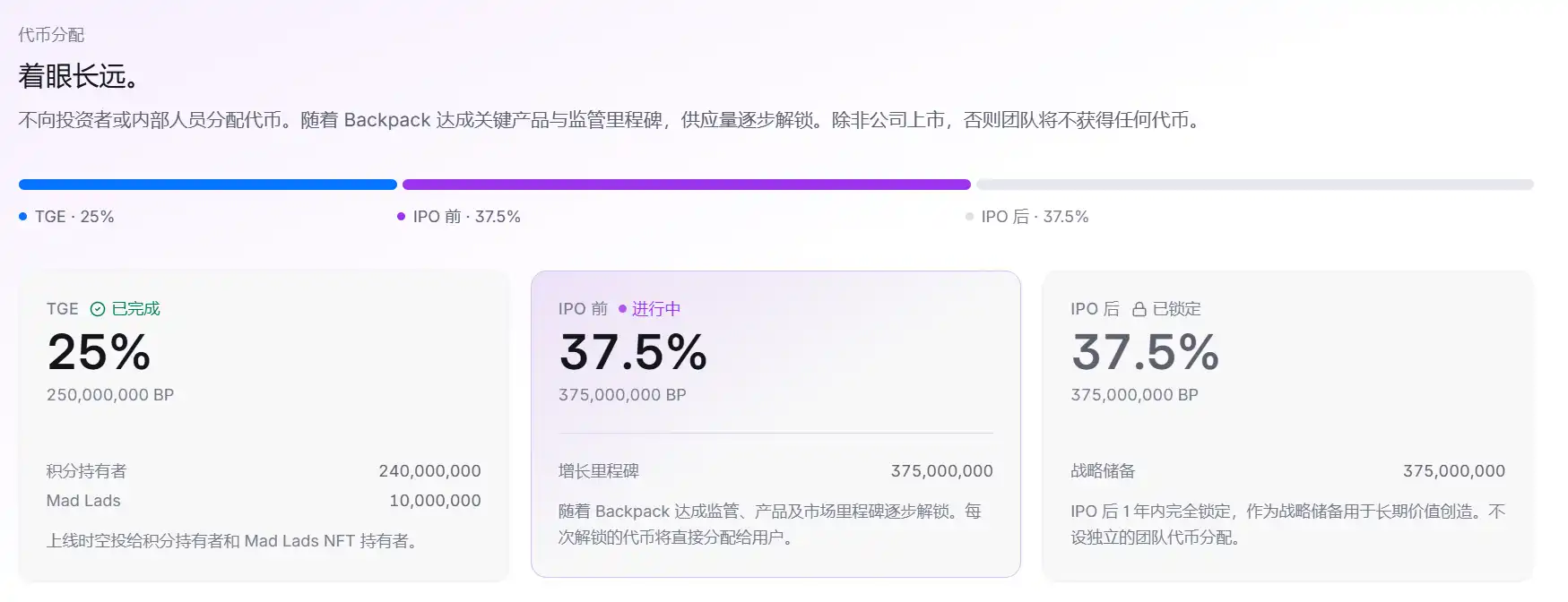
Supporting the above business development is the BP token and its unique economic structure launched as early as March. The total supply of 1 billion tokens is divided into three phases: 25% (250 million) at TGE was entirely airdropped to community users, with approximately 240 million allocated to participants in the points program and 10 million to Mad Lads NFT holders. At launch, the team, founders, and investors received 0 token allocation; 37.5% in the Pre-IPO phase is tied to growth triggers such as regulatory milestones and product launches, continuing to be distributed to users upon unlocking; 37.5% in the Post-IPO phase enters the company treasury, locked for at least one year after an IPO, with the team benefiting only through equity, not directly through tokens.

The most attention-grabbing mechanism is the equity conversion design: users who stake BP for at least 1 year gain the right to convert their tokens into company equity upon an IPO or acquisition, with the bonus increasing with holding time up to the 4th year based on the initial unlock.

Additionally, staking provides benefits such as tiered trading fee discounts, extra yield on USD collateral, free wire transfers, and priority access to the Backpack Card. Currently, about 66% (approximately 165 million) of the circulating supply is staked.

While the airdrop process was technically smooth, it also sparked community discussion. Supporters argue that the "no insider TGE allocation" model is quite radical, and the points system genuinely rewarded trading and ecosystem participation. Criticism focused on the relatively strict Sybil filtering mechanism, which led to some long-term users having their points removed, resulting in lower-than-expected allocations, as well as noticeable profit-taking during the post-listing price correction. CEO Armani Ferrante publicly denied allegations of team OTC sales.

These controversies temporarily affected market sentiment, but as tangible products like Backpack Securities were launched, the focus is gradually shifting from allocation details to the platform's long-term growth and the token's actual utility. Against the backdrop of the platform's expansion into U.S. stock brokerage and tokenization services, the long-term alignment value of BP's staking and equity mechanisms is being reevaluated.

Perguntas relacionadas

QWhat is the key factor driving the recent sharp increase in the price of Backpack's BP token?

AThe key driver is Backpack's expansion into traditional U.S. stock brokerage and asset tokenization services through its new Backpack Securities platform, starting with the tokenized SpaceX (SPCX) offering on Solana.

QWhat is the unique feature of BP's tokenomics regarding team and investor allocation?

AAt TGE, 0 tokens were allocated to the team, founders, or investors. 100% of the initial circulating supply (25% of total) was airdropped to the community. Team members can only benefit through company equity (via a token conversion option post-IPO), not through direct token holdings.

QWhat significant milestone for Backpack occurred on June 12 alongside SpaceX's NASDAQ IPO?

AOn June 12, the tokenized product for SpaceX, SPCX, was launched on Solana. It is a 1:1 tokenized representation of real SpaceX stock, facilitating 24/7 on-chain trading.

QWhat major benefit can BP stakers obtain, and what percentage of the circulating supply is currently staked?

AStakers who lock BP for at least one year gain the right to convert their tokens into company equity upon an IPO or acquisition. Currently, approximately 66% (about 165 million) of the circulating supply is staked.

QWhat criticism did the BP token airdrop face from parts of the community?

ACriticism focused on the Sybil filtering mechanism being overly strict, which led to some long-term users having their points invalidated and receiving fewer tokens than expected. There were also accusations of team OTC selling, which the CEO denied.

Leituras Relacionadas

WeChat AI Card Hands-On Guide: Has the AI Shopping Era Arrived?

**"WeChat AI Card" Practical Test Guide: Has the Era of AI Shopping Arrived?** WeChat has officially launched the "AI Exclusive Card," a feature integrated into its Workbuddy AI assistant. This card is designed to handle payments for AI-initiated purchases. Our hands-on test reveals it's not yet a tool for fully autonomous AI shopping, but rather a controlled payment layer for AI agents. The AI Card functions as an isolated sub-wallet within WeChat Pay. Users must bind the card and transfer funds into it from their main wallet. Crucially, every transaction requires explicit user confirmation via smartphone scan; AI cannot spend autonomously. Currently accessible through the Workbuddy agent, the card targets specific digital consumption scenarios: purchasing paid content (reports, data), calling paid APIs/tools, and subscribing to services. Its design prioritizes security and control by separating funds and mandating approval for each payment. We tested a real-world scenario: ordering bubble tea via Workbuddy using a "Meituan Life Assistant" skill. The process encountered multiple hurdles: high "skill" usage costs (exceeding daily free credits), and most importantly, while a payment was successfully initiated, the AI purchased an incorrect product (a mismatched group-buy coupon instead of the desired drink). This highlights the current limitation: the **AI Card only solves the payment step**. The broader challenge lies in the **AI agent's execution chain**—accurately understanding intent, navigating third-party platforms, selecting the right product, and ensuring proper fulfillment. The payment succeeded, but the purchase failed to meet the user's need. In conclusion, the WeChat AI Exclusive Card is a cautious, early-step experiment in AI commerce. It provides a secure, user-controlled payment method for agent interactions but is not yet capable of reliable, end-to-end complex purchases. For now, it's best used for low-value, low-risk digital services with careful user verification at each step. The vision of AI handling complete shopping tasks remains a work in progress.

marsbitHá 48m

WeChat AI Card Hands-On Guide: Has the AI Shopping Era Arrived?

marsbitHá 48m

Deconstructing Notion's Growth: From a Note-taking Tool to 100 Million Users—How Notion Built a Triple Growth Flywheel Through Product, Templates, and Community

Notion's growth from a niche note-taking tool to a platform with 100 million users is powered by three interconnected flywheels: Product-Led Growth (PLG), a Template Economy, and Community-Driven Growth. First, Notion's PLG strategy relies on a highly flexible, "plastic" product that users can adapt to countless personal and team workflows. Its freemium model lowers the barrier to entry, while features like page sharing and collaboration drive organic, usage-based viral growth as users naturally invite others. Second, the Template Economy solves the "blank page" problem. Templates, created by both Notion and its community, transform abstract product capabilities into concrete, copyable solutions for specific scenarios (e.g., project management, content calendars). This dramatically lowers activation costs for new users and fuels SEO-driven discovery. Third, a vibrant Community acts as a distributed growth engine. Users and official Ambassadors create tutorials, share use cases, and host local events. This community not only educates users but also fosters a sense of identity around pursuing "better ways of working," strengthening loyalty and enabling global, low-cost expansion. Together, these flywheels create a self-reinforcing ecosystem: a great product attracts users who create templates and community content, which in turn attracts more users and deepens engagement. This system allowed Notion to scale from individuals to teams and enterprises through a bottom-up adoption path. Looking ahead, AI integration promises to accelerate these flywheels further by making templates smarter and the platform a potential AI-native work operating system. Ultimately, Notion's defensible advantage is not just its features, but this deeply entrenched network of user assets, creators, and community trust.

marsbitHá 49m

Deconstructing Notion's Growth: From a Note-taking Tool to 100 Million Users—How Notion Built a Triple Growth Flywheel Through Product, Templates, and Community

marsbitHá 49m

$10 Billion, Qualcomm to Acquire Chip Legend Jim Keller's Company

Global mobile chip giant Qualcomm is in advanced talks to acquire AI chip startup Tenstorrent in a deal valued between $8-10 billion, according to media reports. This potential acquisition would be one of the largest in the AI chip sector in recent years. Tenstorrent, led by legendary chip architect Jim Keller, has gained prominence for its RISC-V architecture and AI accelerator designs. The move highlights Qualcomm's strategic push to diversify beyond its core smartphone chip business. As the smartphone market matures, Qualcomm is aggressively targeting growth in automotive, data center, and cloud AI. Acquiring Tenstorrent would allow Qualcomm to rapidly enter the high-end AI computing market, bypassing lengthy in-house development cycles. Tenstorrent's cost-effective system architecture, which avoids expensive HBM memory and relies on standard Ethernet for clustering, offers a potential alternative to Nvidia's costly solutions. Furthermore, Tenstorrent's high-performance RISC-V CPU technology and its focus on the automotive and edge computing segments align with Qualcomm's strategic goals, including its "Snapdragon Digital Chassis" platform. Despite the strategic rationale, the high valuation has sparked some investor caution. The successful integration of Tenstorrent's open-source culture and independent team into Qualcomm's organization, along with the commercialization of its technology, remains a key challenge.

marsbitHá 1h

$10 Billion, Qualcomm to Acquire Chip Legend Jim Keller's Company

marsbitHá 1h

Trading

Spot
Futuros
活动图片