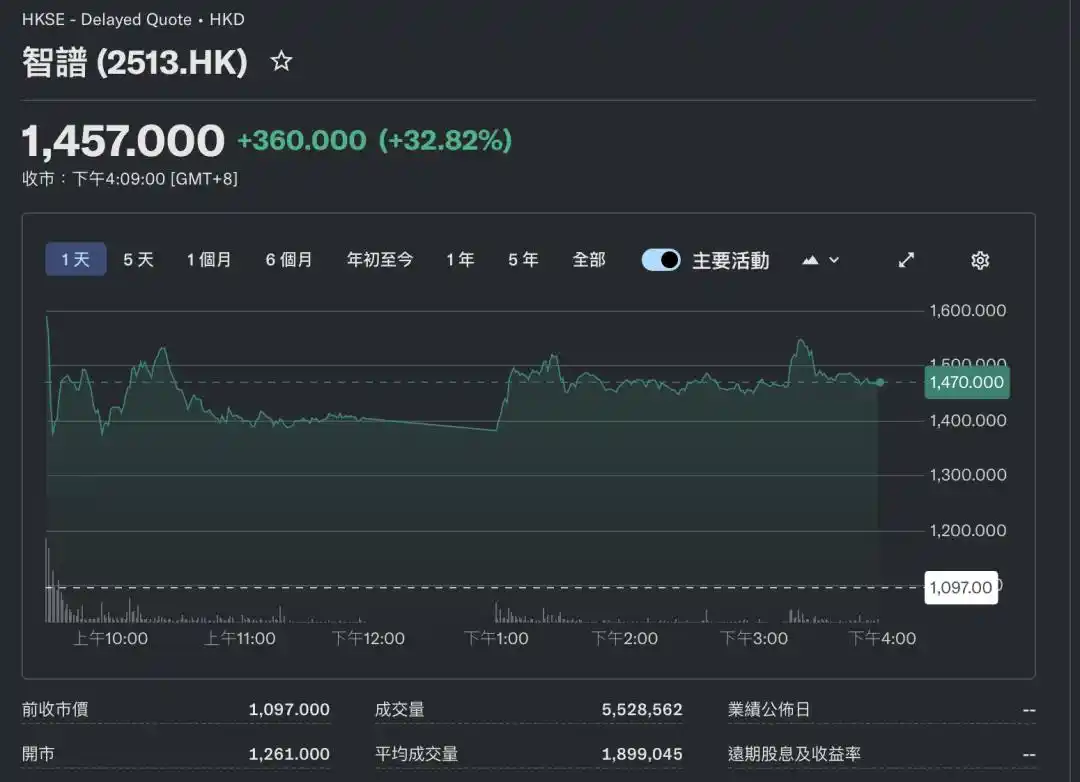
On June 15th, when the Hong Kong stock market opened, Zhipu AI's stock price surged continuously, with an intraday peak increase of 47.6%, setting a new record for single-day trading volume since its listing. By market close, the gain had moderated to 32.82%, with the total market capitalization exceeding HK$649.6 billion.
The immediate trigger came from two industry news items two days earlier.
On June 12th, Anthropic suspended access to its latest flagship models Claude Fable 5 and Claude Mythos 5 for compliance with U.S. government export control requirements. A day later, Zhipu AI announced that its latest open-source model GLM-5.2 was made available to all Coding Plan users, with APIs and open-source model weights scheduled for release the following week under the MIT license.
When the Most Advanced Models Become 'Not Necessarily Available'
On June 12th, Anthropic issued an official announcement stating that the U.S. government, invoking national security authorities, had issued an export control directive requiring the suspension of access to Claude Fable 5 and Claude Mythos 5 for all foreign nationals. The restrictions applied to non-U.S. users both inside and outside the United States, even including foreign employees within Anthropic.
Limited by the technical inability to accurately distinguish user nationality in real-time, Anthropic ultimately chose to temporarily disable the two models for all global customers to ensure compliance. This occurred just three days after the models' official release. As of now, both models are marked as unavailable on Anthropic's website, with no clear timeline for restoration.
As top-tier closed-source models in terms of current performance, the Claude series is deeply integrated into the workflows of many developers and enterprises for long-context tasks, code development, and complex document processing. The sudden suspension directly impacted numerous teams, sparking heated discussions within the community about alternative solutions.
Just as discussions about the suspension were gaining momentum, on June 13th, Zhipu AI announced that its open-source flagship model GLM-5.2 was fully accessible to all Coding Plan users, covering Lite, Pro, Max, and Team editions. It also previewed that APIs and model weights would be launched the following week, open-sourced under the MIT license.
Over the past few years, competition in the large model industry has primarily revolved around capability.
Whose reasoning is stronger, whose coding ability is better, and who can first break through new capability boundaries have largely determined the choices of developers and enterprise customers.
However, the Anthropic incident exposed another, previously often overlooked issue: beyond capability, whether continuous and stable access to a model can be guaranteed.
In this Anthropic event, for many developers and enterprises relying on overseas models for R&D, even with accounts and paid subscriptions, they faced the risk of models suddenly becoming unavailable.
This is also why this incident sparked far more discussion in the developer community than typical product updates.
As AI gradually evolves from a chat tool into infrastructure for software development, enterprise operations, and even production processes, model stability, sustainability, and controllability are beginning to become metrics as crucial as model capability itself.
Zhipu AI stated in its announcement, "Cutting-edge intelligence should not belong only to a few, nor should it be subject to recall by a few rules at any time." This statement corresponds to the new reality facing the global AI industry today.
From 'Who is Stronger' to 'Who is More Accessible'
The rapid reaction of the capital market essentially represents an early pricing-in of changes in industry logic. Beyond the stock performance, the market is more focused on the signals released by GLM-5.2 itself.
According to information disclosed by Zhipu AI, GLM-5.2 is its most capable open-source model to date, supporting a 1M context window, with a particular focus on enhancing long-context coding task capabilities. Zhipu positions it as a "truly usable 1M context" model, aiming to address the issue of models forgetting context in prolonged, multi-step engineering tasks.
A core keyword here is "Long Horizon Task." As AI Agents evolve from conversational tools into execution tools, models need to continuously handle thousands of tool calls, tens of thousands of lines of code, and massive amounts of intermediate state information. The longer the context window, the stronger the model's ability to maintain project state and task continuity.
Current industry competition has shifted from "answering questions" to "continuous work." For developers, what truly matters is not parameter scale, but whether a model can maintain consistency and reliability over complex tasks lasting several hours or even days.
Judging by the market reaction, investors have clearly become aware of this shift as well.
Dongfang Securities noted in a research report that the Anthropic model incident exposed the risk of closed-source model access being subject to a single jurisdiction, which may drive more enterprises to shift core AI capabilities towards domestic foundational models and localized deployment. Meanwhile, GLM-5.2's open-sourcing under the MIT license further lowers the barrier for enterprise trial and integration.
Over the past year, capital market valuations for large model companies have been largely based on model capability and market share. Today, as the global regulatory environment intensifies, a new valuation dimension is emerging — who can provide developers and enterprises with AI capabilities that are stable, sustainable, and accessible in the long term.
When access to the world's most advanced models begins to be influenced by external factors, openness, accessibility, and autonomous controllability are becoming new bargaining chips in AI competition.
This article is from the WeChat public account "GeekPark" (ID: geekpark), author: Lian Ran, editor: Zheng Xuan