Huobi HTX New Assets Weekly Review (12.1-12.7): PIPPIN Soars 150%, Bankruptcy Sector Rebounds Strongly Over the Weekend

深潮Published on 2025-12-11Last updated on 2025-12-11

Abstract

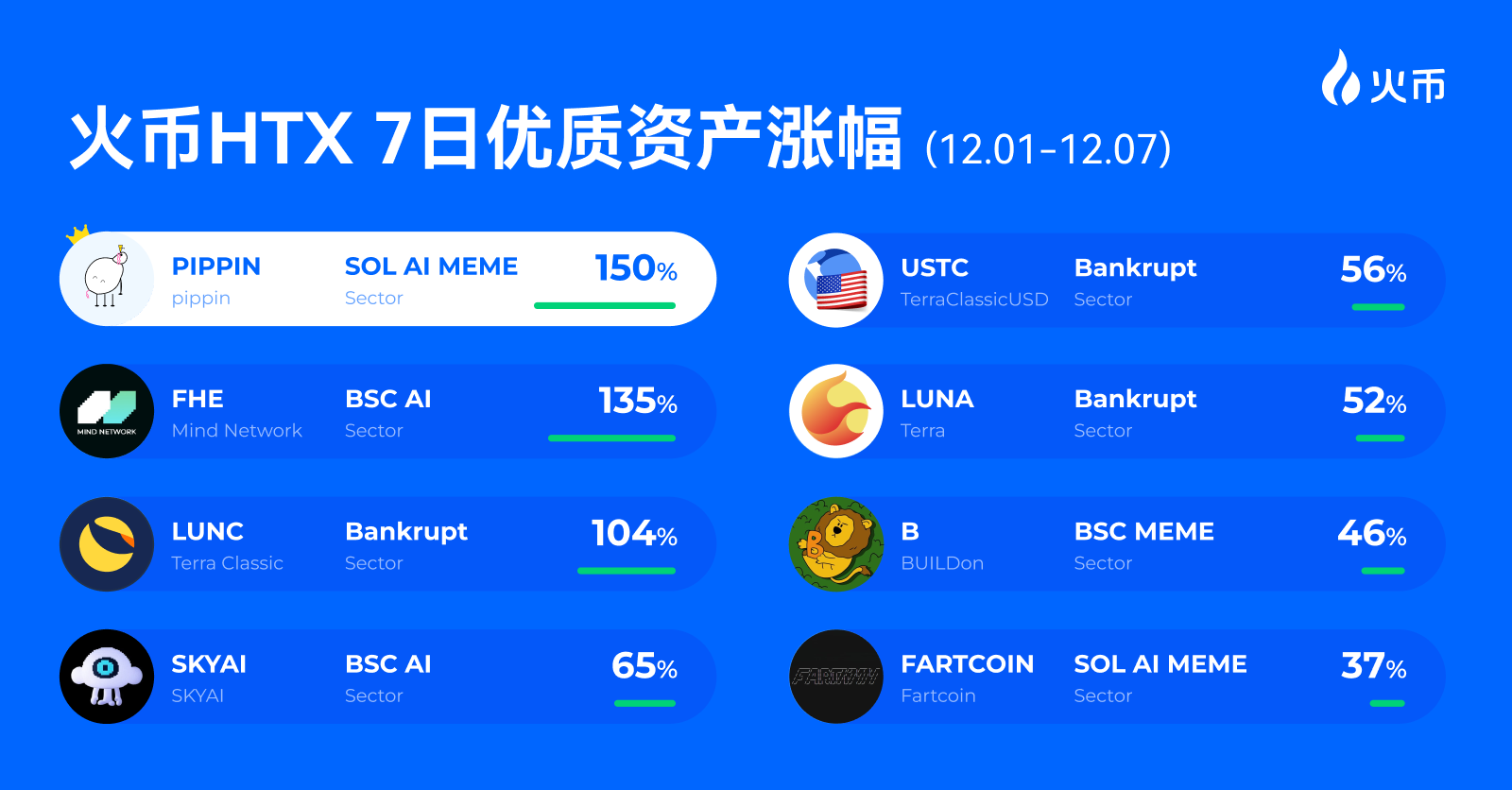
Huobi HTX Weekly New Assets Recap (Dec 1–7): PIPPIN Surges 150%, Bankruptcy Sector Rebounds Over Weekend From December 1 to 7, multiple high-volatility assets on Huobi HTX saw strong rallies amid mixed market sentiment and improved risk appetite. SOL and BSC-based AI meme tokens like PIPPIN and FHE led the gains, showing strong recovery momentum, while the long-dormant bankruptcy sector also rebounded due to recent news around founder Do Kwon. SOL Meme tokens were among the top performers, with PIPPIN rising 150% as the top gainer. Other notable gainers included FARTCOIN (+37%) and MOODENG (+32%), reflecting continued interest in AI and meme narratives on Solana. On BSC, AI-related tokens also performed strongly. FHE (Mind Network) rose 135%, driven by discussions around homomorphic encryption and data security. SKYAI gained 65%, and B (BUILDon) increased by 46%. The bankruptcy sector, including LUNC (+104%), USTC (+56%), and LUNA (+52%), saw a significant rebound over the weekend, fueled by sentiment and speculative interest. Overall, the week was marked by a return of high-risk, high-volatility trading, with AI memes and bankruptcy tokens leading the rally. Huobi HTX continues to provide users with diverse and dynamic trading opportunities in the evolving crypto market.

Over the past week (December 1 to December 7), influenced by both fluctuating market sentiment and a renewed risk appetite among investors, several highly volatile assets on the Huobi HTX platform experienced strong rallies. AI Meme assets on the SOL and BSC chains, such as PIPPIN and FHE, led the gains, displaying a "dead cat bounce" style recovery. Meanwhile, the long-dormant bankruptcy sector saw a rotation due to recent news about founder Do Kwon. Below are the highlights of this week's top performers.
SOL Meme: Strongest Inflow of Funds, PIPPIN Leads with 150% Gain

Over the past week, the SOL ecosystem remained at the center of high-volatility narratives, with the combination of AI + Meme becoming the most chased sector. The narrative features typical short-term gaming characteristics, and SOL remains one of the most suitable public chains for incubating highly elastic assets.

  • PIPPIN (Pippin): Up 150%, the top gainer this period. Pippin is an SVG unicorn drawn using the latest LLM benchmark on ChatGPT 4o. Pippin was created by Yohei Nakajima, a recognized innovator and thought leader in the AI VC field (followed by Jeff Bezos and Marc Andreessen).

  • FARTCOIN (Fartcoin): Up 37%, continuing the "AI + MEME" fusion trend. Fartcoin is a Meme token on the SOL chain inspired by truth terminal.

  • MOODENG (Moo Deng): Up 32%, a catch-up asset boosted by the rising sentiment in the SOL ecosystem. As a hippo-themed Meme asset on the SOL chain, market participants began spreading to traditional Meme sectors after chasing AI Memes.

BSC AI: On-Chain AI Application Heat Continues

The AI sector on the BSC chain also performed prominently. From on-chain trends, BSC's AI projects generally feature "technical concepts, light asset operation, and high community participation," making them more likely to form liquidity resonance in a short time. This week's concentrated gains also indicate that funds are willing to continue seeking high-beta opportunities in "low-threshold, strong narrative" sectors.

  • FHE (Mind Network): Entered the list as the second top gainer with a 135% weekly increase, one of the most noteworthy technical assets this week. Mind Network is promoting the development of a new generation of zero-trust internet transmission protocol (HTTPZ). Ongoing discussions around homomorphic encryption and on-chain data security have driven market sentiment.

  • SKYAI: Up 65%, continuing the "rotation logic" of small-cap AI assets on BSC. SKYAI is a comprehensive AI ecosystem powered by MCP, aiming to seamlessly integrate intelligent solutions across industries. Currently, SKYAI supports aggregated datasets from BSC and Solana, totaling over 10 billion rows.

  • B (BUILDon): Up 46%. BUILDon represents a hybrid Layer-2 blockchain solution that leverages Bitcoin's security framework and Ethereum Virtual Machine (EVM) compatibility to facilitate dApp development.

Bankruptcy Sector: Weekend Sentiment Ignites "Nostalgia"

The biggest surprise this weekend came from the strong rebound in the bankruptcy sector. The long-dormant LUNA-related assets saw significant rebounds amid improved sentiment:

  • LUNC (Terra Classic): Up 104% weekly, leading the bankruptcy sector. Terra Classic (LUNC) is the original native cryptocurrency of the Terra blockchain. After the collapse of the Terra stablecoin (UST) and network fork in May 2022, the name was changed to Terra Classic to distinguish it from the new Terra blockchain (LUNA 2.0). Community-level "restructuring expectations" and "historical sentiment" once again became driving factors.

  • USTC (Terra Classic USD): Up 56%, an emotion-linked asset, strengthening in sync with LUNC. It is a decentralized algorithmic stablecoin pegged to the US dollar.

  • LUNA (Terra): Up 52%, continuing the sector rotation. It is worth emphasizing that this sector represents the market's short-term attention to "nostalgic assets," with extremely high volatility, where gains and risks coexist.

Dual Drivers of AI Meme and Bankruptcy Sector, Short-Term Risk Appetite Fully Recovers

Overall, 12/1-12/7 was a typical week of "return of speculative行情". The AI Meme赛道 on SOL and BSC saw significant gains, and the bankruptcy sector staged a strong counterattack over the weekend. Assets on the Huobi HTX platform showed strong rotation and high elasticity. As market sentiment continues to warm up, short-term traders will still have ample volatility opportunities in the coming weeks.

In this round of multi-sector共振上涨, Huobi HTX will continue to leverage the deep resources and agile response capabilities of its global platform to lead the diffusion of wealth effects in the next stage, providing users with more certain asset growth opportunities.

About Huobi HTX

Huobi HTX was established in 2013. After 12 years of development, it has evolved from a cryptocurrency exchange into a comprehensive blockchain business ecosystem covering digital asset trading, financial derivatives, research, investment, incubation, and other businesses.

Huobi HTX, as a leading global Web3 gateway, adheres to a development strategy of global expansion, ecological prosperity, wealth effect, and security compliance, providing comprehensive, secure, and reliable value and services to global virtual currency enthusiasts.

To learn more about Huobi HTX, please visit https://www.htx.com/ or HTX Square, and follow us on X, Telegram, and Discord. For further inquiries, please contact [email protected].

Related Questions

QWhich asset had the highest weekly gain on Huobi HTX from December 1 to December 7, and what was the percentage increase?

APIPPIN (Pippin) had the highest weekly gain, with a 150% increase.

QWhat was the main narrative driving the performance of SOL ecosystem assets during the week?

AThe main narrative was the combination of AI and Meme, which became the most chased sector, with SOL being one of the most suitable public chains for incubating high-elasticity assets.

QWhich BSC-based AI asset saw a 135% weekly increase and is focused on zero-trust internet transmission protocols?

AFHE (Mind Network) saw a 135% weekly increase and is advancing a new generation of zero-trust internet transmission protocol (HTTPZ).

QWhy did the bankrupt sector, including assets like LUNC and USTC, experience a significant rebound over the weekend?

AThe rebound was driven by renewed community sentiment around 'reorganization expectations' and 'historical nostalgia,' particularly influenced by recent news about founder Do Kwon.

QWhat overall market trend does the article describe for the period from December 1 to December 7 on Huobi HTX?

AThe period was characterized as a typical 'speculative行情回归期' (speculative market return period), with strong rotations and high elasticity in assets, driven by AI Meme sectors on SOL and BSC, and a rebound in the bankrupt sector, indicating a comprehensive recovery in short-term risk appetite.

Related Reads

When Hyperliquid Takes Away Solana's "Internet Capital Markets" Script

The article discusses how Solana's vision of becoming the "Internet Capital Markets" is being challenged, primarily by the rise of Hyperliquid. While Solana positioned itself as a high-performance blockchain for tokenizing all global assets, its native token SOL has significantly underperformed, and its core narrative faces pressure. Hyperliquid, initially a perpetual contracts platform, has evolved into a specialized Layer 1 financial network. Its focused, trading-optimized design is attracting users and capital, suggesting a vertical L1 may be better suited for a core capital market than a general-purpose chain like Solana. This external competition was compounded by an internal $200M+ exploit on Solana's key derivatives protocol, Drift, creating a strategic vacuum. In response, Solana founder Anatoly Yakovenko heavily promoted the Phoenix protocol as a decentralized, composable alternative. However, Phoenix's trading volume remains far behind leading platforms. Solana supporters also launched critiques against Hyperliquid's decentralization, citing its limited validators and closed-source code. Critics countered that Solana's own decentralization metrics have weakened, and the foundation's overt backing of Phoenix caused friction with other ecosystem builders. The piece concludes that Solana risks losing the "Internet Capital Markets" race if it cannot regain dominance in derivatives, potentially remaining a meme coin hub rather than achieving its grand ambition of hosting all global assets.

marsbit1h ago

When Hyperliquid Takes Away Solana's "Internet Capital Markets" Script

marsbit1h ago

Trump Signs Executive Order, Kraken, Coinbase and Others May Gain Access to Fed Payment Channels

President Trump has signed an executive order, "Incorporating Financial Technology Innovation into the Regulatory Framework," pressuring the Federal Reserve to reassess its rules on granting non-bank financial companies—including crypto and fintech firms—access to its payment systems, specifically master accounts that connect to the Fedwire settlement system. Currently, such accounts are primarily reserved for depository institutions. The order mandates a review to determine if broader access is permissible and to establish an application process. This move, supported by figures like Senator Cynthia Lummis, aims to reduce barriers to innovation and lower public payment costs by fostering fairer competition. It does not grant immediate access but could pave the way for companies like Kraken, Coinbase, Ripple, and Circle to reduce reliance on intermediary banks, lowering costs and speeding up settlements. A key precedent is the Kansas City Fed granting Kraken's parent company a restricted master account in March, offering limited payment services without interest or credit privileges. This model is seen as a potential template for allowing controlled access while mitigating systemic risk. Other firms like Anchorage, Paxos, and BitGo, which hold specialized banking charters, are also well-positioned to apply. The banking industry, represented by the American Bankers Association, opposes easing access, arguing any institution handling bank-like payments must meet the same stringent regulatory, consumer protection, and risk-management standards as traditional banks. Their core concerns include potential systemic risks, compliance gaps in areas like anti-money laundering, and the diversion of liquidity from the traditional banking system. The outcome of the Fed's review will be crucial in determining whether and how crypto and fintech firms can integrate more directly into the core U.S. financial infrastructure, balancing innovation with financial stability.

marsbit1h ago

Trump Signs Executive Order, Kraken, Coinbase and Others May Gain Access to Fed Payment Channels

marsbit1h ago

The First Large-Scale Strike in the AI Era Comes from the Factories That Build AI

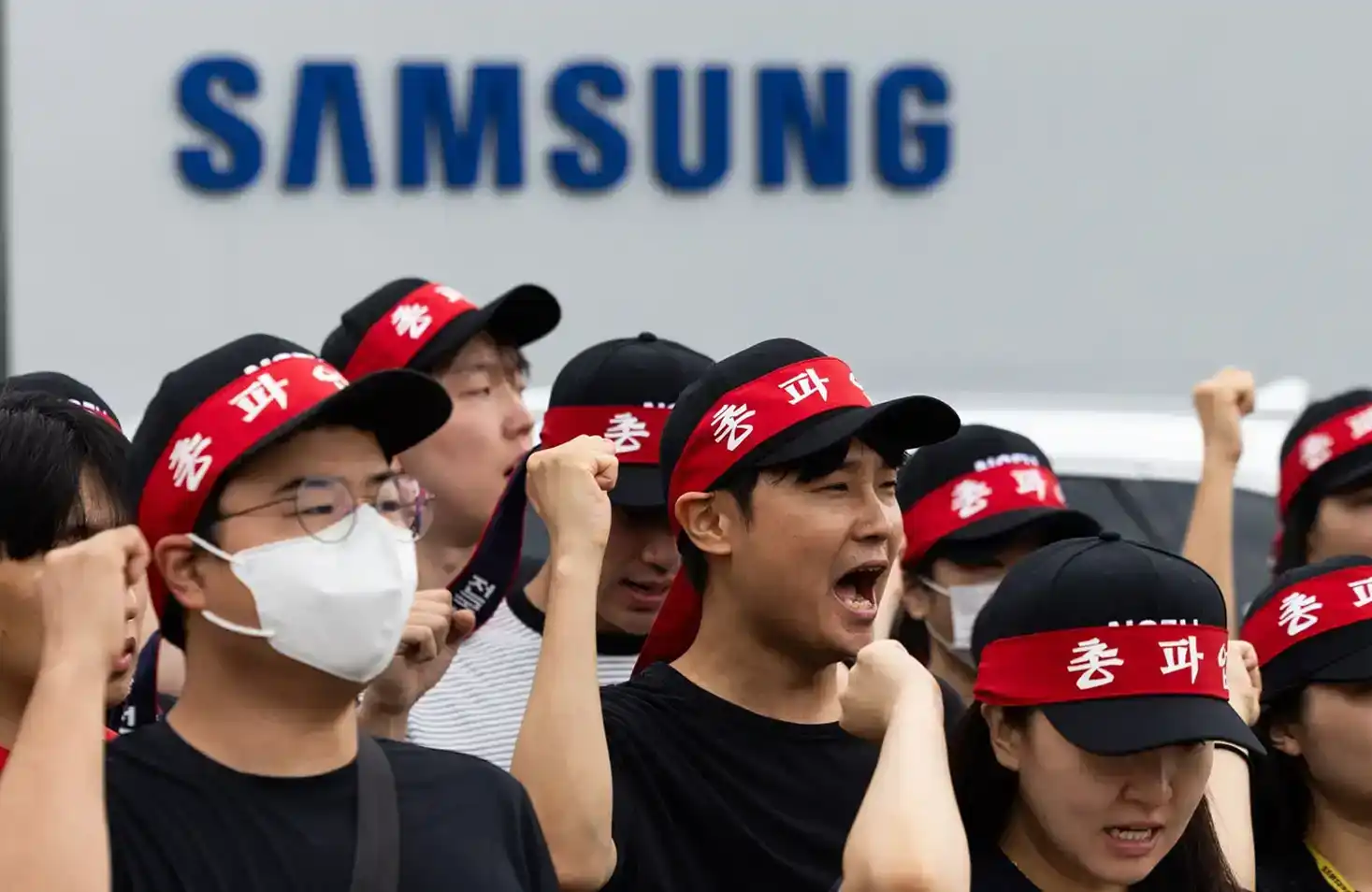
The article describes a potential large-scale strike at Samsung Electronics, narrowly averted in May 2026 after a temporary agreement. The strike, planned by the company's union, would have been the first major labor action in the AI era targeting a core AI supply chain player. Samsung, alongside SK Hynix, produces roughly two-thirds of the world's memory chips, critical components for AI training and data centers like HBM. An 18-day strike could have disrupted global supply, affecting prices and production for tech companies and cloud providers. For South Korea, where semiconductors constitute about 35% of exports and Samsung represents a quarter of the stock market's value, such an action threatens national economic stability. The union's demands include a 7% base wage increase and, crucially, a clear, substantial profit-sharing model. They want 15% of annual operating profit as an employee bonus pool and the removal of the existing cap (about 50% of annual salary). This frustration is amplified by seeing rival SK Hynix successfully negotiate a deal granting employees 10% of operating profit as bonuses, with reports suggesting some workers could receive bonuses equivalent to hundreds of thousands of dollars. The conflict stems from deeper issues in South Korea's chaebol (conglomerate) system, where rapid national industrialization often prioritized corporate growth over labor rights. Samsung long maintained a "no union" policy until a 2020 apology from its leader. The article argues this strike highlights a fundamental tension in the AI age: as technology advances and corporate profits soar—often driven by AI—the workers who build the infrastructure are demanding a fair share and dignity, rejecting the notion that they are mere expendable components in a machine that "must not stop." The piece concludes that the true test of the AI era isn't just computational power, but whether the people who build the future can secure a stable and valued place within it.

marsbit2h ago

The First Large-Scale Strike in the AI Era Comes from the Factories That Build AI

marsbit2h ago

Ripple’s Fed Master Account Bid Gains Momentum After Trump Order

President Donald Trump has signed an executive order directing financial regulators and the Federal Reserve to review expanding fintech and crypto firms' access to core payment infrastructure. This order significantly advances the industry's push for direct Fed connectivity, a central issue for Ripple. The company has been seeking a Federal Reserve master account as part of its strategy for its RLUSD stablecoin, which would allow it to hold reserves directly with the central bank and access its payment rails. The order, titled "Integrating Financial Technology Innovation into Regulatory Frameworks," mandates a Fed review within 120 days on allowing access for entities like uninsured depository institutions and non-bank financial companies, including those in digital assets. This creates a formal policy timeline for resolving whether crypto payment firms must rely on traditional bank intermediaries. Ripple's application for a national bank charter and a master account is part of this broader landscape. The issue gained precedent when Kraken Financial received a limited-purpose master account, while Custodia Bank's application was denied after a legal battle. The Fed has also proposed a more restricted "payment account" option. Trump's order does not guarantee approval for Ripple but forces a high-level examination of the regulatory barriers, bringing the company's long-running effort to the forefront of Washington's financial policy agenda.

bitcoinist2h ago

Ripple’s Fed Master Account Bid Gains Momentum After Trump Order

bitcoinist2h ago

Trading

Spot
Futures

Hot Articles

Discussions

Welcome to the HTX Community. Here, you can stay informed about the latest platform developments and gain access to professional market insights. Users' opinions on the price of S (S) are presented below.

活动图片