Huobi HTX New Assets Weekly Review (12.1-12.7): PIPPIN Soars 150%, Bankruptcy Sector Rebounds Strongly Over the Weekend

深潮Published on 2025-12-11Last updated on 2025-12-11

Abstract

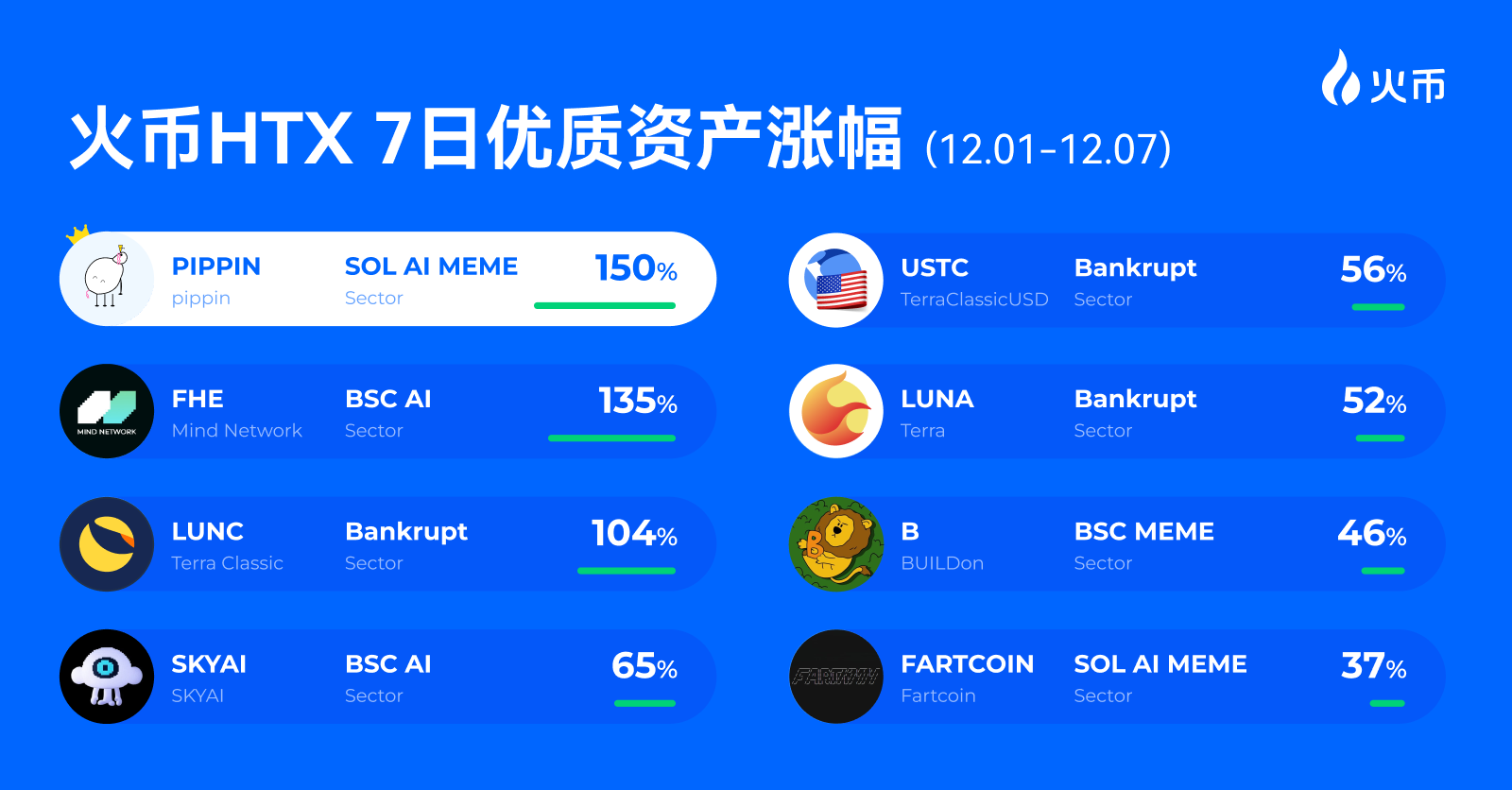
Huobi HTX Weekly New Assets Recap (Dec 1–7): PIPPIN Surges 150%, Bankruptcy Sector Rebounds Over Weekend From December 1 to 7, multiple high-volatility assets on Huobi HTX saw strong rallies amid mixed market sentiment and improved risk appetite. SOL and BSC-based AI meme tokens like PIPPIN and FHE led the gains, showing strong recovery momentum, while the long-dormant bankruptcy sector also rebounded due to recent news around founder Do Kwon. SOL Meme tokens were among the top performers, with PIPPIN rising 150% as the top gainer. Other notable gainers included FARTCOIN (+37%) and MOODENG (+32%), reflecting continued interest in AI and meme narratives on Solana. On BSC, AI-related tokens also performed strongly. FHE (Mind Network) rose 135%, driven by discussions around homomorphic encryption and data security. SKYAI gained 65%, and B (BUILDon) increased by 46%. The bankruptcy sector, including LUNC (+104%), USTC (+56%), and LUNA (+52%), saw a significant rebound over the weekend, fueled by sentiment and speculative interest. Overall, the week was marked by a return of high-risk, high-volatility trading, with AI memes and bankruptcy tokens leading the rally. Huobi HTX continues to provide users with diverse and dynamic trading opportunities in the evolving crypto market.

Over the past week (December 1 to December 7), influenced by both fluctuating market sentiment and a renewed risk appetite among investors, several highly volatile assets on the Huobi HTX platform experienced strong rallies. AI Meme assets on the SOL and BSC chains, such as PIPPIN and FHE, led the gains, displaying a "dead cat bounce" style recovery. Meanwhile, the long-dormant bankruptcy sector saw a rotation due to recent news about founder Do Kwon. Below are the highlights of this week's top performers.
SOL Meme: Strongest Inflow of Funds, PIPPIN Leads with 150% Gain

Over the past week, the SOL ecosystem remained at the center of high-volatility narratives, with the combination of AI + Meme becoming the most chased sector. The narrative features typical short-term gaming characteristics, and SOL remains one of the most suitable public chains for incubating highly elastic assets.

  • PIPPIN (Pippin): Up 150%, the top gainer this period. Pippin is an SVG unicorn drawn using the latest LLM benchmark on ChatGPT 4o. Pippin was created by Yohei Nakajima, a recognized innovator and thought leader in the AI VC field (followed by Jeff Bezos and Marc Andreessen).

  • FARTCOIN (Fartcoin): Up 37%, continuing the "AI + MEME" fusion trend. Fartcoin is a Meme token on the SOL chain inspired by truth terminal.

  • MOODENG (Moo Deng): Up 32%, a catch-up asset boosted by the rising sentiment in the SOL ecosystem. As a hippo-themed Meme asset on the SOL chain, market participants began spreading to traditional Meme sectors after chasing AI Memes.

BSC AI: On-Chain AI Application Heat Continues

The AI sector on the BSC chain also performed prominently. From on-chain trends, BSC's AI projects generally feature "technical concepts, light asset operation, and high community participation," making them more likely to form liquidity resonance in a short time. This week's concentrated gains also indicate that funds are willing to continue seeking high-beta opportunities in "low-threshold, strong narrative" sectors.

  • FHE (Mind Network): Entered the list as the second top gainer with a 135% weekly increase, one of the most noteworthy technical assets this week. Mind Network is promoting the development of a new generation of zero-trust internet transmission protocol (HTTPZ). Ongoing discussions around homomorphic encryption and on-chain data security have driven market sentiment.

  • SKYAI: Up 65%, continuing the "rotation logic" of small-cap AI assets on BSC. SKYAI is a comprehensive AI ecosystem powered by MCP, aiming to seamlessly integrate intelligent solutions across industries. Currently, SKYAI supports aggregated datasets from BSC and Solana, totaling over 10 billion rows.

  • B (BUILDon): Up 46%. BUILDon represents a hybrid Layer-2 blockchain solution that leverages Bitcoin's security framework and Ethereum Virtual Machine (EVM) compatibility to facilitate dApp development.

Bankruptcy Sector: Weekend Sentiment Ignites "Nostalgia"

The biggest surprise this weekend came from the strong rebound in the bankruptcy sector. The long-dormant LUNA-related assets saw significant rebounds amid improved sentiment:

  • LUNC (Terra Classic): Up 104% weekly, leading the bankruptcy sector. Terra Classic (LUNC) is the original native cryptocurrency of the Terra blockchain. After the collapse of the Terra stablecoin (UST) and network fork in May 2022, the name was changed to Terra Classic to distinguish it from the new Terra blockchain (LUNA 2.0). Community-level "restructuring expectations" and "historical sentiment" once again became driving factors.

  • USTC (Terra Classic USD): Up 56%, an emotion-linked asset, strengthening in sync with LUNC. It is a decentralized algorithmic stablecoin pegged to the US dollar.

  • LUNA (Terra): Up 52%, continuing the sector rotation. It is worth emphasizing that this sector represents the market's short-term attention to "nostalgic assets," with extremely high volatility, where gains and risks coexist.

Dual Drivers of AI Meme and Bankruptcy Sector, Short-Term Risk Appetite Fully Recovers

Overall, 12/1-12/7 was a typical week of "return of speculative行情". The AI Meme赛道 on SOL and BSC saw significant gains, and the bankruptcy sector staged a strong counterattack over the weekend. Assets on the Huobi HTX platform showed strong rotation and high elasticity. As market sentiment continues to warm up, short-term traders will still have ample volatility opportunities in the coming weeks.

In this round of multi-sector共振上涨, Huobi HTX will continue to leverage the deep resources and agile response capabilities of its global platform to lead the diffusion of wealth effects in the next stage, providing users with more certain asset growth opportunities.

About Huobi HTX

Huobi HTX was established in 2013. After 12 years of development, it has evolved from a cryptocurrency exchange into a comprehensive blockchain business ecosystem covering digital asset trading, financial derivatives, research, investment, incubation, and other businesses.

Huobi HTX, as a leading global Web3 gateway, adheres to a development strategy of global expansion, ecological prosperity, wealth effect, and security compliance, providing comprehensive, secure, and reliable value and services to global virtual currency enthusiasts.

To learn more about Huobi HTX, please visit https://www.htx.com/ or HTX Square, and follow us on X, Telegram, and Discord. For further inquiries, please contact glo-media@htx-inc.com.


Trending Cryptos

Related Questions

QWhich asset had the highest weekly gain on Huobi HTX from December 1 to December 7, and what was the percentage increase?

APIPPIN (Pippin) had the highest weekly gain, with a 150% increase.

QWhat was the main narrative driving the performance of SOL ecosystem assets during the week?

AThe main narrative was the combination of AI and Meme, which became the most chased sector, with SOL being one of the most suitable public chains for incubating high-elasticity assets.

QWhich BSC-based AI asset saw a 135% weekly increase and is focused on zero-trust internet transmission protocols?

AFHE (Mind Network) saw a 135% weekly increase and is advancing a new generation of zero-trust internet transmission protocol (HTTPZ).

QWhy did the bankrupt sector, including assets like LUNC and USTC, experience a significant rebound over the weekend?

AThe rebound was driven by renewed community sentiment around 'reorganization expectations' and 'historical nostalgia,' particularly influenced by recent news about founder Do Kwon.

QWhat overall market trend does the article describe for the period from December 1 to December 7 on Huobi HTX?

AThe period was characterized as a typical 'speculative行情回归期' (speculative market return period), with strong rotations and high elasticity in assets, driven by AI Meme sectors on SOL and BSC, and a rebound in the bankrupt sector, indicating a comprehensive recovery in short-term risk appetite.

Related Reads

Dialogue with Yihui Capital, SoundAI Technology, Ling Universe, and Zhongbo Jili: Opportunities and Challenges in the AI Smart Hardware Track

On June 28, 2026, an event titled "New Opportunities in AI Hardware: The Battle for Interactive Entry Points Begins" was held in Beijing. It featured a report from ITJuzi and discussions with experts from SoundAI, Ling Universe, One Reed Capital, and Zhongbo Juli on the opportunities and challenges in China's AI hardware sector. Key report findings highlight the sector's intense activity: 327 out of 431 startups founded post-2023 have secured funding, with 179 investments in H1 2026 alone. The landscape is dominated by embodied intelligent robots, while wearable tech like smart rings and AI glasses shows rapid growth. Geographically, Shenzhen leads, leveraging its superior hardware supply chain, followed by Beijing and Shanghai. The overarching trend is for companies to focus on micro-innovations within specific scenarios rather than reinventing foundational technology. Industry leaders shared several critical insights: 1. **Balancing Innovation & Market Readiness**: Entrepreneurs face the "hammer looking for a nail" dilemma. Success requires balancing technical capability with user acceptance, cost control, and incremental design improvements rather than chasing disruptive innovation. 2. **Competitive Landscape**: The future interactive entry point may not be a single super-device but a mix of universal terminals and specialized, scenario-specific hardware. While large companies have ecosystem advantages, startups can win by deeply targeting vertical markets and specific user groups. 3. **Core Challenges & Business Models**: Key hurdles include deep understanding of AI models and navigating non-transparent hardware supply chains. Viable business models may involve selling hardware at cost and generating revenue through software subscriptions, but this requires tight control over both hardware BOM and model inference costs. 4. **The Road to Commercialization**: The ultimate test is market validation—achieving sales growth and sustainable cash flow. Companies must find the right application scenario, use edge computing effectively, and close the loop from technology to commercial success. 5. **The Future of Interaction**: Proactive, context-aware interaction is the next frontier, though it's currently limited by issues like model hallucinations and environmental perception. The near-term focus should be on identifying target users and creating a coherent experience in specific domains, such as health wearables. In summary, to succeed in the competitive AI hardware arena, companies must strategically choose their niche, build a team with the right geographical advantages (e.g., leveraging Shenzhen's supply chain), and most importantly, execute a flawless commercialization strategy that translates technology into market-accepted products and sustainable business growth.

marsbitJust now

Dialogue with Yihui Capital, SoundAI Technology, Ling Universe, and Zhongbo Jili: Opportunities and Challenges in the AI Smart Hardware Track

marsbitJust now

CryptoQuant Founder: The Cost to Double BTC Has Increased by 20,000 Times, Where Will the $100 Billion Buying Power Come From?

CryptoQuant founder Ki Young Ju analyzes Bitcoin's current capital challenge. He notes that the cryptocurrency market has grown too large for retail-driven momentum alone to generate massive price increases as in past cycles. His calculations show that in 2011, approximately $2.7 million in capital inflow could push BTC's price up by 550x, whereas the current cycle requires an estimated $101 billion in new capital just for a 100% price increase. This shift underscores that sustaining a bull run now depends on attracting large-scale, long-term institutional capital rather than short-term speculative trading. Recent outflows from US spot Bitcoin ETFs, totaling nearly $10 billion since May, highlight the fragility of current demand and challenge the narrative of deep institutional support. While surveys indicate continued institutional interest, these entities prioritize regulated products, risk management, and portfolio integration over speculative gains. For the next significant bull market, Bitcoin must transition to being a core macro asset. The key drivers are no longer just more buyers, but capital allocation from larger, slower-moving entities like wealth advisors, corporate treasuries, banks, and sovereign wealth funds. This new phase pits Bitcoin against other major asset classes like AI for a share of institutional capital, making its growth trajectory dependent on sustained, high-quality inflows from diversified financial balance sheets.

marsbit4m ago

CryptoQuant Founder: The Cost to Double BTC Has Increased by 20,000 Times, Where Will the $100 Billion Buying Power Come From?

marsbit4m ago

Goldman Sachs Research Report Analysis: Circle and USDC Are Moving Beyond the Crypto World, Cross-Border Payments and AI Agents Become New Battlegrounds

Goldman Sachs published a summary of its meeting with Circle Internet Group (issuer of USDC) on July 5th. The core takeaway is that stablecoins, led by USDC, are evolving from a crypto-native tool into foundational infrastructure for traditional finance and the AI economy. USDC's use cases are rapidly expanding beyond crypto trading into cross-border payments, e-commerce, capital market settlements, and notably, payments for AI agents. Circle's management emphasized that stablecoin growth is now decoupled from crypto market cycles, driven by this diversification. They outlined five key application layers and highlighted USDC's network effects, global liquidity depth, and regulatory compliance as competitive moats. Circle distinguishes USDC from bank-issued tokenized deposits, arguing the former is an open, internet-native system without bank credit risk. Strategically, Circle is building a broader fintech platform with its Arc Layer 1 blockchain, the Circle Payments Network for cross-border transfers, and an "Agentic Stack" to serve AI agent economies, where USDC already dominates. Regarding regulation, Circle views potential U.S. legislation like the CLARITY Act as a catalyst for growth rather than a constraint, expecting it to encourage broader institutional adoption and active usage. Goldman Sachs maintains a Neutral rating on Circle with a $96 price target, noting the company's shift from a pure stablecoin issuer to a financial infrastructure provider. Key risks include competition from USDT and potential earnings pressure from declining interest rates on its reserve assets.

marsbit1h ago

Goldman Sachs Research Report Analysis: Circle and USDC Are Moving Beyond the Crypto World, Cross-Border Payments and AI Agents Become New Battlegrounds

marsbit1h ago

Trading

Spot

Hot Articles

Discussions

Welcome to the HTX Community. Here, you can stay informed about the latest platform developments and gain access to professional market insights. Users' opinions on the price of S (S) are presented below.

活动图片