How USDT’s $185B growth could challenge Ethereum’s position

ambcryptoPublished on 2026-02-05Last updated on 2026-02-05

Abstract

The article discusses how Tether's (USDT) rapid growth is increasingly challenging Ethereum's (ETH) position as the second-largest cryptocurrency by market capitalization. USDT's market cap has reached $185 billion, narrowing the gap with Ethereum's $272 billion. This trend is driven by rising demand for dollar-pegged stablecoins, while Ethereum faces bearish market conditions and selling pressure from large holders. Tether's recently released quarterly report highlights strong fundamentals, with monthly active on-chain users hitting a new all-time high of 24.8 million in Q4 2025. USDT accounted for 68.4% of all stablecoin monthly active users, demonstrating its dominant and resilient position despite new competitors. In contrast, Ethereum is experiencing increased selling activity from whale and shark wallets, contributing to downward price pressure. Exchange reserves have remained stable, indicating that the selling is entering the market rather than being held on exchanges. The current trajectory suggests that if Tether continues to benefit from stablecoin adoption and Ethereum's selling pressure persists, the market cap gap between the two could close faster than anticipated.

As demand for dollar-pegged liquidity continues to rise, Tether’s [USDT] footprint is beginning to compete with Ethereum [ETH] for the market’s #2 spot.

Things are heating up!

Tether closes in on Ethereum

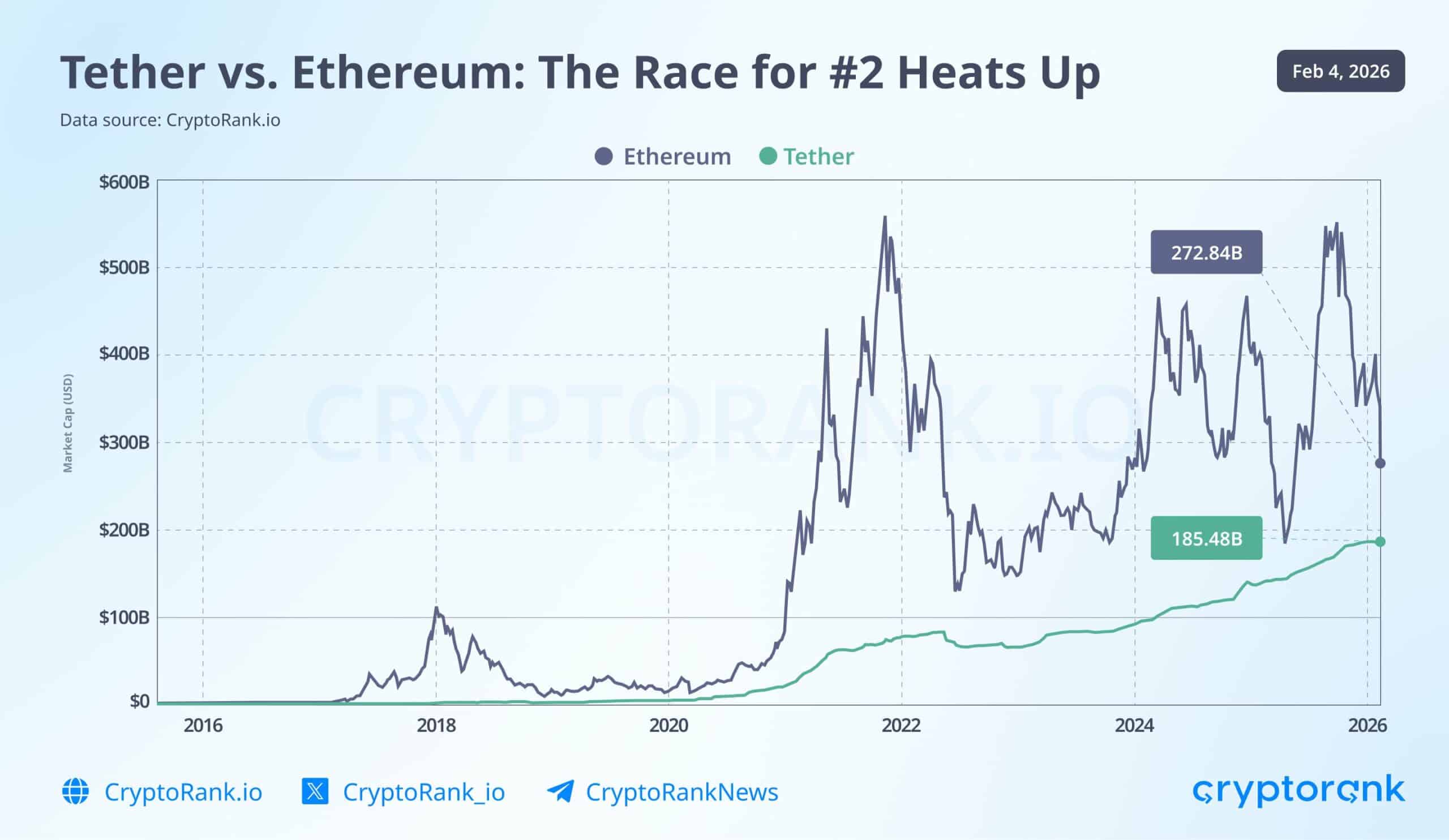
USDT’s market cap has continued to climb alongside stablecoins’ foothold in the space. This comes amid Ethereum’s (and much of the greater market’s) struggles under bearish conditions.

That contrast is critical.

Source: X

Data per Cryptorank showed that the gap between Ethereum and Tether’s market cap is narrowing at a steady pace. Tether was at $185 billion while Ethereum sat at $272 billion at the time of writing.

With stablecoins gaining ground year after year, the idea of Tether flipping Ethereum for the #2 spot no longer feels far-fetched.

Supported by real usage

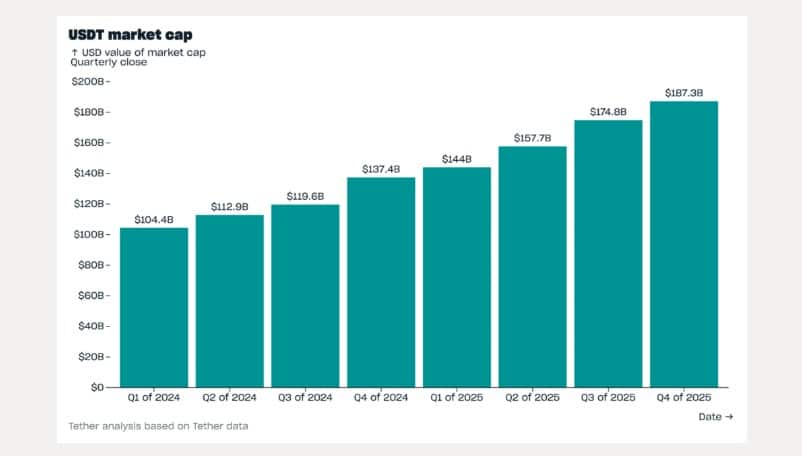
According to their recently released quarterly report, Tether’s monthly active on-chain users hit a new ATH in Q4 2025. The number is roughly 24.8 million.

Source: Tether

More importantly, USDT made up 68.4% of all stablecoin monthly active users during the quarter. Demand has remained consistently strong through 2024 and 2025.

Despite the arrival of newer competitors, most real activity continues to flow through Tether, an advantage that has proven difficult to dislodge.

Ethereum’s supply pressure isn’t helping

Source: Alphractal

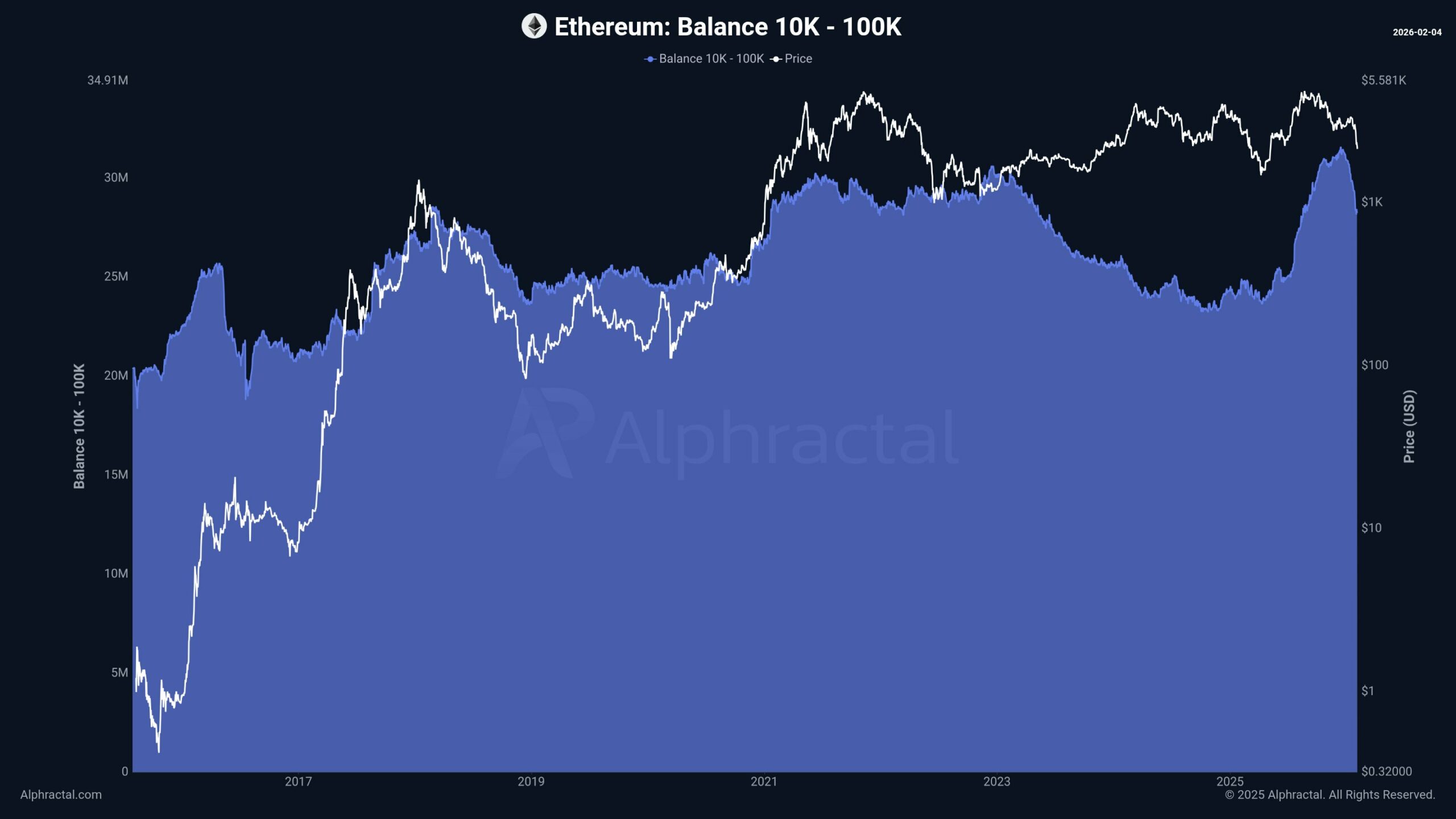
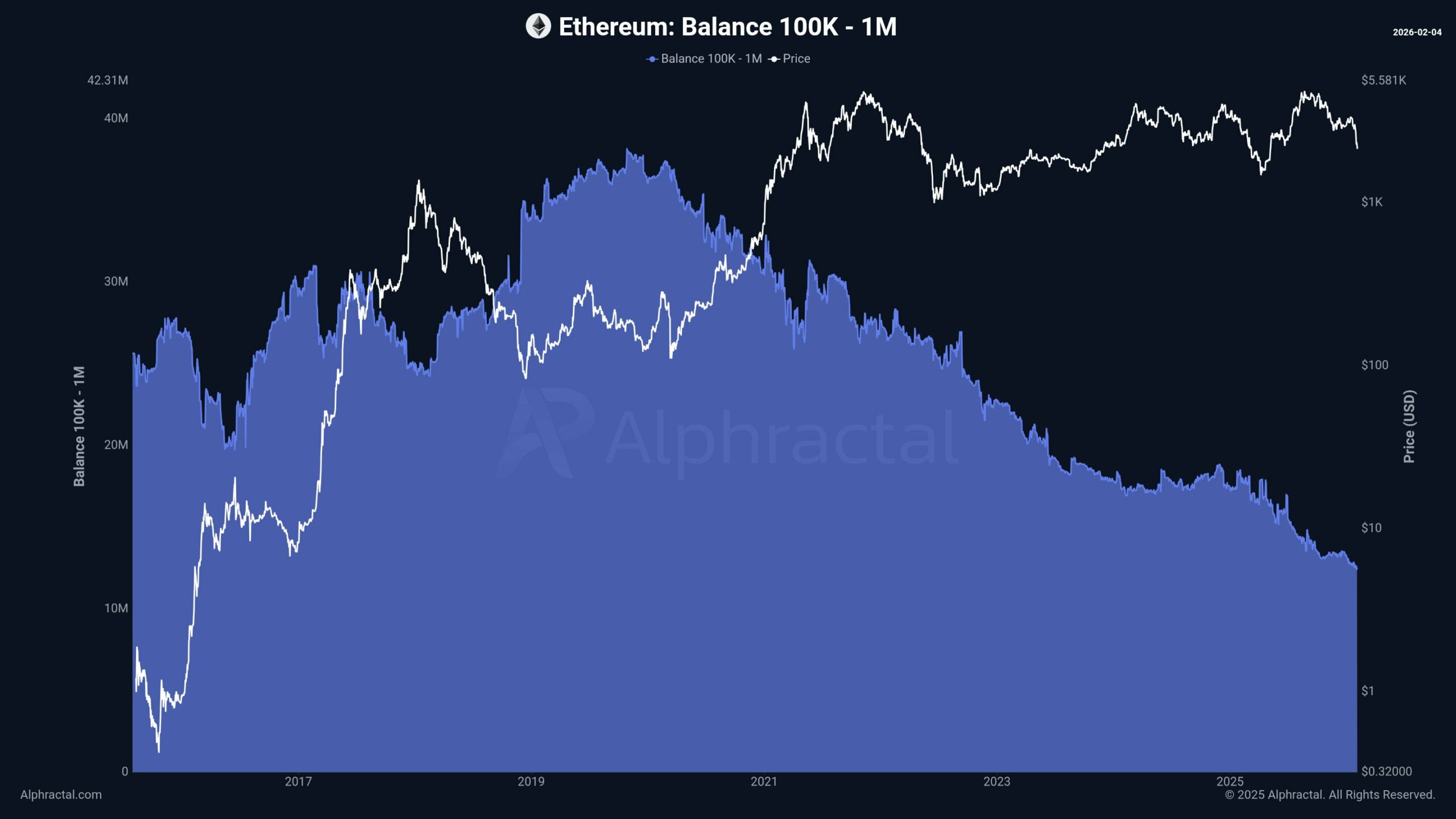
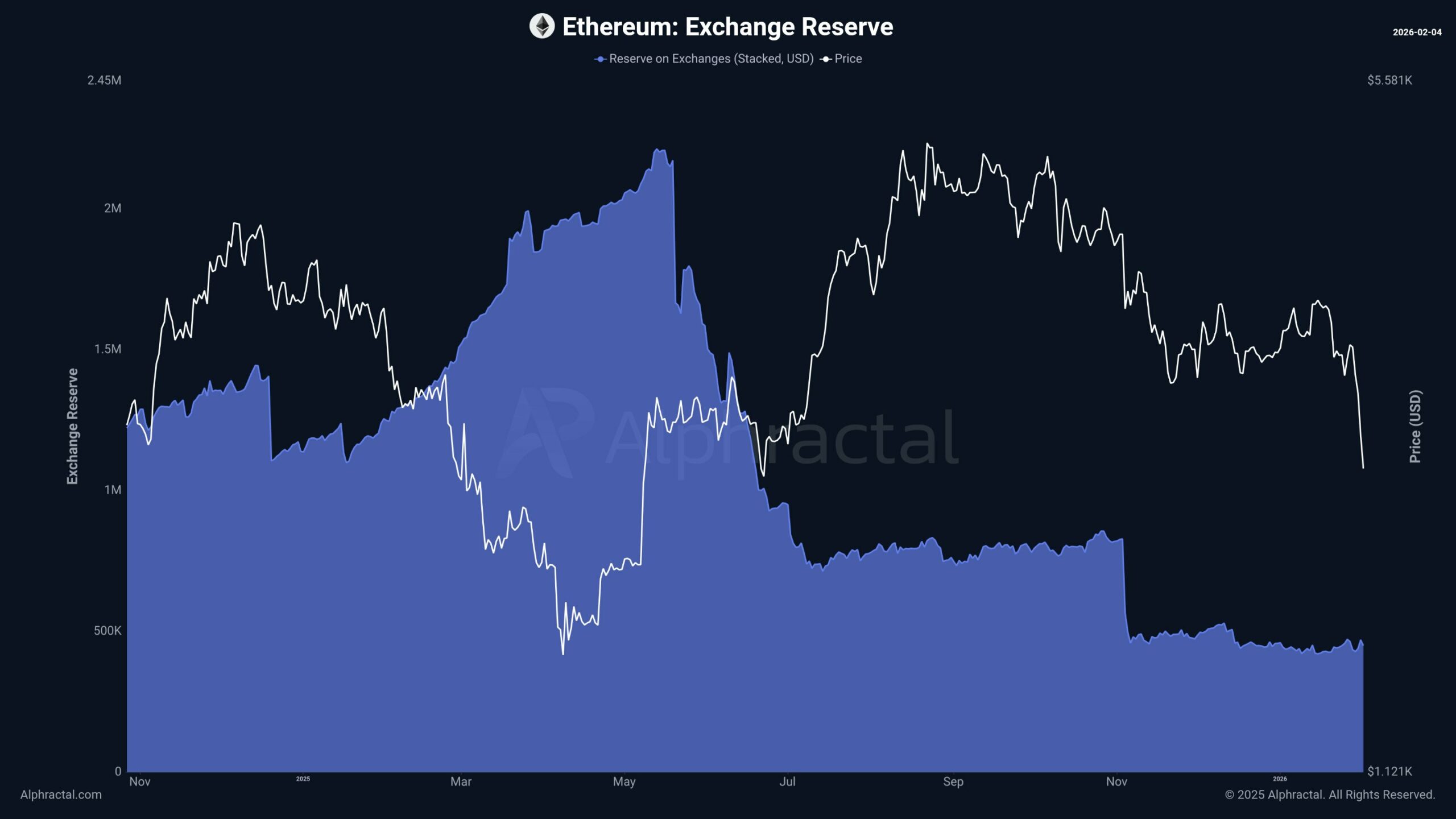
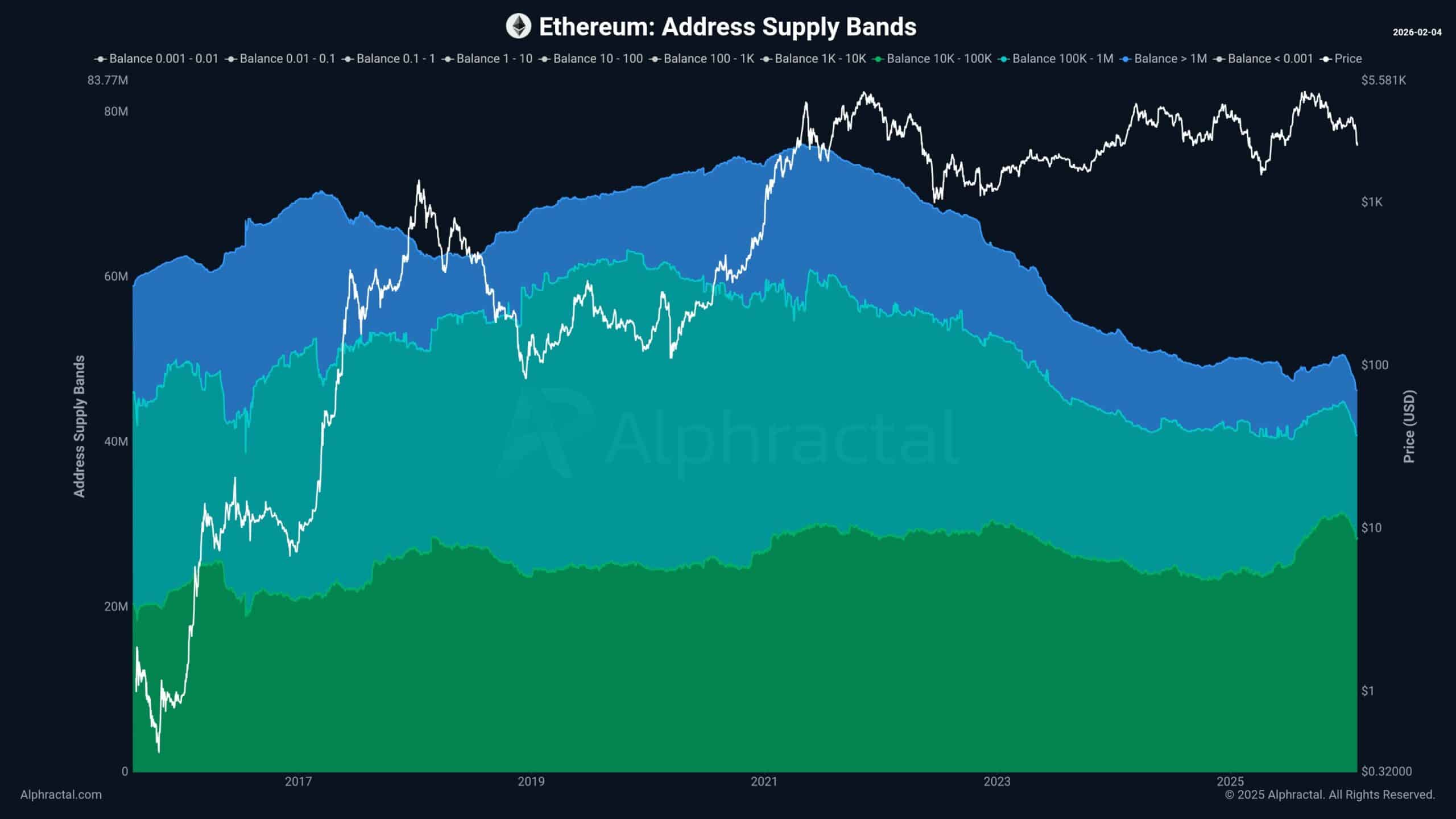
Recent data proved that larger ETH holders have been reducing exposure. Whale and shark wallets are selling more than they’re buying.

Source: Alphractal

Importantly, this isn’t just ETH moving onto exchanges for operations. Exchange reserves have stayed relatively flat, which means there’s more selling pressure entering the market.

Source: Alphractal

As Alphractal CEO Joao Wedson noted, this kind of activity usually starts at the top of the ownership stack and tends to drag prices lower through sell-side pressure.

Source: Alphractal

If Ethereum’s current trajectory persists while Tether continues to gain from rising stablecoin adoption, the gap between them could close more quickly than many anticipate.


Final Thoughts

  • Tether’s rush toward crypto’s #2 spot looks very realistic.
  • If Ethereum’s whale-led selling persists, the USDT-ETH gap could compress faster.
Next: Ethereum at 3-year low against Bitcoin? – History says THIS comes next…
Share
  • Share
  • Tweet

Related Questions

QWhat is the current market capitalization of Tether (USDT) and Ethereum (ETH) as mentioned in the article?

AAt the time of writing, Tether's market cap was $185 billion, while Ethereum's was $272 billion.

QAccording to Tether's quarterly report, what was the new ATH for its monthly active on-chain users in Q4 2025?

ATether's monthly active on-chain users hit a new all-time high (ATH) of roughly 24.8 million in Q4 2025.

QWhat percentage of all stablecoin monthly active users did USDT account for during the quarter?

AUSDT made up 68.4% of all stablecoin monthly active users during the quarter.

QWhat trend among Ethereum's larger holders is contributing to its supply pressure?

ALarger ETH holders, specifically whale and shark wallets, have been reducing their exposure by selling more than they are buying, which creates sell-side pressure in the market.

QWhy does the article suggest that Tether could potentially flip Ethereum for the #2 spot in market cap?

AThe article suggests this is possible because Tether's market cap is steadily growing due to rising demand for stablecoins and strong real usage, while Ethereum faces selling pressure from large holders and struggles under bearish market conditions.

Related Reads

UBS: The Crowdedness of A-Share Tech Stocks Is Far From Reaching Historical Peaks

UBS: A-share tech stocks still far from peak crowding levels A-shares' technology sector has seen a strong rebound, with trading activity hitting record highs, raising concerns about market crowding. However, UBS Securities argues that a key indicator of institutional positioning suggests the current crowding level remains well below historical peaks. While the large-cap tech sector's share of total A-share trading volume and market capitalization have reached historical highs, the overweight ratio of domestic mutual funds in this sector stood at 9.9% in Q1 2026. This is down from 11.6% in Q3 2025 and significantly lower than the historical peak of 14.1% in Q4 2015. It also pales in comparison to the historical peak overweight of 18.7% for the consumer sector. UBS notes that typical cycles from a low to a peak in fund overweighting last about three years, and the current outperformance of the tech/growth style has lasted less than two years since the policy pivot in September 2024. UBS expects A-share earnings recovery to accelerate, providing fundamental support. It forecasts 2026 A-share profit growth to rise to 11% from 3.9% in 2025. Non-financial A-share profits grew 11.8% YoY in Q1 2026, with gross and net profit margins at their highest since 2023. Persistent fund inflows, the expansion of thematic ETFs, and a recovery in private fund issuance are supporting market liquidity. In tactical allocation, UBS favors growth and cyclical styles under its "slow bull" base case, with overweight ratings on six sectors: Electronics (benefiting from semiconductor inventory recovery and AI innovation), Communications (driven by AI computing demand), Machinery (aided by domestic capex recovery), Non-ferrous Metals (due to rising copper/aluminum prices), Chemicals (supported by anti-involution policies), and Electrical Equipment (driven by policy support and AI data center power demand).

marsbit59m ago

UBS: The Crowdedness of A-Share Tech Stocks Is Far From Reaching Historical Peaks

marsbit59m ago

Trading

Spot
Futures

Hot Articles

Discussions

Welcome to the HTX Community. Here, you can stay informed about the latest platform developments and gain access to professional market insights. Users' opinions on the price of ETH (ETH) are presented below.

活动图片