How Did a Monero Enthusiast Become the 'Gatekeeper' of Bitcoin?

比推Published on 2026-01-14Last updated on 2026-01-14

Abstract

On January 8th, Bitcoin Core appointed TheCharlatan as its sixth core maintainer, the first such appointment since 2023. Core maintainers are responsible for merging code into Bitcoin Core and signing official releases, acting as editors who ensure the integrity and security of the software. Unlike early days when a single individual held this power, the role is now distributed among multiple trusted contributors. TheCharlatan, a computer science graduate from the University of Zurich, has been contributing to Bitcoin Core since 2018 and has over a decade of experience in crypto development. He is known for his work on improving Bitcoin Core’s verification logic and modularizing its codebase. His appointment was supported by at least 20 Bitcoin Core developers. Notably, TheCharlatan has also contributed to privacy-focused cryptocurrencies like Monero in the past. On social media, he occasionally shares Bitcoin-maximalist views, emphasizing simplicity and immutability as core principles of digital cash. The article also highlights the growing decentralization of Bitcoin’s development and mentions other key maintainers, including Ava Chow, who played a critical role in preventing a consensus split over the Ordinals debate.

Author: Golem

Original Title: For the First Time in Three Years, Bitcoin's 6th Core Maintainer Emerges


On January 8, the Bitcoin Core team promoted developer TheCharlatan (X: @sedited) to core maintainer, making him the sixth member to hold trusted keys. The other five trusted key holders include: Marco Falke (promoted in 2016), Gloria Zhao (promoted in 2022), Ryan Ofsky (promoted in 2023), Hennadii Stepanov (promoted in 2021), and Ava Chow (promoted in 2021).

This appointment marks the first addition of a trusted key holder since 2023. Over the past decade, only 13 people have been granted this permission, highlighting its importance and the strictness of the selection process.

Bitcoin Core Maintainers: The 'Editors' of Bitcoin Developers

Bitcoin Core is currently the primary development and maintenance team for the Bitcoin mainnet. It is responsible for writing, maintaining, testing, and releasing the software used by most full nodes, along with accompanying tools and documentation. Bitcoin Core is non-profit and operates mainly on external funding.

The Bitcoin Core development team consists of 41 members who contribute the vast majority of the project's code. Among them, only 6 developers are granted the title of "Core Maintainer"—they are the only six people in the world with the authority to merge code into Bitcoin Core and sign the released program files (binaries).
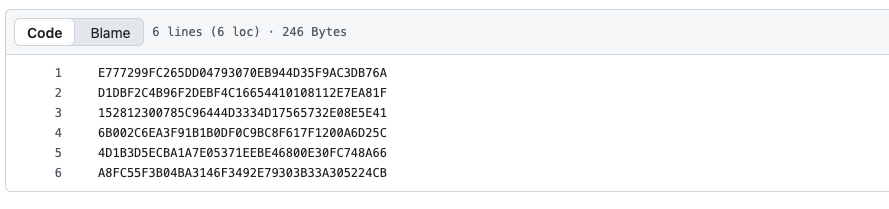
Signatures of the 6 Core Maintainers

To draw an analogy, Bitcoin Core maintainers are like the "editors" of Bitcoin network developers. Anyone can contribute code and submit PRs to the codebase, but only the core maintainers have the authority to merge code into the official repository and sign releases. This is similar to how editors review submissions, deciding whether developers' code will be accepted and published or returned for revisions.

The signatures of Bitcoin Core maintainers ensure security, giving all nodes and users confidence that the release is "official and unaltered." However, Bitcoin Core maintainers do not have the direct power to trigger on-chain rule changes. For example, even if Bitcoin Core maintainers have signed and released program files for a soft fork or hard fork, the actual success of the upgrade depends on adoption and consensus from users and miners, not just the signatures of the maintainers.

When Bitcoin was first created, Satoshi Nakamoto was the sole core maintainer, with exclusive authority to change the core codebase. Later, Satoshi passed this privilege to Gavin Andresen, who then passed it to Wladimir van der Laan. For a long time, the power to maintain/change the Bitcoin network code rested with a single individual. It wasn't until 2022, when Wladimir van der Laan stepped down and became embroiled in litigation with Craig Wright (who claimed to be Satoshi Nakamoto), that this power began to decentralize.

Even so, Bitcoin Core maintainers still play a crucial role. Those who become core maintainers typically enjoy high levels of trust and reputation within the community or have made outstanding contributions to the Bitcoin network.

For example, one core maintainer, Ava Chow, is a transgender female developer. In 2024, when Bitcoin core developer Luke Dashjr proposed restricting Ordinals transactions at the consensus level, it was Ava Chow who rejected the PR on the grounds of "lack of consensus and creating noise," preventing a potential severe split in the Bitcoin network consensus and becoming an unsung hero.
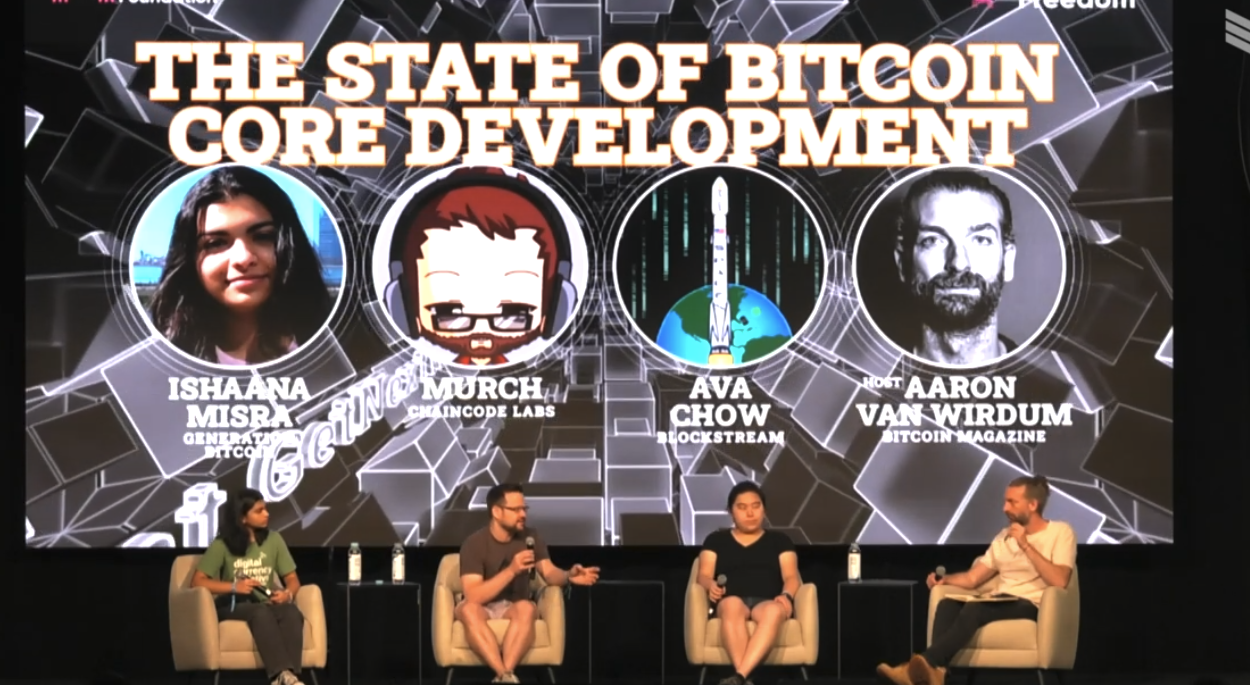
Ava Chow attended Bitcoin 2024

For introductions and contributions of other core maintainers, please refer to a related article (Related Reading: Who Guards Satoshi's Legacy? A Look at the 41-Person Army Behind Bitcoin's Trillion-Dollar Market Cap). Next, we will introduce why TheCharlatan became the sixth core maintainer.

TheCharlatan: A Decade of Crypto Development Experience

TheCharlatan graduated from the University of Zurich with a degree in computer science. He is South African and focuses on reproducibility and the validation logic of Bitcoin Core. In a 2024 blog post, he claimed to have been developing this project for over two years. TheCharlatan's work involves systematically splitting, organizing, and modularizing Bitcoin Core's validation logic, enabling other users to safely reuse it.

TheCharlatan

TheCharlatan is widely popular among Bitcoin Core developers. During the process of promoting him to core maintainer, at least 20 members expressed their approval. When nominating him, glozow praised: "He is a reliable reviewer with extensive experience in key areas of the codebase, thoughtful about what we deliver to users and developers, and deeply familiar with the technical consensus process."
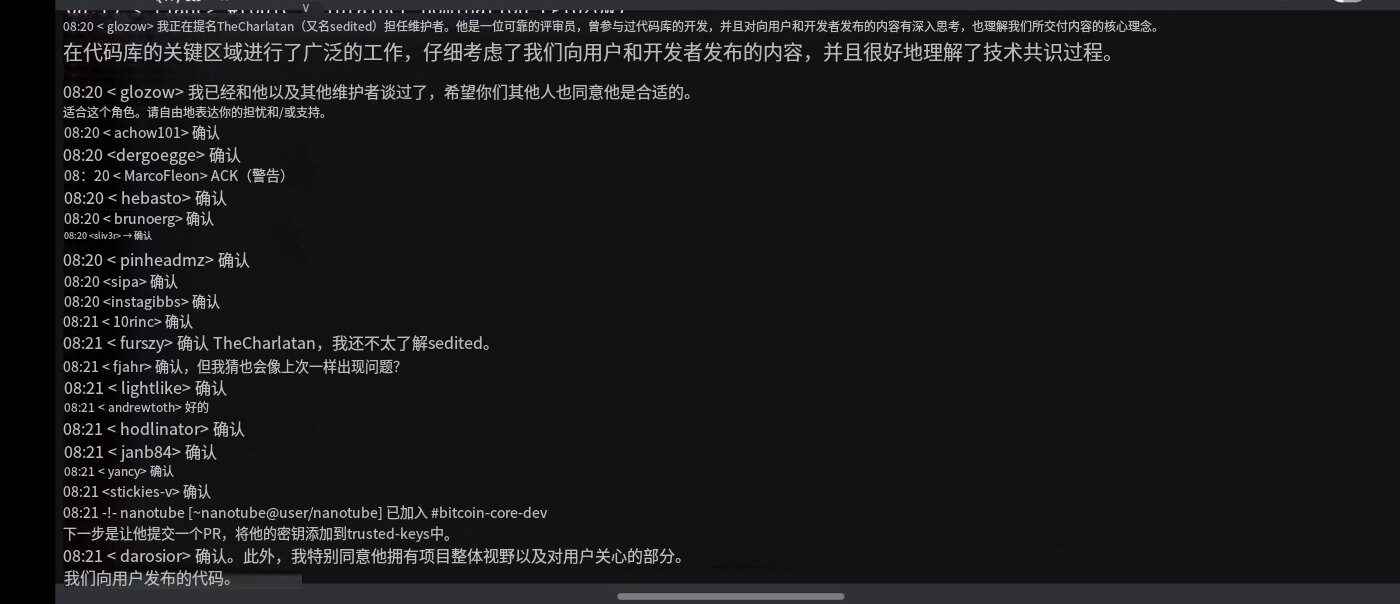
Bitcoin Core Developer Group Chat (Translated)

According to his GitHub account, TheCharlatan first engaged in crypto development in 2015, creating a cryptocurrency price display tool. This tool was a simple Linux desktop widget with built-in price alerts that triggered when set thresholds were reached. His crypto development activities became more frequent after 2017, and he began contributing code to Bitcoin Core in 2018. Thus, it can be inferred that TheCharlatan first encountered Bitcoin Core eight years ago, making him a veteran.

It is also worth noting that in 2021-2022, TheCharlatan contributed to a Farcaster project codebase. This project allowed people to exchange Bitcoin and Monero peer-to-peer with anyone running a Farcaster node.

TheCharlatan indeed has a "soft spot" for Monero. In 2020, he researched the potential destruction issues caused by using hardware wallets to transfer Monero and explored time-lock vulnerabilities in Monero.

Of course, true tech geeks can be somewhat elusive. TheCharlatan often retweets technical posts on platform X but rarely expresses his own opinions (in May 2025, he posted that he dislikes NFTs even more). However, since June 2025, he has been repeating a tweet every month with the content: "Cash on the internet. No auto-updates."

I was afraid this might be some kind of secret code among Bitcoin tech geeks or a cultural slogan I wasn't aware of, so I asked AI to explain the meaning of these two sentences. The AI said these two sentences actually express an extreme Bitcoin fundamentalist view:

"True internet-native cash should be as simple, brutal, and immutable as physical cash. Once you start introducing automatic updates, governance votes, and frequent rule changes, it's no longer cash—it becomes another centralized/semi-centralized/manipulable 'digital bank account.'"


Twitter: https://twitter.com/BitpushNewsCN

Bitpush TG Discussion Group: https://t.me/BitPushCommunity

Bitpush TG Subscription: https://t.me/bitpush

Original link: https://www.bitpush.news/articles/7602798

Trending Cryptos

Related Questions

QWho was recently promoted as the 6th core maintainer of Bitcoin Core, and when did this happen?

ATheCharlatan (X: @sedited) was promoted as the 6th core maintainer of Bitcoin Core on January 8th.

QWhat is the primary responsibility of a Bitcoin Core maintainer?

AA Bitcoin Core maintainer has the authority to merge code into the official Bitcoin Core repository and sign the released program files (binaries), ensuring they are official and unaltered.

QHow many developers currently have trusted keys for Bitcoin Core, and why is this role significant?

AThere are currently 6 developers with trusted keys for Bitcoin Core. This role is significant because only these maintainers can merge code and sign official binaries, and over the past decade, only 13 people have been granted this permission, highlighting its importance and strict selection process.

QWhat notable contribution did core maintainer Ava Chow make in 2024?

AIn 2024, Ava Chow rejected a PR from Luke Dashjr that aimed to restrict Ordinals transactions at the consensus level, preventing a potential severe consensus split in the Bitcoin network.

QWhat is TheCharlatan's background and one of his key interests in cryptocurrency development?

ATheCharlatan graduated in Computer Science from the University of Zurich, has over a decade of crypto development experience, and has a particular interest in Monero, having researched issues related to hardware wallet transfers and time-lock vulnerabilities in Monero.

Related Reads

Goldman Sachs: July Smashes Through Crowded Trades, U.S. Stock Bull Market Not Broken but Harder to Navigate

Goldman Sachs: July Sees Crowded Trades Unwound, U.S. Bull Market Intact but Getting Tougher. The U.S. stock market in July did not see an index-level crash, but rather a significant unwinding of speculative positions. While the S&P 500 remained stable—trading within a narrow 3.5% range and staying within 2% of its high—underlying market dynamics were volatile. Heavily crowded trades, particularly in high-momentum tech, AI-linked stocks, and Asian strategies, faced severe pressure and forced deleveraging. Data indicates this was a meaningful cleanse, not a minor adjustment. Global tech exposure saw its largest sell-off in over five years, leverage in Korean equity ETFs plummeted, and Goldman's prime brokerage recorded the largest gross exposure reduction since late 2022. Leverage on momentum factors among fundamental long/short clients fell to the 28th percentile of its one-year range. The AI trade narrative shifted from pure potential to a focus on tangible returns. While Meta failed to show clear AI monetization, Microsoft and Amazon provided evidence that massive capital expenditure is translating into scalable revenue and product growth, preventing a blanket sell-off of the AI sector. The Federal Reserve's more opaque communication style and volatility in long-end Treasury yields have introduced new friction, particularly for rate-sensitive growth and tech stocks. The broader outlook for U.S. equities remains favorable, supported by a strong economy, robust earnings, and substantial AI capital expenditure. However, risk/reward is no longer cheap, and the market's upward elasticity has weakened. The Nasdaq 100's trajectory—up 12% year-to-date despite significant pullbacks—illustrates that the bull trend persists but the path is becoming more difficult. The key lesson from July is that the market no longer rewards crowded, highly leveraged trades, requiring more disciplined and liquid portfolio approaches.

marsbit18m ago

Goldman Sachs: July Smashes Through Crowded Trades, U.S. Stock Bull Market Not Broken but Harder to Navigate

marsbit18m ago

Interview with Robinhood Executive: Meme + Tokenized US Stocks as "Barbell" Customer Acquisition Strategy, All Business Lines Achieve Hundreds of Millions in Revenue

Interview with Robinhood executive Johann Kerbrat reveals the company's "barbell" customer acquisition strategy for its new Robinhood Chain, combining meme tokens with tokenized stocks. Three weeks after mainnet launch, the chain has seen over $3B in weekly DEX volume and 105M transactions. Kerbrat explains the logic behind the permissionless chain: meme tokens attract DeFi users, while tokenized real-world assets (RWA), currently over 90 US stocks and ETFs accessible in 120+ countries, serve global users. The goal is to bring Robinhood's 27 million funded accounts on-chain by simplifying DeFi with a user-friendly interface, exemplified by features like Robinhood Earn which offers yield without requiring wallet management. Built on Arbitrum's technology stack for its speed, low cost, and Ethereum's security, the chain focuses on financial products like Earn, spot trading, and perpetuals. Kerbrat downplays direct competition with platforms like Base, emphasizing the goal of expanding the overall market for on-chain assets. He details selective partnerships (e.g., Morpho, Lighter) based on compliance, unique UX, and differentiation. While regulatory clarity is pending for US perpetuals, the expansion continues via Bitstamp in Europe. Finally, Kerbrat positions Robinhood as a "super app" integrating stocks, options, crypto, banking, and AI trading, with all major business lines generating hundreds of millions in revenue. For the chain, current priority is driving adoption over maximizing gas fee revenue.

marsbit2h ago

Interview with Robinhood Executive: Meme + Tokenized US Stocks as "Barbell" Customer Acquisition Strategy, All Business Lines Achieve Hundreds of Millions in Revenue

marsbit2h ago

Fidelity Q3 Report: BTC, ETH, and SOL Continue to Build Bottoms; How Much Further Will This Crypto Bear Market Go?

Fidelity's Q3 Crypto Signal Report analyzes the current bear market, noting Bitcoin (BTC), Ethereum (ETH), and Solana (SOL) are in a prolonged bottoming phase. Key indicators like the weighted Net Unrealized Profit/Loss (NUPL) have turned negative (-0.01), signaling the market is slightly below its aggregate cost basis, with BTC acting as the primary stabilizing asset. BTC's dominance has risen to 68%, indicating a lack of capital rotation to other digital assets. Performance has been weak across the board, with BTC, ETH, and SOL down significantly year-to-date. Market sentiment is depressed, exacerbated by substantial outflows from spot ETPs and a challenging macro environment. The report compares the current ~203-day downtrend to historical ~300-day bottoming cycles, suggesting the process may be two-thirds complete, with late 2026 as a potential timeframe to monitor. For Bitcoin, NUPL at 0.09 indicates cautious sentiment, while momentum signals remain negative. The Yardstick metric points to potential undervaluation relative to network security (hashrate). Ethereum's NUPL is deep in the "capitulation" zone at -0.43, a historically positive signal for future returns, though its momentum and network fee revenue are negative. Solana shows the deepest NUPL at -0.72 but demonstrates relative resilience in on-chain activity and stablecoin transfer volume. The report concludes that while several metrics are near historical capitulation levels, a definitive market bottom has not yet been established. The path forward likely involves continued consolidation, with BTC's relative strength and fundamental on-chain usage for ETH and SOL providing key areas for investor observation.

marsbit2h ago

Fidelity Q3 Report: BTC, ETH, and SOL Continue to Build Bottoms; How Much Further Will This Crypto Bear Market Go?

marsbit2h ago

Trading

Spot

Hot Articles

What is $BITCOIN

DIGITAL GOLD ($BITCOIN): A Comprehensive Analysis Introduction to DIGITAL GOLD ($BITCOIN) DIGITAL GOLD ($BITCOIN) is a blockchain-based project operating on the Solana network, which aims to combine the characteristics of traditional precious metals with the innovation of decentralized technologies. While it shares a name with Bitcoin, often referred to as “digital gold” due to its perception as a store of value, DIGITAL GOLD is a separate token designed to create a unique ecosystem within the Web3 landscape. Its goal is to position itself as a viable alternative digital asset, although specifics regarding its applications and functionalities are still developing. What is DIGITAL GOLD ($BITCOIN)? DIGITAL GOLD ($BITCOIN) is a cryptocurrency token explicitly designed for use on the Solana blockchain. In contrast to Bitcoin, which provides a widely recognized value storage role, this token appears to focus on broader applications and characteristics. Notable aspects include: Blockchain Infrastructure: The token is built on the Solana blockchain, known for its capacity to handle high-speed and low-cost transactions. Supply Dynamics: DIGITAL GOLD has a maximum supply capped at 100 quadrillion tokens (100P $BITCOIN), although details regarding its circulating supply are currently undisclosed. Utility: While precise functionalities are not explicitly outlined, there are indications that the token could be utilized for various applications, potentially involving decentralized applications (dApps) or asset tokenization strategies. Who is the Creator of DIGITAL GOLD ($BITCOIN)? At present, the identity of the creators and development team behind DIGITAL GOLD ($BITCOIN) remains unknown. This situation is typical among many innovative projects within the blockchain space, particularly those aligning with decentralized finance and meme coin phenomena. While such anonymity may foster a community-driven culture, it intensifies concerns about governance and accountability. Who are the Investors of DIGITAL GOLD ($BITCOIN)? The available information indicates that DIGITAL GOLD ($BITCOIN) does not have any known institutional backers or prominent venture capital investments. The project seems to operate on a peer-to-peer model focused on community support and adoption rather than traditional funding routes. Its activity and liquidity are primarily situated on decentralized exchanges (DEXs), such as PumpSwap, rather than established centralized trading platforms, further highlighting its grassroots approach. How DIGITAL GOLD ($BITCOIN) Works The operational mechanics of DIGITAL GOLD ($BITCOIN) can be elaborated on based on its blockchain design and network attributes: Consensus Mechanism: By leveraging Solana’s unique proof-of-history (PoH) combined with a proof-of-stake (PoS) model, the project ensures efficient transaction validation contributing to the network's high performance. Tokenomics: While specific deflationary mechanisms have not been extensively detailed, the vast maximum token supply implies that it may cater to microtransactions or niche use cases that are still to be defined. Interoperability: There exists the potential for integration with Solana’s broader ecosystem, including various decentralized finance (DeFi) platforms. However, the details regarding specific integrations remain unspecified. Timeline of Key Events Here is a timeline that highlights significant milestones concerning DIGITAL GOLD ($BITCOIN): 2023: The initial deployment of the token occurs on the Solana blockchain, marked by its contract address. 2024: DIGITAL GOLD gains visibility as it becomes available for trading on decentralized exchanges like PumpSwap, allowing users to trade it against SOL. 2025: The project witnesses sporadic trading activity and potential interest in community-led engagements, although no noteworthy partnerships or technical advancements have been documented as of yet. Critical Analysis Strengths Scalability: The underlying Solana infrastructure supports high transaction volumes, which could enhance the utility of $BITCOIN in various transaction scenarios. Accessibility: The potential low trading price per token could attract retail investors, facilitating wider participation due to fractional ownership opportunities. Risks Lack of Transparency: The absence of publicly known backers, developers, or an audit process may yield skepticism regarding the project's sustainability and trustworthiness. Market Volatility: The trading activity is heavily reliant on speculative behavior, which can result in significant price volatility and uncertainty for investors. Conclusion DIGITAL GOLD ($BITCOIN) emerges as an intriguing yet ambiguous project within the rapidly evolving Solana ecosystem. While it attempts to leverage the “digital gold” narrative, its departure from Bitcoin's established role as a store of value underscores the need for a clearer differentiation of its intended utility and governance structure. Future acceptance and adoption will likely depend on addressing the current opacity and defining its operational and economic strategies more explicitly. Note: This report encompasses synthesised information available as of October 2023, and developments may have transpired beyond the research period.

1.3k Total ViewsPublished 2025.05.13Updated 2025.05.13

What is $BITCOIN

Discussions

Welcome to the HTX Community. Here, you can stay informed about the latest platform developments and gain access to professional market insights. Users' opinions on the price of BTC (BTC) are presented below.

活动图片