How Bitcoin and Ethereum absorbed $500 mln last week – Without a rally

ambcryptoPublished on 2025-12-15Last updated on 2025-12-15

Abstract

Bitcoin and Ethereum spot ETFs recorded over $500 million in net inflows between December 8th and 12th, yet both cryptocurrencies showed almost no price movement during that period. Bitcoin ETFs attracted $287 million, largely driven by BlackRock’s IBIT, while Ethereum ETFs saw $209 million in inflows, led by products from BlackRock and Fidelity. Despite this steady institutional demand, Bitcoin traded around $89,600, down 2.16% for the week, and Ethereum hovered near $3,127, dipping just 0.23%. The market’s muted reaction is attributed to several factors: traders had priced in a Federal Reserve rate cut in advance, Bitcoin faced strong resistance near the $92K–$94K range, and overall risk sentiment remained cautious. ETF-driven demand appears to be more focused on strategic, long-term allocation rather than short-term speculation. Bitcoin ETFs now hold approximately $118.3 billion in net assets, and Ethereum ETFs manage around $19.4 billion, indicating significant capital commitment. The disconnect between steady inflows and flat prices suggests that price is no longer an immediate indicator of demand. If inflows continue with low volatility, the next significant price move could be sudden and unexpected as ownership shifts quietly.

Bitcoin and Ethereum just had a strong week on paper, but you wouldn’t know it by looking at prices.

Between the 8th and 12th of December, Bitcoin and Ethereum spot ETFs combined pulled in a little more than $500 million in net inflows! And yet, both assets barely budged.

It’s strange. Steady money is coming in, yet prices are going nowhere.

ETF money kept coming, prices didn’t

Source: Farside Investors

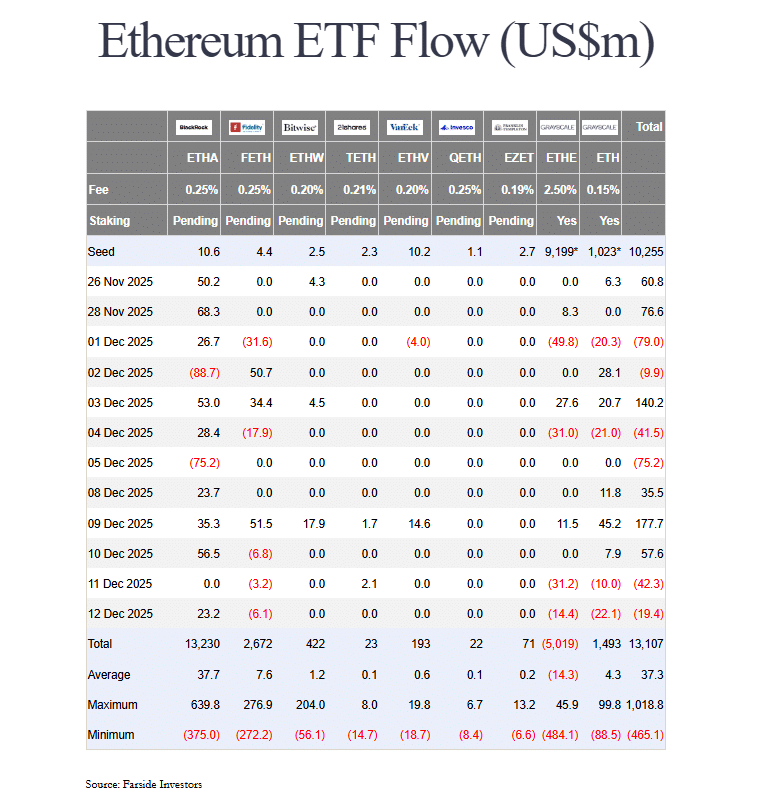
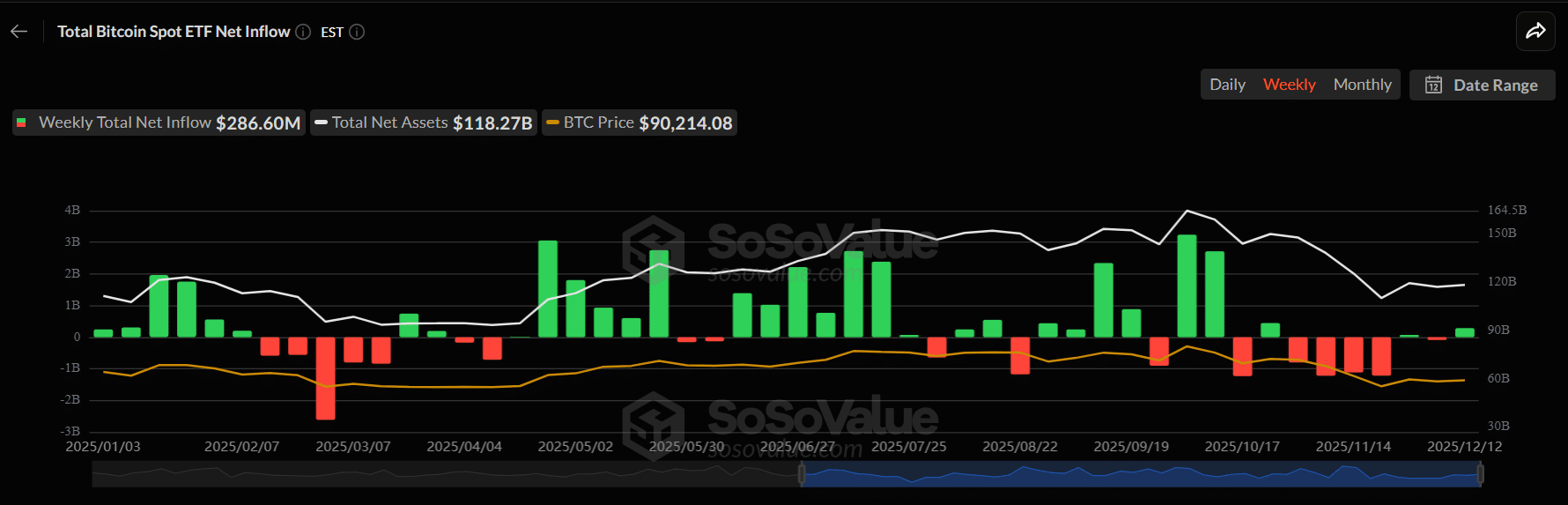
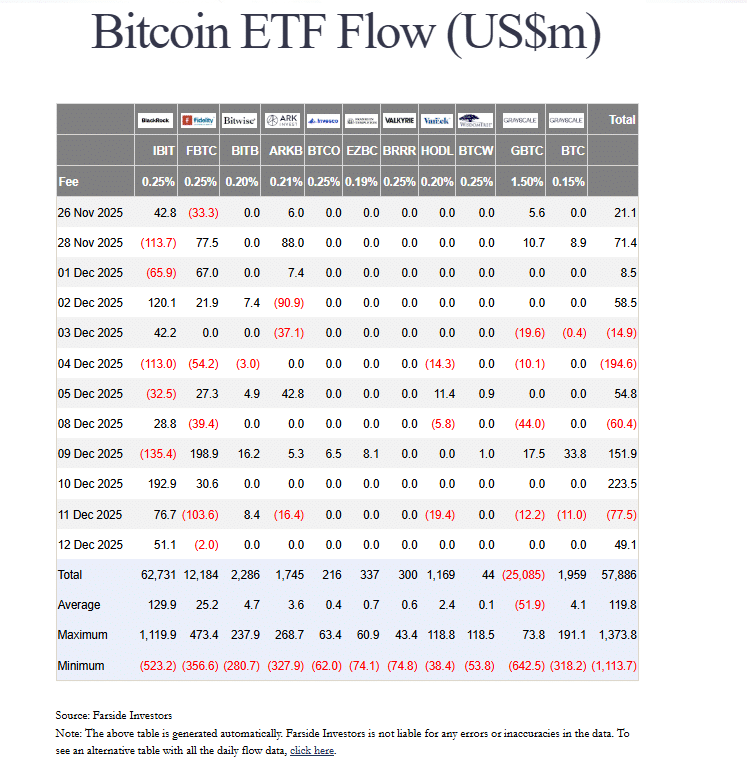
Between the 8th and 12th of December, Bitcoin ETFs recorded $287 million in net inflows, led largely by BlackRock’s IBIT, which saw consistent daily additions despite a few mixed sessions.

Source: Farside Investors

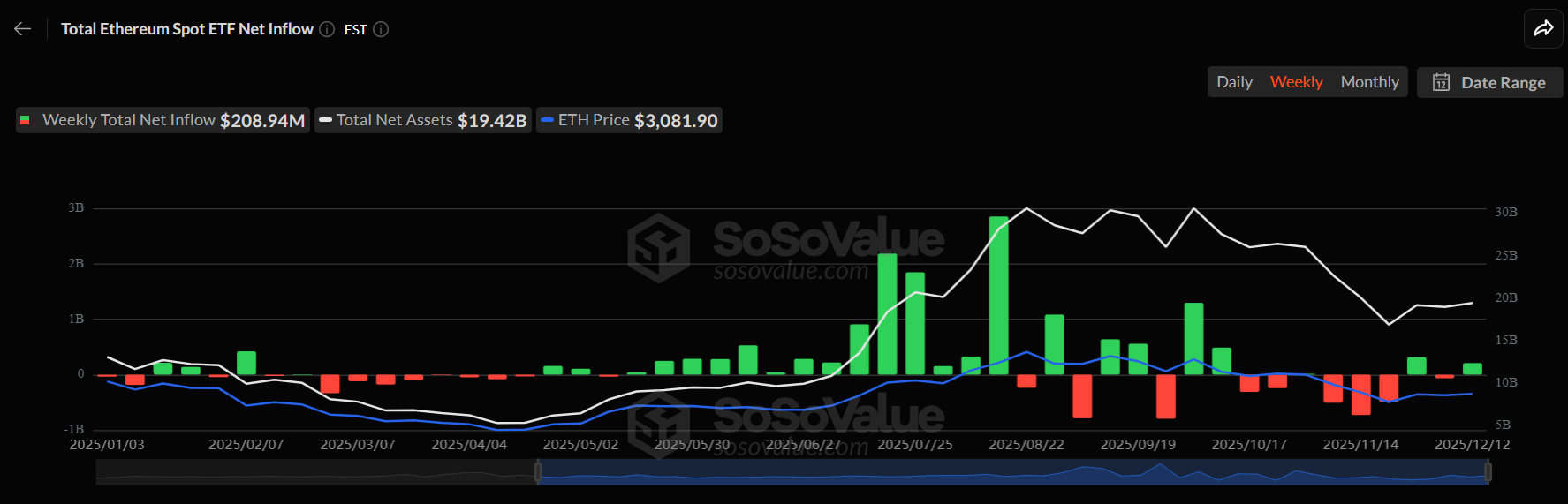
Ethereum ETFs followed a similar pattern, posting $209 million in weekly inflows, with BlackRock’s ETHA and Fidelity’s FETH leading the demand.

Source: CoinMarketCap

However, Bitcoin [BTC] traded near $89.6K, down 2.16% on the week, with a market cap of roughly $1.78 trillion.

Ethereum [ETH] traded around $3,127, slipping just 0.23% over the week, with a market value close to $377 billion.

The market is absorbing capital with steady ETF buying, calmer price moves, and no rush from traders on either side.

Why did prices stay flat?

Market forces kept Bitcoin and Ethereum prices largely range-bound. Traders were still digesting a Federal Reserve rate cut that failed to spark a rally, as the move had already been fully priced in.

Bitcoin also struggled to break resistance around the $92K-$94K range, keeping prices capped. Risk sentiment remained cautious into early December.

As a result, Bitcoin traded at nearly $90,000 throughout the week and Ethereum traded between $3.1K to 3.2K. ETF demand is increasingly centered around longer-term allocation than impulse.

2025 in ETFs

Bitcoin and Ethereum ETFs have continued to grow steadily despite long stretches of flat or declining prices.

Source: SoSoValue

Bitcoin spot ETFs now hold about $118.3 billion in total net assets, while Ethereum ETFs sit near $19.4 billion, so there’s strong capital commitment.

Source: SoSoValue

Even in weeks like the latest one, price barely reacted. That disconnect means that price is no longer the immediate feedback loop for demand.

If inflows remain steady with subdued volatility, the next move may surprise you. Ownership will have shifted hands while the market looked elsewhere.


Final Thoughts

  • $500M+ in Bitcoin and Ethereum ETF inflows met flat prices this last week.
  • When ownership shifts without chaos, the next Bitcoin and Ethereum move often comes fast and unexpected.
Next: Is Bitcoin done dumping? What BTC accumulation trends say
Share
  • Share
  • Tweet

Related Reads

Huang Renxun Dramatically 'Saves' South Korean Stock Market

In early June, South Korea's stock market experienced a sharp decline, with the KOSPI index dropping over 5% and triggering a trading halt. Amid this volatility, NVIDIA CEO Jensen Huang's visit to Seoul provided a dramatic boost to market sentiment. During his trip, Huang held a dinner meeting with SK Group Chairman Chey Tae-won and SK Hynix CEO Kwak Noh-Jung. He announced that NVIDIA's new Vera CPU would utilize SK Hynix DRAM and confirmed a multi-year technical collaboration between the two companies. This partnership aims to co-develop next-generation memory for NVIDIA's AI infrastructure roadmap, covering products from data center supercomputers to personal AI devices. Huang also publicly commented that AI company stocks were attractively priced. A key announcement was that NVIDIA's upcoming Vera Rubin AI supercomputer systems will use HBM4 memory, with supply qualifications granted to all three major suppliers: SK Hynix, Samsung Electronics, and Micron Technology. Despite this multi-sourcing strategy, Huang warned that the industry-wide chip shortage, affecting everything from wafers to packaging, is expected to persist for several years due to relentless demand from global AI factory construction. The collaboration extends beyond memory supply. SK Hynix will employ NVIDIA's AI platforms and Omniverse digital twin technology to enhance its own semiconductor design, simulation, and manufacturing processes, aiming for more autonomous factory operations. This visit builds upon a prior October 2025 agreement for SK Group to build a large-scale AI data center using over 50,000 NVIDIA GPUs. Huang's itinerary also included meetings with other Korean giants like Hyundai, LG, and Samsung, indicating NVIDIA's broader strategy to deepen ties with South Korea's tech industry.

链捕手4h ago

Huang Renxun Dramatically 'Saves' South Korean Stock Market

链捕手4h ago

When Inference Becomes a Scarce Resource, Who Captures the Value?

When Inference Becomes the Scarce Resource, Who Captures the Value? The core AI bottleneck has shifted from model training to inference (runtime execution). While concerns persisted about an "AI compute gap"—initially a $200B, now a $600B problem—the market is now recognizing that the solution and value lie in the inference layer. Nvidia's financial restructuring around "serving tokens" and Cerebras's successful IPO highlight this shift. Inference is a recurring, usage-based cost, estimated to be 10-50x larger than the one-time training market, especially with the rise of agentic AI. The inference stack spans six layers: silicon (e.g., Nvidia), bare metal (e.g., CoreWeave), GPU rental/aggregation, deployment/optimization, model APIs, and end applications. Most companies operate in one layer. However, Hyperbolic uniquely spans three layers (GPU rental, deployment, and model APIs) without owning any hardware. It aggregates fragmented GPU supply from multiple cloud providers into a standardized pool, offering developers the cheapest available compute through intelligent routing. Its multi-cloud aggregation creates a data moat and a flywheel: more supply leads to better pricing data and liquidity, attracting more developers and providers. In contrast, applications like Venice operate at the top of the stack, reselling privacy-wrapped inference but remaining dependent on and constrained by the underlying compute costs they purchase. As inference demand explodes, value accrues not just to consumer applications but increasingly to the aggregation and routing layer that captures their cost of revenue. The coming potential GPU oversupply reinforces this dynamic. While hardware owners may suffer from depreciation, asset-light aggregators like Hyperbolic benefit from price arbitrage, routing workloads to the cheapest available capacity. The ultimate winner in the inference economy may not be the entity with the most GPUs, but the one that can most efficiently discover, aggregate, and route the world's fragmented compute.

链捕手4h ago

When Inference Becomes a Scarce Resource, Who Captures the Value?

链捕手4h ago

Trading

Spot
Futures

Hot Articles

How to Buy SFP

Welcome to HTX.com! We've made purchasing SafePal (SFP) simple and convenient. Follow our step-by-step guide to embark on your crypto journey.Step 1: Create Your HTX AccountUse your email or phone number to sign up for a free account on HTX. Experience a hassle-free registration journey and unlock all features.Get My AccountStep 2: Go to Buy Crypto and Choose Your Payment MethodCredit/Debit Card: Use your Visa or Mastercard to buy SafePal (SFP) instantly.Balance: Use funds from your HTX account balance to trade seamlessly.Third Parties: We've added popular payment methods such as Google Pay and Apple Pay to enhance convenience.P2P: Trade directly with other users on HTX.Over-the-Counter (OTC): We offer tailor-made services and competitive exchange rates for traders.Step 3: Store Your SafePal (SFP)After purchasing your SafePal (SFP), store it in your HTX account. Alternatively, you can send it elsewhere via blockchain transfer or use it to trade other cryptocurrencies.Step 4: Trade SafePal (SFP)Easily trade SafePal (SFP) on HTX's spot market. Simply access your account, select your trading pair, execute your trades, and monitor in real-time. We offer a user-friendly experience for both beginners and seasoned traders.

704 Total ViewsPublished 2026.05.22Updated 2026.06.02

How to Buy SFP

How to Buy CTR

Welcome to HTX.com! We've made purchasing Citrea (CTR) simple and convenient. Follow our step-by-step guide to embark on your crypto journey.Step 1: Create Your HTX AccountUse your email or phone number to sign up for a free account on HTX. Experience a hassle-free registration journey and unlock all features.Get My AccountStep 2: Go to Buy Crypto and Choose Your Payment MethodCredit/Debit Card: Use your Visa or Mastercard to buy Citrea (CTR) instantly.Balance: Use funds from your HTX account balance to trade seamlessly.Third Parties: We've added popular payment methods such as Google Pay and Apple Pay to enhance convenience.P2P: Trade directly with other users on HTX.Over-the-Counter (OTC): We offer tailor-made services and competitive exchange rates for traders.Step 3: Store Your Citrea (CTR)After purchasing your Citrea (CTR), store it in your HTX account. Alternatively, you can send it elsewhere via blockchain transfer or use it to trade other cryptocurrencies.Step 4: Trade Citrea (CTR)Easily trade Citrea (CTR) on HTX's spot market. Simply access your account, select your trading pair, execute your trades, and monitor in real-time. We offer a user-friendly experience for both beginners and seasoned traders.

581 Total ViewsPublished 2026.05.25Updated 2026.06.02

How to Buy CTR

What is USOIL

USOILUSDT Perpetual Contract is the trading symbol for West Texas Intermediate (WTI) Crude Oil priced in US dollars, representing 1 barrel of crude oil.

599 Total ViewsPublished 2026.05.25Updated 2026.05.25

What is USOIL

Discussions

Welcome to the HTX Community. Here, you can stay informed about the latest platform developments and gain access to professional market insights. Users' opinions on the price of A (A) are presented below.

活动图片