Here’s Why Bitcoin’s Next Major Rally Matters For Short-Term BTC Holders’ Sentiment

bitcoinistPublished on 2026-01-08Last updated on 2026-01-08

Abstract

Despite a recent pullback, Bitcoin is holding above $91,000 as the market enters a volatile phase. Short-term holders remain at a loss, but a decisive break above the $99,000 level—the short-term holder realized price—could significantly shift their sentiment. According to on-chain analytics, the Net Unrealized Profit/Loss (NUPL) for short-term holders is approaching the break-even point. Historically, this zone acts as resistance, and breaking above it may trigger renewed conviction or capitulation. However, current on-chain demand remains weak, and low trading volume suggests a lack of strong investor interest. Sustained movement toward $100,000 will require a significant recovery in demand and trading activity.

Despite the recent pullback, the price of Bitcoin has managed to hold above the $91,000 level as the market shifts towards a volatile state once again. While BTC continues to face sideways movements, short-term holders remain underwater. However, a sharp bounce above a specific level could be a game-changer for these investors.

A Make-Or-Break Point For Bitcoin STHs Is Fast Approaching

Following the brief bounce on Monday, Bitcoin is closing in on a pivotal price zone that could reshape the sentiment and behavior of short-term BTC holders. This objective was disclosed by Alphractal, an advanced investment and on-chain data analytics platform, after examining the BTC Short-Term Holder NUPL (Net Unrealized Profit/Loss).

Related Reading: Bitcoin Value Days Destroyed Reaches Lowest Point Of The Current Cycle, A Structural Calm?

As the market approaches this threshold, On-chain measures indicate a change in attitude, with speculative capital starting to reevaluate risk, spending patterns shifting, and unrealized profits and losses constricting. The level signifies the zone where feeble hands may capitulate or re-enter the market with conviction.

According to the platform, the Bitcoin short-term holder NUPL has started to rise again and is currently heading toward the 0 level. Such a move toward the level indicates that the holders are moving to a break-even zone and are close to lowering their unrealized losses.
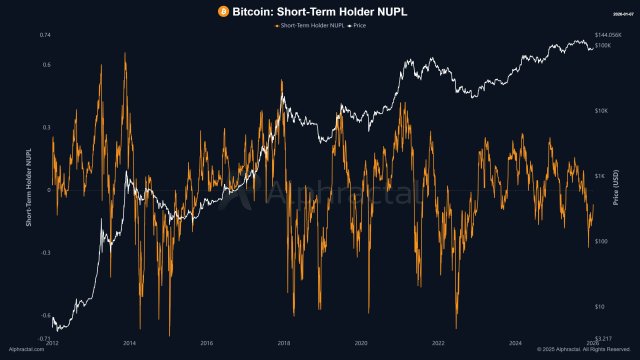
BTC short-term holders are still in loss | Source: Chart from Alphractal on X

It is important to note that the area around the 0 level has historically served as a resistance for the short-term holder NUPL metric. However, a move into positive territory is only expected to occur if BTC breaks above and holds the $99,000 mark, which currently represents the short-term holder realized price.

Until that happens, the platform highlighted that the majority of short-term holders continue to operate at a loss. Interestingly, this will keep the market sensitive to volatility spikes and defensive profit-taking, especially from the group.

Whether the $99,000 level serves as a launchpad or a stress test, it is clear that Bitcoin’s path to this crucial area might completely change the near-term environment for both traders and short-term investors.

BTC’s Bullish Movement Is Weak Because Of Investors’ Demand

Bitcoin quickly lost its renewed bullish momentum, and several reasons have been linked to why this happened. However, one of the key reasons that stands out strongly is the demand for the flagship crypto asset.

In a CryptoQuant Quicktake research, Caueconomy, a market expert and author, revealed that the demand for BTC is still weak and needs to recover. Despite the price of BTC recently rising to the $93,000 level, the expert noted that apparent on-chain demand is still low and requires a stronger comeback to sustain a return to $100,000.

Currently, demand for a return to on-chain movement has not yet shown clear signs of improvement due to the market’s low trading volume and still conflicting attitude. However, Caueconomy stated that this could happen now, with the end of the holiday period, as many investors are likely to reduce trading.

BTC trading at $90,455 on the 1D chart | Source: BTCUSDT on Tradingview.com

Trending Cryptos

Related Questions

QWhat is the key price level that could change the situation for Bitcoin short-term holders according to the article?

AThe key price level is $99,000, which represents the short-term holder realized price. A break above and hold of this level could move the Short-Term Holder NUPL into positive territory, changing their sentiment.

QWhat does the Bitcoin Short-Term Holder NUPL metric approaching the 0 level indicate?

AIt indicates that short-term holders are moving toward a break-even zone and are close to lowering their unrealized losses.

QAccording to the on-chain analytics platform Alphractal, what is the current state of most short-term Bitcoin holders?

AThe majority of short-term holders continue to operate at a loss.

QWhat is one of the main reasons cited for Bitcoin's weak bullish momentum, as per the CryptoQuant Quicktake research?

AThe demand for Bitcoin is still weak and needs to recover, with on-chain demand remaining low despite recent price increases.

QWhat historical role has the area around the 0 level played for the Short-Term Holder NUPL metric?

AThe area around the 0 level has historically served as a resistance for the short-term holder NUPL metric.

Related Reads

Global Stock Market's Storm Center: South Korea's Stock Market De-leveraging Is Largely Complete

Storm's Eye: South Korean Market De-leveraging Nears Completion The recent sharp correction in South Korean equities, with the KOSPI index dropping 32% from its June high, has been a key trigger for global tech stock volatility. The core driver was not a fundamental shift but a forced de-leveraging process within the market's unique structure, which is now largely complete. Two main leverage channels amplified the sell-off: 1. **Leveraged ETFs:** Their size, proportionally four times larger than in the U.S., peaked near $50 billion. Their mandatory daily rebalancing mechanism created a vicious cycle of "price drop → forced selling → further drop." Approximately 75% of this excess has been unwound, shrinking to $26 billion, with regulatory curbs now blocking new inflows. 2. **Hedge Fund Leverage:** Using swaps to magnify exposure, hedge funds saw their net long positioning fall by over 50% from peak levels. The most intense phase of this institutional de-leveraging is over. In contrast, **retail margin debt** poses minimal systemic risk. At 0.5% of market cap, it is far lower than in the U.S. or China, lacks automatic triggers, and is concentrated in smaller stocks. The conclusion: the high-leverage structures most prone to "chain-reaction selling" have been substantially cleared. The market is transitioning from a liquidity-driven crash to one priced more on fundamentals. The article argues that the AI trend—centered on Korean memory chips—remains intact. This episode represents a painful but necessary clearing of crowded trades, not the end of the AI revolution. For investors, the key question is conviction in the long-term AI direction; if the trend is real, current volatility is a cost of entry, not a terminal risk.

链捕手1h ago

Global Stock Market's Storm Center: South Korea's Stock Market De-leveraging Is Largely Complete

链捕手1h ago

Trading

Spot

Hot Articles

Discussions

Welcome to the HTX Community. Here, you can stay informed about the latest platform developments and gain access to professional market insights. Users' opinions on the price of S (S) are presented below.

活动图片















