Here’s When Bitcoin’s Next Bull Run Is Likely To Kick Off

bitcoinistPublished on 2026-02-18Last updated on 2026-02-18

Abstract

Bitcoin's recent price decline has ended the current cycle, but a key on-chain indicator suggests when the next bull run might begin. The Net Unrealized Profit/Loss (NUPL) metric for Long-Term Holders has historically signaled the start of a new bull market when it turns negative, indicating peak pessimism and seller exhaustion. Currently at 0.36, it shows holders are still in profit. Analysts note that when it flips red, it marks maximum depression, coin transfer to stronger hands, and cycle renewal. Additionally, Bitcoin accumulator addresses are aggressively buying, with monthly accumulation reaching 372,000 BTC, indicating long-term confidence and supply absorption.

Bitcoin’s price has fallen sharply over the past few months, bringing an end to the bull market cycle. However, a closely watched Bitcoin market indicator is currently drawing renewed attention in the sector due to its reputation in determining when the next possible BTC bull run could take place.

History Says Bitcoin Rallies When This Metric Flips Red

After Bitcoin’s steep pullback, investors are now watching closely for the next bullish breakout that could kick off another BTC bull run. On-chain indicators have often been a reliable source for determining the next bull run, and Joao Wedson has highlighted a key metric that stands out in this context.

Specifically, the verified author and founder of Alphractal has shared insights into the matter using the Bitcoin Net Unrealized Profit/Loss (NUPL) for Long-Term Holders. This metric measures the average unrealized profit or loss of the most reliant investors in the market.

According to the expert, the next bull run for Bitcoin usually begins when this metric flips red. Irrespective of how it sounds, previous cycles have demonstrated that the color shift frequently corresponds with times of highest pessimism when selling pressure peaks and long-term accumulation subtly start.
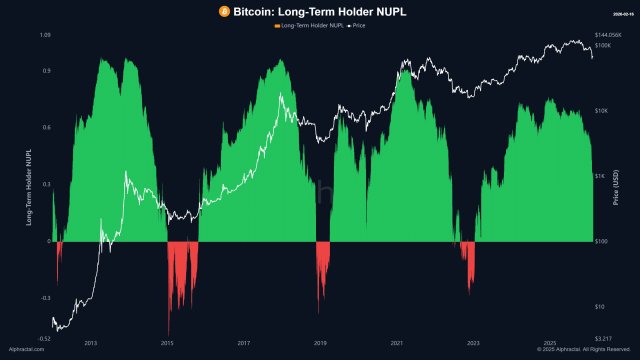
Source: Chart from Joao Wedson on X

Recent data seen on the chart tells that the metric is currently positioned at the 0.36 level, which implies that long-term holders remain on average in terms of profit. However, Wedson highlighted that the most significant signal often emerges when the metric shifts into negative territory.

It is worth noting that when long-term holders NUPL shifts into negative territory, it indicates that losses continue to mount even among the most convinced participants. In the past, this pattern has marked the phase of maximum market depression. In Wedson’s view, this stage reflects seller exhaustion, the transfer of coins to stronger hands, and the beginning of a new market cycle.

This was the last stage before a fresh Bull Run began in earlier cycles. “Opportunities are not built at the top, they are built in depression,” Wedson added.

BTC Accumulator Addresses Are Rising

Darkfost, an author at CryptoQuant, has shared a detailed analysis of Bitcoin accumulator addresses, which appear to be steadily rising. According to the expert, these addresses represent a specific class of long-term holders, and their recent actions are very noteworthy. A tendency toward increasing accumulation often indicates that supply is being covertly absorbed, reducing the quantity of Bitcoin on the open market.

Data shows that the current average monthly accumulation is a staggering 372,000 BTC. These investors or corporations, who continue to accumulate aggressively, seem to be taking advantage of the current dip in Bitcoin. In contrast, the average monthly accumulation of these addresses was only over 10,000 BTC in September 2024.

Market structure indicates that some investors are responding emotionally to short-term price movements, while others seem to be planning for the long run, which has always been one of the best ways to invest in BTC.

BTC trading at $68,412 on the 1D chart | Source: BTCUSDT on Tradingview.com

Related Reads

Will the Fed Still Cut Interest Rates? Tonight's Data Is Crucial

The core debate surrounding the Federal Reserve's potential interest rate cuts is intensifying amid geopolitical conflict and rebounding inflation. The key question is whether high energy prices will cause persistent inflation or weaken consumer demand enough to force the Fed to cut rates. Citigroup presents a bullish case for cuts, arguing that oil supply disruptions from the Strait of Hormuz are temporary and will not lead to lasting inflationary pressure. They point to receding bond yields and oil prices as evidence the market is pricing in a short-lived shock. Citi's data also shows tightening financial conditions, a stabilizing labor market, and healthy tax returns, supporting their view that the path to lower rates remains open. Conversely, Deutsche Bank offers a starkly contrasting, more hawkish outlook. They argue the Fed's current policy is already neutral and expect rates to remain unchanged indefinitely. Their view is based on stalled disinflation progress and a shift toward more hawkish rhetoric from key Fed officials like Waller, who cited risks from prolonged Middle East conflict and tariffs. Other officials, including Williams and Hammack, signaled rates would likely stay on hold for a "considerable time." The market pricing has shifted dramatically, now forecasting zero cuts in 2026. The imminent release of the March retail sales "control group" data is highlighted as a critical test. This metric, which excludes gas station sales, will reveal if high gasoline prices are eroding consumer spending in other areas. A weak reading could support the case for imminent rate cuts, while a strong one would bolster the argument for the Fed to hold steady. This data is pivotal for determining the near-term policy path.

marsbit17m ago

Will the Fed Still Cut Interest Rates? Tonight's Data Is Crucial

marsbit17m ago

The Second Half of Macro Influencer Fu Peng's Career

Fu Peng, a prominent Chinese macroeconomist and former chief economist of Northeast Securities, has joined Hong Kong-based digital asset management firm Bitfire Group (formerly New Huo Group) as its chief economist. This move, announced in April 2026, triggered an 11% surge in Bitfire's stock price. Fu, known for his accessible macroeconomic commentary and large social media following, will focus on integrating digital assets into global asset allocation frameworks, particularly combining FICC (fixed income, currencies, and commodities) with cryptocurrencies for institutional clients. His career includes roles at Lehman Brothers and Solomon International, with significant influence gained through public communication. However, in late 2024, Fu faced temporary social media bans after a controversial private speech at HSBC on China's economic challenges, though he denied regulatory sanctions. He later left Northeast Securities citing health reasons. Bitfire, a licensed virtual asset manager serving high-net-worth clients, seeks to build trust and attract traditional capital through Fu’s expertise and credibility. The partnership represents a strategic shift for both: Fu enters the crypto sector after a traditional finance peak, while Bitfire aims to leverage his macro framework for institutional adoption. Outcomes remain uncertain regarding capital inflows and compatibility within corporate structure.

marsbit1h ago

The Second Half of Macro Influencer Fu Peng's Career

marsbit1h ago

Trading

Spot
Futures

Hot Articles

Discussions

Welcome to the HTX Community. Here, you can stay informed about the latest platform developments and gain access to professional market insights. Users' opinions on the price of S (S) are presented below.

活动图片