Will the Fed Still Cut Interest Rates? Tonight's Data Is Crucial

marsbitPublished on 2026-04-21Last updated on 2026-04-21

Abstract

The core debate surrounding the Federal Reserve's potential interest rate cuts is intensifying amid geopolitical conflict and rebounding inflation. The key question is whether high energy prices will cause persistent inflation or weaken consumer demand enough to force the Fed to cut rates. Citigroup presents a bullish case for cuts, arguing that oil supply disruptions from the Strait of Hormuz are temporary and will not lead to lasting inflationary pressure. They point to receding bond yields and oil prices as evidence the market is pricing in a short-lived shock. Citi's data also shows tightening financial conditions, a stabilizing labor market, and healthy tax returns, supporting their view that the path to lower rates remains open. Conversely, Deutsche Bank offers a starkly contrasting, more hawkish outlook. They argue the Fed's current policy is already neutral and expect rates to remain unchanged indefinitely. Their view is based on stalled disinflation progress and a shift toward more hawkish rhetoric from key Fed officials like Waller, who cited risks from prolonged Middle East conflict and tariffs. Other officials, including Williams and Hammack, signaled rates would likely stay on hold for a "considerable time." The market pricing has shifted dramatically, now forecasting zero cuts in 2026. The imminent release of the March retail sales "control group" data is highlighted as a critical test. This metric, which excludes gas station sales, will reveal if high gasoli...

Amid the dual pressures of geopolitical conflict and rebounding inflation, market expectations for a Fed rate cut are experiencing dramatic swings. The core of the current market博弈 lies in: will soaring energy prices trigger persistent inflation, or will they backfire on consumer demand and force the Fed to cut rates?

On April 21, according to Wind Information, Citi provided a clear bullish case for rate cuts in its latest research report, arguing that oil supply disruptions are merely temporary disturbances, and the path to rate cuts, though bumpy, is clear in direction; while Deutsche Bank poured cold water on this, warning that Fed policy is already in a neutral position and is expected to maintain current rates indefinitely.

As these two major investment banks clash, the upcoming March retail sales data will be a key litmus test to break the deadlock. This data will not only reveal the true destructive impact of high oil prices on core consumption but will also directly determine the Fed's near-term policy path.

Citi: Geopolitical Disturbances Temporary, Direction Towards Rate Cuts Unchanged

Although the market continues to be affected by geopolitical developments, Citi firmly believes that the path to lower rates and a more dovish Fed policy still exists.

The core logic behind this judgment is: the impact of the Strait of Hormuz situation on oil supply is increasingly likely to be short-lived, not a persistent source of inflation. On April 18, there were reports that the Strait of Hormuz would reopen. Although this was later questioned, Treasury yields and oil prices have both retreated from Thursday's highs and remained at lower levels—this in itself is the market pricing in a "transient shock" scenario.

The report points out that Citi's logic chain is clear: Geopolitical conflict is temporary → oil price shock is not persistent → inflationary pressure does not spread → the Fed has the conditions to return to the rate-cutting path.

Furthermore, a series of underlying economic data tracked by Citi shows subtle changes in the macro-financial environment:

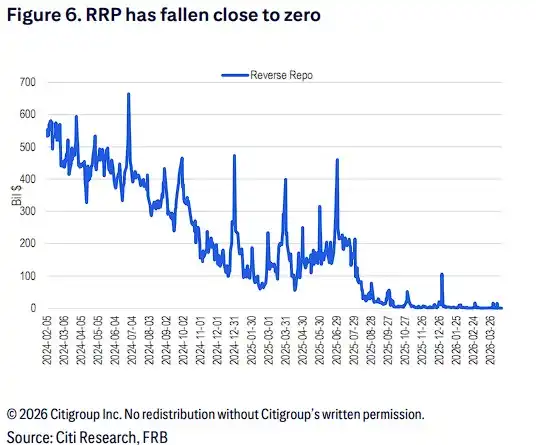
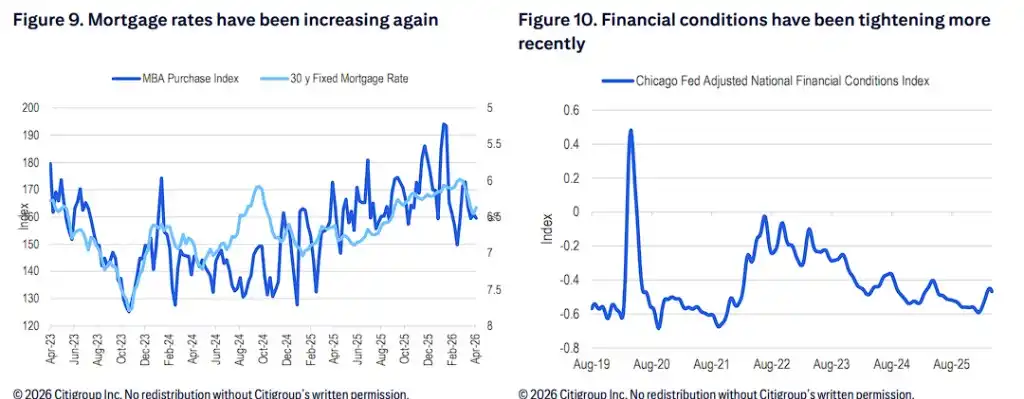
Liquidity and Financial Conditions: The Fed's reverse repo (RRP)规模 has fallen sharply to near zero; meanwhile, recent financial conditions are tightening, and mortgage rates are also trending up again.
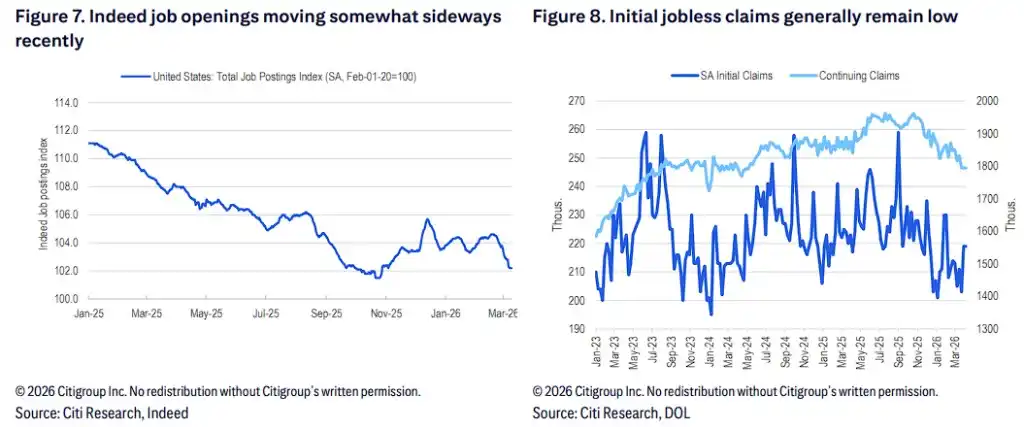
Labor Market: Indeed job openings data has recently shown a sideways trend, although initial jobless claims overall remain low.
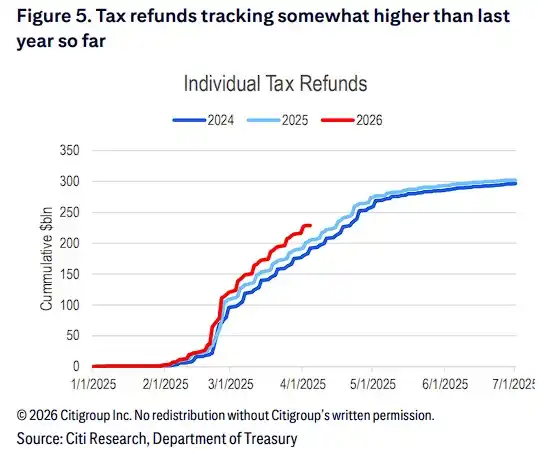
Capital Flows: So far this year, personal tax refunds (cumulative amount in billions of dollars) are slightly higher than the same period last year.
Tonight's Litmus Test: Why is the March "Control Group" Retail Sales Data Key?

As rate cut expectations waver, the upcoming March retail sales data will provide investors with first-hand clues, revealing the extent to which high gasoline prices have cut into consumer spending on other categories of goods.

Citi emphasizes that investors must "look past the surface" when interpreting this data. Due to rising gasoline prices, nominal retail sales for March are bound to surge. However, what truly determines the Fed's policy direction is the "Control group" sales data.

The report points out that this data excludes sales at gas stations and certain specific categories, allowing for a more genuine and accurate reflection of whether high oil prices are causing consumer weakness in other areas. If the "control group" data unexpectedly weakens, it will strongly corroborate that high inflation is backlashing on demand, thereby providing key data support for the Fed's rate-cutting logic.

Deutsche Bank's Cold Water: Policy Already Neutral, Fed May Hold Steady Indefinitely

In stark contrast to Citi's optimistic expectations, Deutsche Bank offered a very cautious judgment on the rate cut outlook. Deutsche Bank clearly stated in its report: The Fed is expected to maintain current rates indefinitely because current policy is already in a neutral position.

Deutsche Bank's pessimistic expectations are mainly based on the following core points:

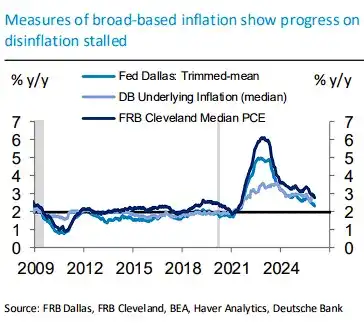
Stalled Disinflation: Broad inflation indicators show that progress in the US fight against inflation has stalled.
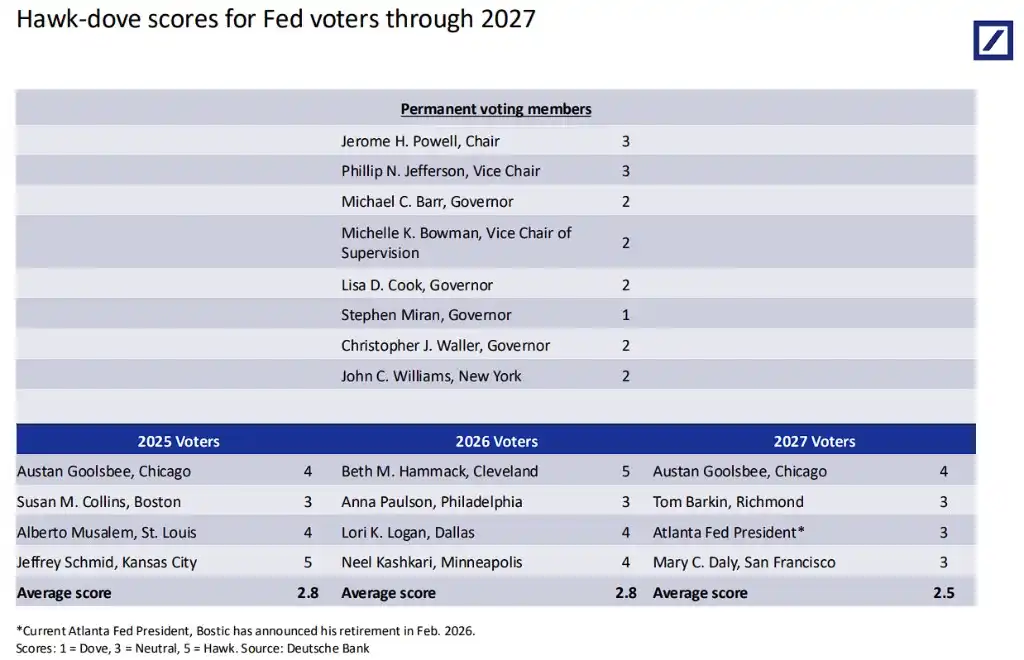
Officials Turn Hawkish: Deutsche Bank's tracking of Fed officials' speeches shows that officials like Waller and Miran (Note: likely a typo, possibly meant Mester or another official) have adopted a more hawkish tone, while most other officials continue to believe the current policy stance is "very appropriate" (well positioned). Details as follows:

· Waller: Leaning hawkish. He noted that a prolonged Middle East conflict would block the path to rate cuts; a series of shocks (tariffs叠加 oil prices) could trigger more persistent inflation rises; he also emphasized that core inflation, excluding tariff effects, is close to 2%, and the labor market has vulnerabilities;

· Miran (Note: likely a reference to another official, possibly a misspelling): Is currently the most dovish voice, supporting 3 or even 4 rate cuts this year, believes the war has not changed the inflation outlook 12 to 18 months out, views the oil price shock as temporary;

· Williams: Believes policy is "right where it needs to be," raised 2026 inflation forecast to about 2.75%, lowered 2026 economic growth forecast to 2% to 2.5%;

· Hammack (Note: likely Harker): Clearly stated that rates will "remain unchanged for quite some time";

· Goolsbee: Warned that if oil prices persist at $90 per barrel, it could spill over to other prices; further rate cuts in 2026 are unlikely, cuts might have to wait until 2027;

· Daly: Believes current policy is in a "very good place," if the oil price shock lasts until year-end, it wouldn't be surprising for market pricing to shift to "zero cuts".

The Fed's March meeting minutes also showed that the vast majority of officials believe the process of inflation returning to the 2% target will be delayed; some officials even discussed the necessity of adding "two-sided risks" wording to the meeting statement,暗示 the possibility of rate hikes is not completely ruled out.

Deutsche Bank's hawk-dove scoring of Fed officials shows the 2026 voting committee has an average score of 2.8 (1 being the most dovish, 5 the most hawkish), overall leaning neutral-slightly dovish, but dovish voices are clearly in the minority.
Market Pricing Completely Reversed: Facing persistent inflationary pressures and strong economic resilience, market expectations have drastically changed. According to Deutsche Bank's data, current market pricing expects "zero rate cuts" for the entirety of 2026, with the first cut not until Summer 2027.
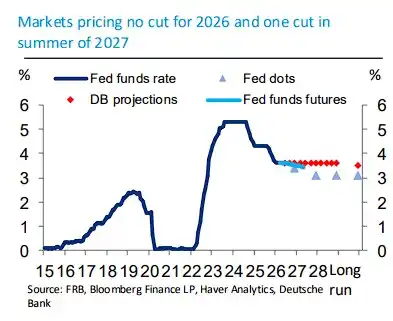
Deutsche Bank expects, under its baseline scenario, the federal funds rate will remain at 3.63% throughout 2026 to 2028, with no rate cuts for the entire year.


Related Questions

QWhat is the core market dilemma regarding the Federal Reserve's interest rate policy, as described in the article?

AThe core market dilemma is whether high energy prices will trigger persistent inflation or instead erode consumer demand to the point of forcing the Federal Reserve to cut interest rates.

QWhich two major banks present opposing views on the likelihood of Fed rate cuts, and what are their stances?

ACitigroup presents an optimistic view, arguing that geopolitical disruptions are temporary and the path to lower rates remains clear. Conversely, Deutsche Bank presents a pessimistic view, warning that Fed policy is already neutral and rates will likely remain unchanged indefinitely.

QWhy is the March retail sales 'control group' data considered a crucial test for the Fed's policy path?

AThe 'control group' data, which excludes sales at gas stations and other specific items, is crucial because it reveals whether high gas prices are causing consumer spending to weaken in other categories. A weak reading would support the argument that high inflation is destroying demand, thus bolstering the case for rate cuts.

QAccording to Deutsche Bank's analysis, what is the current market pricing for Fed rate cuts in 2026?

AAccording to Deutsche Bank, the current market pricing expects zero rate cuts for the entirety of 2026, with the first cut not anticipated until the summer of 2027.

QWhat key reason does Citigroup give for believing the path to lower interest rates remains open despite geopolitical tensions?

ACitigroup's core logic is that the impact on oil supplies from the Hormuz Strait situation is increasingly likely to be brief rather than a source of persistent inflation, thus allowing the Fed conditions to return to a rate-cutting path.

Related Reads

Anthropic Cries Wolf: Is the AGI Threat Real, or Just an IPO Story?

Anthropic has published an article titled "When AI builds itself," discussing the emerging concept of "recursive self-improvement," where AI begins to actively participate in designing, training, testing, and optimizing its own subsequent versions. The company presents internal data showing that by May 2026, over 80% of code merged into its codebase was written by Claude, its AI model. Claude's capabilities have expanded to handling complex, open-ended engineering tasks, achieving a 76% success rate in such areas, and even contributing to research processes, such as optimizing code performance and conducting AI safety experiments. Anthropic outlines an evolution from human-driven development to AI-assisted workflows, culminating in the current stage where AI agents can autonomously write, run, and delegate code. The company cautions that the path toward a "closed loop," where AI continuously improves itself, is becoming visible. It calls for coordinated global mechanisms to potentially slow or pause frontier AI development to allow safety research and societal structures to catch up. However, the timing of this warning coincides with Anthropic's preparations for an IPO, framing the narrative not just as a safety concern but also as a demonstration of Claude's advanced capabilities and its integral role in accelerating Anthropic's own R&D—creating a potential "flywheel" effect for competitive advantage. This contrasts with OpenAI's recent, more policy-oriented discussion of the same risks, highlighting the competitive dynamics in the AI industry as companies position themselves in both the technological and regulatory landscape.

marsbit28m ago

Anthropic Cries Wolf: Is the AGI Threat Real, or Just an IPO Story?

marsbit28m ago

BIT Research: ETF Purchases Have Slowed, Strategy (MicroStrategy) Has Slowed, What Else Can Drive Bitcoin's Rise?

Market Refocus on Inflation and Rate Expectations Weighs on Bitcoin Currently, the market is in a phase of macro-repricing dominated by inflation and interest rate expectations. Bitcoin, which previously benefited from easy liquidity and low inflation, is seeing its core bullish drivers weaken. These drivers were market expectations for interest rate cuts and strong inflows from Bitcoin ETFs and institutions like MicroStrategy (referred to as "Strategy" in the text). The logic has shifted. Recent high inflation data (e.g., CPI hitting 3.8% in a May 2026 report) has caused the market to sharply reduce its rate cut expectations for 2025 and even price in potential hikes. This is a key constraint for Bitcoin, as it lacks cash flows and is highly sensitive to rate expectations. Concurrently, institutional capital flows have slowed significantly. Following the hot CPI data, Bitcoin ETFs saw accelerated outflows, with around $4.3 billion leaving over a period. MicroStrategy's ability to keep adding substantial Bitcoin to its balance sheet is also diminishing. Together, ETF and MicroStrategy holdings total roughly $110 billion, but their momentum as growth engines is cooling. In summary, Bitcoin's current pressure stems not from its own fundamentals but from a changing macro environment. As long as inflation stays elevated, Bitcoin is likely to remain in a consolidating phase. However, historically, inflation eventually peaks. Once it recedes and rate cut expectations rebuild, institutional capital could return, potentially fueling a new and more robust recovery phase for Bitcoin.

marsbit35m ago

BIT Research: ETF Purchases Have Slowed, Strategy (MicroStrategy) Has Slowed, What Else Can Drive Bitcoin's Rise?

marsbit35m ago

Earning 1000 Trillion in Half a Year, 'Pocketing' 20 Million per Capita: This Round of Wealth Creation in the Korean Stock Market is Unprecedented in Scale

The South Korean stock market is experiencing an unprecedented wealth surge in 2026, with household equity and fund asset values soaring by over 1,000 trillion KRW (~$730bn) year-to-date. This translates to an average per capita wealth increase of roughly 20 million KRW, fueled by a historic 109% rally in the KOSPI index. The boom is driven by three converging forces: an AI-driven semiconductor supercycle boosting giants like Samsung and SK Hynix; the government's "Value-Up" market reforms addressing long-standing corporate governance issues; and aggressive real estate regulations that have locked capital within financial markets, preventing profits from flowing back into property. This has triggered a wealth effect, boosting high-end consumption significantly. However, the gains are highly concentrated. The two semiconductor behemoths account for over half the index's value, but retail investors own relatively low stakes in them, systematically missing the biggest rallies. Wealth and consumption benefits are skewed towards luxury goods and imported cars, bypassing mainstream retail. Further risks stem from excessive leverage, with high trading volume in leveraged ETFs, and a market sentiment heavily reliant on the AI sector's fortunes and speculative rumors. While this cycle marks a potential shift from real estate to equities as a primary wealth generator for Koreans, its sustainability, amid structural imbalances and leverage, remains a critical test.

marsbit41m ago

Earning 1000 Trillion in Half a Year, 'Pocketing' 20 Million per Capita: This Round of Wealth Creation in the Korean Stock Market is Unprecedented in Scale

marsbit41m ago

Trading

Spot
Futures

Hot Articles

Discussions

Welcome to the HTX Community. Here, you can stay informed about the latest platform developments and gain access to professional market insights. Users' opinions on the price of S (S) are presented below.

活动图片