2026 Global Overview of Crypto Asset Taxation

marsbitPublished on 2026-08-17Last updated on 2026-08-17

Abstract

Global Cryptocurrency Tax Overview for 2026 As cryptocurrencies integrate into the mainstream financial system, tax treatments across jurisdictions have moved from initial regulatory gaps towards institutionalization. The OECD's 2020 report, *Taxing Virtual Currencies*, was a key early comparative study. Since then, more jurisdictions have clarified tax rules through existing laws, specific regulations, or guidance, increasing the procedural and technical complexity of crypto taxation. Currently, crypto taxation is predominantly built upon traditional tax frameworks, typically applying income tax, capital gains tax, corporate tax, and indirect taxes based on asset nature and transaction activity. The maturity of rules varies: basic trading and mining are well-covered, while DeFi, NFTs, and other on-chain activities involve more complex asset exchanges and profit recognition, with corresponding tax rules remaining underdeveloped. Significant disparities exist in tax treatment and effective tax burdens across jurisdictions. Crypto assets can trigger direct taxes, indirect taxes, and property-related levies. Factors such as holding period, transaction type, income nature, and taxpayer status further influence the tax outcome. The global crypto tax landscape is thus evolving from the initial question of "whether to tax" towards more nuanced classification and treatment of different assets, transactions, and economic activities. The scope of crypto tax rules continues to expan...

Author: FinTax

Abstract

As crypto assets gradually enter the mainstream financial system, jurisdictions are shifting from early regulatory gaps to institutionalization in their tax treatment. The OECD's 2020 publication, "Taxing Virtual Currencies," was one of the early comprehensive studies that systematically compared the tax treatment of crypto assets across multiple jurisdictions. Subsequently, with the development of the crypto asset market, an increasing number of jurisdictions have begun clarifying relevant tax treatments through existing tax laws, special provisions, or tax guidance, leading to continuous growth in the procedural and complex nature of crypto asset taxation.

From the perspective of existing systems, the taxation of crypto assets remains primarily built upon traditional tax frameworks. Jurisdictions typically incorporate them into existing income tax, capital gains tax, corporate income tax, and indirect tax systems based on the nature of the asset and transaction activities, further specifying details through special provisions or tax guidance. The maturity of rules varies across different activities. Common activities such as buying/selling and mining entered the tax system earlier, while on-chain native activities like DeFi and NFT involve more complex asset exchanges, income recognition, and transaction structures, with related tax rules still relatively lagging.

Meanwhile, significant differences exist in tax treatment and effective tax burdens across jurisdictions. Crypto assets may involve direct taxes, indirect taxes, and property-related taxes simultaneously. Different holding periods, transaction methods, income nature, and taxpayer status can also alter tax outcomes. Therefore, the global crypto asset tax system is gradually shifting from the question of whether to tax towards more refined classification and treatment of different assets, transactions, and economic activities.

Crypto Tax Rules Continue to Expand

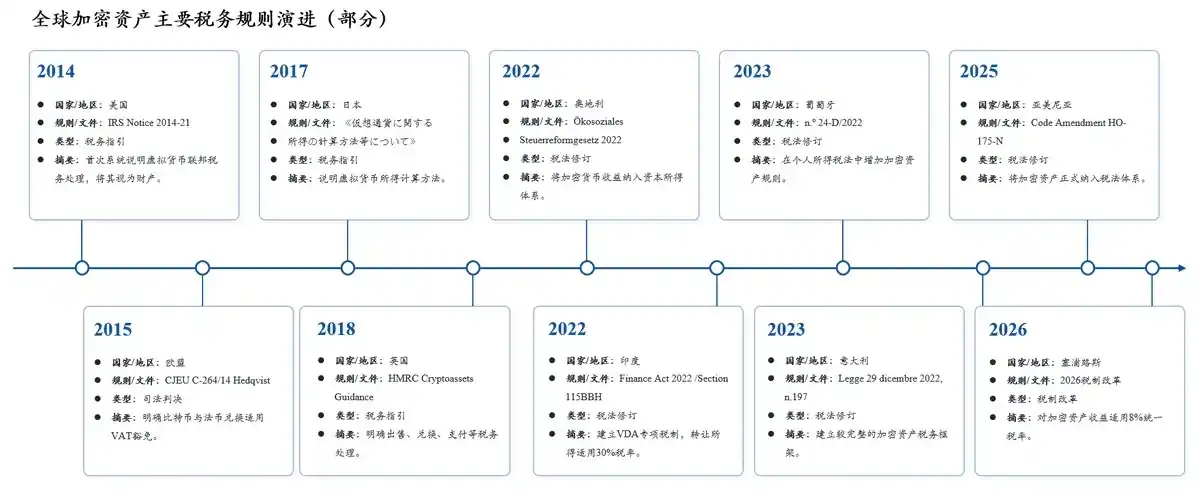
Crypto assets entered the tax system relatively late. The OECD's 2020 report, "Taxing Virtual Currencies: An Overview of Tax Treatments and Emerging Tax Policy Issues," conducted a systematic comparison of the income tax, consumption tax, and property tax implications of crypto assets based on the participation of over 50 jurisdictions. It was the first comprehensive study of its kind covering such a broad range of jurisdictions at the time. The OECD noted that research into the tax implications of crypto assets in various regions was still in its early stages, with no consistent treatment established on fundamental issues such as asset nature, taxable events, income classification, and valuation.

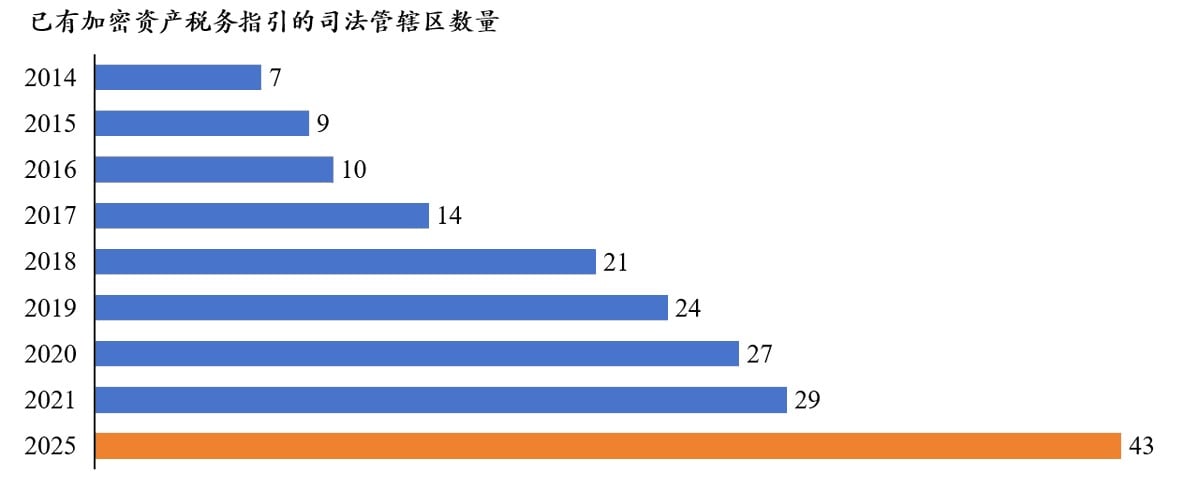
Since then, the coverage of crypto asset tax rules has continued to expand. PwC data from 2021 showed that jurisdictions with tax guidance for crypto assets increased from 7 in 2014 to 29 in 2021, more than quadrupling in seven years. By 2025, this number had further increased to 43. While coverage continued to expand, existing systems also accelerated in refinement and extension.
Existing Tax Regimes Still Dominate, with Diverging Rule Maturity

Currently, the taxation of crypto assets still primarily relies on existing tax systems. The U.S. continues to treat digital assets as property subject to general tax rules, while Australia's 2025 tax review concluded that existing tax laws already cover digital asset transactions. A European Commission comparison across 27 member states showed that most member states handle crypto assets mainly within the existing tax framework, with corporate crypto business income uniformly included in corporate income tax.
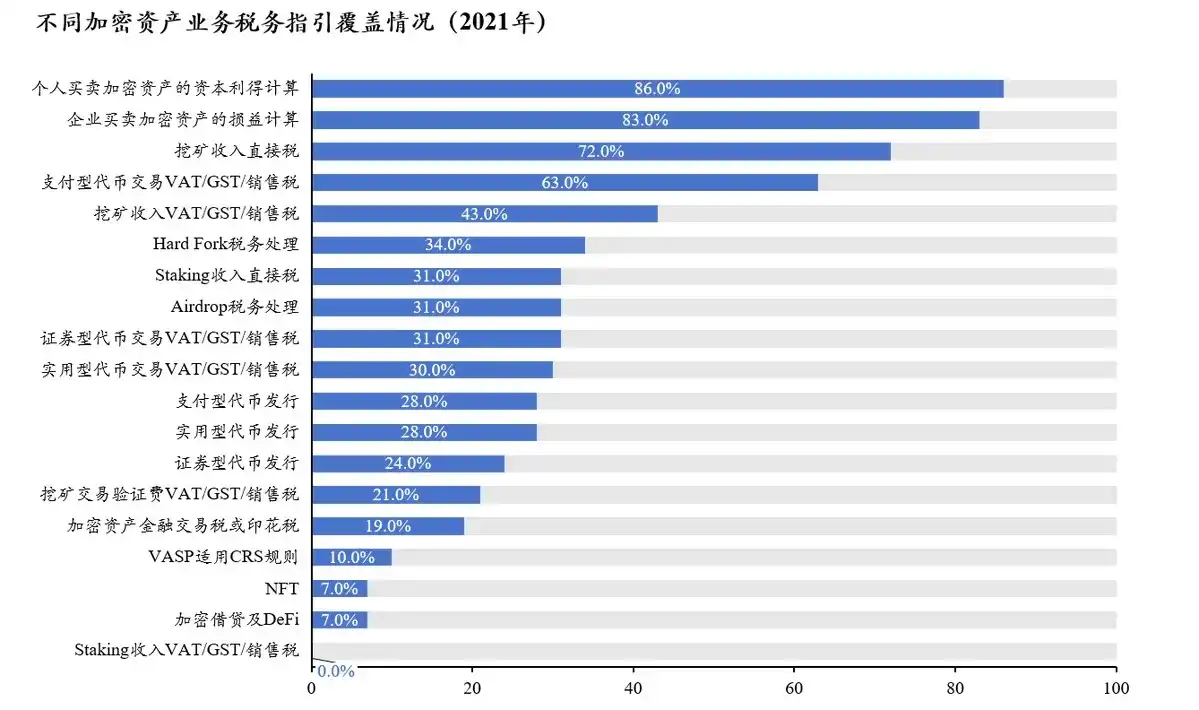
Tax rule coverage for different crypto activities is uneven. In PwC's 2021 survey of over 40 jurisdictions, the proportions having tax guidance for individual and corporate crypto asset buying/selling were 86% and 83% respectively, 72% for mining, but only 31% for staking, and just 7% each for DeFi and NFT. By 2025, this disparity persisted: Germany's latest income tax guidance for crypto assets covers many common transaction types, but NFT and liquidity mining are still not included; Australia also lists DAOs, DeFi, GameFi, and NFT as areas requiring further study. Overall, activities more easily mapped to traditional assets, income, and financial transactions are more readily absorbed by existing tax laws; the more complex the on-chain structure, the more tax rules tend to lag.

Significant Tax Burden Differences Across Jurisdictions

Crypto asset taxation is highly complex. The tax burden is not determined by a single rate but may involve multiple tax types such as personal income tax, capital gains tax, corporate income tax, value-added tax or sales tax, property tax, and inheritance tax. Specific application also depends on the nature of the transaction. For example, buying/selling, payments, mining, staking, and business operations may respectively constitute asset disposal, investment income, or business income, subject to different tax calculation rules.

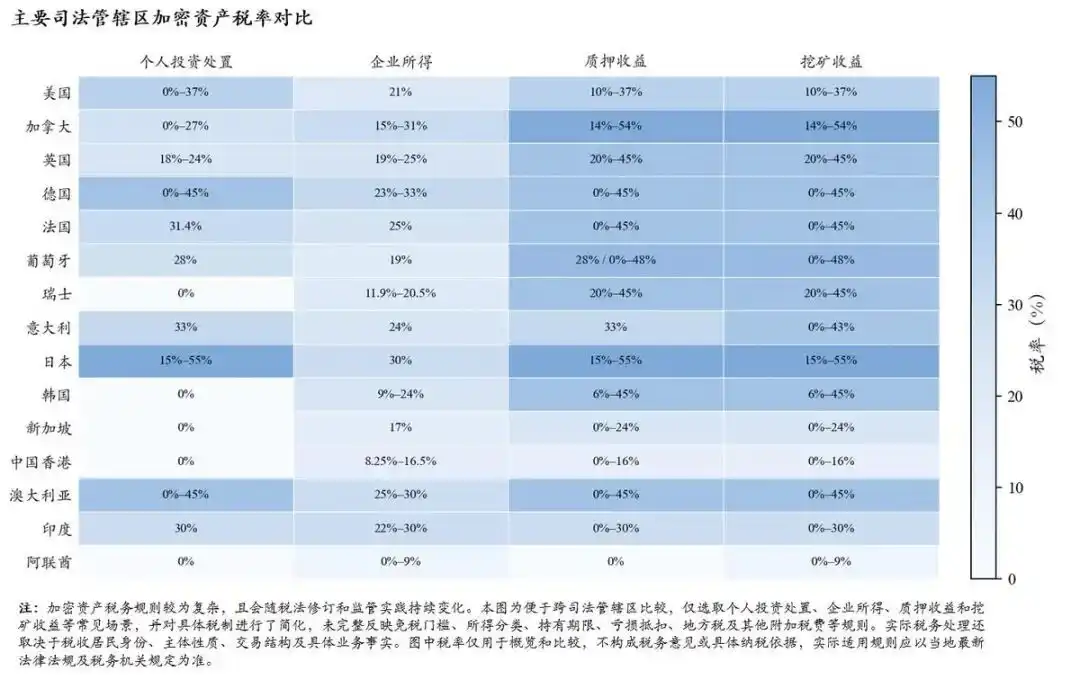
Therefore, so-called "crypto tax friendliness" is a comprehensive judgment based on individual needs and jurisdictional rules. Beyond nominal tax rates, factors such as tax residency status, individual or corporate entity status, income classification, holding period, tax-exempt thresholds, and long-term holding incentives must be considered. The same jurisdiction may be friendly towards long-term personal investment but apply a completely different tax burden for high-frequency trading, mining, or corporate operations.

The figure below compares representative tax rates in major jurisdictions, considering common scenarios such as personal investment disposal, corporate income, staking rewards, and mining rewards. The comparison also factors in economic scale, crypto asset market activity, and regional representativeness, revealing significant differences in actual tax burdens. Given the complexity and continuous evolution of crypto asset tax rules globally, certain applicable conditions and special rules have been simplified in the figure for easier visual comparison. For complete tax rules of a specific jurisdiction, please refer to our series of foundational research on crypto taxation.
Related Questions

QWhat was a key early comparative study on the taxation of cryptocurrencies published by the OECD in 2020?

AThe OECD published a key early comparative study titled 'Taxing Virtual Currencies: An Overview of Tax Treatments and Emerging Tax Policy Issues' in 2020, which systematically compared the income, consumption, and property tax treatments of crypto-assets across more than 50 jurisdictions.

QAccording to the article, how many jurisdictions had issued specific tax guidance on crypto-assets by 2025, based on the trend mentioned?

ABy 2025, the number of jurisdictions that had issued specific tax guidance on crypto-assets had increased to 43, continuing the expansion from 29 in 2021 and just 7 in 2014.

QWhat does the article identify as a primary characteristic of how crypto-assets are taxed globally?

AA primary characteristic is that the taxation of crypto-assets is still predominantly built upon traditional tax systems. Jurisdictions typically incorporate them into existing income tax, capital gains tax, corporate tax, and indirect tax frameworks, with further clarification through specific rules or guidance.

QWhich crypto-related activities had the lowest percentage of tax guidance coverage according to PwC's 2021 survey mentioned in the article?

AAccording to PwC's 2021 survey mentioned, DeFi and NFT activities had the lowest coverage, with only 7% of the over 40 surveyed jurisdictions having issued specific tax guidance for each. Staking was also relatively low at 31%.

QWhy is determining a 'crypto-tax-friendly' jurisdiction considered complex according to the article?

AIt is considered complex because tax liability is not determined by a single rate but can involve multiple taxes (e.g., income, capital gains, corporate, VAT/GST). The final outcome depends on factors like the taxpayer's status (individual/company), nature of the activity (trading, mining, staking), classification of income, holding period, and specific exemptions or incentives offered by the jurisdiction.

Related Reads

Technological Self-Reliance in China: A War from Lithography Machines to ABF Films

"China's Tech Independence: A Battle from Lithography Machines to ABF Film" In August 2026, Japan's Ajinomoto announced a 30% supply cut of ABF film to Chinese mainland clients, causing industry-wide shock and fears of price hikes and shortages in the semiconductor supply chain. That same year, Chinese company Lotus Holdings, known for its MSG business, acquired a small domestic ABF film startup for 103 million yuan, aiming to change this passive situation. ABF film is a core insulating material for advanced CPU, GPU, and AI chip packages. Ajinomoto, originally a food flavoring company, has monopolized over 95% of the global ABF film market for nearly 30 years, deriving its technology from byproducts of monosodium glutamate production. With AI chips consuming 5-10 times more ABF film than traditional chips, the supply-demand gap is widening. Ajinomoto's supply cut to China, where domestic ABF film production accounts for less than 5%, directly threatens the production of domestic high-end AI chips and their substrates. This incident highlights a crucial but often overlooked truth: the vulnerabilities in China's quest for technological self-reliance extend beyond headline areas like lithography machines to critical but seemingly minor components—insulating films, photoresists, electronic specialty gases, etc. The article frames China's tech independence as a multi-front war. While major breakthroughs have been achieved in chip design (e.g., Huawei's HiSilicon), foundry (e.g., SMIC), and memory chips (e.g., YMTC), countless smaller "Ajinomoto-style" chokepoints remain. Lotus Holdings' acquisition represents a significant shift: the battle is no longer fought only by tech giants but has become a collective, industry-wide effort involving companies from diverse backgrounds. Historically, external blockades have often spurred China's technological breakthroughs, as seen with Huawei's Kirin chips and YMTC's 3D NAND flash memory. Ajinomoto's supply cut, while a short-term challenge, may similarly catalyze domestic innovation in ABF film and other critical materials. The path to technological sovereignty is long and arduous, requiring sustained patience and investment to fill every gap in the complex supply chain. Lotus's move is not an immediate solution but a step towards that future, symbolizing a broader, relentless march toward independence.

marsbit2m ago

Technological Self-Reliance in China: A War from Lithography Machines to ABF Films

marsbit2m ago

The Great Ethereum "Rate Cut" Debate: Is Now the Golden Window for Staking with the Unconventional EIP-8363?

Ethereon's economic policy is under review as a new proposal, EIP-8363, sparks debate over potential "interest rate cuts" for staking. The unconventional proposal suggests gradually increasing the proportion of newly issued ETH rewards that are burned as the total staked ETH ratio rises, with issuance fully offset by burns once the ratio nears 50%. This would drive the protocol-level staking APR towards 0%, though validators would still earn transaction fees and MEV. This discussion emerges as staked ETH approaches 35% of supply, with the current protocol APR at ~2.6%. The core question is whether Ethereum needs to continue paying high issuance costs for marginal gains in security once sufficient participation is achieved. EIP-8363 aims to optimize security spending, but critics warn it could disproportionately impact solo stakers and potentially increase centralization among large, resilient operators. Paradoxically, this debate coincides with the Pectra upgrade (EIP-7251), which introduces native compounding for staking rewards, significantly improving capital efficiency for long-term holders. This creates a dual narrative: the protocol is making staking more efficient while reconsidering the economic incentive to stake. For long-term ETH holders, this environment may present a "time window" rather than a fixed-rate opportunity. While future APRs are expected to trend downward, starting staking earlier maximizes the compounding effect over time. The decision to stake depends on individual factors like investment horizon, liquidity needs, and risk tolerance regarding options like native validation, staking services, or liquid staking tokens (LSTs). The evolution from encouraging staking to managing its economic cost marks a new, mature phase for Ethereum's tokenomics, where the true value of staking may increasingly lie in the long-term power of compounding time.

marsbit10m ago

The Great Ethereum "Rate Cut" Debate: Is Now the Golden Window for Staking with the Unconventional EIP-8363?

marsbit10m ago

Analyst States Bitcoin Remains Within $61-68k Range

An analyst stated that Bitcoin is likely to remain within a trading range of $61,000 to $68,000. According to Kirill Komalenkov, director of strategic communications at Bitbanker, Bitcoin continues to trade sideways amidst declining market volatility. He attributes its current stability to high market liquidity, with volatility near three-year lows. Komalenkov warned that sustained low activity carries risks of a price decline, with potential tests of support at $62,300 and $61,600. He suggested that major market players might use the current situation to accumulate liquidity, meaning any initial breakout from the range could be a false move. The analyst expects this sideways movement to persist until the latter part of August. Key factors for determining future market direction include fund flows into Exchange-Traded Funds (ETFs) and trader activity. However, Komalenkov noted a potential negative scenario for the second half of August, where heightened geopolitical tensions or hawkish rhetoric from US monetary authorities could trigger a new decline. In such a case, Bitcoin could fall to a range of $45,000–$50,000 by early autumn, which might form a new base for a potential market recovery later in the season. Separately, a Russian deputy finance minister recently announced that non-qualified investors in Russia will soon be allowed to legally purchase Bitcoin, Ethereum, and popular stablecoins, with an annual limit of 300,000 rubles per intermediary.

cryptonews.ru12m ago

Analyst States Bitcoin Remains Within $61-68k Range

cryptonews.ru12m ago

Trading

Spot
活动图片