From $150 to $200,000 in 8 Hours: This Year Has Seen Many Bitcoin Mining "Chosen Ones"

Foresight NewsPublished on 2026-07-15Last updated on 2026-07-15

Abstract

Title: 8 Hours, $150 to $200,000: Bitcoin Mining's 'Chosen Ones' in 2026. In early July 2026, a miner connected a $150 Bitaxe Gamma device (with a hash rate below 1 TH/s) to home Wi-Fi. Miraculously, after just 8 hours on a public pool, it mined block 957382, earning 3.1382 BTC (~$200k). With the device's share of the total network hash rate being less than one 900-millionth, the theoretical waiting time was an astronomical 16,701 years. This event, with odds similar to winning a major lottery, is not isolated in 2026. In February, a miner rented 1 PH/s of hashing power for $75 and mined a block within hours. In March, a 480 GH/s Bitaxe Pocket Rig defied 25,000-year odds to find a block worth ~$258k. Other cases followed in April and May, where small-scale or outdated hardware operators successfully mined blocks through solo or public pools. According to statistics, individual miners have found 12 blocks in 2026 so far. However, over 99.9% of blocks are still controlled by industrial mining pools. These stories represent extreme statistical luck, akin to winning a mathematical lottery, rather than a shift in mining dynamics. They capture attention precisely because of their absurdly low probability, highlighting that while most miners cover electricity costs with little return, a few "chosen ones" occasionally hit the jackpot.


Author: Eric, Foresight News


In the early morning of July 10th, Beijing time, a Bitcoin miner plugged a $150 Bitaxe Gamma into a socket, connected it to their home WiFi, and ran it on Public Pool for 8 hours, miraculously mining Bitcoin block 957382 and receiving 3.1382 BTC, worth approximately $200,000 at the time.
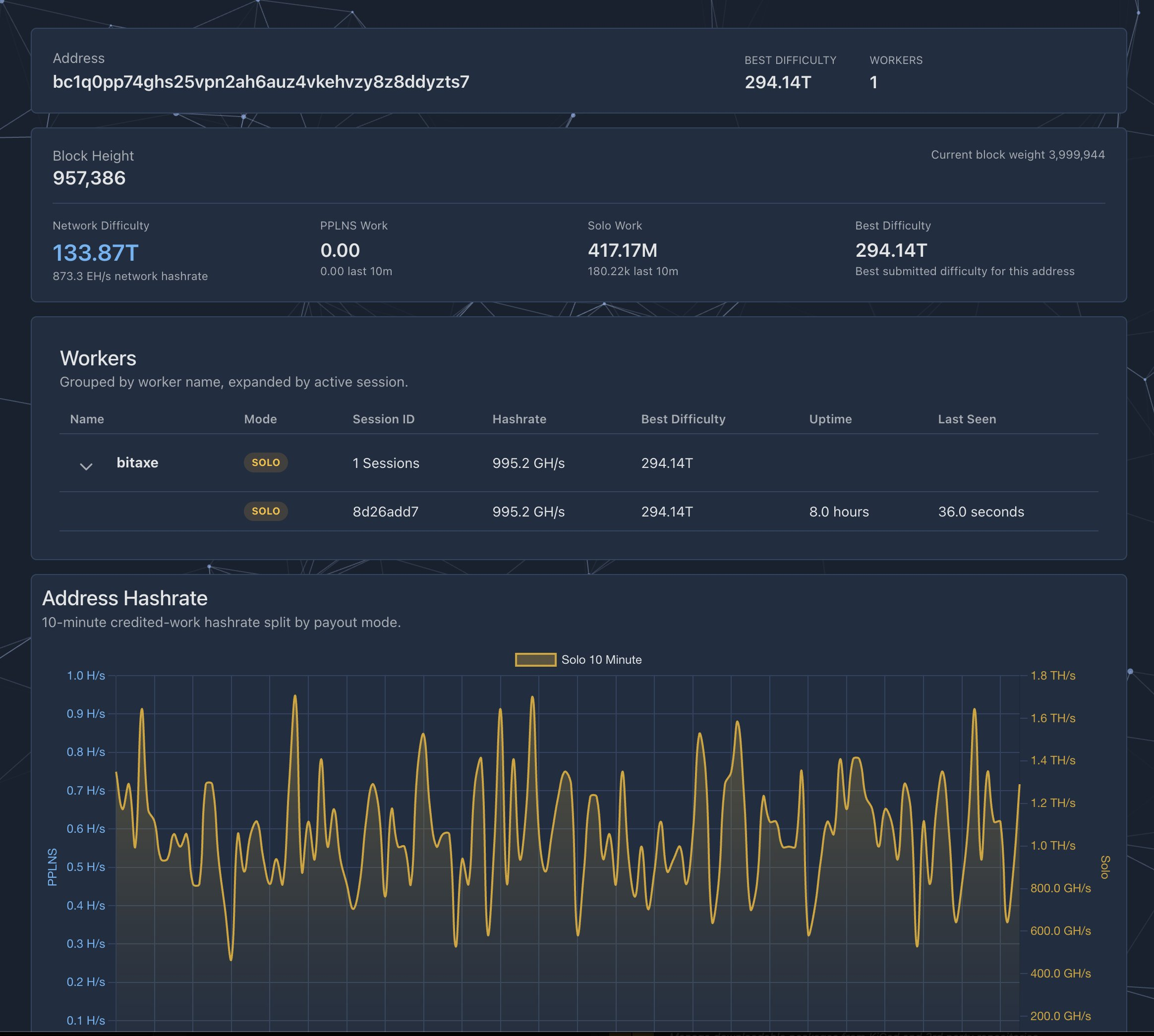


This so-called 'miner' is only the size of a router: equipped with a BM1370 chip, a power consumption of 15 to 21 watts, and a hash rate of less than 1 TH/s. During its mining period, the total Bitcoin network hash rate was about 874 EH/s, meaning this little device's share was less than one nine-hundred-millionth of the network.


At that rate, this small machine would theoretically need to wait 16,701 years to mine a single block—roughly from the Late Paleolithic period around 14,000 BC to today. Back then, Homo sapiens hadn't yet mastered agriculture and animal husbandry, surviving solely by hunting.


But this "chosen one" did it in just 8 hours. During that time, Bitcoin went through 48 block periods, making his winning odds about 1 in 18.3 million.


What does that number mean? The probability of winning the top prize in the Chinese welfare lottery "Double Color Ball" is about 1 in 17.72 million. In other words, with a device smaller than a set-top box, in less than one night, he accomplished a feat equivalent to hitting the Double Color Ball jackpot, with a return of about 1,330 times his investment.


This kind of "absurd" event isn't the first to happen this year.


Back in February, another miner didn't even buy hardware; they spent $75 renting 1 PH/s of hash rate on a hash power leasing platform and tried their luck on CKPool. Based on the Bitcoin network's hash rate at the time, this miner's probability of mining a single block was about 1 in 800,000, theoretically requiring a 15-year wait. Yet, before the $75 was even spent, block 938092 was theirs, netting them 3.125 BTC.


On March 10th, a 480 GH/s Bitaxe Pocket Rig also struck gold. With a hash rate half that of the device mentioned earlier, calculations based on data from the time suggested an expected block discovery time exceeding 25,000 years for this miner. But it just so happened to find block 887212 on a day in March, taking home a reward worth about $258,000. CKPool's operator, Con Kolivas, later remarked on social media that such hash power had only tens of millions-to-one odds of winning daily, calling it "pure, outrageous luck."


There have been several such examples this year. On April 9th, a miner using approximately 70 TH/s (equivalent to an older Antminer S17+) mined block 944306 via CKPool, receiving about 3.128 BTC (worth around $222,000), with daily winning odds of about 1 in 100,000. In late May, a miner using a small cluster of 14 Canaan Nano devices (total hash rate 157 TH/s) mined block 951771 via Braiins Solo, earning a reward worth about $232,000.


According to CoinDesk statistics, individual miners have mined a total of 24 blocks in the past 12 months, with 12 of those blocks in 2026 alone being claimed by individual miners using mining rigs as "lottery tickets." Compared to the total number of Bitcoin blocks in those 12 months, these lucky individuals account for less than five ten-thousandths.


Excluding these extremely lucky outliers, over 99.9% of blocks are still firmly controlled by industrial-scale mining pools like Foundry USA and AntPool. These lucky winners are more akin to ordinary people winning the lottery jackpot than representatives of any industry trend. But precisely because the odds are absurdly low, these stories become interesting. When someone spends $150 on a small device that looks like an electronic toy, places it on a desk, and 8 hours later finds $200,000 in their account—even if it only happens once, it's enough bragging rights for a lifetime.


Of course, behind all these low-probability events are countless unlucky souls who have run their rigs for months or even years without mining anything, quietly paying electricity bills all the while. Bitcoin mining has always been like this: the sudden wealth stories of a few make the news headlines, while the majority's equipment heats up quietly in the corner. It's just that every once in a while, someone with luck so good it induces jealousy comes along, reminding us that this endeavor is, at its core, still a mathematical lottery. And this year's lottery seems to be particularly favoring those trying their luck with small stakes.


Trending Cryptos

Related Questions

QWhat is the key detail of the Bitcoin mining miracle described at the beginning of the article?

AA miner used a $150 Bitaxe Gamma device with less than 1 TH/s hash rate. It ran for 8 hours, connected to a public pool, and miraculously mined Bitcoin block 957382, earning 3.1382 BTC worth approximately $200,000 at the time.

QHow does the article quantify the extreme improbability of the event involving the Bitaxe Gamma miner?

AThe article states that based on its hash rate relative to the network's total hash power, the device theoretically needed about 16,701 years to mine a block. The probability of it succeeding in that specific 8-hour period was roughly 1 in 18.3 million, comparable to winning the jackpot in a Chinese 'Double Color Ball' lottery.

QWhat other example of a low-probability mining success is mentioned from February?

AIn February, another miner rented 1 PH/s of hash power for $75 on a hashrate rental platform. Despite a theoretical probability of about 1 in 800,000 and an expected wait time of 15 years to find a block, they successfully mined block 938092 within their rental period and received 3.125 BTC.

QAccording to CoinDesk's statistics cited in the article, how many blocks were mined by individual miners in the past 12 months?

AAccording to CoinDesk's statistics, individual miners mined a total of 24 blocks in the past 12 months, with 12 of those blocks occurring in 2026 alone.

QWhat is the article's conclusion about the broader reality of Bitcoin mining despite these 'lucky' stories?

AThe article concludes that these stories represent extreme, lottery-like luck and are not indicative of an industry trend. Over 99.9% of blocks are still controlled by industrial-scale mining pools. For every lucky winner, countless others run their equipment for months or years without reward, paying electricity costs. Bitcoin mining remains fundamentally a mathematical lottery.

Related Reads

Founder of Real Vision: We Are Living in the Era of Exponential Growth

Real Vision founder Raoul Pal argues that humanity is now in an "Age of Exponential Growth," a reality the human brain's linear intuition struggles to comprehend. The core drivers are the convergence of multiple, mutually-reinforcing technological curves: Artificial Intelligence, robotics, solar & storage, biotechnology, and blockchain networks. He notes that while his 2021 analysis correctly identified fiat currency debasement and assets like Bitcoin as inflation hedges, he underestimated the scale of change. Beyond monetary liquidity, a more profound force is at work: these key technologies have moved from theoretical promise into simultaneous, accelerating commercialization. They are no longer growing in parallel but are fusing, creating a "double exponential" growth curve. AI and robotics create an "artificial labor supply," breaking the cycle of debt-driven growth needed to offset aging demographics. Energy, particularly solar power guided by Wright's Law, is seeing collapsing costs, removing a key bottleneck for compute-hungry AI. Cryptocurrencies are evolving from monetary assets into the essential, programmable settlement layer for transactions between future AI agents. This fusion creates a feedback loop: AI optimizes energy grids, cheaper energy powers more compute, which builds better AI, and crypto networks settle the transactions. This leads to "Reed's Law" playing out at scale, where intelligent nodes (AI agents) form and re-form groups at machine speed, creating network value that grows at 2^n. Pal concludes that the critical question is no longer how to protect jobs from machines, but how to own a share of the machines and their foundational infrastructure. He sees the 2030-2032 period as a potential "Economic Singularity" where these trends fully merge, fundamentally transforming the economy. The data, he asserts, shows this is not a bubble but an observable, quantifiable new era.

Foresight News54m ago

Founder of Real Vision: We Are Living in the Era of Exponential Growth

Foresight News54m ago

Golden Age VS Crisis Era? Bank of Korea Set to Hike Rates, Brokerage Margin Requirements May Increase 5-Fold

South Korea's financial authorities are taking coordinated action to cool an overheated and volatile stock market. The Bank of Korea is widely expected to raise its benchmark interest rate by 25 basis points to 2.75% on Thursday, which would be its first hike in approximately three and a half years since January 2023. Analysts predict further increases, potentially bringing the rate to 3.00% by year-end. This move aims to tighten market liquidity, raising costs for leveraged investments. Concurrently, major Korean brokerages have agreed to raise the minimum investment requirement for single-stock leveraged ETFs fivefold, from 10 million won to 50 million won, to curb excessive retail speculation. This follows extreme market swings focused on major chip stocks like Samsung Electronics and SK Hynix, which together account for nearly half of the KOSPI index's weight. The index itself has seen a dramatic 204% surge from its recent low. President Yoon Suk Yeol acknowledged market instability and urged regulators to address risks from leveraged products. Meanwhile, financial watchdogs are imposing new limits on stock-backed loans to individual investors to prevent bubble formation. These measures come as foreign investors have been massive net sellers this year, offloading a record $110 billion in assets, while domestic retail investors, using significant leverage, have been the primary buyers, absorbing the sales pressure. The government's multi-pronged strategy seeks to stabilize the market by restricting leverage, raising barriers, and tightening monetary policy.

Odaily星球日报1h ago

Golden Age VS Crisis Era? Bank of Korea Set to Hike Rates, Brokerage Margin Requirements May Increase 5-Fold

Odaily星球日报1h ago

From Being Ignored to the Venture Capital Queen Investing: Has AI Revived This Ultra-Niche Sector?

From obscurity to receiving investment from the "queen of venture capital," AI has revitalized the ultra-niche social networking track. In recent years, the social networking sector experienced a deep freeze in venture capital, with high-profile projects like the video social app "Huayin" (founded by a former WeChat core team member) and the offline-online dating app "Single's Tavern" ultimately failing. These failures underscored the immense difficulty of challenging WeChat's dominance in熟人社交 (close-contact social networking) and the general lack of scalable monetization paths for niche concepts like metaverse, female-only, or Muslim community apps. However, a shift emerged in 2025. "Liangpei," an AI-powered matchmaking company, secured a $2 million angel round from Today Capital, led by renowned investor Xu Xin. Its approach uses AI conversational profiling to create detailed user matches and charges only upon successful connections. Similarly, projects like "Pixel Rhythm" (reportedly focused on AI-assisted content creation for Gen Z overseas) and "Moobius" (AI-native group chat) signal a new trend. The investment logic has fundamentally changed. Instead of pursuing broad, traffic-driven "platform dreams" to compete with giants like WeChat, Douyin, or Soul, the new wave focuses on using AI as a tool to solve specific, high-pain-point problems for targeted, niche user segments. The path to viability now lies in achieving healthy cash flow by solving a concrete problem rather than chasing massive scale.

marsbit1h ago

From Being Ignored to the Venture Capital Queen Investing: Has AI Revived This Ultra-Niche Sector?

marsbit1h ago

Trading

Spot

Hot Articles

What is $BITCOIN

DIGITAL GOLD ($BITCOIN): A Comprehensive Analysis Introduction to DIGITAL GOLD ($BITCOIN) DIGITAL GOLD ($BITCOIN) is a blockchain-based project operating on the Solana network, which aims to combine the characteristics of traditional precious metals with the innovation of decentralized technologies. While it shares a name with Bitcoin, often referred to as “digital gold” due to its perception as a store of value, DIGITAL GOLD is a separate token designed to create a unique ecosystem within the Web3 landscape. Its goal is to position itself as a viable alternative digital asset, although specifics regarding its applications and functionalities are still developing. What is DIGITAL GOLD ($BITCOIN)? DIGITAL GOLD ($BITCOIN) is a cryptocurrency token explicitly designed for use on the Solana blockchain. In contrast to Bitcoin, which provides a widely recognized value storage role, this token appears to focus on broader applications and characteristics. Notable aspects include: Blockchain Infrastructure: The token is built on the Solana blockchain, known for its capacity to handle high-speed and low-cost transactions. Supply Dynamics: DIGITAL GOLD has a maximum supply capped at 100 quadrillion tokens (100P $BITCOIN), although details regarding its circulating supply are currently undisclosed. Utility: While precise functionalities are not explicitly outlined, there are indications that the token could be utilized for various applications, potentially involving decentralized applications (dApps) or asset tokenization strategies. Who is the Creator of DIGITAL GOLD ($BITCOIN)? At present, the identity of the creators and development team behind DIGITAL GOLD ($BITCOIN) remains unknown. This situation is typical among many innovative projects within the blockchain space, particularly those aligning with decentralized finance and meme coin phenomena. While such anonymity may foster a community-driven culture, it intensifies concerns about governance and accountability. Who are the Investors of DIGITAL GOLD ($BITCOIN)? The available information indicates that DIGITAL GOLD ($BITCOIN) does not have any known institutional backers or prominent venture capital investments. The project seems to operate on a peer-to-peer model focused on community support and adoption rather than traditional funding routes. Its activity and liquidity are primarily situated on decentralized exchanges (DEXs), such as PumpSwap, rather than established centralized trading platforms, further highlighting its grassroots approach. How DIGITAL GOLD ($BITCOIN) Works The operational mechanics of DIGITAL GOLD ($BITCOIN) can be elaborated on based on its blockchain design and network attributes: Consensus Mechanism: By leveraging Solana’s unique proof-of-history (PoH) combined with a proof-of-stake (PoS) model, the project ensures efficient transaction validation contributing to the network's high performance. Tokenomics: While specific deflationary mechanisms have not been extensively detailed, the vast maximum token supply implies that it may cater to microtransactions or niche use cases that are still to be defined. Interoperability: There exists the potential for integration with Solana’s broader ecosystem, including various decentralized finance (DeFi) platforms. However, the details regarding specific integrations remain unspecified. Timeline of Key Events Here is a timeline that highlights significant milestones concerning DIGITAL GOLD ($BITCOIN): 2023: The initial deployment of the token occurs on the Solana blockchain, marked by its contract address. 2024: DIGITAL GOLD gains visibility as it becomes available for trading on decentralized exchanges like PumpSwap, allowing users to trade it against SOL. 2025: The project witnesses sporadic trading activity and potential interest in community-led engagements, although no noteworthy partnerships or technical advancements have been documented as of yet. Critical Analysis Strengths Scalability: The underlying Solana infrastructure supports high transaction volumes, which could enhance the utility of $BITCOIN in various transaction scenarios. Accessibility: The potential low trading price per token could attract retail investors, facilitating wider participation due to fractional ownership opportunities. Risks Lack of Transparency: The absence of publicly known backers, developers, or an audit process may yield skepticism regarding the project's sustainability and trustworthiness. Market Volatility: The trading activity is heavily reliant on speculative behavior, which can result in significant price volatility and uncertainty for investors. Conclusion DIGITAL GOLD ($BITCOIN) emerges as an intriguing yet ambiguous project within the rapidly evolving Solana ecosystem. While it attempts to leverage the “digital gold” narrative, its departure from Bitcoin's established role as a store of value underscores the need for a clearer differentiation of its intended utility and governance structure. Future acceptance and adoption will likely depend on addressing the current opacity and defining its operational and economic strategies more explicitly. Note: This report encompasses synthesised information available as of October 2023, and developments may have transpired beyond the research period.

805 Total ViewsPublished 2025.05.13Updated 2025.05.13

What is $BITCOIN

Discussions

Welcome to the HTX Community. Here, you can stay informed about the latest platform developments and gain access to professional market insights. Users' opinions on the price of BTC (BTC) are presented below.

活动图片