Ethereum’s Vitalik Buterin challenges Europe’s “no space” vision for digital assets

ambcryptoPublished on 2025-12-27Last updated on 2025-12-27

Abstract

Ethereum co-founder Vitalik Buterin has criticized the European Union’s Digital Services Act (DSA), warning that it risks creating a digital environment with "no space" for controversial ideas or products. Buterin argues that the DSA’s approach to making platforms safer is flawed, as it may lead to excessive surveillance and enforcement rather than addressing the real issue—algorithmic amplification of extreme content. He advocates for a "Pirate Party approach" focused on user empowerment and pluralism. Amid tightening regulations, privacy coins like Zcash and Monero have become the best-performing crypto sector in 2025, with Zcash surging over 700% as investors seek assets that preserve financial autonomy. This trend coincides with the EU’s enforcement of MiCA and other strict crypto regulations, which have increased scrutiny on stablecoins, anti-money laundering measures, and operational risks. Buterin’s comments reflect broader concerns that restrictive policies may inadvertently fuel demand for privacy-focused tools, as seen in earlier bans on privacy coins in Japan and U.S. sanctions on Tornado Cash. The ongoing regulatory clampdown in Europe appears to be driving capital toward cryptographic assets designed to uphold user privacy and freedom.

The privacy coin boom taking place in 2025 is no coincidence.

Key industry stakeholders have time and again pushed back strongly against rules that leave no breathing space for crypto. The latest to have his say is Ethereum co-founder Vitalik Buterin.

What’s happening?

Buterin has strong opinions against the European Union’s Digital Services Act (DSA). In a recent X post, the Ethereum co-founder warned that the law risks creating a digital environment where there is “no space” for controversial ideas or products to exist at all.

“I hope European govs do not go this way, and instead take a Pirate Party approach of user empowerment.”

While the DSA aims to make online platforms safer and more accountable, Buterin argued that this philosophy is flawed. He believes the problem isn’t that unpopular or extreme ideas exist, but that algorithms often amplify them at scale. Trying to erase such ideas entirely, he said, risks encouraging excessive surveillance and enforcement.

“There is a real opportunity to reaffirm freedom of speech in a unique and different way, that emphasizes pluralism and pushes against unbalanced attempts to manipulate the discourse…”

Privacy coins take the lead

Source: Artemis

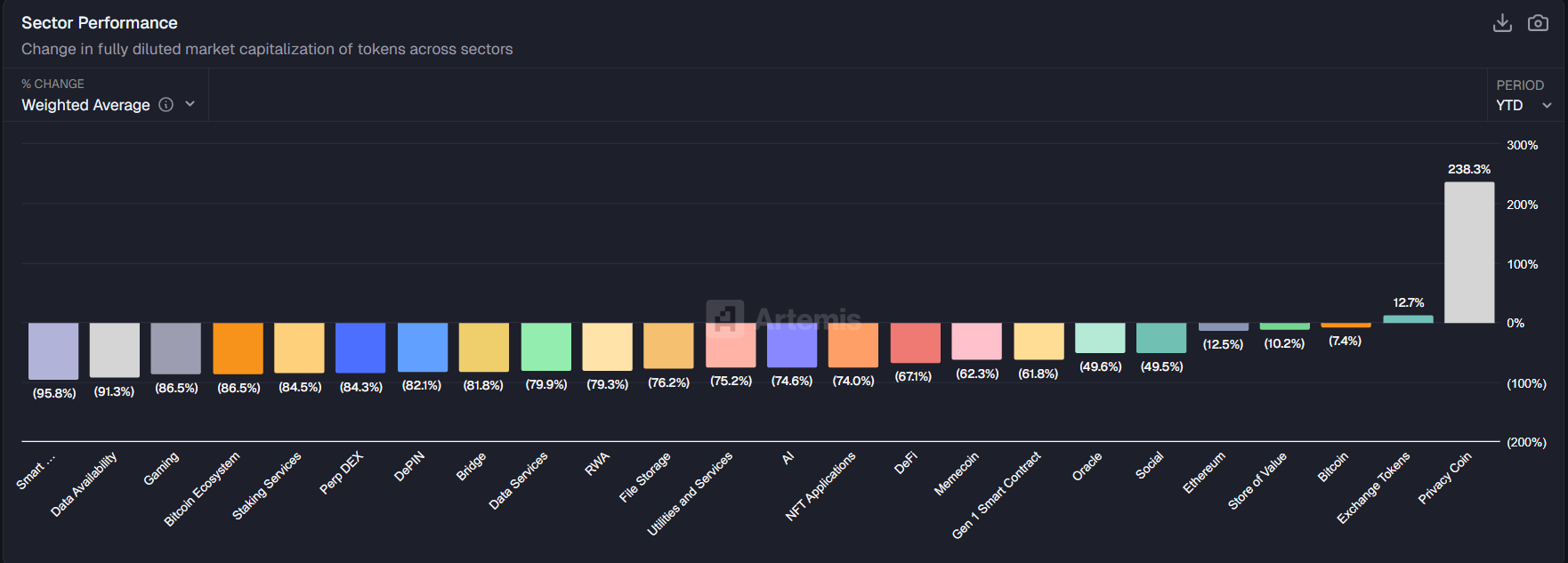
This control and freedom discord is starting to impact the numbers. While most crypto sectors have struggled this year, privacy coins are moving in the opposite direction.

In fact, data from Artemis revealed that they are the best-performing sector YTD, far outperforming everything else.

Source: TradingView

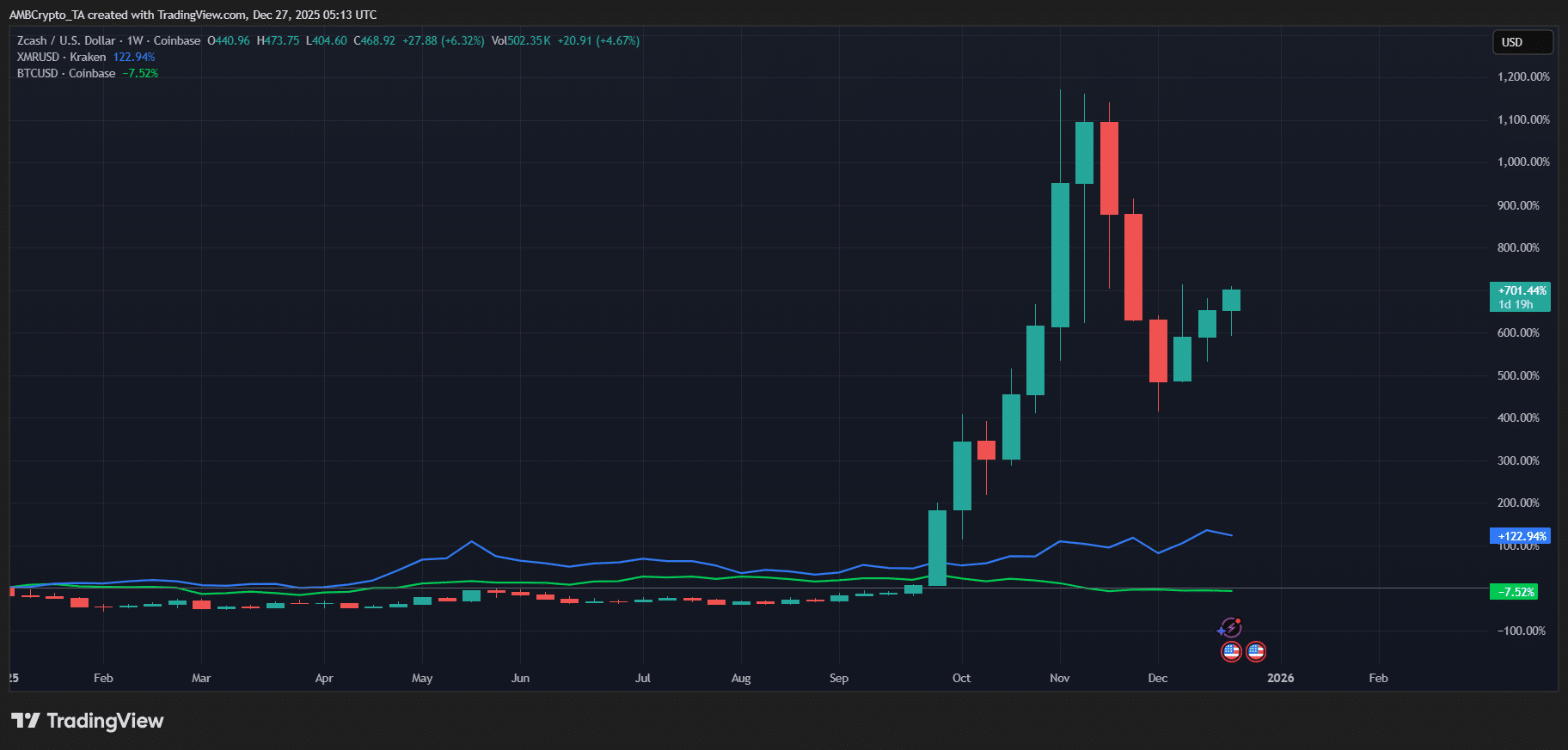
While Bitcoin [BTC] remains the market’s anchor, its performance this cycle has been relatively restrained.

Over the same period that Bitcoin has struggled to push higher, Zcash [ZEC] has surged by more than 700%. Monero [XMR] has held its ground with far less downside too.

Source: Coinmarketcap

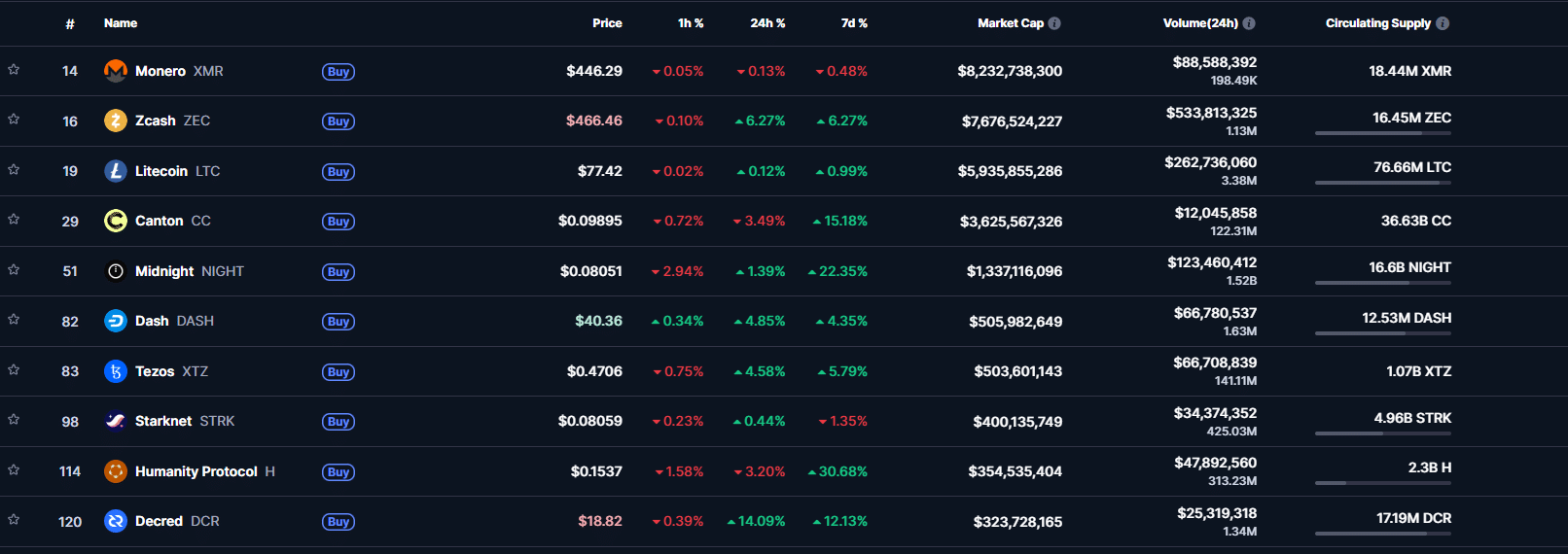
Trading activity is rising as well, with privacy coins climbing the rankings by volume and market cap. As regulations increase, capital is rotating towards assets built to preserve the holder’s autonomy.

Next: Just 1–2% – Here’s how retirement funds can change crypto forever
Share
  • Share
  • Tweet

Related Questions

QWhat is Vitalik Buterin's main criticism of the European Union's Digital Services Act (DSA)?

AVitalik Buterin argues that the DSA risks creating a digital environment with 'no space' for controversial ideas or products, warning that it could lead to excessive surveillance and enforcement instead of addressing the real issue of algorithms amplifying extreme content.

QWhy are privacy coins performing exceptionally well in 2025 according to the article?

APrivacy coins are the best-performing crypto sector in 2025 because as regulations like MiCA and the DSA tighten control, capital is rotating toward assets designed to preserve user autonomy and privacy.

QHow does Buterin suggest the European Union should approach digital regulation instead of the DSA?

AButerin advocates for a 'Pirate Party approach of user empowerment,' which emphasizes pluralism and resists unbalanced attempts to manipulate discourse, rather than erasing controversial ideas entirely.

QWhat specific examples of privacy coin performance are highlighted in the article?

AZcash (ZEC) surged over 700% during a period when Bitcoin struggled to advance, while Monero (XMR) also held its ground with significantly less downside volatility.

QHow has regulatory action in Europe and the U.S. influenced the focus on privacy coins?

AU.S. sanctions on Tornado Cash and EU enforcement of MiCA and DSA have made compliance harder for exchanges, leading to delistings of privacy coins—yet this has increased interest and investment in privacy-focused cryptocurrencies as users seek alternatives.

Related Reads

DeepSeek Funding: Liang Wenfeng's 'Realist' Pivot

DeepSeek, a leading Chinese AI company, has initiated its first external funding round, aiming to raise at least $300 million at a valuation of no less than $10 billion. This move marks a significant shift from its founder Liang Wenfeng’s previous idealistic stance of rejecting external capital to maintain independence. Despite strong financial backing from its parent company, quantitative trading firm幻方量化 (Huanfang Quant), which provided an estimated $700 million in revenue in 2025 alone, DeepSeek faces mounting challenges. Key issues include a 15-month gap in major model updates, delays in its flagship V4 release, and the loss of several core researchers to competitors offering significantly higher compensation. The company is also undergoing a strategic pivot by migrating its infrastructure from NVIDIA’s CUDA to Huawei’s Ascend platform, a move aligned with China’s push for technological self-reliance amid U.S. export controls. However, DeepSeek lags behind rivals like智谱AI and MiniMax—both now publicly listed—in areas such as product ecosystem, multimodal capabilities, and commercialization. The funding round, though relatively small in scale, is seen as a way to establish a market-validated valuation anchor, making employee stock options more competitive and facilitating talent retention. It also signals DeepSeek’s transition from a pure research-oriented organization to a commercially-driven player in the global AI ecosystem.

marsbit25m ago

DeepSeek Funding: Liang Wenfeng's 'Realist' Pivot

marsbit25m ago

Solana Q1 Report: Revenue Plunges 68% Year-on-Year, Developers Decrease by 30%

Solana Q1 2026 Report: Key Metrics Show Significant Decline Amid Market Reset Solana experienced a substantial downturn in Q1 2026, with key performance indicators reflecting a broader market cooling. Total network revenue (REV) fell to $89.9 million, down 68% year-over-year (YoY) and 1.4% quarter-over-quarter (QoQ). This decline was driven by reduced speculative activity, which had previously fueled the network during the 2024/2025 bull market. Key revenue components saw mixed results: base fees dropped 8.7% QoQ, Jito tips (MEV) fell 19.7%, priority fees rose 23%, and vote fees declined 44.5%. The annualized real yield for stakers was just 0.17%, down 67% YoY. Network GDP, generated by top applications, fell 7% QoQ to $451 million. Pump Fun emerged as a standout, generating $103 million (up 3% QoQ), surpassing Solana's L1 revenue. However, daily active addresses averaged 2.4 million, down 4.8% YoY. Stablecoin supply on Solana reached $15.9 billion, down 2.7% QoQ but up 18% YoY. USDC and USDT remained dominant. DEX volumes averaged $3.2 billion daily, with private DEXs now accounting for 60% of all volume. The network's net dilution rate was 4.38%, while the cost to produce $1 of REV was $8.10, up 93% YoY. The number of new tokens created on launchpads grew 42% QoQ to 3 million, with Pump Fun dominating 85% of this market. Despite the downturn, Solana's core strengths remain: its position as a hub for retail trading apps, potential in perpetual markets, and growing use in stablecoin-based fintech applications, particularly in Latin America. However, developer activity declined 32% YoY, slightly worse than Ethereum's 29% drop. The network must now focus on attracting traditional finance, competing in perpetual markets, and sustaining developer ecosystem growth to drive the next expansion cycle.

marsbit1h ago

Solana Q1 Report: Revenue Plunges 68% Year-on-Year, Developers Decrease by 30%

marsbit1h ago

Trading

Spot
Futures

Hot Articles

Discussions

Welcome to the HTX Community. Here, you can stay informed about the latest platform developments and gain access to professional market insights. Users' opinions on the price of S (S) are presented below.

活动图片