Ethereum’s Vitalik Buterin challenges Europe’s “no space” vision for digital assets

ambcryptoPublished on 2025-12-27Last updated on 2025-12-27

Abstract

Ethereum co-founder Vitalik Buterin has criticized the European Union’s Digital Services Act (DSA), warning that it risks creating a digital environment with "no space" for controversial ideas or products. Buterin argues that the DSA’s approach to making platforms safer is flawed, as it may lead to excessive surveillance and enforcement rather than addressing the real issue—algorithmic amplification of extreme content. He advocates for a "Pirate Party approach" focused on user empowerment and pluralism. Amid tightening regulations, privacy coins like Zcash and Monero have become the best-performing crypto sector in 2025, with Zcash surging over 700% as investors seek assets that preserve financial autonomy. This trend coincides with the EU’s enforcement of MiCA and other strict crypto regulations, which have increased scrutiny on stablecoins, anti-money laundering measures, and operational risks. Buterin’s comments reflect broader concerns that restrictive policies may inadvertently fuel demand for privacy-focused tools, as seen in earlier bans on privacy coins in Japan and U.S. sanctions on Tornado Cash. The ongoing regulatory clampdown in Europe appears to be driving capital toward cryptographic assets designed to uphold user privacy and freedom.

The privacy coin boom taking place in 2025 is no coincidence.

Key industry stakeholders have time and again pushed back strongly against rules that leave no breathing space for crypto. The latest to have his say is Ethereum co-founder Vitalik Buterin.

What’s happening?

Buterin has strong opinions against the European Union’s Digital Services Act (DSA). In a recent X post, the Ethereum co-founder warned that the law risks creating a digital environment where there is “no space” for controversial ideas or products to exist at all.

“I hope European govs do not go this way, and instead take a Pirate Party approach of user empowerment.”

While the DSA aims to make online platforms safer and more accountable, Buterin argued that this philosophy is flawed. He believes the problem isn’t that unpopular or extreme ideas exist, but that algorithms often amplify them at scale. Trying to erase such ideas entirely, he said, risks encouraging excessive surveillance and enforcement.

“There is a real opportunity to reaffirm freedom of speech in a unique and different way, that emphasizes pluralism and pushes against unbalanced attempts to manipulate the discourse…”

Privacy coins take the lead

Source: Artemis

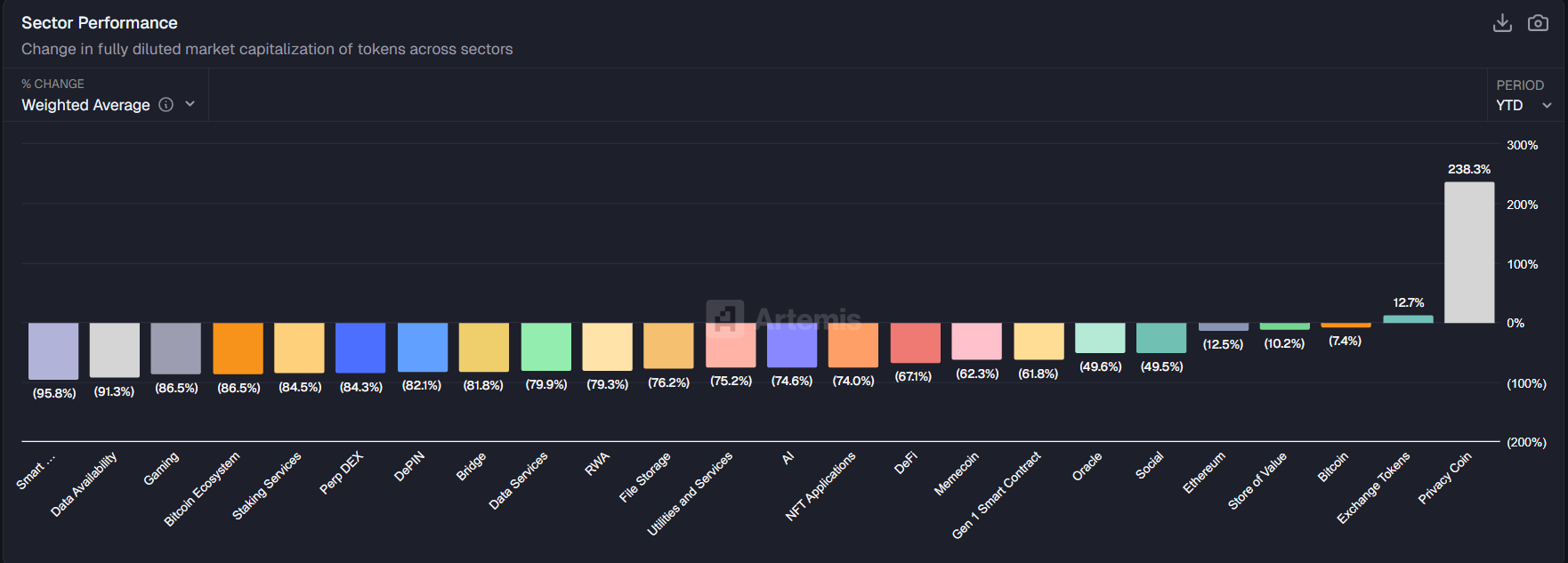
This control and freedom discord is starting to impact the numbers. While most crypto sectors have struggled this year, privacy coins are moving in the opposite direction.

In fact, data from Artemis revealed that they are the best-performing sector YTD, far outperforming everything else.

Source: TradingView

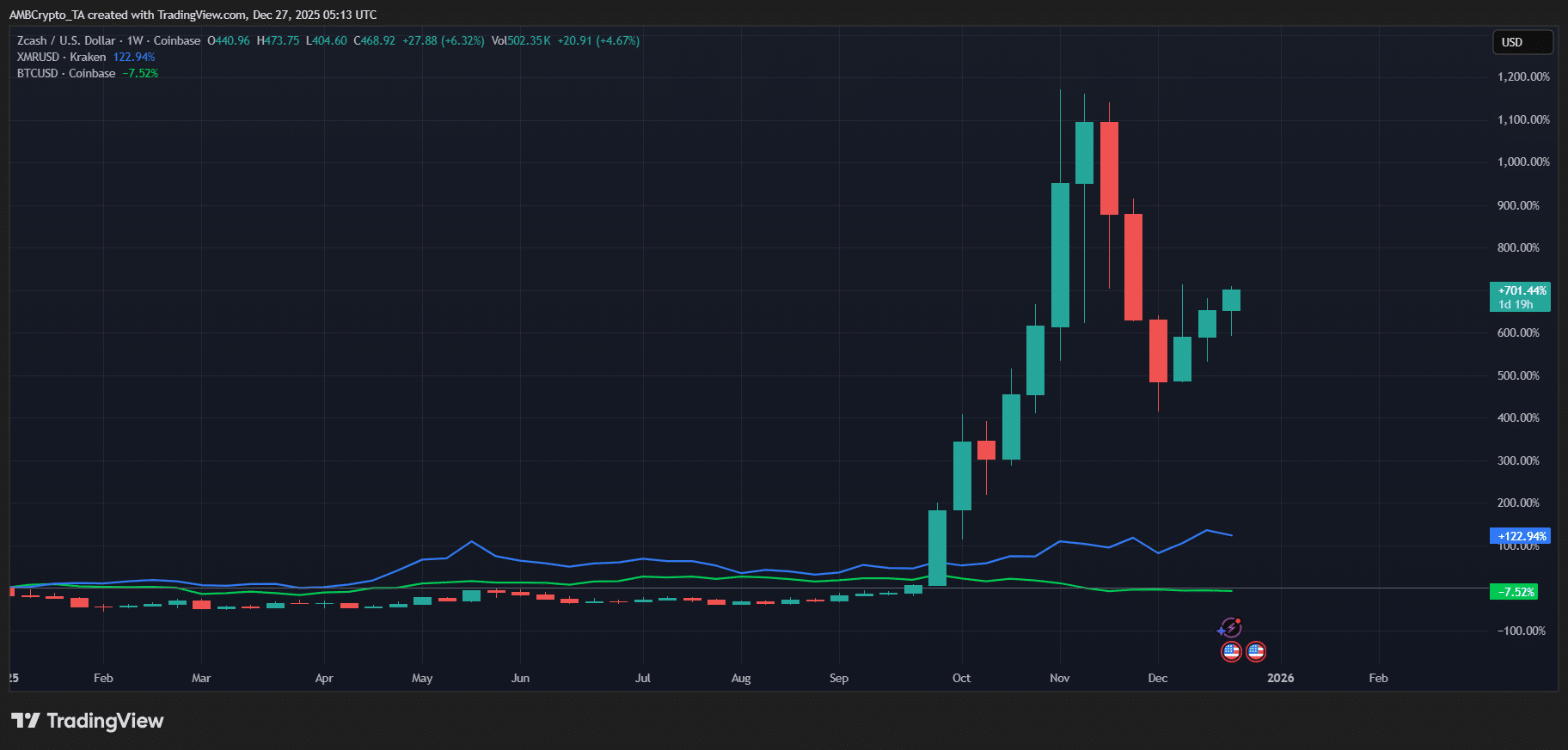
While Bitcoin [BTC] remains the market’s anchor, its performance this cycle has been relatively restrained.

Over the same period that Bitcoin has struggled to push higher, Zcash [ZEC] has surged by more than 700%. Monero [XMR] has held its ground with far less downside too.

Source: Coinmarketcap

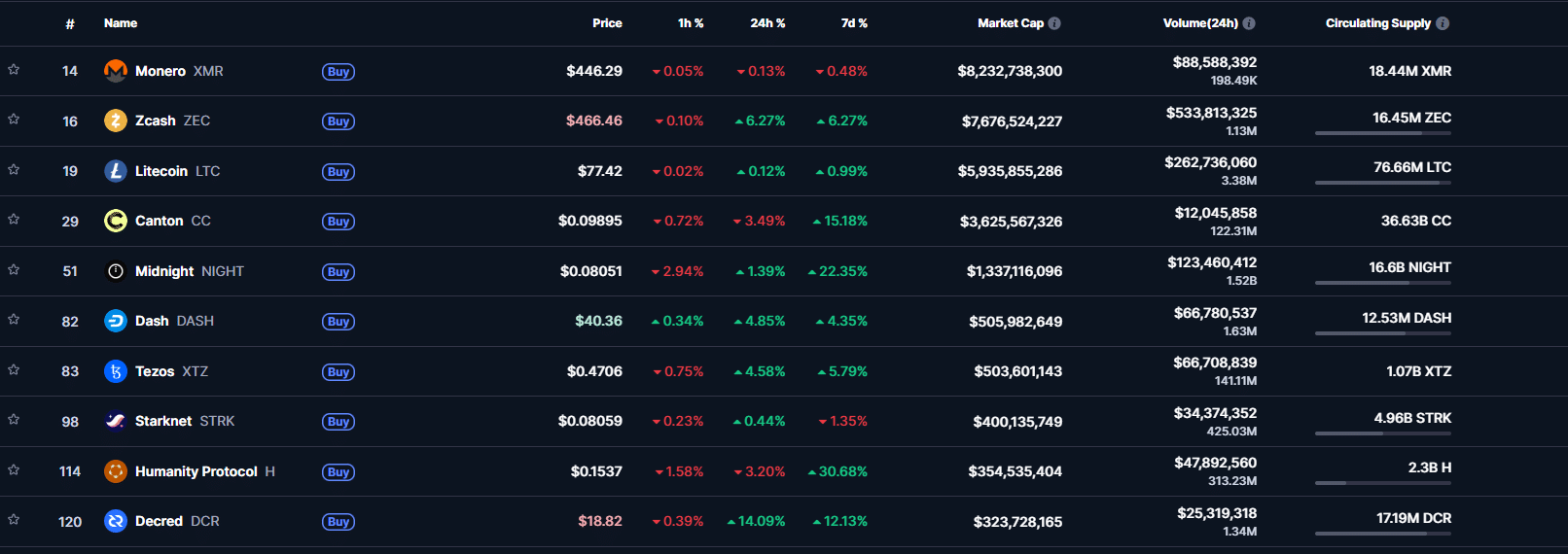
Trading activity is rising as well, with privacy coins climbing the rankings by volume and market cap. As regulations increase, capital is rotating towards assets built to preserve the holder’s autonomy.

Next: Just 1–2% – Here’s how retirement funds can change crypto forever
Share
  • Share
  • Tweet

Related Questions

QWhat is Vitalik Buterin's main criticism of the European Union's Digital Services Act (DSA)?

AVitalik Buterin argues that the DSA risks creating a digital environment with 'no space' for controversial ideas or products, warning that it could lead to excessive surveillance and enforcement instead of addressing the real issue of algorithms amplifying extreme content.

QWhy are privacy coins performing exceptionally well in 2025 according to the article?

APrivacy coins are the best-performing crypto sector in 2025 because as regulations like MiCA and the DSA tighten control, capital is rotating toward assets designed to preserve user autonomy and privacy.

QHow does Buterin suggest the European Union should approach digital regulation instead of the DSA?

AButerin advocates for a 'Pirate Party approach of user empowerment,' which emphasizes pluralism and resists unbalanced attempts to manipulate discourse, rather than erasing controversial ideas entirely.

QWhat specific examples of privacy coin performance are highlighted in the article?

AZcash (ZEC) surged over 700% during a period when Bitcoin struggled to advance, while Monero (XMR) also held its ground with significantly less downside volatility.

QHow has regulatory action in Europe and the U.S. influenced the focus on privacy coins?

AU.S. sanctions on Tornado Cash and EU enforcement of MiCA and DSA have made compliance harder for exchanges, leading to delistings of privacy coins—yet this has increased interest and investment in privacy-focused cryptocurrencies as users seek alternatives.

Related Reads

How Risky is the "Death Spiral" of MSTR and STRC?

Summary: This article explores the perceived "death spiral" risk between MicroStrategy (MSTR), its Bitcoin holdings, and its perpetual preferred stock (STRC), drawing comparisons to the LUNA-UST collapse. While both systems feature price anchors, high yields for holders, and potential feedback loops, their core mechanisms differ fundamentally. The MSTR-STRC structure relies on continuous financing to sustain its high dividend payouts, primarily through stock ATM offerings. A negative feedback cycle could occur: falling MSTR stock price makes raising equity capital harder, increasing pressure to sell Bitcoin, which undermines STRC confidence and further depresses MSTR. However, unlike LUNA-UST's automated, direct linkage, the MSTR-STRC loop is weaker and has brakes: STRC dividends can be deferred or rates lowered, and STRC holders have a $100/share liquidation preference in bankruptcy, providing a price floor. The company's sustainability hinges on its ability to continue financing. Its current ~$900 million USD reserves cover only about 6.3 months of its ~$1.71 billion annual interest/dividend burden. The next six months are critical, aligning with both the potential bottom in Bitcoin's four-year cycle and the depletion timeline of its reserves. While a LUNA-style catastrophic collapse is deemed highly unlikely due to structural differences, the key question is whether MicroStrategy can navigate this period through healthy deleveraging to restart its capital engine.

Foresight News5m ago

How Risky is the "Death Spiral" of MSTR and STRC?

Foresight News5m ago

How Much Debt Does Strategy Really Have? Is There a Risk of Implosion?

MicroStrategy's Debt Risk: A Turning Point in the "Never Sell" Strategy As of June 3, 2026, MicroStrategy holds 843,706 bitcoins (valued at ~$53.1B) but faces significant financial obligations. Its capital structure includes $6.75B in convertible notes and $15.48B in perpetual preferred stock (led by the $8.5B STRC series), creating an annual payout burden of ~$1.71B. With software revenue at only ~$500M, interest and dividend obligations far exceed operating income. A critical shift occurred in late May 2026 when the company sold 32 bitcoins for ~$2.5M to cover dividends, breaking CEO Michael Saylor's long-standing "never sell" pledge. This symbolic move triggered a sharp decline in both Bitcoin's price and MSTR stock, reflecting market fears about cash flow sustainability. The core of the strain is the STRC perpetual preferred stock, designed as a "permanent loan" with no maturity date but requiring high monthly dividends (currently 11.5%). Its business model relies on a three-part cycle: issuing new STRC shares, using proceeds to buy more Bitcoin and fund a USD reserve, and using that reserve to pay dividends. This cycle depends on continuous investor demand for STRC and Bitcoin's price appreciation. Analysis shows Bitcoin needs to appreciate at least 2.3% annually to cover the $1.71B in yearly obligations at current holdings. With Bitcoin price down ~22% from March 2026 highs, this pressure has intensified. The company's $900M USD reserve can only cover about 7 months of payments if STRC issuance stalls. Key risks are not immediate bankruptcy or forced Bitcoin liquidation (as BTC is not collateral), but rather: 1) The erosion of MSTR's premium to its Bitcoin holdings (mNAV), which would cripple its ability to raise cheap capital; 2) A vicious cycle where stagnant Bitcoin prices reduce STRC demand, draining the USD reserve and forcing BTC sales, further depressing prices. The period from February 2027 to September 2028 is a crucial test, with over $5.9B in convertible notes facing put options or maturity. In essence, MicroStrategy has evolved from a simple Bitcoin holder into a complex financial entity acting like a "private Bitcoin bank," leveraging its BTC holdings to create layered financial products. Its survival depends on maintaining Bitcoin's price trend, its stock premium, and market appetite for its preferred shares. The recent token sale marks not a betrayal of its Bitcoin thesis, but an admission that the leveraged strategy must eventually be paid for.

marsbit15m ago

How Much Debt Does Strategy Really Have? Is There a Risk of Implosion?

marsbit15m ago

Anthropic Cries Wolf: Is the AGI Threat Real, or Just an IPO Story?

Anthropic has published an article titled "When AI builds itself," discussing the emerging concept of "recursive self-improvement," where AI begins to actively participate in designing, training, testing, and optimizing its own subsequent versions. The company presents internal data showing that by May 2026, over 80% of code merged into its codebase was written by Claude, its AI model. Claude's capabilities have expanded to handling complex, open-ended engineering tasks, achieving a 76% success rate in such areas, and even contributing to research processes, such as optimizing code performance and conducting AI safety experiments. Anthropic outlines an evolution from human-driven development to AI-assisted workflows, culminating in the current stage where AI agents can autonomously write, run, and delegate code. The company cautions that the path toward a "closed loop," where AI continuously improves itself, is becoming visible. It calls for coordinated global mechanisms to potentially slow or pause frontier AI development to allow safety research and societal structures to catch up. However, the timing of this warning coincides with Anthropic's preparations for an IPO, framing the narrative not just as a safety concern but also as a demonstration of Claude's advanced capabilities and its integral role in accelerating Anthropic's own R&D—creating a potential "flywheel" effect for competitive advantage. This contrasts with OpenAI's recent, more policy-oriented discussion of the same risks, highlighting the competitive dynamics in the AI industry as companies position themselves in both the technological and regulatory landscape.

marsbit1h ago

Anthropic Cries Wolf: Is the AGI Threat Real, or Just an IPO Story?

marsbit1h ago

Trading

Spot
Futures

Hot Articles

Discussions

Welcome to the HTX Community. Here, you can stay informed about the latest platform developments and gain access to professional market insights. Users' opinions on the price of S (S) are presented below.

活动图片