Ethereum’s Price Dips, But Bitmine Immersion Is Buying More ETH Through Market Chaos

bitcoinistPublished on 2026-03-06Last updated on 2026-03-06

Abstract

Ethereum's price has dipped significantly from its recent all-time high of $4,900, yet it has rebounded above $2,100. Despite the ongoing market turbulence, Bitmine Immersion is capitalizing on the volatility by expanding its Ethereum holdings. The company recently purchased an additional 50,900 ETH, bringing its total holdings to approximately 4.47 million ETH, which represents about 3.7% of the circulating supply. According to Bitmine's CEO Tom Lee, this strategic accumulation is a deliberate move, reflecting strong conviction in Ethereum's long-term prospects and expectations of a market recovery by March. From a technical perspective, Ethereum's price movement is closely aligned with Bitcoin's, showing signs of a potential bullish trend. Analysts suggest that while the market structure remains fragile and short-term direction is not guaranteed, the breaking of key resistance levels and the current price action indicate the possibility of a larger upward move. The price is now attempting to break above the $2,150 resistance level, signaling a potential shift in market sentiment.

Ethereum may have bounced back above the $2,100 price level once again, but it is still far away from its recent all-time high of $4,900. Even with ETH falling this hard from its recent high, big companies are still adopting the leading altcoin, and Bitmine Immersion is demonstrating this institutional demand.

Bitmine Adds More Ethereum Amid Turbulent Conditions

Despite ongoing market turbulence, popular company Bitmine Immersion is pressing forward with its crypto expansion strategy, acquiring more Ethereum into its portfolio. The behavior suggests that the firm is leaning into volatility rather than withdrawing from it, indicating conviction in Ethereum’s long-term prospects.

According to the report from CryptoRus, the firm made another purchase of roughly 50,900 ETH, bringing its total holdings to about 4.47 million ETH. After the recent purchase, Bitmine immersion now holds roughly 3.7% of all circulating supply, making it one of the biggest holders of the altcoin across the sector.

This is not a small treasury bet. Tom Lee, the Chief Executive Officer (CEO) of Bitmine, stated that the buying is deliberate and expects stocks and crypto to be up again in March while arguing that the markets are likely in the late stages of bottoming despite war headlines.
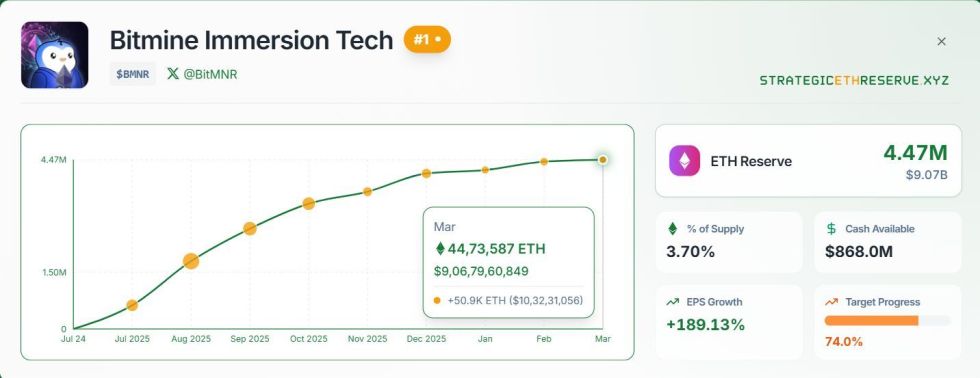
Source: Chart from CryptoRus on X

CryptoRus highlighted that these moves by Bitmine are a clear positioning, possibly ahead of a major upward move. With hundreds of millions in cash on hand, BitMine continues to accumulate ETH, viewing the decline as a chance rather than a red flag.

Although this indicates how at least one sizable, experienced player is interpreting this stage of the cycle, it does not ensure short-term price direction. When treasury buyers step in during a period of weakness, it often implies that the companies are ignoring the noise or FUD and are gearing up for the next leg.

ETH’s Price In Alignment With Bitcoin’s

On the 1-day timeframe, Ethereum’s price is currently following Bitcoin’s move higher in addition to the formation of the white bullish triangle scenario. In the past, it was assumed that even if one more low had developed, it would have probably been the last low in the structure. However, More Crypto Online stated that it has become less relevant with the current price action, and that possibility was present in the yellow scenario.

From here, the price can always go lower, but the key point of the bearish triangle required a break of support, which never occurred. Rather, the indication that the market was moving higher has been removed. A B-wave rally was still anticipated, even in the alternate scenario that permitted one more low.

Like Bitcoin, Ethereum has been monitoring the possibility of a bigger B-wave rally on the longer period, and it now seems to be taking place. However, the structure remains fragile and does not necessarily mark the beginning of a sustained impulsive rally. Thus, the expert noted that this move should be treated in terms of probabilities rather than certainty.

After resistance was broken, the short-term negative scenario that had been indicated on the chart was eliminated. Currently, the price is trying to break above the top limit of the range at $2,150.

ETH trading at $2,099 on the 1D chart | Source: ETHUSDT on Tradingview.com

Related Questions

QWhat is Bitmine Immersion doing despite the current market turbulence in the crypto space?

ADespite the ongoing market turbulence, Bitmine Immersion is continuing with its crypto expansion strategy by acquiring more Ethereum, indicating a conviction in its long-term prospects.

QHow much Ethereum did Bitmine Immersion purchase recently, and what is their total holding now?

ABitmine Immersion recently purchased roughly 50,900 ETH, bringing its total holdings to about 4.47 million ETH, which is approximately 3.7% of all circulating supply.

QAccording to the article, what does Tom Lee, CEO of Bitmine, expect for stocks and crypto in March?

ATom Lee, the CEO of Bitmine, stated that he expects stocks and crypto to be up again in March and argues that the markets are likely in the late stages of bottoming.

QWhat key price level is Ethereum's price currently trying to break above, as mentioned in the analysis?

AEthereum's price is currently trying to break above the top limit of the range at $2,150.

QHow does the article describe the nature of the current market move for Ethereum in terms of its sustainability?

AThe article describes the current market move as a potential B-wave rally but notes that the structure remains fragile and does not necessarily mark the beginning of a sustained impulsive rally. It should be treated in terms of probabilities rather than certainty.

Related Reads

In-Depth Report on the On-Chain Lending Market: When Off-Chain Credit Meets On-Chain Liquidation

The on-chain lending market has evolved from a peripheral DeFi niche into core financial infrastructure. As of early 2026, total value locked (TVL) in on-chain lending protocols has reached $64.3 billion, accounting for 53.54% of total DeFi TVL, making it the largest and most mature vertical within decentralized finance. Aave dominates the sector with approximately $32.9 billion in TVL, commanding nearly half of the market—a leadership position that is unlikely to be challenged in the foreseeable future. However, the path of on-chain lending forward is not without risk. Liquidation cascades, credit defaults, and cross-chain vulnerabilities remain systemic threats hanging over the industry. At the same time, a deeper structural transformation is underway: on-chain lending is shifting from a “leverage tool for crypto-native users” to a “compliant gateway for institutional capital”. The scale of RWA (Real World Asset) lending has surpassed $18.5 billion, with U.S. Treasuries and government securities increasingly serving as core collateral. Institutional capital inflows are reshaping both the user base and risk appetite of the sector. This report systematically analyzes the evolution of on-chain lending definitions, competitive dynamics, core risks, and future trends, providing a comprehensive industry outlook for investors and trade practitioners. Key findings suggest that the “one dominant player with several strong challengers” structure will persist in the short term, while fixed-rate lending, compliant collateral, and institutional credit underwriting will define the next phase of competition. For investors focused on DeFi infrastructure, three key opportunity tracks stand out, namely, the Aave ecosystem (Morpho, Spark), RWA lending protocols (Ondo, Maple) and fixed-rate innovation (Notional, Pendle).

HTX Learn1h ago

In-Depth Report on the On-Chain Lending Market: When Off-Chain Credit Meets On-Chain Liquidation

HTX Learn1h ago

Fu Peng's First Public Speech in 2026: What Exactly Are Crypto Assets? Why Did I Join the Crypto Asset Industry?

Fu Peng, a renowned macroeconomist and now Chief Economist at New火 Group, delivered his first public speech of 2026 at the Hong Kong Web3 Festival. He explained his perspective on crypto assets and why he joined the industry, framing it within the context of macroeconomic trends and financial evolution. Fu emphasized that crypto assets are transitioning from an early, belief-driven phase to a mature, institutionally integrated asset class. He drew parallels to the 1970s-80s, when technological advances (like computing) revolutionized traditional finance, leading to the rise of FICC (Fixed Income, Currencies, and Commodities). Similarly, current advancements in AI, data, and blockchain are reshaping finance, with crypto assets becoming part of a new "FICC + C" (C for Crypto) framework. He noted that institutional capital, including traditional hedge funds, avoided early crypto due to its speculative nature but are now engaging as regulatory clarity emerges (e.g., stablecoin laws, CFTC classifying crypto as a commodity). Fu predicted that 2025-2026 marks a turning point where crypto becomes a standardized, financially viable asset for diversified portfolios, akin to commodities or derivatives in traditional finance. Fu defined Bitcoin not as "digital gold" in a simplistic sense but as a value-preserving, financially tradable asset. He highlighted that crypto's future lies in regulated, institutional adoption, moving away from retail-dominated trading. His entry into crypto signals this maturation, where traditional finance integrates crypto into mainstream asset management.

marsbit2h ago

Fu Peng's First Public Speech in 2026: What Exactly Are Crypto Assets? Why Did I Join the Crypto Asset Industry?

marsbit2h ago

Trading

Spot
Futures

Hot Articles

Discussions

Welcome to the HTX Community. Here, you can stay informed about the latest platform developments and gain access to professional market insights. Users' opinions on the price of ETH (ETH) are presented below.

活动图片













