Ethereum Shows Signs Of Strength With Stronger Network Activity Supporting Growth

bitcoinistPublished on 2026-05-14Last updated on 2026-05-14

Abstract

Despite a slight price pullback, Ethereum's fundamentals show strength, driven by robust network activity and transaction growth. The altcoin has broken out of a multi-year consolidation phase, suggesting potential for significant upward movement. Over 7.33 million ETH (6% of supply) is locked on corporate balance sheets, and Ethereum's inflation rate is now lower than Bitcoin's post-Merge. Network performance is surging, with transaction volumes on the mainnet and Layer 2 solutions reaching all-time highs. Ethereum maintains a dominant 55-60% share of the Total Value Locked (TVL) in DeFi since mid-2022, reinforced by deep collateral markets and proven resilience. It hosts 50% of all stablecoin market capitalization and over 60% of tokenized real-world assets, indicating strong institutional trust and sticky capital. Experts note the fundamentals are aligning with the positive technical chart setup, strengthening investor conviction in Ethereum's long-term value.

While the price of Ethereum may have slightly pulled back, the underlying structure and fundamentals continue to show signs of strength. At the same time, the ETH network is demonstrating robust performance as transaction activity sees a steady increase across the blockchain.

Growing Network Strength Pushes Ethereum Back Into Focus

Ethereum’s recent upward momentum in the past few days is not only seen in its price action. This renewed strength is being observed across the ETH ecosystem as the network’s performance surges, which is triggering fresh momentum in the market.

During the period, there has been rising transaction activity, stronger on-chain engagement, and continued growth in key sectors that appear to be strengthening investors’ conviction in the network’s long-term value.

After examining the ETH chart in the monthly time frame, Leon Waidmann, a market expert and head of research at Lisk, revealed that the altcoin is currently exhibiting a trend that has caught the attention of the market. The chart shows a three-year sideways consolidation in a clean range supported by a breakout. Specifically, the momentum indicator at the bottom just broke out of its multi-year base.

ETH has been ranging since 2023, and building energy at the base of the structure. After a period of building strength, the altcoin has broken above the multi-year resistance, which has created a classic accumulation before a major move.
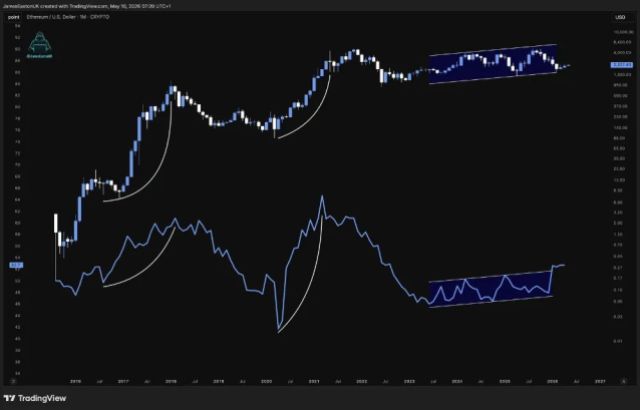
Source: Chart from Leon Waidmann on X

Consolidation phases are sometimes a positive reaction as they can precede upside movement. Waidmann noted that the longer the consolidation phase, the bigger the move out of it will be. What makes this period interesting is the increased network performance that is coinciding with the current momentum.

As stated by the expert, over 7.33 million ETH, representing 6% of all ETH supply, are locked on corporate balance sheets. Furthermore, inflation across the ETH ecosystem is currently lower than that of Bitcoin since the introduction of the Merge update. Other significant achievements include the surge in transactions on the ETH mainnet and layer 2 solutions, reaching new all-time highs. “The fundamentals are catching up, and the chart is setting up,” Waidmann added.

ETH Dominating DeFi And Lending

Etherealize has shared a recent report from Galaxy Research regarding Ethereum. In the report, the platform’s VP Research noted that ETH’s TVL market share has held remarkably steady at roughly 55% to 60% since mid-2022. The ETH network is witnessing notable liquidity, reinforcing its dominance in lending and DeFi.

This is due to the depth of its collateral markets, oracle infrastructure, and surviving multiple market crashes. Such development leads to the creation of a trust premium that newer chains cannot quickly replicate, particularly for the largest allocators whose risk tolerance is the lowest.

Also, stablecoin issuance on the network has skyrocketed to 50% of all stablecoin market cap, and over 60% of all tokenized real-world assets are issued on ETH. According to the platform, this is possibly some of the stickiest capital on Ethereum because institutional RWA issuers select a chain after months of legal examination, custodian integration, and compliance sign-off.

ETH trading at $2,301 on the 1D chart | Source: ETHUSDT on Tradingview.com

Related Questions

QDespite a slight price pullback, what shows signs of strength for Ethereum according to the article?

AThe underlying structure and fundamentals of Ethereum, particularly the robust network performance and steady increase in transaction activity, show signs of strength.

QWhat key on-chain metrics are strengthening investor conviction in Ethereum's long-term value?

ARising transaction activity, stronger on-chain engagement, and continued growth in key sectors are strengthening investor conviction.

QWhat did analyst Leon Waidmann note about Ethereum's multi-year consolidation phase on the monthly chart?

AHe noted that the longer the consolidation phase, the bigger the move out of it will be, describing it as a classic accumulation before a major move.

QWhat is Ethereum's approximate TVL (Total Value Locked) market share in DeFi since mid-2022, as cited in the Galaxy Research report?

AEthereum's TVL market share has held remarkably steady at roughly 55% to 60% since mid-2022.

QWhat specific achievements highlight Ethereum's dominance in stablecoins and tokenized real-world assets (RWAs)?

AStablecoin issuance on Ethereum is 50% of the total market cap, and over 60% of all tokenized real-world assets are issued on the network.

Related Reads

Winter for Crypto IPOs: Consensys and Ledger Withdraw Applications

The crypto IPO window is tightening significantly in 2026, marked by prominent companies delaying or pausing their public listing plans. Following a successful 2025 "harvest year" that saw Circle, Bullish, and Gemini go public amidst a bull market, the tide has turned. Consensys, developer of MetaMask, recently postponed its IPO until at least fall 2026. Hardware wallet leader Ledger also suspended its planned US listing due to unfavorable market conditions, with Kraken having previously delayed its own plans. This shift is driven by a cooling market in 2026, characterized by a significant Bitcoin price correction, declining trading volumes, and reduced investor risk appetite for crypto stocks. The poor post-IPO performance of 2025 listings like Circle and Bullish, which saw major share price declines, has heightened investor caution. This contrasts sharply with the current AI sector, where companies like SpaceX, OpenAI, and Anthropic are commanding massive valuations and investor enthusiasm based on narratives of stable, exponential growth. Crypto companies now face pressure to transition from hype-driven models to demonstrating reliable cash flows and robust compliance. While the paused IPO plans may lead to valuation resets and affect ecosystem liquidity, they also accelerate industry consolidation toward stronger, more compliant infrastructure players. A potential recovery in Bitcoin's price and clearer regulations could reopen the IPO window in the latter half of 2026.

marsbit1h ago

Winter for Crypto IPOs: Consensys and Ledger Withdraw Applications

marsbit1h ago

ChatGPT Can Manage Your Money for You. Would You Trust It with Your Bank Account?

OpenAI has launched a personal finance tool for ChatGPT, currently in preview for US-based ChatGPT Pro users. This feature allows users to connect their bank and investment accounts (via Plaid, supporting over 12,000 institutions) directly to ChatGPT. It analyzes transactions, generates visual dashboards, and offers conversational financial advice—such as budgeting or planning for major purchases—based on the user's actual data. This move follows OpenAI's acquisitions of fintech startups Roi and Hiro Finance, signaling a strategic push into vertical "super assistant" applications, similar to its earlier health-focused feature. However, the launch has sparked significant privacy concerns. Critics question the safety of granting such sensitive financial access to an AI, especially amid ongoing lawsuits alleging OpenAI shared user chat data with third parties like Meta and Google. OpenAI emphasizes that ChatGPT only reads data (no transaction capabilities), deletes it within 30 days if disconnected, and offers opt-out options for model training. Yet, trust remains a major hurdle. The trend reflects a broader industry shift: AI companies like Anthropic and Perplexity are also targeting high-value, data-rich domains like finance and health. While technically promising, the tool operates in a regulatory gray area—it provides personalized guidance but disclaims formal financial advice or liability. Ultimately, OpenAI's challenge is convincing users to trust an AI with their most private financial information.

marsbit1h ago

ChatGPT Can Manage Your Money for You. Would You Trust It with Your Bank Account?

marsbit1h ago

Trading

Spot
Futures

Hot Articles

Discussions

Welcome to the HTX Community. Here, you can stay informed about the latest platform developments and gain access to professional market insights. Users' opinions on the price of ETH (ETH) are presented below.

活动图片