Ethereum Price Slips Below Whale Cost Basis — More Pain For Bulls?

bitcoinistPublished on 2026-02-08Last updated on 2026-02-08

Abstract

Ethereum's price experienced a significant downturn in early February, falling over 30% and briefly dropping below $1,850. A critical development occurred as the price slipped below the realized price (average on-chain acquisition cost) of all investor cohorts, including large holders (whales) with over 100k ETH, whose cost basis is approximately $2,074. Historically, this whale cost level has acted as strong resistance in downtrends and reliable support in uptrends. A break below it suggests two potential outcomes: a sharp rebound if reclaimed as support (as seen in 2020 and 2022), or further capitulation toward multi-year lows (as in 2018-2019). Key resistance for any recovery is seen between $2,534–$2,675 (the realized price of smaller holders). If the $2,074 level is not reclaimed within 30-45 days, ETH could decline further to $1,800 or even $1,300–$1,600. At the time of writing, ETH is trading at $2,030, up over 7% in 24 hours.

In line with its bearish market structure, the Ethereum price struggled significantly in the first week of February. The cryptocurrency’s value fell by more than 30% over the week, crashing to as low as $1,850 on Friday, February 6. Amid the Ethereum market downturn, a significant development has emerged — one which could make or mar the world’s second-largest cryptocurrency.

Ethereum Breaches Realized Price Across All Investor Cohorts

In a recent post on Quicktake, on-chain analyst MorenoDV shared a shocking development within the Ethereum network. The analyst highlighted that the Ethereum price recently slipped below the cost basis of multiple investor groups.

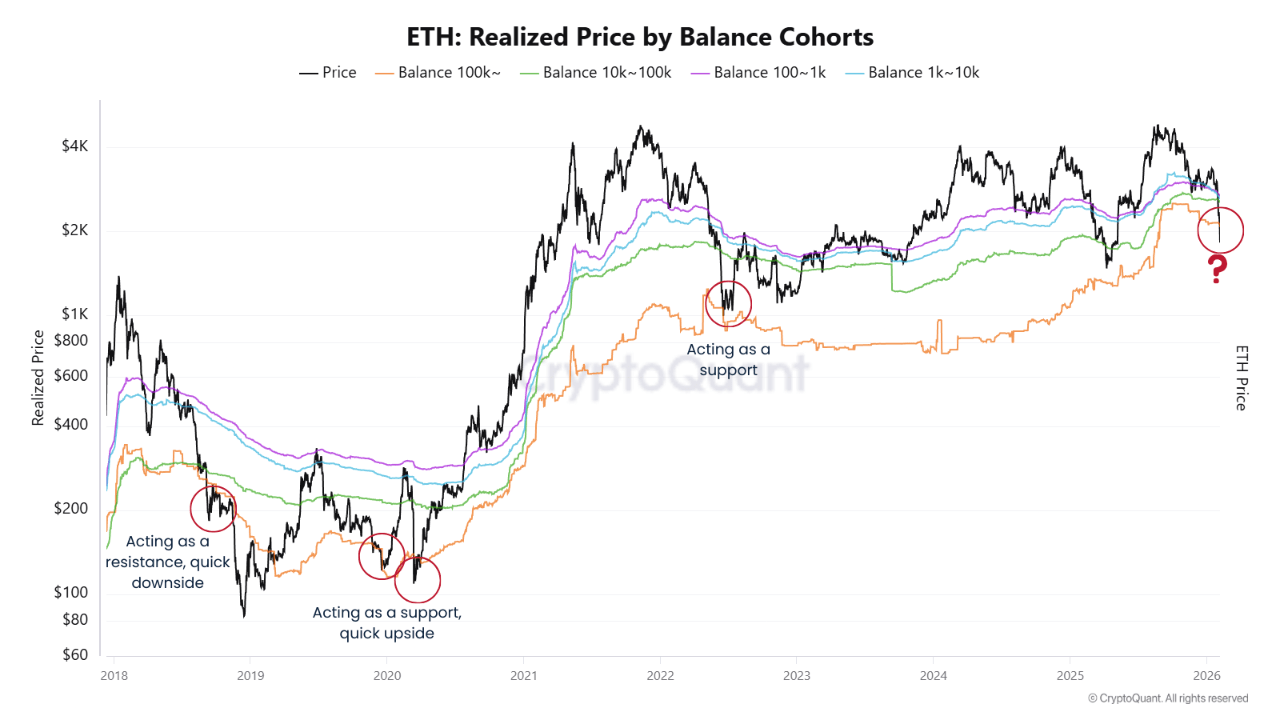
The revelation is based on the Realized Price by Balance Cohorts metric, which monitors the average on-chain cost basis of Ethereum holders. The metric groups these investors by wallet size, showing where these cohorts are holding profitably or running at losses.

Source: CryptoQuant

In the chart above, we see the Ethereum price break beneath multiple cost bases (represented with yellow, green, blue, and purple lines). The most striking, however, is the loss of the realized price of the largest holders (with 100k ETH and above stored), which stands at around $2,074.

Historically, the realized price of this investor class (with more than 100k ETH in holdings) has taken on dual roles for the Ethereum price, depending on its trajectory. According to data from 2019, mid-2020, and late 2022 price actions, whale realized price typically takes on a role of formidably resisting price during downtrends; during uptrends, it interestingly acts as reliable support.

Hence, at periods where the Ethereum price stabs through the whale realized price to the downside, MorenoDV explained that two potential paths typically emerge. In his words: “either a violent snap-back rally as the level flips to support (2020, 2022), or further capitulation into multi-year lows (2018-2019).”

Major ETH Price Levels To Watch

Because the Ethereum price went through all investor cohorts’ realized prices at the same time, there is something worth noting here. MorenoDV pointed out that smaller holders collectively have their realized prices between the $2,534 – $2,675 range.

Thus, should the Ethereum price attempt to recover previous legs, the $2,534–$2,675 price range will pose significant resistance to that effort. However, the aforementioned range is not the most critical one for the Ethereum price.

The analyst highlighted the whale cohort’s realized price, which is approximately $2,074 — to be the most critical for the Ethereum price. Following previous extrapolations, a reclamation of this level would likely follow historical trends and push prices upwards, while failure to retake this level within a period of 30 – 45 days would precede significant drawdowns.

In the event that the latter scenario holds true, the Ethereum price could swiftly fall to $1,800, or even lower. If price breaks beneath $1,800 and is sustained below this level, MorenoDV hypothesizes that this could lead Ethereum to the $1,600–$1,300 levels.

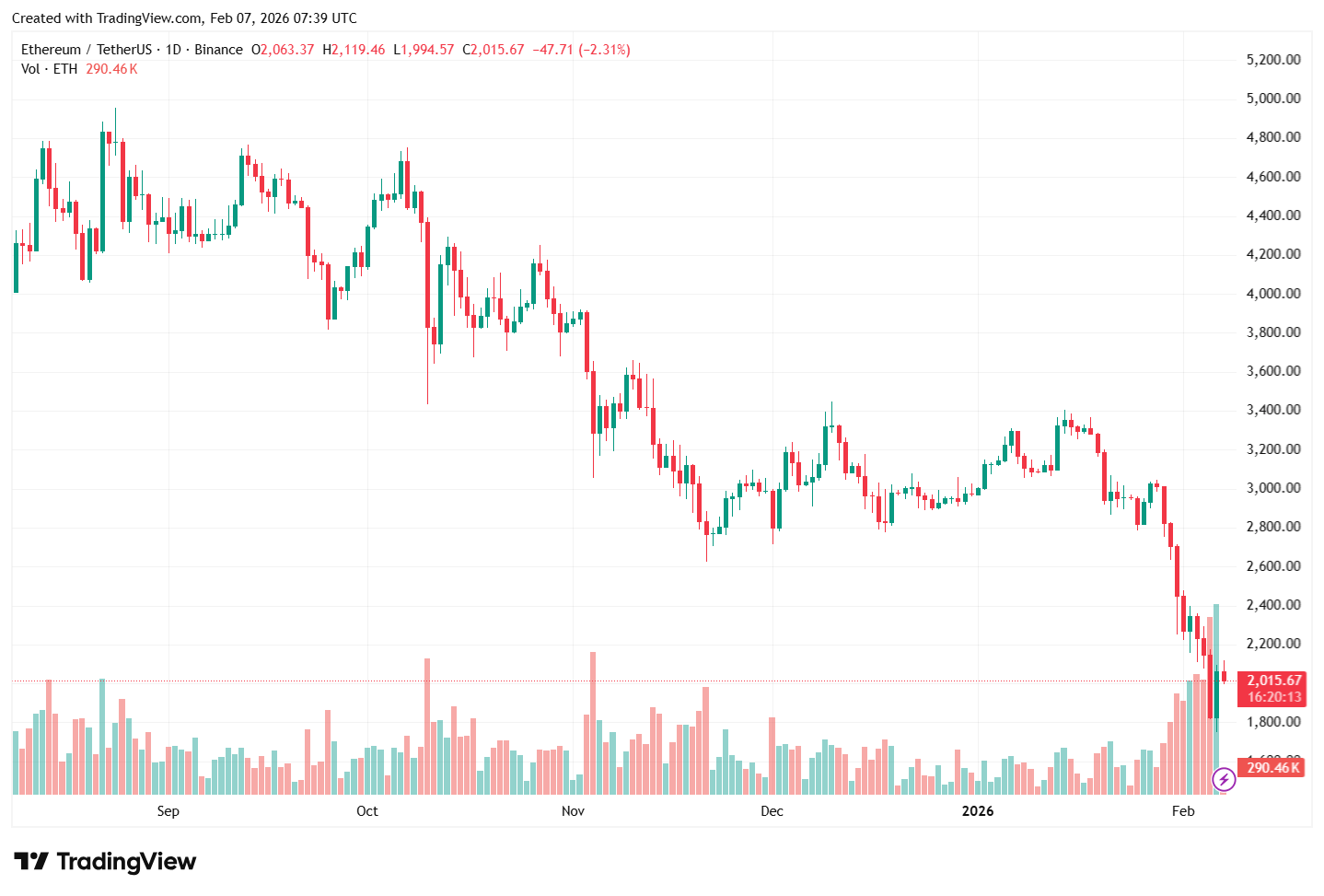
As of this writing, Ethereum stands at a valuation of $2,030, reflecting an over 7% jump in the past 24 hours.

The price of ETH on the daily timeframe | Source: ETHUSDT chart on TradingView

Related Questions

QWhat is the significance of the Ethereum price falling below the whale cost basis?

AThe Ethereum price falling below the whale cost basis (around $2,074) is significant because this level has historically acted as formidable resistance during downtrends and reliable support during uptrends. A break below it could lead to either a violent snap-back rally if reclaimed as support, or further capitulation into multi-year lows.

QAccording to the on-chain metric, what is the realized price range for smaller Ethereum holders?

AAccording to the Realized Price by Balance Cohorts metric, smaller Ethereum holders collectively have their realized prices in the range of $2,534 to $2,675.

QWhat are the two potential outcomes when the Ethereum price breaks below the whale realized price to the downside?

AThe two potential outcomes are: 1) a violent snap-back rally as the level flips to support (as seen in 2020 and 2022), or 2) further capitulation into multi-year lows (as seen in 2018-2019).

QWhat is the most critical price level to watch for the Ethereum price according to the analyst?

AThe most critical price level to watch is the whale cohort's realized price, which is approximately $2,074. Reclaiming this level would likely push prices upward, while failure to retake it within 30-45 days could precede significant drawdowns.

QWhat price levels could Ethereum fall to if it breaks and sustains below $1,800?

AIf the Ethereum price breaks beneath $1,800 and is sustained below that level, the analyst hypothesizes it could lead to a drop to the $1,600–$1,300 levels.

Related Reads

Popular Interaction Collection | Interstate Launches Points Event; Flip Early Waitlist Application (June 12)

**Interstate Launches Points Event, Flip Opens Early Waitlist Applications** *Originally published by Odaily Planet Daily, author Asher.* **Interstate**, an infrastructure platform integrating on-chain transactions for assets like Meme tokens, prediction markets, and xStocks, has launched a points event. Each trade on the platform now rewards users with points. The project has completed a $1.5 million seed round from investors including MH Ventures, Alchemy Ventures, and Marshland Capital. Users can visit the official website to connect their wallets and start earning points through trading tasks (note: the site may experience high traffic). **Flip**, an AI-powered financial assistant, has opened applications for its early waitlist. The platform allows users to manage finances via chat, helping with spending tracking, bill management, investment portfolio monitoring (including stocks and crypto), and more. Flip recently raised $1.4 million in a pre-seed round led by The House Fund and participated in a16z's Speedrun accelerator. Interested users can join the waitlist via the official website. **ArcNova**, an AI-native infrastructure platform for short-form video and entertainment, continues to offer tasks for earning points. Users can sign in daily, complete social and app tasks, and refer friends to accumulate points. The project announced a $15 million funding round in May, backed by Adaverse Ventures, Animoca Brands, and others. The task portal is accessible through the ArcNova website. These updates highlight ongoing opportunities for user engagement and potential rewards across emerging crypto and AI projects.

Odaily星球日报1h ago

Popular Interaction Collection | Interstate Launches Points Event; Flip Early Waitlist Application (June 12)

Odaily星球日报1h ago

MoneyGram: Why Did We Launch Our Own Stablecoin?

MoneyGram, a global leader in cross-border remittances for over 80 years, has launched its own stablecoin, MGUSD. The initiative aims to evolve from single-transaction services to becoming a more integral part of users' financial lives. By allowing customers to hold a stable US dollar balance within the MoneyGram app, MGUSD enables not only remittances but also everyday spending, currency exchange, cash access, and future financial services. Targeting the billions globally who face challenges like currency volatility or lack of bank accounts, MGUSD leverages Stellar blockchain technology with a self-custody wallet architecture. This gives users control over their assets while providing a secure, compliant experience through a trusted brand. The approach focuses on solving existing customer pain points within MoneyGram's established network, rather than competing for broad crypto market liquidity. A key advantage is MoneyGram's hybrid model, combining digital services with the world's largest physical network for crypto-to-cash conversions. The stablecoin also modernizes the company's internal infrastructure, streamlining treasury management and partner settlements, with annual forex volume via stablecoins already reaching $2 billion. The project was delivered in about a year, driven by a reorganization into agile, cross-functional teams that operate with startup-like speed while leveraging decades of institutional expertise. Partners include Stablecoin (issuance), Crossmint (wallet APIs), Fireblocks (enterprise treasury), m0 (smart contracts), and the Stellar network. MoneyGram emphasizes that enhancing direct consumer offerings strengthens its partner ecosystem. The future direction is clear: to provide users worldwide with stable value storage, better financial tools, and greater control over their funds through a trusted, existing network.

Foresight News2h ago

MoneyGram: Why Did We Launch Our Own Stablecoin?

Foresight News2h ago

Trading

Spot
Futures

Hot Articles

Discussions

Welcome to the HTX Community. Here, you can stay informed about the latest platform developments and gain access to professional market insights. Users' opinions on the price of ETH (ETH) are presented below.

活动图片