Ethereum Network Takes The Crown As The Home Of On-Chain AI Agents

bitcoinistPublished on 2026-02-27Last updated on 2026-02-27

Abstract

Ethereum is emerging as the dominant hub for on-chain AI agents, expanding beyond its DeFi roots. A recent report highlights that it hosts over 27,300 AI agents, significantly more than other major chains like Base and BNB Smart Chain. When combined with its Layer 2 networks, the Ethereum ecosystem supports the vast majority of all on-chain AI activity. Analysts note that AI agents thrive on Ethereum due to its deep liquidity, battle-tested infrastructure, and strong network effects. Bitmine Immersion is positioned to benefit from this trend, holding 4.4 million ETH and building staking network MAVAN to support Ethereum’s next phase and the growing ecosystem of AI-driven economic transactions.

Ethereum network dominance is turning out to be constructive rather than speculative as the blockchain expands beyond its Decentralized Finance (DeFi) stance. After dominating as a leader in on-chain finance, the network is now leading AI innovation.

AI Innovation Accelerates On The Ethereum Network

As the blockchain landscape expands, the Ethereum network is taking the spotlight in terms of Artificial Intelligence (AI) innovation. A recent report indicates that the blockchain is emerging as the primary hub for on-chain AI agents, suggesting an expansion beyond its roots in DeFi.

Compared to other chains, ETH is gradually becoming the home for these projects, surpassing them by a long shot. More autonomous, revenue-generating AI systems are being constantly hosted and supported by the blockchain.

As seen on the chart shared by Leon Waidmann, a data analyst and the head of research at Lisk, the number of AI agents on Ethereum has reached 27,315. Other major chains, such as Base, Monad, MegaETH, and BNB Smart Chain, have recorded 19,499, 8,348, 8,150, and 6,689 in AI agents, respectively. With this figure, the ETH network now handles 40% more AI agents than the chain in second spot.
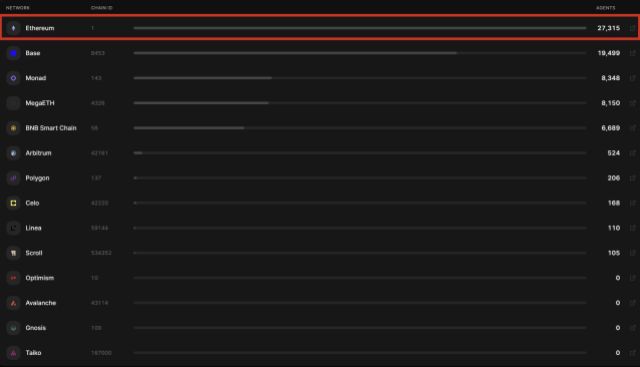
Source: Chart from Leon Waidmann on X

However, this may be larger than it looks. Base, along with Arbitrum, Scroll, Linea, and MegaETH, is an Ethereum Layer 2, which means the ETH ecosystem accounts for the vast majority of all on-chain AI agents when put together.

During this period, discussions regarding a haven for the AI agents. Providing an answer that aligns with that of the market, Waidmann stated that these agents live where the liquidity is, where the smart contracts are battle-tested. In addition, this is where the infrastructure is deepest and where the network effects are at their strongest.

Bitmine In The Center Of The AI Agents’ Growth

BMNR Bullz has revealed on X that Bitmine Immersion is positioned for Ethereum’s next phase and AI agents. With the internet shifting from moving information to moving value, the company is emerging as a pioneer of the transition. Previously considered as separate trends, blockchain, stablecoins, and AI are now converging into a programmable economic system where transactions, settlement, and capital allocation occur natively online.

The world is seeing a change with tens, potentially hundreds, of billions of AI agents set to interact and perform economic functions over the internet. These agents will need to work with programmable money, open settlement, and neutral infrastructure, not legacy rails, and this is where Ethereum comes in.

This is structurally bullish for ETH, and Bitmine was built around that reality. Bitmine boasts roughly 4.4 million ETH, marking about 3.7% of the total supply. There is zero debt and no forced selling through cycles from the company; therefore, reserving liquidity to accumulate during drawdowns. Furthermore, the firm has locked away 3 million ETH in staking, earning native yield.

Beyond holding and staking, Bitmine is building a staking and validation network, MAVAN, created to bolster its assets and expand to stake other companies’ crypto over time. This network will position the company at the forefront of ETH’s next phase and AI agent, and as part of the infrastructure layer supporting external capital.

ETH trading at $2,038 on the 1D chart | Source: ETHUSDT on Tradingview.com

Trending Cryptos

Related Questions

QAccording to the article, which blockchain network is leading in on-chain AI agents and by what margin?

AThe Ethereum network is leading in on-chain AI agents, handling 40% more AI agents than the chain in second place.

QWhat key reasons does Leon Waidmann give for why AI agents are primarily on the Ethereum network?

ALeon Waidmann states that AI agents live where the liquidity is, where smart contracts are battle-tested, where the infrastructure is deepest, and where the network effects are at their strongest.

QWhat company is highlighted as being positioned for Ethereum's next phase and AI agents, and how much ETH does it hold?

ABitmine Immersion is highlighted, and it boasts roughly 4.4 million ETH, which is about 3.7% of the total supply.

QBeyond holding ETH, what specific network is Bitmine building to support its position in the ecosystem?

ABitmine is building a staking and validation network called MAVAN to bolster its assets and expand to stake other companies' crypto.

QWhat major shift on the internet does the article mention that is creating the need for AI agents to work with programmable money?

AThe article mentions that the internet is shifting from moving information to moving value, which requires AI agents to work with programmable money, open settlement, and neutral infrastructure.

Related Reads

IPO Imminent, OpenAI Faces Major Personnel Upheaval

OpenAI, preparing for a potential IPO, is experiencing significant leadership turmoil. In mid-August 2026, longtime "GPU geek" Scott Gray quietly left, and within three days, Chief Operating Officer Brad Lightcap (8-year veteran) and Chief Revenue Officer Denise Dresser (8-month tenure) departed. This follows a broader exodus of at least 10 senior executives in 2026, including heads of product, safety, and ethics. Analysts view this as a strategic "surgery" to transform from a research lab into a sales-driven enterprise company before going public. Revenue now tilts toward enterprise clients, surpassing consumer income sooner than expected, with annualized revenue reaching $40 billion. The new CRO, Dali Rajic, is a veteran enterprise sales leader. Concurrently, OpenAI has disbanded independent safety teams like "Preparedness," which assessed catastrophic risks, integrating their functions into core research. Critics warn this removes dedicated "brakes" on AI development. The leadership vacuum raises questions about who is the clear second-in-command after former apps CEO Fidji Simo moved to an advisory role. Co-founder Greg Brockman appears to be consolidating power. As OpenAI races against rival Anthropic ($47B annualized revenue), it faces the dual challenge of commercial execution while managing the departure of foundational technical talent and ensuring responsible AI development remains a priority.

marsbit1h ago

IPO Imminent, OpenAI Faces Major Personnel Upheaval

marsbit1h ago

AI Can 'Have Moods Too'! New Research from USTC: Confusion and Anxiety Make AI Work Better

The article discusses research from the University of Science and Technology of China and Oxford, revealing that allowing AI to recognize and act upon simulated "internal emotions" can significantly improve its performance. The study demonstrates a coherent pairing between specific emotional states in AI agents and their subsequent skill choices. For instance, an agent feeling curious and desirous will search for products, while one feeling confused and tense will rephrase queries. This mirrors human decision-making influenced by emotions. Statistical validation showed a 76.5% semantic consistency in these pairings. Crucially, the research challenges the traditional view of AI errors as flaws to be eliminated. It found that "bad" emotions like confusion, tension, or frustration serve as useful metacognitive signals, indicating a mismatch between the current strategy and the environment. By responding to these signals, AI can proactively adjust before a failure occurs. This is particularly effective in complex tasks prone to failure. For example, in tasks like "heating an item" and "picking up two items," success rates surged from 9.6% to 56.9% and 4.4% to 31.3%, respectively, when using the emotion-driven skill selection method (EMOTION2SKILL). The AI's "nervous" state about a closed microwave, for instance, prompted it to check and open it first, preventing failure. The article also mentions related work from Tianjin University, which embeds emotional prediction into world models (Large Emotional World Model, LEWM), significantly improving prediction accuracy in human-centric environments. Removing emotional data was found to degrade performance even in unrelated logical reasoning tasks. These studies build on earlier findings, like those from Anthropic, that identifiable emotional representations exist within large language models (LLMs). The focus is shifting from philosophical debate about AI emotion to practically harnessing these internal states as functional signals to enhance AI robustness and capability.

marsbit2h ago

AI Can 'Have Moods Too'! New Research from USTC: Confusion and Anxiety Make AI Work Better

marsbit2h ago

Trading

Spot

Hot Articles

How to Buy HOME

Welcome to HTX.com! We've made purchasing Defi.app (HOME) simple and convenient. Follow our step-by-step guide to embark on your crypto journey.Step 1: Create Your HTX AccountUse your email or phone number to sign up for a free account on HTX. Experience a hassle-free registration journey and unlock all features.Get My AccountStep 2: Go to Buy Crypto and Choose Your Payment MethodCredit/Debit Card: Use your Visa or Mastercard to buy Defi.app (HOME) instantly.Balance: Use funds from your HTX account balance to trade seamlessly.Third Parties: We've added popular payment methods such as Google Pay and Apple Pay to enhance convenience.P2P: Trade directly with other users on HTX.Over-the-Counter (OTC): We offer tailor-made services and competitive exchange rates for traders.Step 3: Store Your Defi.app (HOME)After purchasing your Defi.app (HOME), store it in your HTX account. Alternatively, you can send it elsewhere via blockchain transfer or use it to trade other cryptocurrencies.Step 4: Trade Defi.app (HOME)Easily trade Defi.app (HOME) on HTX's spot market. Simply access your account, select your trading pair, execute your trades, and monitor in real-time. We offer a user-friendly experience for both beginners and seasoned traders.

6.3k Total ViewsPublished 2025.06.10Updated 2026.06.10

How to Buy HOME

Discussions

Welcome to the HTX Community. Here, you can stay informed about the latest platform developments and gain access to professional market insights. Users' opinions on the price of HOME (HOME) are presented below.

活动图片