Elon Musk's First Interview in 2026: Discussing the Impact of AI, Robotics, Energy, and US-China Competition on the Near Future

marsbitОпубликовано 2026-01-13Обновлено 2026-01-13

Введение

In a January 2026 interview, Elon Musk discussed the profound impact of AI, robotics, energy, and global competition on the near future. He declared 2026 as the "Year of Singularity," asserting that AI progress is exponential, with AGI achievable by 2026 and AI intelligence surpassing all humans combined by 2030. Musk predicted that Optimus robots would outperform human surgeons within three years, making high-quality healthcare essentially free due to AI, chip performance, and robotic dexterity advancing exponentially. He argued that pursuing medical degrees would become pointless unless for social reasons. On global AI competition, Musk stated China would dominate in computing power, citing its massive electricity production (3 times the U.S. by 2026), reduced chip advantage gaps, and exceptional execution capabilities. He envisioned the AI landscape led by XAI, Google, and China. For energy, Musk emphasized solar power as the ultimate solution, proposing a three-phase plan: doubling grid efficiency with battery storage, deploying space-based solar satellites, and eventually building satellite factories on the Moon. He described energy as the future currency. Economically, Musk suggested that money might become irrelevant in 10-20 years due to AI and robotics driving abundance, leading to "Universal High Income" (UHI) instead of UBI. He warned of a turbulent 3-7 year transition period. He also noted that work would become optional within two decades, expressed concern ...

Video: Moonshots

Compiled by: Model English

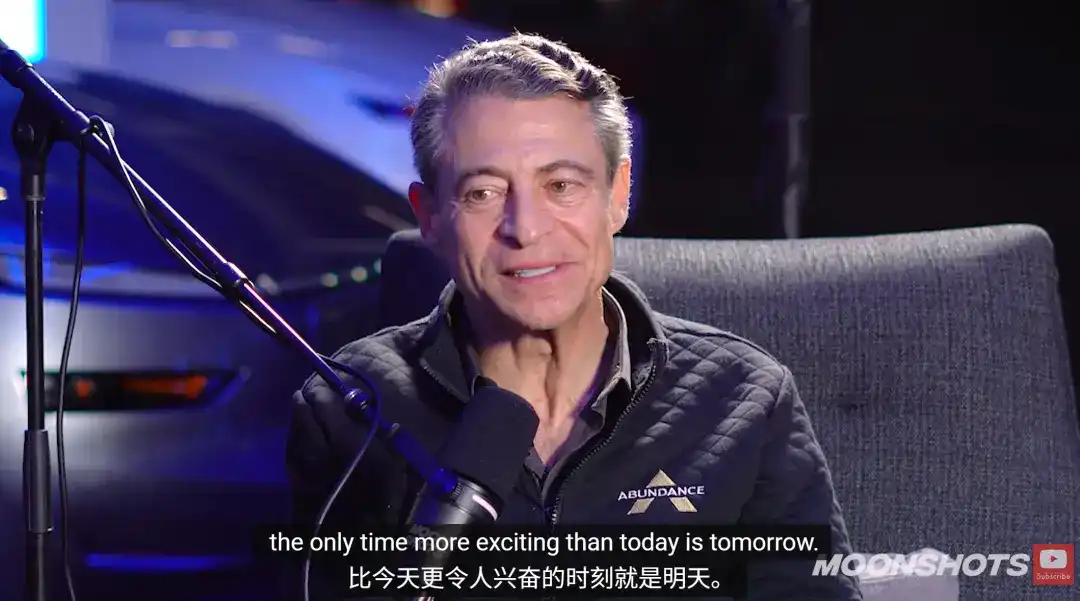
On January 6, 2026, Tesla founder Elon Musk was interviewed by renowned futurist and Singularity University founder Peter Diamandis and investor Dave Blundin.

In this podcast titled "Moonshots #220," the three engaged in a deep three-hour conversation. Musk clearly stated that 2026 is the "Year of Singularity" and elaborated on the industrial, technological, and economic foundations supporting this argument, painting a picture of a future reshaped by technological transformation.
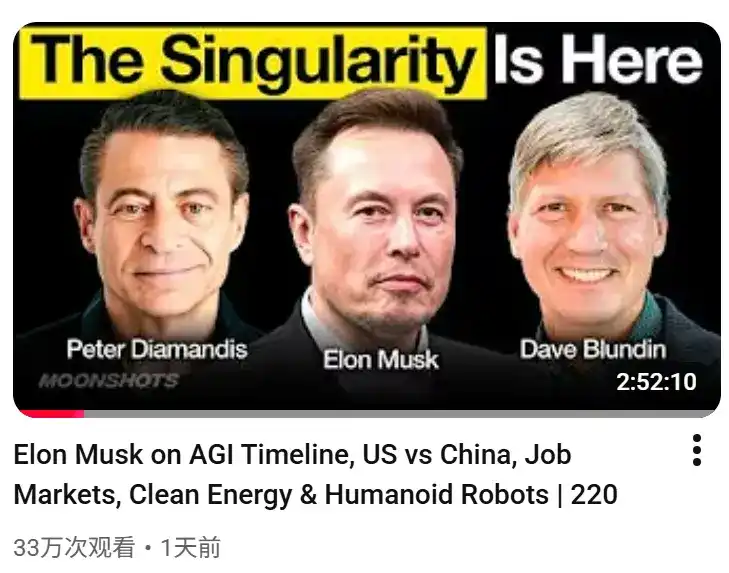
The conversation covered nearly 10 themes, including artificial intelligence, labor and social change, energy development, education and talent, health and longevity, space exploration, and innovation and entrepreneurship, totaling over 85,600 words. Many of the insights were extremely profound and forward-thinking.

To help everyone quickly grasp the core points of the interview, we have compiled and summarized the highlights to share with you all!

1. AI Exceeds Imagination; Intelligence Level to Surpass All Humanity Combined by 2030

Host Peter asked Musk, "Why are you so optimistic?"

Musk did not answer directly but instead offered a more shocking observation: "We are not moving towards the singularity; we are already living in it."
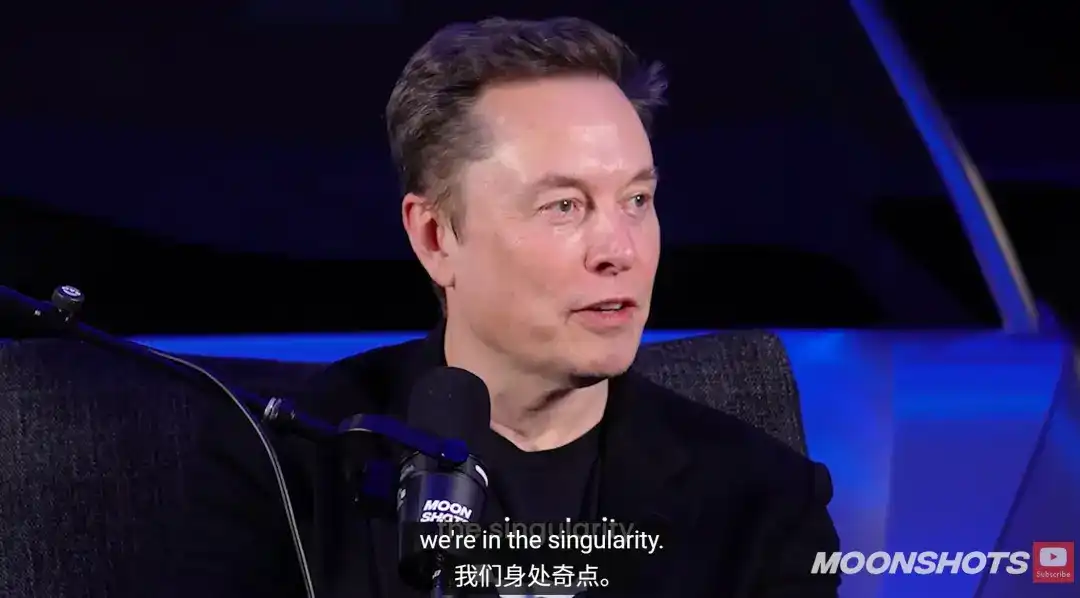
He explained that the pace of AI progress is so rapid that he himself is astonished several times a week—just as he finds one breakthrough amazing, a new shock arrives two days later. This is the power of exponential growth.

Musk predicted that AGI (Artificial General Intelligence) will be achieved in 2026, and by 2030, AI's intelligence level will surpass the sum total of all humanity.

2. Disruption in the Medical Field; Attending Medical School Will Be Meaningless

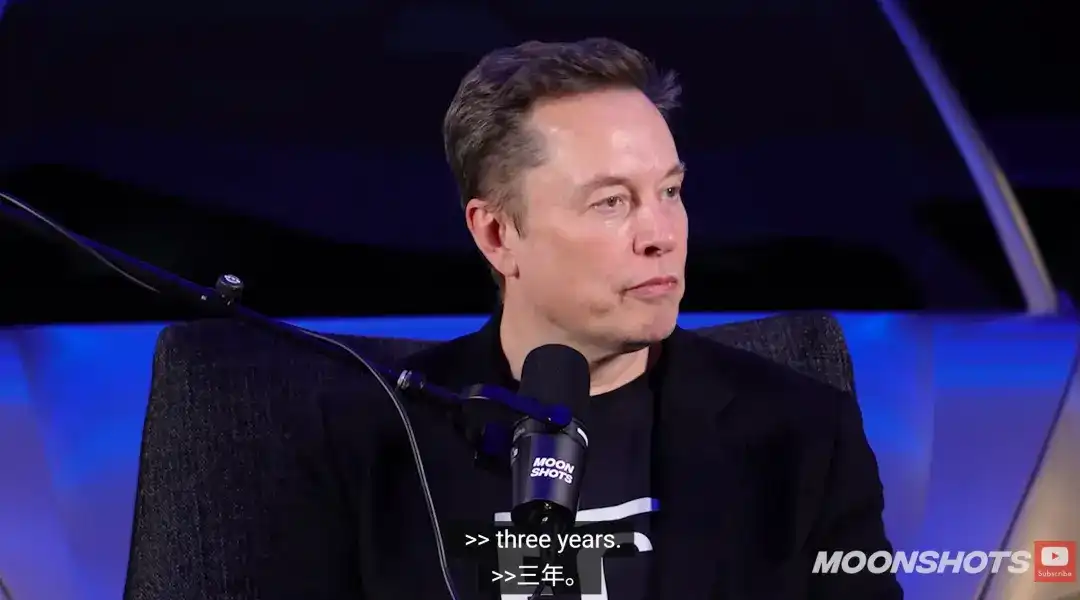
Addressing the current shortage of doctors and skilled surgeons, Musk predicted that within three years, the Optimus robot will become a better surgeon than any human, and this will be applied "at scale."

"In the future, the best medical care will basically be free," Musk stated.

Why so fast?

Musk pointed to the triple exponential growth advantages of robotic doctors:

  • First, exponential growth in AI capabilities;
  • Second, exponential growth in chip performance;
  • Third, exponential growth in electromechanical dexterity.

Multiplying these three exponential curves results in a rocket-like explosion of speed.
Musk added that more importantly, robots have a "recursive effect," meaning a robot's experience can accumulate, and all robots share the same knowledge base.

Ten thousand robotic doctors performing surgeries means each one can possess the experience of ten thousand operations. Different patients, different emergencies, different complications, even every detail under full spectrum light including infrared, ultraviolet, and X-ray—they can master it all precisely. Moreover, they won't get distracted because they argued with their family the night before, nor will their hands tremble from fatigue after four hours of continuous surgery.

Musk believes that (attending medical school in the future) is "meaningless. Unless it's for social reasons."
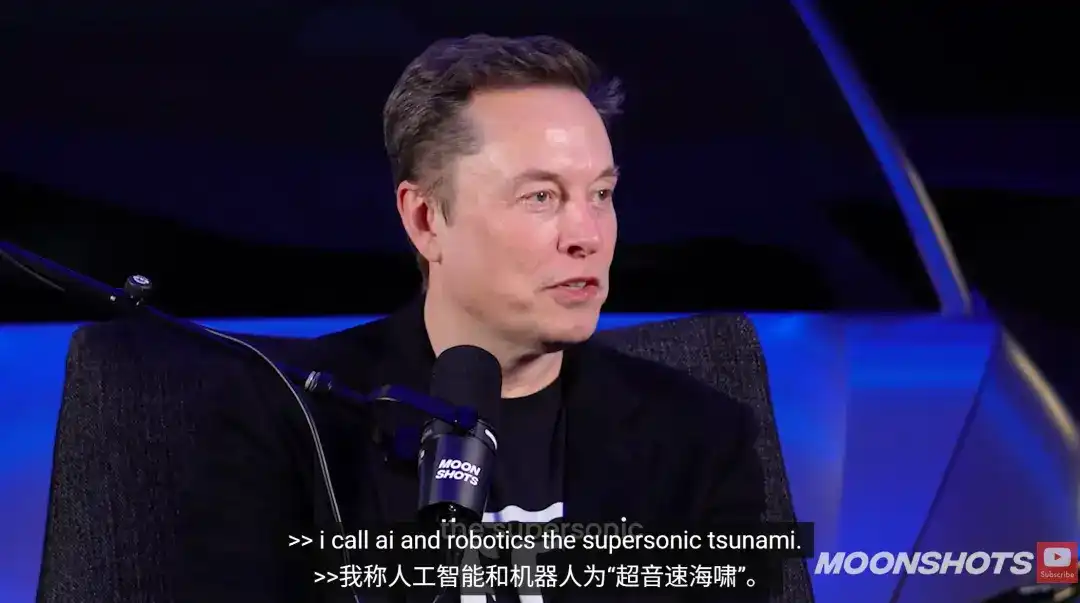
3. US-China AI Competition; China's Computing Power Will Far Exceed Other Regions

Regarding the current AI competition landscape, Musk asserted with great certainty: Based on current trends, China will far exceed the rest of the world in AI computing power.
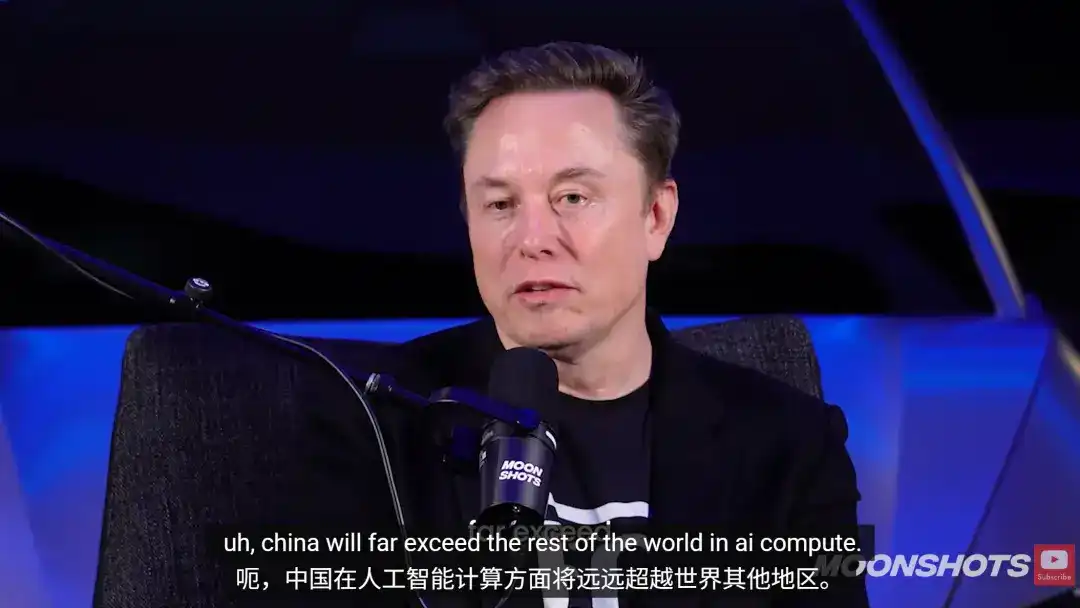
He provided three key reasons:

1) Overwhelming Power Advantage

China's power generation in 2026 will be three times that of the United States. Last year, China added 500 terawatt-hours of electricity, 70% of which came from solar power. Musk couldn't help but remark, "It's like they listen to everything I say and then immediately put it into action."

2) Chip Generation Gap Narrows; Moore's Law is Dead

From 3nm to 2nm, chip performance only improved by 10%, meaning Moore's Law has失效 (shīxiào - become invalid). The US chip advantage is continuously diminishing, making it easier for China to catch up.

3) Unmatched Execution Capability

Musk stated frankly: "I've met too many Chinese engineers. When the requirements are clear, their speed and scale of execution are unimaginable."

He predicted that the final world AI competition landscape will consist of XAI, Google, and China.
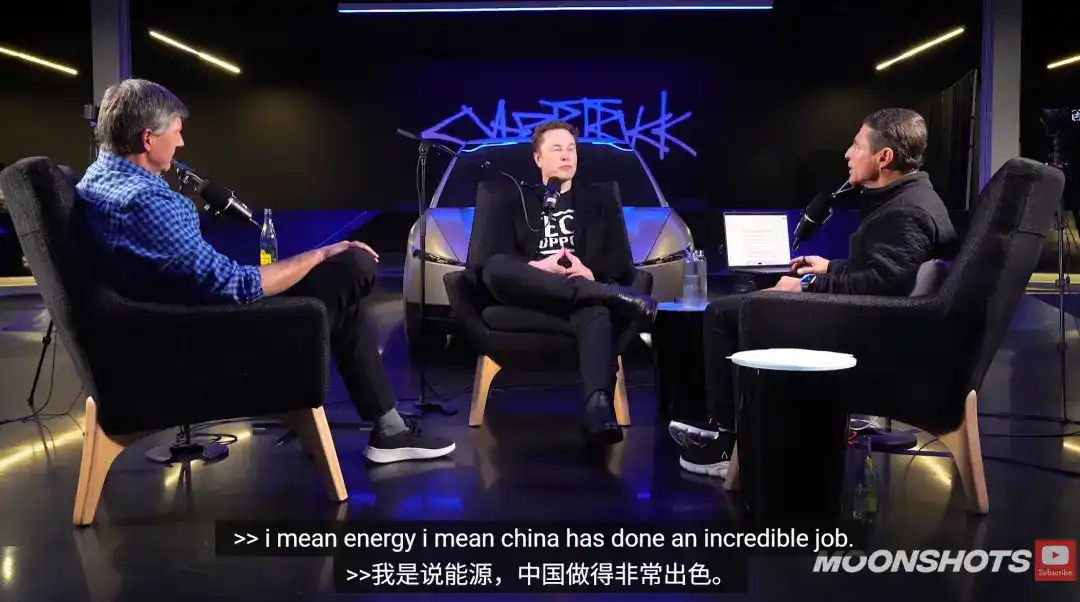
4. Energy Revolution; Solar is the Only Answer

Regarding the prospects of solar energy, Musk's attitude is exceptionally firm:

"The sun accounts for 99.8% of the mass of the solar system. Doing nuclear fusion on Earth is like making ice in Antarctica—we have a free giant nuclear reactor 93 million miles above our heads, so why build a small one on Earth?"

He proposed a three-step plan for solar energy development:

Step 1: Double the Efficiency of the Existing Power Grid

Power plants have大量 (dàliàng - a large amount of) idle capacity at night, but not enough during peak daytime hours. The solution is to use Tesla's Mega Pack batteries to store idle electricity at night and release it during peak daytime hours. This doubles energy throughput without building any new power plants.

Step 2: Launch Solar Power into Space

The environment where AI satellites are located in space has daylight 24 hours a day, maximizing solar energy utilization. Deploying these satellites would take about 8,000 launches, one launch per hour持续 (chíxù -持续 for) a full year.

Step 3: Build Satellite Factories on the Moon

To capture solar energy on a larger scale, we cannot rely solely on launching satellites from Earth. Musk's ultimate plan is to build factories on the Moon, using local materials to manufacture satellites and then sending them directly into orbit from the Moon.

Musk emphasized: "The currency of the future is essentially energy—with energy, you can power AI, manufacture anything, and change the physical world."

5. Economy and Currency; Money Might Not Matter in 10-20 Years

This is one of the most颠覆 (diānfù -颠覆颠覆颠覆颠覆颠覆颠覆颠覆颠覆颠覆颠覆颠覆颠覆颠覆颠覆颠覆颠覆颠覆颠覆颠覆颠覆颠覆颠覆颠覆颠覆颠覆颠覆颠覆颠覆颠覆颠覆颠覆颠覆颠覆颠覆颠覆颠覆颠覆颠覆颠覆颠覆颠覆颠覆颠覆颠覆颠覆颠覆颠覆颠覆颠覆颠覆颠覆颠覆颠覆颠覆颠覆颠覆颠覆颠覆颠覆颠覆颠覆颠覆颠覆颠覆颠覆颠覆颠覆颠覆颠覆颠覆颠覆颠覆颠覆颠覆颠覆颠覆颠覆颠覆颠覆颠覆颠覆颠覆颠覆颠覆颠覆颠覆颠覆颠覆颠覆颠覆颠覆颠覆颠覆颠覆颠覆颠覆颠覆颠覆颠覆颠覆颠覆颠覆颠覆颠覆颠覆颠覆颠覆颠覆颠覆颠覆颠覆颠覆颠覆颠覆颠覆颠覆颠覆颠覆颠覆颠覆颠覆颠覆颠覆颠覆颠覆颠覆颠覆颠覆颠覆颠覆颠覆颠覆颠覆颠覆颠覆颠覆颠覆颠覆颠覆颠覆颠覆颠覆颠覆颠覆颠覆颠覆颠覆颠覆颠覆颠覆颠覆颠覆颠覆颠覆颠覆颠覆颠覆颠覆颠覆颠覆颠覆颠覆颠覆颠覆颠覆颠覆颠覆颠覆颠覆颠覆颠覆颠覆颠覆颠覆颠覆颠覆颠覆颠覆颠覆颠覆颠覆颠覆颠覆颠覆颠覆颠覆颠覆颠覆颠覆颠覆颠覆颠覆颠覆颠覆颠覆颠覆颠覆颠覆颠覆颠覆颠覆颠覆颠覆颠覆颠覆颠覆颠覆颠覆颠覆颠覆颠覆颠覆颠覆颠覆颠覆颠覆颠覆颠覆颠覆颠覆颠覆颠覆颠覆颠覆颠覆颠覆颠覆颠覆颠覆颠覆颠覆颠覆颠覆颠覆颠覆颠覆颠覆颠覆颠覆颠覆颠覆颠覆颠覆颠覆颠覆颠覆颠覆颠覆颠覆颠覆颠覆颠覆颠覆颠覆颠覆颠覆颠覆颠覆颠覆颠覆颠覆颠覆颠覆颠覆颠覆颠覆颠覆颠覆颠覆颠覆颠覆颠覆颠覆颠覆颠覆颠覆颠覆颠覆颠覆颠覆颠覆颠覆颠覆颠覆颠覆颠覆颠覆颠覆颠覆颠覆颠覆颠覆颠覆颠覆颠覆颠覆颠覆颠覆颠覆颠覆颠覆颠覆颠覆颠覆颠覆颠覆颠覆颠覆颠覆颠覆颠覆颠覆颠覆颠覆颠覆颠覆颠覆颠覆颠覆颠覆颠覆颠覆颠覆颠覆颠覆颠覆颠覆颠覆颠覆颠覆颠覆颠覆颠覆颠覆颠覆颠覆颠覆颠覆颠覆颠覆颠覆颠覆颠覆颠覆颠覆颠覆颠覆颠覆颠覆颠覆颠覆颠覆颠覆颠覆颠覆颠覆颠覆颠覆颠覆颠覆颠覆颠覆颠覆颠覆颠覆颠覆颠覆颠覆颠覆颠覆颠覆颠覆颠覆颠覆颠覆颠覆颠覆颠覆颠覆颠覆颠覆颠覆颠覆颠覆颠覆颠覆颠覆颠覆颠覆颠覆颠覆颠覆颠覆颠覆颠覆颠覆颠覆颠覆颠覆颠覆颠覆颠覆颠覆颠覆颠覆颠覆颠覆颠覆颠覆颠覆颠覆颠覆颠覆颠覆颠覆颠覆颠覆颠覆颠覆颠覆颠覆颠覆颠覆颠覆颠覆颠覆颠覆颠覆颠覆颠覆颠覆颠覆颠覆颠覆颠覆颠覆颠覆颠覆颠覆颠覆颠覆颠覆颠覆颠覆颠覆颠覆颠覆颠覆颠覆颠覆颠覆颠覆颠覆颠覆颠覆颠覆颠覆颠覆颠覆颠覆颠覆颠覆颠覆颠覆颠覆颠覆颠覆颠覆颠覆颠覆颠覆颠覆颠覆颠覆颠覆颠覆颠覆颠覆颠覆颠覆颠覆颠覆颠覆颠覆颠覆颠覆颠覆颠覆颠覆颠覆颠覆颠覆颠覆颠覆颠覆颠覆颠覆颠覆颠覆颠覆颠覆颠覆颠覆颠覆颠覆颠覆颠覆颠覆颠覆颠覆颠覆颠覆颠覆颠覆颠覆颠覆颠覆颠覆颠覆颠覆颠覆颠覆颠覆颠覆颠覆颠覆颠覆颠覆颠覆颠覆颠覆颠覆颠覆颠覆颠覆颠覆颠覆颠覆颠覆颠覆颠覆颠覆颠覆颠覆颠覆颠覆颠覆颠覆颠覆颠覆颠覆颠覆颠覆颠覆颠覆颠覆颠覆颠覆颠覆颠覆颠覆颠覆颠覆颠覆颠覆颠覆颠覆颠覆颠覆颠覆颠覆颠覆颠覆颠覆颠覆颠覆颠覆颠覆颠覆颠覆颠覆颠覆颠覆颠覆颠覆颠覆颠覆颠覆颠覆颠覆颠覆颠覆颠覆颠覆颠覆颠覆颠覆颠覆颠覆颠覆颠覆颠覆颠覆颠覆颠覆颠覆颠覆颠覆颠覆颠覆颠覆颠覆颠覆颠覆颠覆颠覆颠覆颠覆颠覆颠覆颠覆颠覆颠覆颠覆颠覆颠覆颠覆颠覆颠覆颠覆颠覆颠覆颠覆颠覆颠覆颠覆颠覆颠覆颠覆颠覆颠覆颠覆颠覆颠覆颠覆颠覆颠覆颠覆颠覆颠覆颠覆颠覆颠覆颠覆颠覆颠覆颠覆颠覆颠覆颠覆颠覆颠覆颠覆颠覆颠覆颠覆颠覆颠覆颠覆颠覆颠覆颠覆颠覆颠覆颠覆颠覆颠覆颠覆颠覆颠覆颠覆颠覆颠覆颠覆颠覆颠覆颠覆颠覆颠覆颠覆颠覆颠覆颠覆颠覆颠覆颠覆颠覆颠覆颠覆颠覆颠覆颠覆颠覆颠覆颠覆颠覆颠覆颠覆颠覆颠覆颠覆颠覆颠覆颠覆颠覆颠覆颠覆颠覆颠覆颠覆颠覆颠覆颠覆颠覆颠覆颠覆颠覆颠覆颠覆颠覆颠覆颠覆颠覆颠覆颠覆颠覆颠覆颠覆颠覆颠覆颠覆颠覆颠覆颠覆颠覆颠覆颠覆颠覆颠覆颠覆颠覆颠覆颠覆颠覆颠覆颠覆颠覆颠覆颠覆颠覆颠覆颠覆颠覆颠覆颠覆颠覆颠覆颠覆颠覆颠覆颠覆颠覆颠覆颠覆颠覆颠覆颠覆颠覆颠覆颠覆颠覆颠覆颠覆颠覆颠覆颠覆颠覆颠覆颠覆颠覆颠覆颠覆颠覆颠覆颠覆颠覆颠覆颠覆颠覆颠覆颠覆颠覆颠覆颠覆颠覆颠覆颠覆颠覆颠覆颠覆颠覆颠覆颠覆颠覆颠覆颠覆颠覆颠覆颠覆颠覆颠覆颠覆颠覆颠覆颠覆颠覆颠覆颠覆颠覆颠覆颠覆颠覆颠覆颠覆颠覆颠覆颠覆颠覆颠覆颠覆颠覆颠覆颠覆颠覆颠覆颠覆颠覆颠覆颠覆颠覆颠覆颠覆颠覆颠覆颠覆颠覆颠覆颠覆颠覆颠覆颠覆颠覆颠覆颠覆颠覆颠覆颠覆颠覆颠覆颠覆颠覆颠覆颠覆颠覆颠覆颠覆颠覆颠覆颠覆颠覆颠覆颠覆颠覆颠覆颠覆颠覆颠覆颠覆颠覆颠覆颠覆颠覆颠覆颠覆颠覆颠覆颠覆颠覆颠覆颠覆颠覆颠覆颠覆颠覆颠覆颠覆颠覆颠覆颠覆颠覆颠覆颠覆颠覆颠覆颠覆颠覆颠覆颠覆颠覆颠覆颠覆颠覆颠覆颠覆颠覆颠覆颠覆颠覆颠覆颠覆颠覆颠覆颠覆颠覆颠覆颠覆颠覆颠覆颠覆颠覆颠覆颠覆颠覆颠覆颠覆颠覆颠覆颠覆颠覆颠覆颠覆颠覆颠覆颠覆颠覆颠覆颠覆颠覆颠覆颠覆颠覆颠覆颠覆颠覆颠覆颠覆颠覆颠覆颠覆颠覆颠覆颠覆颠覆颠覆颠覆颠覆颠覆颠覆颠覆颠覆颠覆颠覆颠覆颠覆颠覆颠覆颠覆颠覆颠覆颠覆颠覆颠覆颠覆颠覆颠覆颠覆颠覆颠覆颠覆颠覆颠覆颠覆颠覆颠覆颠覆颠覆颠覆颠覆颠覆颠覆颠覆颠覆颠覆颠覆颠覆颠覆颠覆颠覆颠覆颠覆颠覆颠覆颠覆颠覆颠覆颠覆颠覆颠覆颠覆颠覆颠覆颠覆颠覆颠覆颠覆颠覆颠覆颠覆颠覆颠覆颠覆颠覆颠覆颠覆颠覆颠覆颠覆颠覆颠覆颠覆颠覆颠覆颠覆颠覆颠覆颠覆颠覆颠覆颠覆颠覆颠覆颠覆颠覆颠覆颠覆颠覆颠覆颠覆颠覆颠覆颠覆颠覆颠覆颠覆颠覆颠覆颠覆颠覆颠覆颠覆颠覆颠覆颠覆颠覆颠覆颠覆颠覆颠覆颠覆颠覆颠覆颠覆颠覆颠覆颠覆颠覆颠覆颠覆颠覆颠覆颠覆颠覆颠覆颠覆颠覆颠覆颠覆颠覆颠覆颠覆颠覆颠覆颠覆颠覆颠覆颠覆颠覆颠覆颠覆颠覆颠覆颠覆颠覆颠覆颠覆颠覆颠覆颠覆颠覆颠覆颠覆颠覆颠覆颠覆颠覆颠覆颠覆颠覆颠覆颠覆颠覆颠覆颠覆颠覆颠覆颠覆颠覆颠覆颠覆颠覆颠覆颠覆颠覆颠覆颠覆颠覆颠覆颠覆颠覆颠覆颠覆颠覆颠覆颠覆颠覆颠覆颠覆颠覆颠覆颠覆颠覆颠覆颠覆颠覆极富洞察与远见。 Musk explained that in 10-20 years, either we won't exist anymore, or money will no longer be important.

Many people worry that AI will cause widespread unemployment, but Musk proposed a new concept—"Universal High Income" (UHI). This is not the government-distributed "Universal Basic Income (UBI)" but a more fundamental change in economic logic:

AI and robots will cause the output growth rate of goods and services to exceed the growth rate of the money supply, leading to plummeting prices and production costs approaching zero. When the output growth rate of goods and services exceeds the growth rate of the money supply, it causes prices to暴跌 (bàodiē - plummet).

Because物质 (wùzhì - material goods) are extremely abundant, everyone can easily obtain the goods and services they desire.

But he also warned that the next 3-7 years will be very bumpy:

We will simultaneously experience radical change, social unrest, and great prosperity; this is an inevitable transition period. And if none of this happens, it means we have encountered bigger problems—such as stalled AI development or civilizational collapse.

6. Careers and the Future; Work Will Become Optional

Musk predicted that within less than 20 years, work will become optional. AI and robots will make work a "hobby" within 10-20 years, allowing people to freely pursue their interests.

He also expressed concern about the global decline in birth rates, believing that population decline is a huge threat to civilization because "more people mean more consciousness, which helps humanity understand the universe."

7. Education and Growth; The Essence of Learning is Returning to Curiosity

Musk pointed out that the traditional education model is dead.

Due to his own poor school experience, he does not like the current education model—"I found school painful. It was boring, and in South Africa, it was also violent."

He believes that over the years, the driving force behind his continuous learning has been "curiosity about the nature of the universe. I'm just curious about the meaning of life and the reality we live in."

With the rapid development of AI, he坦言 (tǎnrán - admitted frankly) that obviously AI can be a personalized teacher. It is infinitely patient and answers all your questions. But you still need curiosity, you still need to want to learn. He has already launched an AI personalized education pilot in El Salvador.

At the end of the interview, Musk also admitted that he was once very pessimistic and even suggested slowing down AI development multiple times, but ultimately found that rather than being a pessimistic bystander, it's better to be an optimistic participant.

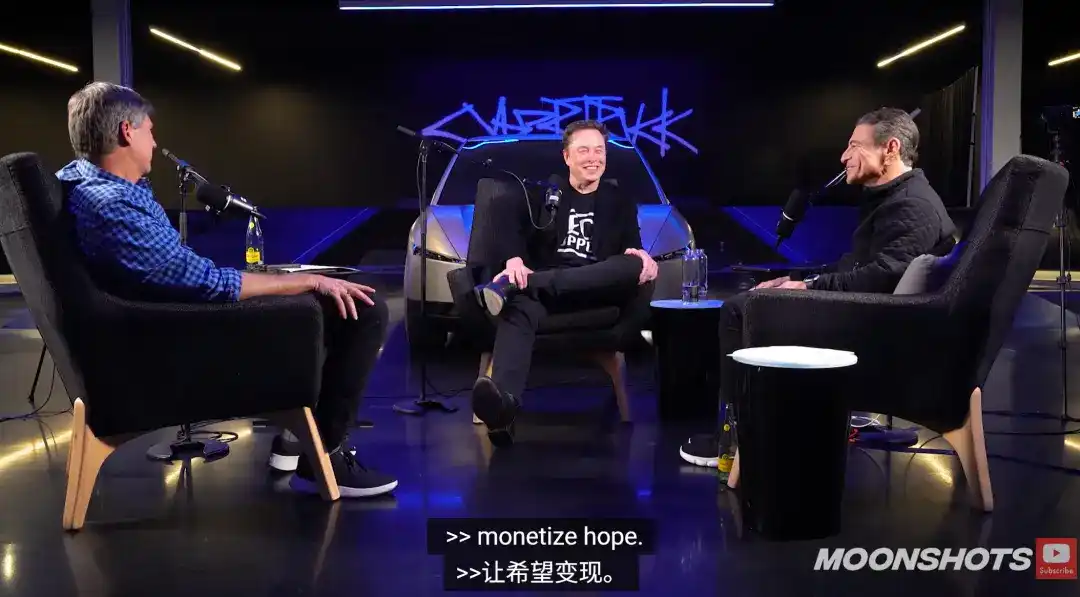
He sincerely offered everyone a piece of advice, which is—Make Hope a Reality!

Let's encourage each other!
Связанные с этим вопросы

QWhat is Elon Musk's prediction about the timeline for achieving AGI and surpassing total human intelligence?

AElon Musk predicts that AGI (Artificial General Intelligence) will be achieved by 2026, and by 2030, AI's intelligence level will surpass the sum total of all human intelligence.

QHow does Musk justify his claim that going to medical school will become 'meaningless' in the near future?

AMusk claims it will be meaningless because within three years, Optimus robots will become better surgeons than any human and will be deployed at scale. This is due to the exponential growth in AI capability, chip performance, and electromechanical dexterity, combined with the 'recursive effect' where all robots share a collective knowledge base, making them more precise and reliable than human doctors.

QWhat are the three key reasons Musk gives for China's projected dominance in AI compute power?

AThe three key reasons are: 1) Power Advantage: China's electricity generation will be triple that of the US by 2026, with 70% of new capacity coming from solar. 2) Diminishing Chip Advantage: The performance gap between chip generations (e.g., 3nm to 2nm) is narrowing, making it easier for China to catch up as Moore's Law becomes less effective. 3) Unmatched Execution: Chinese engineers demonstrate incredible speed and scale of execution when goals are clearly defined.

QWhat is Musk's three-step plan for a solar energy revolution?

AMusk's three-step plan is: 1) Double the efficiency of the existing power grid by using batteries like Tesla's Mega Pack to store excess energy at night and release it during peak daytime hours. 2) Launch solar panels into space, where the sun is always shining, to achieve the highest efficiency. 3) Ultimately, build a satellite factory on the Moon to manufacture and launch satellites directly from there, using local materials.

QWhat does Musk mean by 'Universal High Income' (UHI) and how does it differ from Universal Basic Income (UBI)?

AUniversal High Income (UHI) is an economic concept where the abundance of goods and services produced by AI and robots causes prices to plummet as production costs approach zero. This allows everyone to easily obtain what they need, making money less important. It differs from government-funded Universal Basic Income (UBI) because it is a fundamental change in the economic logic of production and cost, not a redistribution of money.

Похожее

Can a Hair Dryer Earn $34,000? Deciphering the Reflexivity Paradox in Prediction Markets

An individual manipulated a weather sensor at Paris Charles de Gaulle Airport with a portable heat source, causing a Polymarket weather market to settle at 22°C and earning $34,000. This incident highlights a fundamental issue in prediction markets: when a market aims to reflect reality, it also incentivizes participants to influence that reality. Prediction markets operate on two layers: platform rules (what outcome counts as a win) and data sources (what actually happened). While most focus on rules, the real vulnerability lies in the data source. If reality is recorded through a specific source, influencing that source directly affects market settlement. The article categorizes markets by their vulnerability: 1. **Single-point physical data sources** (e.g., weather stations): Easily manipulated through physical interference. 2. **Insider information markets** (e.g., MrBeast video details): Insiders like team members use non-public information to trade. Kalshi fined a剪辑师 $20,000 for insider trading. 3. **Actor-manipulated markets** (e.g., Andrew Tate’s tweet counts): The subject of the market can control the outcome. Evidence suggests Tate’sociated accounts coordinated to profit. 4. **Individual-action markets** (e.g., WNBA disruptions): A single person can execute an event to profit from their pre-placed bets. Kalshi and Polymarket handle these issues differently. Kalshi enforces strict KYC, publicly penalizes insider trading, and reports to regulators. Polymarket, with its anonymous wallet-based system, has historically been more permissive, arguing that insider information improves market accuracy. However, it cooperated with authorities in the "Van Dyke case," where a user traded on classified government information. The core paradox is reflexivity: prediction markets are designed to discover truth, but their financial incentives can distort reality. The more valuable a prediction becomes, the more likely participants are to influence the event itself. The market ceases to be a mirror of reality and instead shapes it.

marsbit16 мин. назад

Can a Hair Dryer Earn $34,000? Deciphering the Reflexivity Paradox in Prediction Markets

marsbit16 мин. назад

First Day Review of "Musk's WeChat" XChat: Even Worse Than Expected

Elon Musk's much-anticipated "WeChat-like" app, XChat, has officially launched after multiple delays. The initial review reveals a product that falls short of expectations, offering an experience largely similar to X Platform's (formerly Twitter) direct messages, despite being marketed as an encrypted communication tool. Key observations from the first-day test include: 1. The app's promoted "end-to-end encryption" and its claimed relation to Bitcoin's architecture were criticized by experts as a superficial attempt to capitalize on crypto buzz, with no real technical connection. 2. Musk's vision of an ad-free "secure communication system" is technically met, but only because the app is currently extremely basic, featuring only a single chat interface. 3. A promised anti-screenshot feature appears inconsistent; it works in X Platform group chats but fails within the XChat app itself, where screenshots still capture avatars. 4. The app supports 45 languages and has a 16+ age rating, indicating a broader tolerance for content compared to WeChat's 13+ rating. 5. A puzzling login process requires users to verify the email associated with their X account. 6. The touted encryption" feels minimal in practice, with its presence only indicated by a simple "Encrypted - Yes" label on messages. 7. Disappearing message timers for groups can be set from 5 minutes to 4 weeks, with the timer starting upon being read by a user. 8. Group invite links are shared with X Platform groups. 9. Group size limits are planned to be increased, aiming for 1000 members, a move that has drawn user criticism. 10. The app offers 8 different colored icons, and its chat bubbles are notably similar to WeChat's. Message deletion options mimic Telegram's. Crucially, many pre-announced features like importing X contacts, integrating Grok AI, X Money payments, and Cashtags are not yet available. The initial release is seen as a bare-bones and underwhelming first step.

Odaily星球日报1 ч. назад

First Day Review of "Musk's WeChat" XChat: Even Worse Than Expected

Odaily星球日报1 ч. назад

Торговля

Спот
Фьючерсы

Популярные статьи

Как купить S

Добро пожаловать на HTX.com! Мы сделали приобретение Sonic (S) простым и удобным. Следуйте нашему пошаговому руководству и отправляйтесь в свое крипто-путешествие.Шаг 1: Создайте аккаунт на HTXИспользуйте свой адрес электронной почты или номер телефона, чтобы зарегистрироваться и бесплатно создать аккаунт на HTX. Пройдите удобную регистрацию и откройте для себя весь функционал.Создать аккаунтШаг 2: Перейдите в Купить криптовалюту и выберите свой способ оплатыКредитная/Дебетовая Карта: Используйте свою карту Visa или Mastercard для мгновенной покупки Sonic (S).Баланс: Используйте средства с баланса вашего аккаунта HTX для простой торговли.Третьи Лица: Мы добавили популярные способы оплаты, такие как Google Pay и Apple Pay, для повышения удобства.P2P: Торгуйте напрямую с другими пользователями на HTX.Внебиржевая Торговля (OTC): Мы предлагаем индивидуальные услуги и конкурентоспособные обменные курсы для трейдеров.Шаг 3: Хранение Sonic (S)После приобретения вами Sonic (S) храните их в своем аккаунте на HTX. В качестве альтернативы вы можете отправить их куда-либо с помощью перевода в блокчейне или использовать для торговли с другими криптовалютами.Шаг 4: Торговля Sonic (S)С легкостью торгуйте Sonic (S) на спотовом рынке HTX. Просто зайдите в свой аккаунт, выберите торговую пару, совершайте сделки и следите за ними в режиме реального времени. Мы предлагаем удобный интерфейс как для начинающих, так и для опытных трейдеров.

1.2k просмотров всегоОпубликовано 2025.01.15Обновлено 2025.03.21

Как купить S

Sonic: Обновления под руководством Андре Кронье – новая звезда Layer-1 на фоне спада рынка

Он решает проблемы масштабируемости, совместимости между блокчейнами и стимулов для разработчиков с помощью технологических инноваций.

2.2k просмотров всегоОпубликовано 2025.04.09Обновлено 2025.04.09

Sonic: Обновления под руководством Андре Кронье – новая звезда Layer-1 на фоне спада рынка

HTX Learn: Пройдите обучение по "Sonic" и разделите 1000 USDT

HTX Learn — ваш проводник в мир перспективных проектов, и мы запускаем специальное мероприятие "Учитесь и Зарабатывайте", посвящённое этим проектам. Наше новое направление .

1.8k просмотров всегоОпубликовано 2025.04.10Обновлено 2025.04.10

HTX Learn: Пройдите обучение по "Sonic" и разделите 1000 USDT

Обсуждения

Добро пожаловать в Сообщество HTX. Здесь вы сможете быть в курсе последних новостей о развитии платформы и получить доступ к профессиональной аналитической информации о рынке. Мнения пользователей о цене на S (S) представлены ниже.

活动图片