Earnings Report, CLARITY Bill, and Warsh's Arrival: CRCL Faces Three Major Tests This Week

marsbitPublished on 2026-05-11Last updated on 2026-05-11

Abstract

Circle (CRCL) faces three major tests this week that will significantly impact its stock price and valuation. First, on May 11, it will release its Q1 2026 earnings. Key metrics to watch are overall revenue and EPS, the proportion of revenue paid to distributors like Coinbase, and growth in non-interest income. The market also awaits Circle's stance on renegotiating its revenue-sharing contract with Coinbase, which expires in August. Second, on May 14, the U.S. Senate Banking Committee will vote on the CLARITY Act. This bill aims to establish a clear federal regulatory framework for digital assets. A recent compromise proposal would ban yield on static stablecoin reserves but allow rewards for active ones. Its passage, currently seen as likely by prediction markets, would be a major positive for the industry and Circle. Finally, on May 15, Kevin Warsh will succeed Jerome Powell as Federal Reserve Chair. Warsh's proposed policy of quantitative tightening combined with interest rate cuts could pose a short-term headwind for CRCL, as lower rates reduce Circle's primary revenue from USDC reserves. However, long-term prospects may improve as Warsh, a known crypto investor who opposes a Fed CBDC, is seen as potentially favorable to regulated private stablecoins like USDC.

Author|Azuma(@azuma_eth)

The Q1 earnings report on May 11th, the CLARITY bill's Senate hurdle on May 14th, and the Federal Reserve leadership change on May 15th... Circle (CRCL) is set to face three major tests this week. Each challenge will directly impact CRCL's price movement and may even redefine its valuation logic.

In the following, Odaily Planet Daily will analyze the progress and expectations of these three key events one by one and predict their potential impact on CRCL (Odaily Note: The following content does not constitute any investment advice).

Event One: 2026 Q1 Earnings Report

Tonight at 20:00, Circle will release its 2026 first-quarter earnings report before the US stock market opens, followed by an earnings conference call.

There are three main focal points for this earnings report.

  • The first is Circle's consolidated revenue and profit data for Q1 this year. Current market expectations for Circle's Q1 revenue are $715 million, with an expected earnings per share (EPS) of $0.178.
  • The second is the proportion of Circle's distribution costs (primarily to Coinbase) relative to its overall revenue. This represents Circle's dependence on distribution platforms like Coinbase. This ratio has shown a slight downward trend over the past few quarters and is expected to continue this trend in Q1.
  • The third is the growth status of non-interest income, meaning revenue from payments, enterprise, and on-chain businesses. This is the most important long-term data for Circle, indicating whether it can find a second major revenue stream beyond US Treasury interest.

Regarding the distribution contract with Coinbase, analysts are certain to ask about this during the earnings call, and Circle's response will be crucial. In August 2023, Circle signed a three-year contract with Coinbase, stipulating that Coinbase would receive all interest income generated by USDC on its platform, with interest from off-platform USDC split 50/50 between Coinbase and Circle.

This contract expires this August. However, last week the Coinbase CFO emphasized that the contract "renews every three years and never changes." If renewed under the original terms, it would certainly be unfavorable for Circle. Nevertheless, considering the current significant financial pressure on Coinbase and its strong reliance on Circle — all contracts are negotiated — this might be a favorable factor for Circle to seek amendment of the revenue-sharing terms.

  • Odaily Note: Refer to "Q1 Net Loss of $394.1 Million, Coinbase Has No Choice But to Hold Tight to Circle's Thigh".

Personally, I am cautiously optimistic about tonight's earnings report, expecting solid performance, but the focus lies more on Circle's stance regarding the August renewal.

Event Two: CLARITY Bill's Senate Hurdle

On May 14th, US local time, the US Senate Banking Committee will hold a vote hearing on the "Clarity for Digital Assets" bill (CLARITY Act). This will be a critical step for CLARITY to subsequently pass the Senate and become formal legislation.

The CLARITY Act aims to establish a regulatory framework for digital assets, clearly distinguish the classification of digital assets, and delineate the regulatory responsibilities of the US Securities and Exchange Commission (SEC) and the Commodity Futures Trading Commission (CFTC).

On July 17th last year, CLARITY passed the US House of Representatives with an overwhelming majority (vote count approximately 294–134) but encountered resistance when subsequently transferred to the Senate due to disagreements among various parties.

Controversies primarily centered around stablecoin yields, the regulatory approach to DeFi, and the ethics of the Trump family, especially the issue of stablecoin yields. Banking and crypto industries engaged in fierce debate, with Coinbase temporarily exiting negotiations, stalling the bill's progress (Recommended reading "Why Banks Insist on Banning Stablecoin Yields?").

The situation recently took a crucial turn. Senators Tom Tillis and Angela Alsbrooks have reached a compromise proposal, intending to ban yields on static stablecoin reserves but allowing rewards for actively used stablecoins.

Currently, on the prediction market Polymarket, the probability of CLARITY becoming law this year is as high as 76%, indicating relatively positive market sentiment regarding the bill's future progress.
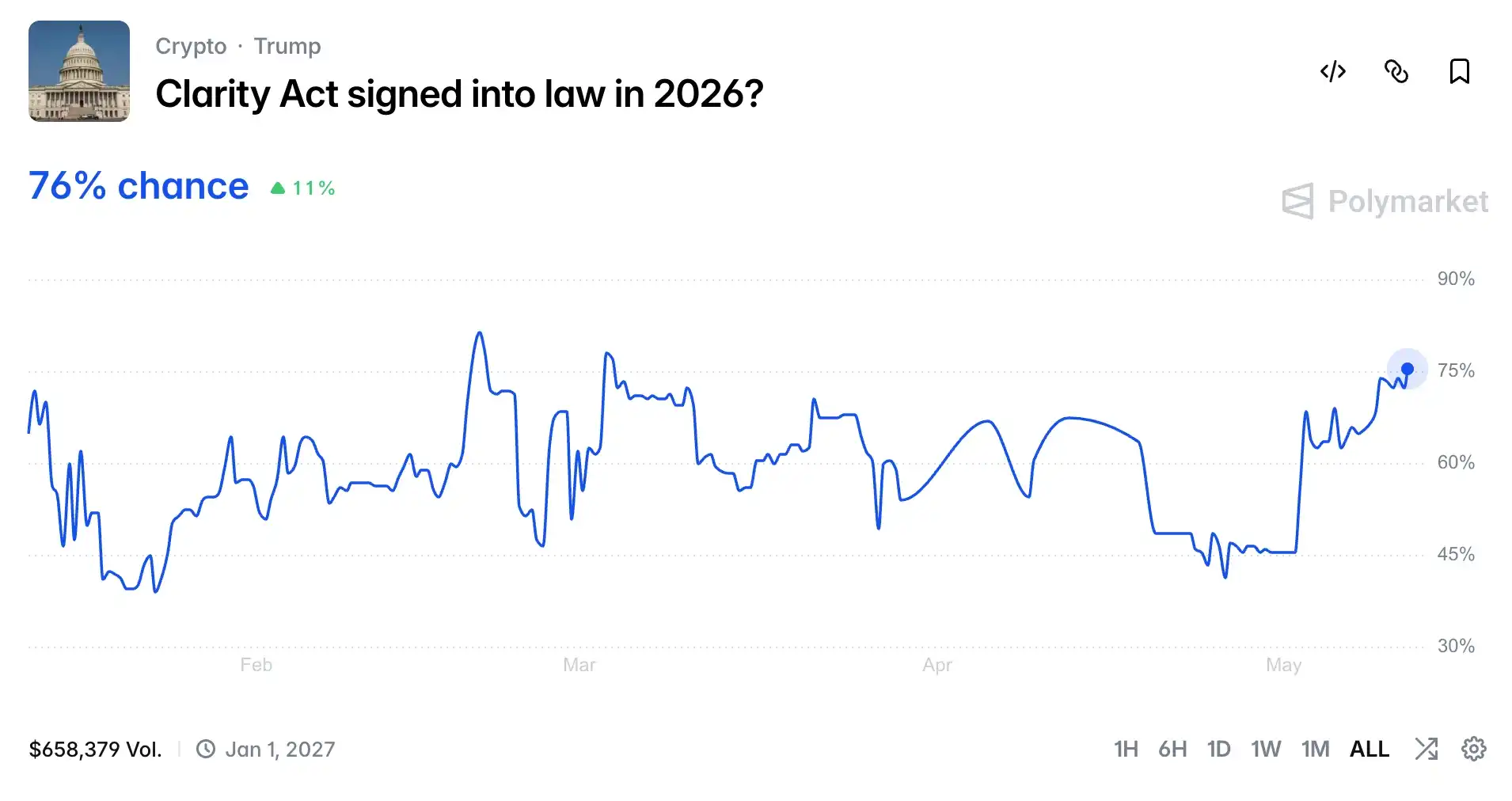
Once CLARITY becomes formal law, it will establish a clear, functional federal regulatory framework for the US digital asset market, addressing long-standing issues of regulatory ambiguity and inconsistent enforcement. This would be a significant positive for all industry participants, including Circle. My prediction on this is relatively optimistic.

Event Three: Federal Reserve Leadership Change

On May 15th, Jerome Powell's term as Federal Reserve Chairman officially ends (he will remain as a Board member until 2028), and his successor will be Kevin Warsh.

On April 29th, the US Senate Banking Committee voted to approve Warsh's nomination. Although it hasn't been confirmed by the full Senate vote yet, that is expected to happen in the coming days.

Unlike Powell, Warsh advocates for an unconventional combination of "balance sheet reduction + interest rate cuts," supporting inflation control through quantitative tightening (QT) while lowering interest rates to provide liquidity for the real economy. He believes QT targets the financial sector, while rate cuts benefit the industrial sector.

For Circle, which still relies primarily on US Treasury interest as its main income source, a market shift towards a rate-cutting cycle would be a direct bearish factor for CRCL. Simultaneously, QT could lead to tightened financial market liquidity in the short term, suppressing the stock market.

However, Warsh himself is a cryptocurrency holder. He is the first Federal Reserve Chair in history to have directly invested in the cryptocurrency field and places extreme importance on "the digital upgrade of US financial competitiveness." Warsh has also explicitly opposed the Fed issuing an official CBDC, arguing that its credit is deeply tied to national sovereignty; if the US dollar's credibility is damaged, the CBDC would also collapse. Therefore, he hopes to bring private stablecoins like USDC into the Federal Reserve's regulatory system, making them "shadow dollars."

Therefore, from a long-term perspective, Warsh taking office could potentially provide Circle with some policy tailwinds at the operational level, aiding its expansion.

So, regarding expectations, the short-term outlook may lean towards pessimism, but the long-term view could shift to neutral or optimistic.


Related Questions

QWhat are the three key events that Circle (CRCL) is facing this week according to the article?

AThe three key events are: 1) The Q1 2026 earnings report release on May 11. 2) The U.S. Senate Banking Committee hearing and vote on the CLARITY Act on May 14. 3) The transition of the Federal Reserve Chair from Powell to Kevin Warsh on May 15.

QWhat is the main concern regarding Circle's expiring contract with Coinbase?

AThe main concern is the terms of renewal. The current three-year contract, which gives Coinbase all interest from USDC on its platform and a 50% share of interest from off-platform USDC, expires in August 2026. The article suggests Circle may seek more favorable terms in the renewal, especially given Coinbase's current financial pressures.

QWhat is the significance of the CLARITY Act for the cryptocurrency industry, particularly for Circle?

AThe CLARITY Act aims to establish a clear federal regulatory framework for digital assets by distinguishing their classification and defining the regulatory roles of the SEC and CFTC. Its passage would be a major positive for industry participants like Circle by resolving long-standing regulatory ambiguity and inconsistent enforcement.

QAccording to the article, what is the potential market impact of Kevin Warsh's expected policy approach as the new Fed Chair?

AKevin Warsh's expected unconventional policy of 'shrinking the balance sheet (QT) + cutting interest rates' could create a short-term headwind for Circle. Rate cuts would directly reduce the interest income from its Treasury holdings (a primary revenue source), while QT could tighten financial market liquidity and pressure equity markets, including CRCL's stock price.

QWhat is the author's long-term view on Circle's prospects under a Kevin Warsh-led Federal Reserve?

AThe author holds a more optimistic long-term view. Despite potential short-term monetary policy headwinds, Kevin Warsh is described as a cryptocurrency holder who strongly supports the digital upgrade of U.S. financial competitiveness, opposes a Fed-issued CBDC, and favors bringing private stablecoins like USDC under the Fed's regulatory umbrella, which could provide favorable policy support for Circle's business expansion.

Related Reads

The AI Agent Era Accelerates Its Arrival: Questflow Defines a New Paradigm of Financial Intelligence with On-Chain AI Brokerage

The AI Agent era is accelerating, with the CB Insights AI 100 list highlighting global investment confidence. The focus has shifted from whether AI works to its speed of deployment and ability to manage complex workflows, with autonomous AI Agents driving this transformation. At the forefront is Questflow, a Singapore-based startup redefining financial intelligence through its on-chain AI brokerage. Unlike tools that merely provide data dashboards, Questflow deploys AI Agents that proactively scan markets, form judgments, and execute trades via a conversational interface—operating 24/7 without requiring manual confirmation for each decision. This embodies the new AI paradigm of agents capable of executing multi-step workflows autonomously. Questflow's mission is to democratize institutional-grade trading intelligence. Historically reserved for the ultra-wealthy, this capability is now accessible starting from just $1 through Questflow's "AI Clone + Copy Trade" model. The platform charges only a 1% execution fee, aligning its incentives directly with users and eliminating traditional management or performance fees. The timing is opportune, aligning with key trends identified by CB Insights: the scalable deployment of AI Agents, accelerated AI adoption in financial services, and the maturation of on-chain infrastructure. With robust liquidity on platforms like Hyperliquid and Polymarket, alongside advancements in AI reasoning and non-custodial wallet security, Questflow is positioned to merge the roles of broker, fund, and exchange into a single, accessible platform for millions.

链捕手4m ago

The AI Agent Era Accelerates Its Arrival: Questflow Defines a New Paradigm of Financial Intelligence with On-Chain AI Brokerage

链捕手4m ago

Why Pricing Social Interactions is Doomed to Fail?

Titled "Why Putting a Price on Social Interaction Is Doomed to Fail," this article critiques attempts to monetize social networks directly through SocialFi models, arguing their inevitable failure stems from a fundamental misunderstanding of media dynamics. Using Marshall McLuhan's theory of "hot" and "cold" media, the author posits that social networks are inherently "cold" media. Their value isn't contained in individual posts but is co-created through user participation, interpretation, and fragmented, ongoing interaction (e.g., replies, shares). This ambiguity and need for user involvement are core to their function. The article asserts that SocialFi projects like Friend.tech failed because introducing real-time, tradable financial pricing (a definitive "hot" signal) into this "cold" environment doesn't add a layer—it replaces the medium's essence. The unambiguous price signal overshadows and nullifies the nuanced, participatory social signal. Users become traders, not participants, and when speculative profits vanish, the underlying social ecosystem—never genuinely cultivated—collapses entirely. This principle extends beyond crypto. The author argues platforms like Twitter have gradually "heated up" through metrics (likes, retweets counts, algorithmically defined value), shifting users from participants to performers and eroding organic engagement. The solution isn't to abandon capital but to manage its entry point. Successful models like Substack, Patreon, or Bandcamp allow capital to "condense" at specific, isolated nodes (e.g., subscriptions, one-time payments) without permeating and "heating" every social interaction. They preserve the core "cold," participatory medium while enabling monetization at designated boundaries. The NFT boom and bust serves as a stark parallel: the ancient "cold" medium of collecting (valued for story, community, gradual accumulation) was rapidly destroyed by platforms that introduced real-time floor prices, rarity scores, and trading dashboards, transforming collectors into speculators and vaporizing cultural value when prices fell. The core lesson: "Liquidity equals heat." Injecting high liquidity and definitive pricing into a "cold" participatory medium doesn't optimize it; it fundamentally alters and destroys its value-creating mechanism. The future lies not in pricing every social gesture but in finding precise, non-invasive points for capital to condense without overheating the entire ecosystem.

marsbit12m ago

Why Pricing Social Interactions is Doomed to Fail?

marsbit12m ago

Jensen Huang's CMU Speech: In the AI Era, Don't Just Watch, Build

Jensen Huang, CEO of NVIDIA and a first-generation immigrant, delivered the commencement address to Carnegie Mellon University's class of 2026. He shared his personal journey from a humble background to founding NVIDIA, emphasizing resilience, learning from failure, and the responsibility that comes with leadership. Huang framed the present moment as the dawn of the AI revolution, a shift he believes is more profound than previous computing waves. He described AI as fundamentally resetting computing—moving from human-written software to machines that understand, reason, and use tools. This will create a new industry for generating intelligence and transform every sector. While acknowledging AI's potential to automate tasks and displace some jobs, Huang distinguished between the *tasks* of a job and its core *purpose*. He argued AI will augment human capability, not replace humans. The real risk, he stated, is not AI itself, but people being left behind by those who effectively use AI. He presented AI as a generational opportunity for massive infrastructure investment—in chip factories, data centers, energy grids, and advanced manufacturing—that could re-industrialize nations like the U.S. and bridge the digital divide by making computing and intelligent tools accessible to all. Huang called for a balanced approach: advancing AI safely and responsibly, establishing prudent policies, ensuring broad access, and encouraging universal participation. He urged the graduates not to fear the future but to engage with optimism and ambition, reminding them of CMU's motto, "My heart is in the work." His core message was clear: this is their moment to actively build and shape the AI-powered future, not merely observe it.

marsbit1h ago

Jensen Huang's CMU Speech: In the AI Era, Don't Just Watch, Build

marsbit1h ago

Trading

Spot
Futures

Hot Articles

Discussions

Welcome to the HTX Community. Here, you can stay informed about the latest platform developments and gain access to professional market insights. Users' opinions on the price of S (S) are presented below.

活动图片