The AI Agent Era Accelerates Its Arrival: Questflow Defines a New Paradigm of Financial Intelligence with On-Chain AI Brokerage

链捕手Published on 2026-05-11Last updated on 2026-05-11

Abstract

The AI Agent era is accelerating, with the CB Insights AI 100 list highlighting global investment confidence. The focus has shifted from whether AI works to its speed of deployment and ability to manage complex workflows, with autonomous AI Agents driving this transformation. At the forefront is Questflow, a Singapore-based startup redefining financial intelligence through its on-chain AI brokerage. Unlike tools that merely provide data dashboards, Questflow deploys AI Agents that proactively scan markets, form judgments, and execute trades via a conversational interface—operating 24/7 without requiring manual confirmation for each decision. This embodies the new AI paradigm of agents capable of executing multi-step workflows autonomously. Questflow's mission is to democratize institutional-grade trading intelligence. Historically reserved for the ultra-wealthy, this capability is now accessible starting from just $1 through Questflow's "AI Clone + Copy Trade" model. The platform charges only a 1% execution fee, aligning its incentives directly with users and eliminating traditional management or performance fees. The timing is opportune, aligning with key trends identified by CB Insights: the scalable deployment of AI Agents, accelerated AI adoption in financial services, and the maturation of on-chain infrastructure. With robust liquidity on platforms like Hyperliquid and Polymarket, alongside advancements in AI reasoning and non-custodial wallet security, Questflow is p...

CB Insights, a globally influential technology market intelligence firm, has released its tenth annual AI 100 list, selecting the world's 100 most promising AI startups in 2026. The list covers the full spectrum of AI innovation from infrastructure to industry-specific vertical applications. The selected companies have collectively raised over $10.9 billion, with more than $2 billion raised in 2026 alone, strongly validating global capital's confidence in the AI Agent sector.

CB Insights noted that the core theme this year has shifted from "Can AI work?" to "How quickly can AI be deployed, governed, and scaled into complex workflows." Among these trends, AI Agents capable of autonomously executing multi-step tasks in production environments are emerging as the core driving force behind the new wave of industrial transformation.
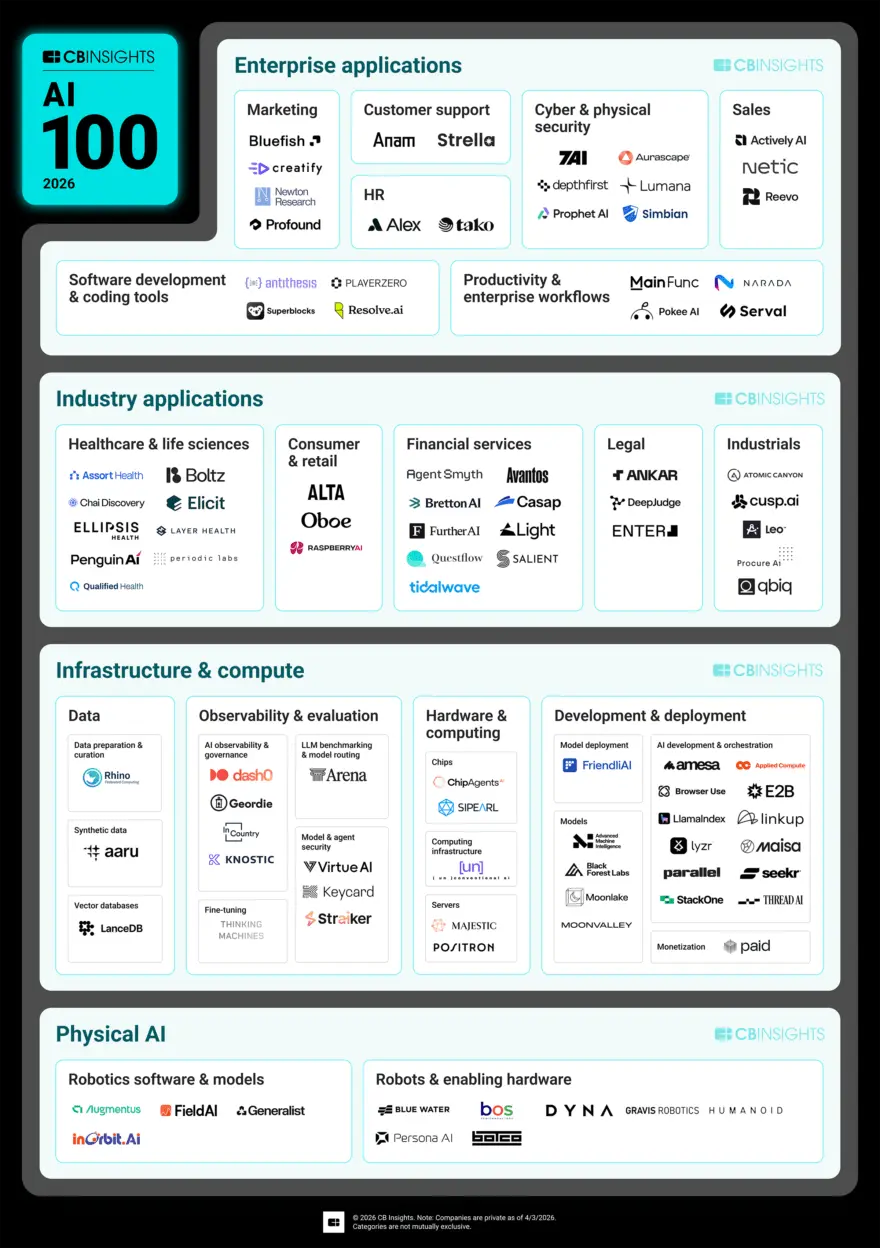
As a deep participant in this wave, Questflow—a Singapore-headquartered startup focused on on-chain AI brokerage—is at the forefront of this transformation with its unique product architecture and business model.

Not Just a Tool, But an AI That Trades For You

While most AI financial tools are still in the "data dashboard" phase, Questflow has already advanced AI Agents to the level of autonomous trading entities. Users don't need to actively search for opportunities; the AI Agents on the platform proactively scan the market, form judgments, and execute trades directly through a conversational interface, operating 24/7 without requiring manual intervention for every decision.

This is precisely the new AI paradigm defined by CB Insights' latest list: Agents capable of independently executing multi-step workflows without requiring step-by-step human confirmation represent the true deployment of AI in production environments. The operation of Questflow's AI Clone simultaneously on the Polymarket prediction market and the Hyperliquid perpetual contract market is the most direct application of this paradigm in the financial field.

Democratizing Financial Intelligence, Breaking Down Wealth Barriers

Questflow's core proposition is concise and powerful: Robinhood got everyone a seat at the table; Questflow gives everyone a brain.

In the past, institutional-grade trading intelligence was a privilege exclusive to wealth—family offices serve clients with over $30 million, private banks even more so, leaving ordinary retail investors to rely on luck. Through its AI Clone + Copy Trade product architecture, Questflow lowers the entry barrier for such capabilities to as little as $1, while maintaining a structure with zero management fees and zero performance fees. Revenue comes from a 1% trade execution fee, aligning interests highly with users and eliminating conflicts.

The Timing Is Right

The three key industry signals emphasized by CB Insights in this year's list—the large-scale deployment of AI Agents, accelerated AI penetration in financial services, and the maturation of on-chain infrastructure—closely align with Questflow's strategic assessment: sufficient on-chain asset liquidity (Hyperliquid monthly trading volume exceeds $30 billion, Polymarket monthly trading volume exceeds $1 billion), enhanced AI reasoning capabilities, and improved security of non-custodial wallet infrastructure. These three forces are converging simultaneously, opening a window of opportunity.

"When millions of people can operate their own quantitative funds, brokers, funds, and exchanges will merge into a single platform," stated the Questflow team. "That's what we are building."


Related Questions

QAccording to the article, what is the key theme shift noted by CB Insights regarding AI development in 2026?

AThe core theme has shifted from 'whether AI works' to 'how fast AI can be deployed, governed, and scaled into complex workflows.'

QWhat specific role does Questflow's AI Agent play in the financial markets, distinguishing it from other AI financial tools?

AQuestflow's AI Agent acts as an autonomous trading entity. It proactively scans markets, forms judgments, and directly executes trades through a conversational interface, 24/7 without requiring human intervention for every decision.

QHow does Questflow aim to 'democratize financial intelligence' according to its core proposition?

AIts proposition is: 'Robinhood put everyone at the table, Questflow gives everyone a brain.' It lowers the access barrier to institutional-grade trading intelligence to as low as $1, using an AI Clone + Copy Trade model with zero management fees, aligning its revenue (1% execution fee) with user success.

QWhat are the three converging forces that create a timely opportunity for Questflow's business, as mentioned in the article?

AThe three converging forces are: 1) Sufficient on-chain asset liquidity (e.g., Hyperliquid's monthly volume exceeding $30B), 2) Enhanced AI reasoning capabilities, and 3) Improved security of non-custodial wallet infrastructure.

QWhat is Questflow's ultimate vision for the future structure of financial services, as stated by its team?

AThe team envisions a future where 'brokers, funds, and exchanges merge into a single platform' when millions of people can operate their own quantitative funds.

Related Reads

Huawei Cloud Rejects Token Price War, Zhou Yuefeng Seeks a New Winning Formula for AI Cloud

At the 2026 Huawei Cloud INSPIRE Creator Conference, CEO Zhou Yuefeng outlined Huawei Cloud's distinct strategy in the competitive AI cloud market. Instead of engaging in price wars based on token volume or Maas revenue—a common focus for rivals like Alibaba Cloud and ByteDance's Volcano Engine—Huawei Cloud is shifting the competition towards real-world productivity gains. Zhou highlighted three core differentiators: a fully domestic computing stack (Ascend, Kunpeng), a focus on government and enterprise clients rather than consumer internet, and a deep commitment to open-source ecosystems. To this end, Huawei Cloud launched a suite of new products under the "Agentic Infra" paradigm, including the AICS Lingqu computing cluster, AMS memory storage, and the ModelArts Next platform. These aim to solve enterprise challenges in deploying AI agents, such as latency, memory, scheduling, and security. The strategy further involves creating specialized industry zones ("AI Dream Factories") for sectors like healthcare and embodied intelligence. For example, a smart medical zone developed with Shanghai Ruijin Hospital aims to democratize expert-level diagnostic capabilities. In essence, Huawei Cloud is positioning itself not as a commodity token provider, but as the foundational infrastructure for industrial AI, leveraging its domestic supply chain and hybrid cloud solutions to serve sectors where productivity, not just scale, is the ultimate measure of value.

marsbit1h ago

Huawei Cloud Rejects Token Price War, Zhou Yuefeng Seeks a New Winning Formula for AI Cloud

marsbit1h ago

70% of the Public Opposes AI, Americans Hope the U.S. Loses the AI War

70% of Americans believe AI development is moving too fast, with growing public resistance evolving from online criticism to real-world protests and violence. This widespread anti-AI sentiment stems from fears of job losses, rising utility costs, environmental damage, threats to democracy, and financial instability. Key incidents illustrate the backlash: Google's former CEO Eric Schmidt was loudly booed at a graduation for promoting AI; AI company ads are vandalized; protests and even violent attacks target AI firms and data centers. Polls show deep public pessimism and strong local opposition to data center construction, often surpassing resistance to nuclear power plants. The core grievances are economic and practical: AI is seen as automating jobs, concentrating wealth, and increasing household electricity and water bills due to massive data center resource demands. Environmentalists also oppose AI's high energy use and carbon emissions. This opposition has turned AI into a major political issue in the US. While the Trump administration prioritizes AI innovation for global competition, bipartisan pushback is growing. Democrats and factions within the MAGA movement are forming temporary alliances to support stricter regulations and local bans on new data centers, pressuring the administration to choose between its tech industry backers and its voter base. The situation highlights a profound national divide over AI's future.

marsbit2h ago

70% of the Public Opposes AI, Americans Hope the U.S. Loses the AI War

marsbit2h ago

Trading

Spot
Futures

Hot Articles

Ethena: Building a New Era of Web3‑Native Digital Dollars

Ethena is an Ethereum‑based synthetic dollar protocol that delivers crypto‑native monetary solutions, including USDe, a synthetic dollar, and sUSDe, a globally accessible U.S. dollar savings asset.

53.1k Total ViewsPublished 2026.03.16Updated 2026.03.16

Ethena: Building a New Era of Web3‑Native Digital Dollars

Discussions

Welcome to the HTX Community. Here, you can stay informed about the latest platform developments and gain access to professional market insights. Users' opinions on the price of ERA (ERA) are presented below.

活动图片