Delphi Digital: The Era of Tokenization Has Arrived

比推Publicado em 2026-02-18Última atualização em 2026-02-18

Resumo

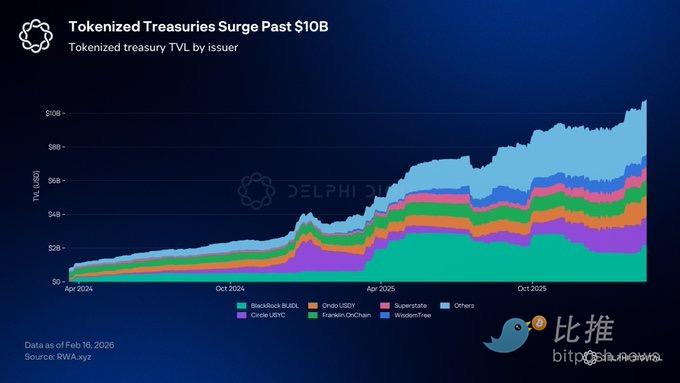
Tokenized U.S. Treasuries surpassed $10 billion in January 2024, led by institutions like BlackRock and Franklin Templeton. While government bonds are relatively straightforward to tokenize due to their standardized nature, equities present greater complexity because they involve shareholder rights such as voting and legal ownership. Two primary models exist: custodian-backed tokens (e.g., xStocks, Backed) offer price exposure but not direct ownership, while transfer agent-registered tokens (e.g., Superstate, Securitize) record holders directly on the shareholder registry, granting full rights. The latter enables functionalities like 24/7 trading, use as collateral in DeFi, cross-margin capabilities with crypto assets, and direct capital raises without traditional underwriters. However, challenges remain, including fragmented liquidity across blockchains, KYC/AML compliance friction, varying international regulations, and limited integration with traditional exchanges. While Nasdaq has applied to trade tokenized securities, broader market adoption depends on regulatory clarity and improved liquidity. The market is betting that the transfer agent model—which offers real ownership—will outperform custodian-based structures. Equities can now be settled instantly, traded around the clock, and used as collateral, but whether this becomes standard depends on regulatory and liquidity developments.

Source: Delphi Digital

Compiled and Edited: BitpushNews


In January, the scale of tokenized treasury bonds exceeded $10 billion, with BlackRock, Franklin Templeton, Ondo, and Circle leading the market. Government bonds were the first to be tokenized because they have standardized instruments and liquid markets, making the process relatively straightforward.

But the real challenge lies with stocks.

Stocks represent shareholders, who possess voting rights and legal rights that must be enforced. Tokenization projects have all hit the same wall: you can mint a token representing a stock, but you do not actually own the share.
Not all tokenized stocks operate in the same way. Tokens issued by platforms like xStocks, Backed, and similar are backed 1:1 by shares held by a custodian. Investors gain price exposure and can trade 24/7, but ownership remains with the custodian.

Custodian vs. Transfer Agent

Superstate and Securitize are registered as transfer agents with the U.S. Securities and Exchange Commission (SEC), directly recording token holders on the company's shareholder registry. In September 2025, when Galaxy Digital was tokenized via Superstate's Opening Bell platform, GLXY token holders became genuine shareholders with voting rights and dividend entitlements. The blockchain was integrated with the shareholder registry.

Securitize has adopted a similar approach on the fund side. As the transfer agent behind BlackRock's BUIDL, they manage one of the largest tokenized treasury funds. They are also bringing institutional-grade private funds on-chain, lowering investment barriers and expanding access to alternative assets that were previously out of reach for most investors.

Recent guidance from SEC staff clarifies this distinction. Issuer-led tokenization through registered transfer agents creates ownership with full shareholder rights. Custodian-backed tokens may face different regulatory treatment and limitations compared to direct shareholder registration.
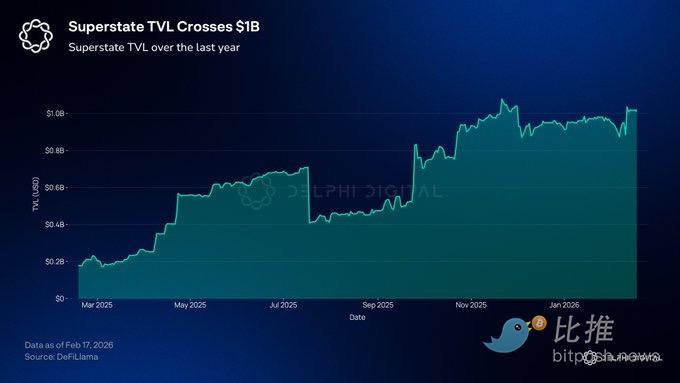
Genuine shareholder status enables functionalities that custodian-backed token structures cannot achieve.

Shareholders can trade 24/7 on supported trading platforms without waiting for the Toronto Stock Exchange to open. Shareholders of Forward Industries can pledge their equity as collateral on Kamino. Even if shares are deposited in lending pools, Superstate tracks beneficial ownership, ensuring dividends are distributed to the correct holders regardless of where the tokens are stored.

Backpack Exchange and Superstate have announced plans to enable cross-margining between tokenized stocks and crypto assets. Once live, traders can hold both tokenized stocks and SOL in the same account and use both as margin. Traditional brokers typically cannot offer this service because stocks and cryptocurrencies exist in completely separate custody and clearing systems.

This is unprecedented capital efficiency. Shareholders can obtain liquidity without selling, hedge across asset classes in a single account, and trade globally without settlement delays.

Raising Capital Without Underwriters

Superstate's direct issuance program allows publicly traded companies to reduce reliance on traditional underwriters for on-chain fundraising. Investors pay with stablecoins, shares are minted directly into their wallets, and companies receive funds instantly, with no cash settlement delays.

Traditional equity fundraising involves underwriters, roadshows, and settlement delays that can last weeks. Direct issuance compresses this into a single transaction, with the shareholder registry updated in real time.

The first issuances are expected later this year, likely from small-cap public companies that find traditional capital market infrastructure too costly relative to their trading size.

Missing Pieces

Liquidity remains fragmented. Tokenized stocks exist on multiple chains with no unified order book connecting them. Trading volumes are small compared to traditional markets, limiting the scale investors can move without impacting prices.

KYC requirements create friction with DeFi's permissionless architecture. Only whitelisted addresses can hold tokenized stocks, meaning they cannot be integrated into every lending protocol or liquidity pool. Issuers need to verify investors before they receive shares, and this verification must persist as tokens move between wallets.

Outside the U.S., regulatory frameworks vary significantly. SEC guidance applies to matters involving U.S. federal securities laws, but Europe, Asia, and other markets have their own rules, which may not align.

Traditional exchanges are watching closely. Nasdaq has filed an application with the SEC to trade tokenized securities. But until regulators and existing participants figure out how this fits into the existing market structure, actual exchange support for on-chain stocks remains pending.

Conclusion

Tokenized treasury bonds have proven that this mechanism can work at scale. Now, the stock space is catching up, achieving genuine compliance and true DeFi integration.

The market is betting that the transfer agent model, which records token holders as actual shareholders, will outperform indirect ownership structures that only provide price exposure.

Stocks can now be settled instantly, traded 24/7, and used as collateral in markets that never close. Whether this becomes the standard for how stocks operate or remains a niche play for crypto-native companies depends on whether liquidity and regulatory clarity can keep up with the infrastructure already in place.


Twitter:https://twitter.com/BitpushNewsCN

Bitpush TG Discussion:https://t.me/BitPushCommunity

Bitpush TG Subscription: https://t.me/bitpush

Original link:https://www.bitpush.news/articles/7612882

Perguntas relacionadas

QWhat is the key difference between tokenized stocks issued by platforms like xStocks/Backed and those registered with the SEC as transfer agents like Superstate/Securitize?

APlatforms like xStocks and Backed issue tokens that are 1:1 backed by stocks held by a custodian, providing price exposure but not actual ownership. In contrast, SEC-registered transfer agents like Superstate and Securitize record token holders directly on the company's shareholder registry, granting them full shareholder rights including voting and dividends.

QWhat major milestone did tokenized treasury products achieve in January, and which companies are leading this market?

AIn January, the size of tokenized treasury products surpassed $10 billion. Companies such as BlackRock, Franklin Templeton, Ondo, and Circle are leading this market.

QWhat are some of the unique functionalities enabled by true shareholder status in tokenized stocks, according to the article?

ATrue shareholder status enables functionalities like 24/7 trading on supported platforms, the ability to use equity as collateral (e.g., on Kamino), receiving dividends regardless of where the token is held, and cross-margining between tokenized stocks and crypto assets in a single account for unprecedented capital efficiency.

QHow does Superstate's direct issuance plan aim to change the traditional capital raising process for public companies?

ASuperstate's direct issuance plan allows public companies to raise capital on-chain with reduced reliance on traditional underwriters. Investors pay with stablecoins, shares are minted directly to their wallets, the company receives funds instantly, and the shareholder registry is updated in real-time, compressing a process that traditionally takes weeks into a single transaction.

QWhat are the main challenges or missing pieces currently hindering the wider adoption of tokenized stocks?

AThe main challenges include fragmented liquidity across different blockchains without a central order book, smaller trading volumes limiting large-scale moves, friction between KYC requirements and DeFi's permissionless architecture, and varying regulatory frameworks outside the U.S. that are not necessarily aligned with the SEC's guidance.

Leituras Relacionadas

TechFlow Intelligence Bureau: KelpDAO Attack Causes Nearly $300 Million Loss, Triggers Aave Withdrawal Wave, RAVE Crashes 95% in a Single Day

China's AI firm DeepSeek is seeking external funding for the first time, with a valuation exceeding $10 billion, signaling intensifying competition and high R&D costs in the domestic large model sector. Meanwhile, OpenAI CEO Sam Altman faces scrutiny over potential conflicts of interest between his personal investments and OpenAI’s business ahead of a possible IPO. In Web3, KelpDAO suffered a $294 million attack due to forged cross-chain messages on LayerZero, leading to massive withdrawals from Aave and a resulting 18% drop in AAVE tokens. Separately, RAVE cryptocurrency collapsed by 95% in a single day amid suspected insider manipulation. Geopolitically, Iran is now demanding Bitcoin payments for transit through the Strait of Hormuz, reflecting both internal governmental discord and the growing adoption of crypto in tense regions. In semiconductors, Nvidia CEO Jensen Huang showed rare public frustration over questions regarding chip sales to China, while the industry faces renewed price hikes. Tesla continues expanding its Robotaxi service, and a Chinese humanoid robot outperformed humans in a half-marathon, marking a milestone in robotics. Despite Middle East tensions and market uncertainties, U.S. stocks continue to rise, prompting discussions about market optimism versus risk blindness. Overall, today’s developments highlight systemic vulnerabilities—in tech, finance, and geopolitics—while also showcasing innovation in crises.

marsbitHá 6h

TechFlow Intelligence Bureau: KelpDAO Attack Causes Nearly $300 Million Loss, Triggers Aave Withdrawal Wave, RAVE Crashes 95% in a Single Day

marsbitHá 6h

Trading

Spot
Futuros

Artigos em Destaque

Como comprar ERA

Bem-vindo à HTX.com!Tornámos a compra de Caldera (ERA) simples e conveniente.Segue o nosso guia passo a passo para iniciar a tua jornada no mundo das criptos.Passo 1: cria a tua conta HTXUtiliza o teu e-mail ou número de telefone para te inscreveres numa conta gratuita na HTX.Desfruta de um processo de inscrição sem complicações e desbloqueia todas as funcionalidades.Obter a minha contaPasso 2: vai para Comprar Cripto e escolhe o teu método de pagamentoCartão de crédito/débito: usa o teu visa ou mastercard para comprar Caldera (ERA) instantaneamente.Saldo: usa os fundos da tua conta HTX para transacionar sem problemas.Terceiros: adicionamos métodos de pagamento populares, como Google Pay e Apple Pay, para aumentar a conveniência.P2P: transaciona diretamente com outros utilizadores na HTX.Mercado de balcão (OTC): oferecemos serviços personalizados e taxas de câmbio competitivas para os traders.Passo 3: armazena teu Caldera (ERA)Depois de comprar o teu Caldera (ERA), armazena-o na tua conta HTX.Alternativamente, podes enviá-lo para outro lugar através de transferência blockchain ou usá-lo para transacionar outras criptomoedas.Passo 4: transaciona Caldera (ERA)Transaciona facilmente Caldera (ERA) no mercado à vista da HTX.Acede simplesmente à tua conta, seleciona o teu par de trading, executa as tuas transações e monitoriza em tempo real.Oferecemos uma experiência de fácil utilização tanto para principiantes como para traders experientes.

347 Visualizações TotaisPublicado em {updateTime}Atualizado em 2025.07.17

Como comprar ERA

Discussões

Bem-vindo à Comunidade HTX. Aqui, pode manter-se informado sobre os mais recentes desenvolvimentos da plataforma e obter acesso a análises profissionais de mercado. As opiniões dos utilizadores sobre o preço de ERA (ERA) são apresentadas abaixo.

活动图片









