Crypto Lobby Group Sounds Alarm Over Senate’s Crypto Bill Threat

bitcoinistPublished on 2026-02-18Last updated on 2026-02-18

Abstract

Coin Center warns that a revised version of the Blockchain Regulatory Certainty Act could redefine legal boundaries for crypto developers. The bill clarifies that individuals who write code or operate infrastructure without controlling users' funds should not be classified as money transmitters. Introduced by Senators Lummis and Wyden, the update aims to distinguish software development from financial services, preventing coders from being treated like bankers. Recent convictions, such as those linked to Tornado Cash and Samourai Wallet, highlight the legal risks developers face. Supporters argue clear rules are essential to retain talent in the U.S., while opponents fear potential loopholes for criminal activity. The Senate Banking Committee has yet to finalize the bill, balancing innovation against regulatory enforcement.

According to Coin Center, a fresh version of the Blockchain Regulatory Certainty Act is on the table and could redraw the lines between crypto, software work and criminal liability.

The bill aims to say, in plain terms, that people who write code or run infrastructure but do not control other people’s crypto funds shouldn’t be treated as money transmitters.

Who Gets Legal Cover

Senators Cynthia Lummis and Ron Wyden offered the updated language after the original measure was introduced by Tom Emmer in the House years ago.

Based on reports, the change is meant to draw a clearer line in federal law between creating tools and moving money. Supporters say that without clear rules, simple acts of coding could be treated like operating a bank.

Opponents worry about loopholes. Debates have already split lawmakers and tech teams in Washington.

High-Profile Convictions And Risk

Reports note several recent prosecutions that helped push this debate into view. The developer linked to Tornado Cash faces charges tied to money transmission. Two men tied to Samourai Wallet were also convicted on similar counts.

Roman Storm is awaiting sentencing. Keonne Rodriguez and Will Lonergan Hill received multi-year terms. These cases are short, sharp reminders that tools used by others can end up at the center of criminal probes.

That fact has pushed more than one developer to ask whether the US remains the easiest place to build.

BTCUSD now trading at $68,092. Chart: TradingView

What Could Change If Protections Weaken

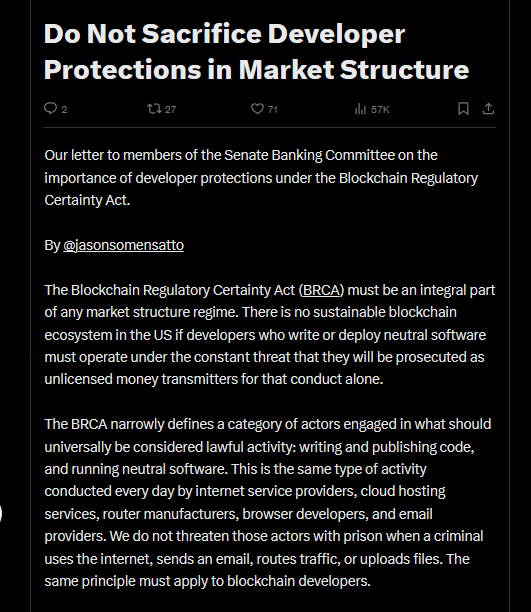
According to Coin Center policy chief Jason Somensatto, diluting the bill would leave creators guessing where liability begins and ends.

In a letter to to the Senate Banking Committee, he argues that software authors deserve the same basic protections as other internet builders — hosting firms, browser teams, and email providers — who are not jailed when a bad actor misuses their products.
Image: Coin Center

The argument is framed around certainty: clear rules, advocates say, let people decide to stay and invest here rather than move projects offshore.

A Decision With Tradeoffs

Reports say the Senate Banking Committee has not yet marked up the bill. Lawmakers must weigh public-safety concerns against the goal of keeping promising technical work in the US.

Some legal experts want narrower safe harbors. Others want stronger guardrails so that criminal abuse can still be prosecuted.

Whichever path the committee picks will shape where developers choose to work, and how people build the next wave of crypto tools.

Featured image from Unsplash, chart from TradingView

Related Questions

QWhat is the main purpose of the Blockchain Regulatory Certainty Act as discussed in the article?

AThe bill aims to clearly state that people who write code or run infrastructure, but do not control other people's crypto funds, should not be treated as money transmitters under federal law.

QWhich two U.S. Senators offered the updated language for the crypto bill?

ASenators Cynthia Lummis and Ron Wyden offered the updated language for the bill.

QAccording to the article, what recent event helped push the debate over developer liability into view?

ASeveral recent prosecutions, including the developer linked to Tornado Cash and the two men tied to Samourai Wallet who were convicted on money transmission charges, helped push this debate into view.

QWhat is the primary concern expressed by Coin Center's policy chief if the bill's protections are weakened?

ACoin Center policy chief Jason Somensatto argues that diluting the bill would leave software creators guessing about where their liability begins and ends, depriving them of the same basic protections as other internet builders.

QWhat two competing interests must U.S. lawmakers weigh when considering this bill, according to the article?

ALawmakers must weigh public-safety concerns against the goal of keeping promising technical work and innovation within the United States.

Related Reads

Why Do You Always Lose Money on Polymarket? Because You're Betting on News, While the Pros Read the Rules

Why do you always lose money on Polymarket? Because you bet on news, while the pros study the rules. This article explains how top traders ("che tou") profit by meticulously analyzing market rules, not just predicting events. Polymarket, a prediction market platform, often sees disputes over event outcomes due to ambiguous rule wording. For instance, a market asking "Who will be the leader of Venezuela by the end of 2026?" was misinterpreted by many who bet on Delcy Rodríguez, assuming she held power. However, the rules specified "officially holds" as the formally appointed, sworn-in individual. Since Nicolás Maduro was still recognized as president officially, he won the market—even being in prison. To resolve such disputes, Polymarket uses a decentralized arbitration system via UMA protocol. The process involves: 1. Proposal: Anyone can propose a market outcome by staking 750 USDC, earning 5 USDC if unchallenged. 2. Dispute: A 2-hour window allows challenges with a 750 USDC stake; successful challengers earn 250 USDC. 3. Discussion: A 48-hour period on UMA Discord for evidence and debate. 4. Voting: UMA token holders vote in two 24-hour phases (blind then public). Outcomes require >65% consensus and 5M tokens voted; otherwise, four re-votes occur before Polymarket intervention. 5. Settlement: Results are final and automatic. Unlike traditional courts, Polymarket’s system lacks separation between arbitrators and stakeholders—voters often hold market positions, creating conflicts of interest. This leads to herd mentality in discussions and non-transparent outcomes without explanatory rulings, preventing precedent formation. Thus, success on Polymarket hinges on deep rule interpretation, not just event prediction, exploiting gaps between reality and contractual wording.

marsbit2m ago

Why Do You Always Lose Money on Polymarket? Because You're Betting on News, While the Pros Read the Rules

marsbit2m ago

DeepSeek Funding: Liang Wenfeng's 'Realist' Pivot

DeepSeek, a leading Chinese AI company, has initiated its first external funding round, aiming to raise at least $300 million at a valuation of no less than $10 billion. This move marks a significant shift from its founder Liang Wenfeng’s previous idealistic stance of rejecting external capital to maintain independence. Despite strong financial backing from its parent company, quantitative trading firm幻方量化 (Huanfang Quant), which provided an estimated $700 million in revenue in 2025 alone, DeepSeek faces mounting challenges. Key issues include a 15-month gap in major model updates, delays in its flagship V4 release, and the loss of several core researchers to competitors offering significantly higher compensation. The company is also undergoing a strategic pivot by migrating its infrastructure from NVIDIA’s CUDA to Huawei’s Ascend platform, a move aligned with China’s push for technological self-reliance amid U.S. export controls. However, DeepSeek lags behind rivals like智谱AI and MiniMax—both now publicly listed—in areas such as product ecosystem, multimodal capabilities, and commercialization. The funding round, though relatively small in scale, is seen as a way to establish a market-validated valuation anchor, making employee stock options more competitive and facilitating talent retention. It also signals DeepSeek’s transition from a pure research-oriented organization to a commercially-driven player in the global AI ecosystem.

marsbit40m ago

DeepSeek Funding: Liang Wenfeng's 'Realist' Pivot

marsbit40m ago

Trading

Spot
Futures

Hot Articles

Discussions

Welcome to the HTX Community. Here, you can stay informed about the latest platform developments and gain access to professional market insights. Users' opinions on the price of S (S) are presented below.

活动图片