CoinShares Survey: Institutional Investors Managing $1.3 Trillion Are Increasing Their BTC Holdings

marsbitPublished on 2026-05-08Last updated on 2026-05-08

Abstract

CoinShares' latest quarterly survey reveals a cautious yet growing institutional interest in cryptocurrencies. Among 26 surveyed investors managing a combined $1.3 trillion in assets, 32% now hold Bitcoin (BTC) and 25% hold Ethereum (ETH), though digital assets typically comprise only about 1% of their portfolios. The report identifies Bitcoin as having the strongest growth prospects, followed by ETH and Solana (SOL). This sentiment is reflected in sustained capital inflows. Digital asset investment products have seen four consecutive weeks of net inflows, totaling $3.9 billion in that period. U.S. spot Bitcoin ETFs alone attracted nearly $1 billion in net inflows in early May, coinciding with BTC's price rising above $80,000. Key drivers for this adoption include improved regulatory clarity and the availability of regulated ETF products, which simplify exposure. However, internal compliance restrictions and regulatory uncertainty remain the primary obstacles to larger-scale investment. A trend noted is capital shifting from older altcoins towards newer DeFi protocols and emerging blockchain sectors.

Author: Sam Bourgi

Compiled by: TechFlow Deep Tide

Deep Tide Introduction: The latest quarterly survey from CoinShares shows that among 26 institutional investors managing a combined $1.3 trillion in assets, 32% already hold BTC and 25% have allocated to ETH. The proportion of digital asset allocation remains low at only about 1%, but fund inflows have been positive for four consecutive weeks, with spot BTC ETFs seeing nearly $1 billion in net inflows in a single week in early May. Improved regulatory friendliness and the opening of ETF channels are the core drivers, while internal compliance restrictions remain the biggest obstacle.

Fund managers are embracing digital assets again. The latest CoinShares survey shows that Bitcoin continues to dominate institutional allocation preferences, and overall crypto market sentiment is also warming.

This April survey covered 26 institutional investors with a combined AUM of $1.3 trillion. The allocation of digital assets in investment portfolios remains low, at about 1%. CoinShares describes this as a "typical entry-level position," corresponding to the current risk-off market environment.

James Butterfill, Head of Research at CoinShares, wrote in the report: "Bitcoin remains the digital asset with the most compelling growth prospects." Sentiment towards ETH and SOL has also improved moderately compared to previous quarters.

Survey data: 32% of respondents have already invested in BTC, and 25% have allocated to ETH.

Institutional investors are gradually increasing their positions, driven by factors such as improving market sentiment, rising ETF adoption, and a more friendly regulatory environment. Meanwhile, respondents cited internal compliance restrictions and regulatory uncertainty as the primary obstacles to broader adoption. The survey also noted a trend: funds are flowing from "legacy altcoins" to newer DeFi protocols and emerging blockchain sectors.
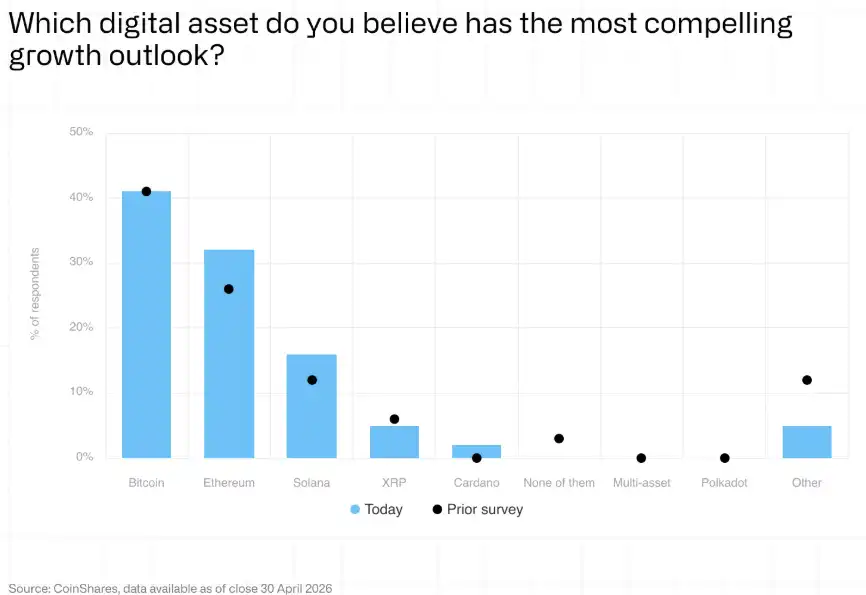
Caption: Fund managers believe Bitcoin has the strongest growth prospects among digital assets, followed by ETH and SOL

Source:CoinShares

Sustained Inflows, Sentiment Indicators Warm Across the Board

The survey's optimistic tone aligns with broader institutional flow data. CoinShares data shows that digital asset investment products have recorded net inflows for multiple consecutive weeks, primarily driven by Bitcoin demand.

Crypto ETPs attracted $1.2 billion in inflows in the four weeks ending April 27, marking the fourth consecutive positive week, with cumulative inflows of $3.9 billion over those four weeks.

This momentum continued into early May. SoSoValue data shows that US spot Bitcoin ETFs recorded nearly $1 billion in net inflows this week, with BTC prices climbing back above $80,000.

Caption: Bitcoin ETF inflows have continued to rise since last Friday

Source: SoSoValue

The inflow trend also aligns with a joint survey by Coinbase and EY-Parthenon: 73% of institutional investors plan to increase their digital asset exposure this year, with most expecting crypto asset prices to rise over the next 12 months.

The launch of US spot Bitcoin ETFs in January 2024 is widely regarded as a turning point for institutional adoption. The ETF structure reduces operational friction for institutions, providing regulated Bitcoin exposure without the need for direct digital asset custody.


Related Questions

QWhat percentage of the surveyed institutional investors manage $1.3 trillion in assets are currently holding Bitcoin?

A32% of the surveyed institutional investors are currently holding Bitcoin.

QWhat are the two main factors cited as driving increased institutional allocation to digital assets according to the CoinShares report?

AThe two main driving factors are improved regulatory friendliness and the opening of ETF access channels.

QWhat does the survey identify as the primary obstacle to larger-scale adoption of digital assets by institutions?

AThe survey identifies internal compliance restrictions and regulatory uncertainty as the primary obstacles to larger-scale adoption.

QHow much net inflow did US spot Bitcoin ETFs record in a single week in early May, according to the article?

AUS spot Bitcoin ETFs recorded nearly $1 billion in net inflows in a single week in early May.

QBesides Bitcoin, which two digital assets showed improved sentiment among institutional investors compared to previous quarters?

ABesides Bitcoin, sentiment for Ethereum (ETH) and Solana (SOL) showed moderate improvement compared to previous quarters.

Related Reads

Gensyn AI: Don't Let AI Repeat the Mistakes of the Internet

In recent months, the rapid growth of the AI industry has attracted significant talent from the crypto sector. A persistent question among researchers intersecting both fields is whether blockchain can become a foundational part of AI infrastructure. While many previous AI and Crypto projects focused on application layers (like AI Agents, on-chain reasoning, data markets, and compute rentals), few achieved viable commercial models. Gensyn differentiates itself by targeting the most critical and expensive layer of AI: model training. Gensyn aims to organize globally distributed GPU resources into an open AI training network. Developers can submit training tasks, nodes provide computational power, and the network verifies results while distributing incentives. The core issue addressed is not decentralization for its own sake, but the increasing centralization of compute power among tech giants. In the era of large models, access to GPUs (like the H100) has become a decisive bottleneck, dictating the pace of AI development. Major AI companies are heavily dependent on large cloud providers for compute resources. Gensyn's approach is significant for several reasons: 1) It operates at the core infrastructure layer (model training), the most resource-intensive and technically demanding part of the AI value chain. 2) It proposes a more open, collaborative model for compute, potentially increasing resource utilization by dynamically pooling idle GPUs, similar to early cloud computing logic. 3) Its technical moat lies in solving complex challenges like verifying training results, ensuring node honesty, and maintaining reliability in a distributed environment—making it more of a deep-tech infrastructure company. 4) It targets a validated, high-growth market with genuine demand, rather than pursuing blockchain integration without purpose. Ultimately, the boundaries between Crypto and AI are blurring. AI requires global resource coordination, incentive mechanisms, and collaborative systems—areas where crypto-native solutions excel. Gensyn represents a step toward making advanced training capabilities more accessible and collaborative, moving beyond a niche controlled by a few giants. If successful, it could evolve into a fundamental piece of AI infrastructure, where the most enduring value in the AI era is often created.

marsbit2h ago

Gensyn AI: Don't Let AI Repeat the Mistakes of the Internet

marsbit2h ago

Why is China's AI Developing So Fast? The Answer Lies Inside the Labs

A US researcher's visit to China's top AI labs reveals distinct cultural and organizational factors driving China's rapid AI development. While talent, data, and compute are similar to the West, Chinese labs excel through a pragmatic, execution-focused culture: less emphasis on individual stardom and conceptual debate, and more on teamwork, engineering optimization, and mastering the full tech stack. A key advantage is the integration of young students and researchers who approach model-building with fresh perspectives and low ego, prioritizing collective progress over personal credit. This contrasts with the US culture of self-promotion and "star scientist" narratives. Chinese labs also exhibit a strong "build, don't buy" mentality, preferring to develop core capabilities—like data pipelines and environments—in-house rather than relying on external services. The ecosystem feels more collaborative than tribal, with mutual respect among labs. While government support exists, its scale is unclear, and technical decisions appear driven by labs, not state mandates. Chinese companies across sectors, from platforms to consumer tech, are building their own foundational models to control their tech destiny, reflecting a broader cultural drive for technological sovereignty. Demand for AI is emerging, with spending patterns potentially mirroring cloud infrastructure more than traditional SaaS. Despite challenges like a less mature data industry and GPU shortages, Chinese labs are propelled by vast talent, rapid iteration, and deep integration with the open-source community. The competition is evolving beyond a pure model race into a contest of organizational execution, developer ecosystems, and industrial pragmatism.

marsbit3h ago

Why is China's AI Developing So Fast? The Answer Lies Inside the Labs

marsbit3h ago

3 Years, 5 Times: The Rebirth of a Century-Old Glass Factory

Corning, a 175-year-old glass company, is experiencing a dramatic revival as a key player in AI infrastructure, driven by surging demand for high-performance optical fiber in data centers. AI data centers require vastly more fiber than traditional ones—5 to 10 times as much per rack—to handle high-speed data transmission between GPUs. This structural demand shift, coupled with supply constraints from the lengthy expansion cycle for fiber preforms, has created a significant supply-demand gap. Nvidia has invested in Corning, along with Lumentum and Coherent, in a $4.5 billion total commitment to secure the optical supply chain for AI. Corning's competitive edge lies in its expertise in producing ultra-low-loss, high-density, and bend-resistant specialty fiber, which is critical for 800G+ and future 1.6T data rates. Its deep involvement in co-packaged optics (CPO) with partners like Nvidia further solidifies its position. While not the largest fiber manufacturer globally, Corning's revenue from enterprise/data center clients now exceeds 40% of its optical communications sales, and it has secured multi-year supply agreements with major hyperscalers including Meta and Nvidia. Financially, Corning's optical communications revenue has surged, doubling from $1.3 billion in 2023 to over $3 billion in 2025. Its stock price has risen nearly 6-fold since late 2023. Key future catalysts include the rollout of Nvidia's CPO products and the scale of undisclosed customer agreements. However, risks include high current valuations and potential disruption from next-generation technologies like hollow-core fiber. The company's long-term bet on light over electricity, maintained even through the telecom bubble crash, is now being validated by the AI boom.

marsbit4h ago

3 Years, 5 Times: The Rebirth of a Century-Old Glass Factory

marsbit4h ago

Trading

Spot
Futures

Hot Articles

What is $BITCOIN

DIGITAL GOLD ($BITCOIN): A Comprehensive Analysis Introduction to DIGITAL GOLD ($BITCOIN) DIGITAL GOLD ($BITCOIN) is a blockchain-based project operating on the Solana network, which aims to combine the characteristics of traditional precious metals with the innovation of decentralized technologies. While it shares a name with Bitcoin, often referred to as “digital gold” due to its perception as a store of value, DIGITAL GOLD is a separate token designed to create a unique ecosystem within the Web3 landscape. Its goal is to position itself as a viable alternative digital asset, although specifics regarding its applications and functionalities are still developing. What is DIGITAL GOLD ($BITCOIN)? DIGITAL GOLD ($BITCOIN) is a cryptocurrency token explicitly designed for use on the Solana blockchain. In contrast to Bitcoin, which provides a widely recognized value storage role, this token appears to focus on broader applications and characteristics. Notable aspects include: Blockchain Infrastructure: The token is built on the Solana blockchain, known for its capacity to handle high-speed and low-cost transactions. Supply Dynamics: DIGITAL GOLD has a maximum supply capped at 100 quadrillion tokens (100P $BITCOIN), although details regarding its circulating supply are currently undisclosed. Utility: While precise functionalities are not explicitly outlined, there are indications that the token could be utilized for various applications, potentially involving decentralized applications (dApps) or asset tokenization strategies. Who is the Creator of DIGITAL GOLD ($BITCOIN)? At present, the identity of the creators and development team behind DIGITAL GOLD ($BITCOIN) remains unknown. This situation is typical among many innovative projects within the blockchain space, particularly those aligning with decentralized finance and meme coin phenomena. While such anonymity may foster a community-driven culture, it intensifies concerns about governance and accountability. Who are the Investors of DIGITAL GOLD ($BITCOIN)? The available information indicates that DIGITAL GOLD ($BITCOIN) does not have any known institutional backers or prominent venture capital investments. The project seems to operate on a peer-to-peer model focused on community support and adoption rather than traditional funding routes. Its activity and liquidity are primarily situated on decentralized exchanges (DEXs), such as PumpSwap, rather than established centralized trading platforms, further highlighting its grassroots approach. How DIGITAL GOLD ($BITCOIN) Works The operational mechanics of DIGITAL GOLD ($BITCOIN) can be elaborated on based on its blockchain design and network attributes: Consensus Mechanism: By leveraging Solana’s unique proof-of-history (PoH) combined with a proof-of-stake (PoS) model, the project ensures efficient transaction validation contributing to the network's high performance. Tokenomics: While specific deflationary mechanisms have not been extensively detailed, the vast maximum token supply implies that it may cater to microtransactions or niche use cases that are still to be defined. Interoperability: There exists the potential for integration with Solana’s broader ecosystem, including various decentralized finance (DeFi) platforms. However, the details regarding specific integrations remain unspecified. Timeline of Key Events Here is a timeline that highlights significant milestones concerning DIGITAL GOLD ($BITCOIN): 2023: The initial deployment of the token occurs on the Solana blockchain, marked by its contract address. 2024: DIGITAL GOLD gains visibility as it becomes available for trading on decentralized exchanges like PumpSwap, allowing users to trade it against SOL. 2025: The project witnesses sporadic trading activity and potential interest in community-led engagements, although no noteworthy partnerships or technical advancements have been documented as of yet. Critical Analysis Strengths Scalability: The underlying Solana infrastructure supports high transaction volumes, which could enhance the utility of $BITCOIN in various transaction scenarios. Accessibility: The potential low trading price per token could attract retail investors, facilitating wider participation due to fractional ownership opportunities. Risks Lack of Transparency: The absence of publicly known backers, developers, or an audit process may yield skepticism regarding the project's sustainability and trustworthiness. Market Volatility: The trading activity is heavily reliant on speculative behavior, which can result in significant price volatility and uncertainty for investors. Conclusion DIGITAL GOLD ($BITCOIN) emerges as an intriguing yet ambiguous project within the rapidly evolving Solana ecosystem. While it attempts to leverage the “digital gold” narrative, its departure from Bitcoin's established role as a store of value underscores the need for a clearer differentiation of its intended utility and governance structure. Future acceptance and adoption will likely depend on addressing the current opacity and defining its operational and economic strategies more explicitly. Note: This report encompasses synthesised information available as of October 2023, and developments may have transpired beyond the research period.

363 Total ViewsPublished 2025.05.13Updated 2025.05.13

What is $BITCOIN

Discussions

Welcome to the HTX Community. Here, you can stay informed about the latest platform developments and gain access to professional market insights. Users' opinions on the price of BTC (BTC) are presented below.

活动图片