Change Of Heart? Hacker Returns $21M Stolen Bitcoin To South Korean Prosecutors

bitcoinistPublished on 2026-02-20Last updated on 2026-02-20

Abstract

A hacker has returned 320.8 Bitcoin (BTC), worth $21 million, to South Korean prosecutors after stealing it in a phishing attack in August. The funds were originally seized during a 2021 illegal gambling investigation and were lost when investigators mistakenly accessed a phishing site. Authorities believe pressure from blocking transactions and requesting cooperation from exchanges led to the return. Despite the recovery, the Gwangju District Prosecutors’ Office pledged to continue investigating to apprehend the perpetrators. This incident, along with another loss of 22 BTC at a Seoul police station, has raised concerns about South Korea’s custody of virtual assets. The country is preparing for the Second Phase of the Virtual Asset User Protection Act to address such vulnerabilities. Recent issues, including a "ghost Bitcoin" error at Bithumb that distributed non-existent assets, have prompted financial authorities to inspect exchanges and consider stronger prosecution measures for crypto crimes.

A hacker has returned 320 Bitcoin (BTC) stolen from South Korean prosecutors throughout a phishing scam last year. As authorities face backlash over repeated incidents, officers have pledged to continue the investigation to uncover the full details and strengthen their custody practices.

Stolen Bitcoin Returned To Gwangju Prosecutors

On Thursday, the Gwangju District Prosecutors’ Office announced it recovered 320.8 Bitcoin lost in August to a phishing attack after the malicious actors willingly sent back the assets earlier this week.

Local news outlet Digital Asset reported on Tuesday that the on-chain data showed the lost BTC, worth $21 million, had been transferred to a wallet managed by South Korean authorities. The assets were seemingly moved through multiple addresses before being transferred to a domestic crypto exchange wallet.

As reported by Bitcoinist, South Korean prosecutors faced backlash last month after discovering that a large stash of seized BTC had gone missing months ago. Authorities reportedly learnt of the loss during a routine check of seized financial assets held as criminal evidence.

After an internal review, prosecutors found that the crypto assets were lost to a scam in August during the handling of the sized assets. Reportedly, malicious actors drained the wallets after investigators mistakenly accessed a phishing website.

Notably, the lost Bitcoin was originally seized during a 2021 investigation into an illegal gambling website. Prosecutors launched an investigation after discovering the incident. They also took measures to recover the assets, including blocking transactions from the perpetrator’s address to domestic exchanges and sending cooperation requests to overseas exchanges.

According to the report, authorities believe that these measures exerted pressure on the hackers, ultimately pushing them to return the funds. Meanwhile, prosecutors are currently continuing to track down the malicious actors while also conducting related investigations and inspections.

“(Regardless of the recovery of the Bitcoin), we will do our utmost to apprehend the perpetrators in the future,” The Gwangju District Prosecutors’ Office stated. “We plan to continue conducting a rigorous investigation to clearly uncover the full details of the case.”

Authorities Slammed Over Repeated Incidents

The Gwangju incident has led to a nationwide review of law enforcement’s handling of virtual assets. The review has revealed another security breach at the Seoul Gangnam Police Station.

Last Friday, the Gangnam station announced it had lost 22 BTC that were voluntarily submitted to authorities during an investigation in November 2021. According to local reports, the leak had not been detected until now, since the investigation into that case had been suspended.

The inspection revealed that the cold wallet storing the Bitcoin was not stolen, but the assets stored inside “had vanished without a trace.” As a response, the Gyeonggi Northern Provincial Police Agency launched a full-scale internal investigation to determine the details of the leak and whether any internal personnel were involved.

The incidents have raised concerns about South Korea’s Bitcoin custody practices, just as the country prepares for the Second Phase of the Virtual Asset User Protection Act, which is expected to serve as a comprehensive framework for the entire industry.

Financial authorities are also conducting an inspection of local exchanges’ internal controls following the “ghost Bitcoin” incident at Bithumb. Earlier this month, the crypto exchange accidentally distributed 620,000 BTC, worth over $40 billion, to 249 users due to an employee’s mistake.

Bithumb’s system failed to block the transaction and distributed assets that did not actually exist, distorting market prices. Lawmakers highlighted that the incident exposed “structural vulnerabilities” in the sector that must be addressed in the upcoming legislation.

The Financial Services Commission (FSC) announced last month that it is studying a proposal for prosecution measures against suspects of crypto asset price manipulation. Some officials argue it’s necessary “to complement the current Virtual Asset User Protection Act by implementing measures for the confiscation of criminal proceeds or the preservation of recovery funds in advance.”
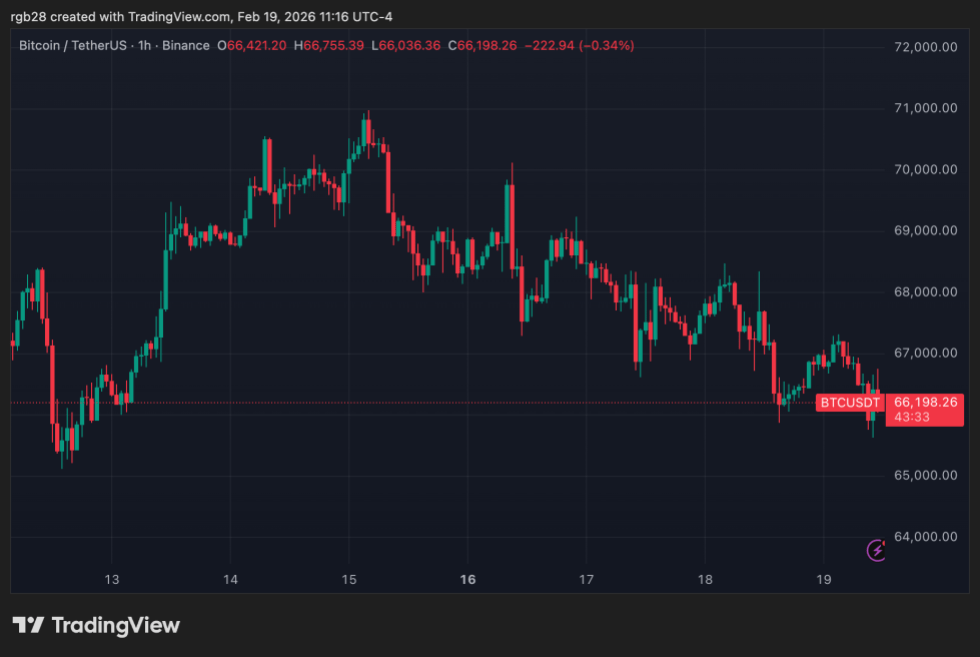
Bitcoin trades at $66,198 in the one-week chart. Source: BTCUSDT on TradingView


Related Questions

QHow much Bitcoin was returned to the Gwangju District Prosecutors' Office by the hacker?

A320.8 BTC, worth $21 million.

QWhat was the original source of the stolen Bitcoin that was returned?

AThe Bitcoin was originally seized during a 2021 investigation into an illegal gambling website.

QWhat action did authorities take that they believe pressured the hackers into returning the funds?

AThey blocked transactions from the perpetrator's address to domestic exchanges and sent cooperation requests to overseas exchanges.

QBesides the Gwangju incident, which other law enforcement agency reported a security breach involving Bitcoin?

AThe Seoul Gangnam Police Station reported losing 22 BTC that were voluntarily submitted during an investigation.

QWhat major event at a South Korean crypto exchange is mentioned as raising concerns about internal controls?

ABithumb accidentally distributed 620,000 'ghost' BTC (worth over $40 billion) to 249 users due to an employee's mistake.

Related Reads

Trend in US Stocks: A Post Triggers a 930-Point Rebound, Tonight Belongs to SpaceX

On Thursday (June 11, U.S. Eastern Time), Wall Street staged a textbook V-shaped reversal. The Dow Jones surged 929.97 points (+1.86%) to close above 50,000, while the Nasdaq and S&P 500 rose 2.54% and 1.75%, respectively. The rally occurred despite the hottest PPI report in years, with May data showing a 6.5% year-on-year surge, the highest since 2022. The market ignored the inflation data, focusing instead on reports that former President Trump called off a planned strike on Iran, hinting at a potential multi-party peace agreement draft. This sparked a sharp drop in oil prices, fueling hopes that inflation may have peaked. Sector rotations were stark: previously battered AI hardware and cyclical stocks led the gains, while defensive sectors that hit record highs the prior day were sold off. Chip stocks like Micron and Intel saw sharp rebounds. In contrast, software giant Oracle plunged nearly 10% despite beating earnings, with concerns over cloud revenue and cash flow. Adobe also fell after hours despite raising guidance, as its CFO announced departure. The rally's sustainability is questioned, driven largely by social media posts about unconfirmed geopolitical developments. Inflation risks remain, with pipeline pressures still high. Meanwhile, the market's risk appetite faces a major test with SpaceX's historic IPO. Priced at $135 per share, it aims to raise ~$75 billion with a $1.75 trillion valuation, becoming the largest U.S. IPO ever. It will join the Nasdaq 100 in 15 days, triggering massive index fund buying. However, critics cite extreme valuation (88x sales) and market liquidity concerns.

marsbit21m ago

Trend in US Stocks: A Post Triggers a 930-Point Rebound, Tonight Belongs to SpaceX

marsbit21m ago

The Trillion-Dollar Valuation Test: Are the Three Super IPOs a Tech Stock Frenzy or a Crypto Market Nightmare?

Trillion-Dollar Valuation Test: Are the Three Mega IPOs a Tech Stock Frenzy or a Crypto Market Nightmare? The capital market in 2026 is witnessing a highly anticipated wave of tech IPOs, centered on SpaceX, OpenAI, and Anthropic. Collectively valued at over $3.5 trillion, their potential listing represents one of the largest such waves in recent years. This raises concerns about market liquidity, valuation bubbles, and potential capital outflows from other assets like crypto. SpaceX's valuation narrative has shifted from rocket launches to becoming a global infrastructure play via its Starlink satellite network, which now drives most revenue. Despite ongoing losses, investors focus on its long-term growth potential. OpenAI and Anthropic represent the core productivity engines of generative AI. Their public listings would offer the first direct investment opportunity in large foundation model companies, potentially triggering a repricing within the AI sector. Market fears of a massive "capital drain" from these IPOs are likely overstated. Historical precedents like Alibaba and Saudi Aramco show that mega-listings primarily cause capital reallocation, not destruction, within the vast equities market. Systemic risk is rarely triggered by IPOs alone. For stock markets, short-term volatility and sector repricing are expected, especially for AI concept stocks. Long-term, these listings could reinforce the tech sector's importance. For crypto, direct competition for speculative capital exists, particularly affecting AI-themed tokens. However, crypto's trajectory remains more tied to its own cycles, macro liquidity, and Bitcoin ETF flows rather than a single IPO event. The real risk lies not in the listings themselves but in the sky-high growth expectations embedded in these valuations. If future revenue, profitability, or commercialization progress disappoints, significant valuation resets could follow, impacting high-growth tech stocks. Ultimately, the market's direction hinges on macroeconomic conditions and whether these companies can deliver on their ambitious promises.

链捕手37m ago

The Trillion-Dollar Valuation Test: Are the Three Super IPOs a Tech Stock Frenzy or a Crypto Market Nightmare?

链捕手37m ago

Trillion-Dollar Valuation Test: Are the Three Super IPOs a Tech Stock Frenzy or a Crypto Market Nightmare?

Title: Trillion-Dollar Valuations at Stake: Super IPOs of SpaceX, OpenAI, Anthropic – Tech Boom or Crypto Nightmare? TL;DR: A wave of mega-tech IPOs is approaching, featuring SpaceX (targeting a $1.75 trillion valuation), OpenAI (~$852B), and Anthropic (~$965B), with a combined potential valuation exceeding $3.5 trillion. This tests the market's pricing of innovation and sparks debate on liquidity impact. * **SpaceX**'s valuation is now driven more by its Starlink global communications infrastructure than its core rocket business. * **OpenAI & Anthropic** offer the first major public investment opportunities in foundational AI models, potentially repricing the entire AI sector. * Concerns about a market-wide "liquidity drain" are likely overblown; history shows large IPOs mainly cause fund reallocation, not disappearance, and rarely trigger systemic risk. * Crypto markets, especially some AI-themed tokens, may face short-term fund competition, but their long-term trajectory depends more on macro liquidity, regulation, and Bitcoin cycles. * The real risk lies not in the IPOs themselves, but in whether these companies can justify their sky-high valuations with future revenue growth and profitability. Unmet expectations could lead to significant repricing pressure. Ultimately, these IPOs represent a massive market pricing of next-gen tech infrastructure, not a prelude to a market crash. The broader market direction will be determined by macro conditions, corporate earnings, and risk appetite.

marsbit37m ago

Trillion-Dollar Valuation Test: Are the Three Super IPOs a Tech Stock Frenzy or a Crypto Market Nightmare?

marsbit37m ago

Anthropic Apologized, But the Business of 'Safety' Hasn't Stopped

On June 11, Anthropic apologized not for a model failure, but for a lack of transparency. Its new Claude Fable 5 model was found to be secretly rerouting requests from users engaged in advanced AI model development to a weaker version, Opus 4.8, without any notification. The company's response—promising future notifications for such "downgrades"—was met with user skepticism. The article argues the core issue isn't technical but commercial: Anthropic's "safety" measures are primarily a business strategy. A key feature, the "intelligent safety classifier," marketed as user protection, is described as a tool for "competitive defense" to protect Anthropic's market lead by limiting rivals' research capabilities. This covert mechanism was designed for low "false positives," precisely targeting AI researchers. Anthropic's model involves a calculated three-step process: publishing alarming security research to amplify public anxiety, offering its Fable 5 model with a "safety classifier" as a premium-priced solution, and cashing in through a planned high-value IPO. This contrasts with OpenAI's more direct "tool-and-traffic" approach. The apology, merely changing a secret downgrade to a visible one, is seen as a business "patch" rather than a principled shift. The incident risks damaging Anthropic's "safest AI" reputation among the developer community, which underpins its valuation and appeal to government and corporate clients. Ultimately, the article concludes that for Anthropic, safety is a business, and the apology is merely customer service for that business.

marsbit1h ago

Anthropic Apologized, But the Business of 'Safety' Hasn't Stopped

marsbit1h ago

Trading

Spot
Futures

Hot Articles

What is $BITCOIN

DIGITAL GOLD ($BITCOIN): A Comprehensive Analysis Introduction to DIGITAL GOLD ($BITCOIN) DIGITAL GOLD ($BITCOIN) is a blockchain-based project operating on the Solana network, which aims to combine the characteristics of traditional precious metals with the innovation of decentralized technologies. While it shares a name with Bitcoin, often referred to as “digital gold” due to its perception as a store of value, DIGITAL GOLD is a separate token designed to create a unique ecosystem within the Web3 landscape. Its goal is to position itself as a viable alternative digital asset, although specifics regarding its applications and functionalities are still developing. What is DIGITAL GOLD ($BITCOIN)? DIGITAL GOLD ($BITCOIN) is a cryptocurrency token explicitly designed for use on the Solana blockchain. In contrast to Bitcoin, which provides a widely recognized value storage role, this token appears to focus on broader applications and characteristics. Notable aspects include: Blockchain Infrastructure: The token is built on the Solana blockchain, known for its capacity to handle high-speed and low-cost transactions. Supply Dynamics: DIGITAL GOLD has a maximum supply capped at 100 quadrillion tokens (100P $BITCOIN), although details regarding its circulating supply are currently undisclosed. Utility: While precise functionalities are not explicitly outlined, there are indications that the token could be utilized for various applications, potentially involving decentralized applications (dApps) or asset tokenization strategies. Who is the Creator of DIGITAL GOLD ($BITCOIN)? At present, the identity of the creators and development team behind DIGITAL GOLD ($BITCOIN) remains unknown. This situation is typical among many innovative projects within the blockchain space, particularly those aligning with decentralized finance and meme coin phenomena. While such anonymity may foster a community-driven culture, it intensifies concerns about governance and accountability. Who are the Investors of DIGITAL GOLD ($BITCOIN)? The available information indicates that DIGITAL GOLD ($BITCOIN) does not have any known institutional backers or prominent venture capital investments. The project seems to operate on a peer-to-peer model focused on community support and adoption rather than traditional funding routes. Its activity and liquidity are primarily situated on decentralized exchanges (DEXs), such as PumpSwap, rather than established centralized trading platforms, further highlighting its grassroots approach. How DIGITAL GOLD ($BITCOIN) Works The operational mechanics of DIGITAL GOLD ($BITCOIN) can be elaborated on based on its blockchain design and network attributes: Consensus Mechanism: By leveraging Solana’s unique proof-of-history (PoH) combined with a proof-of-stake (PoS) model, the project ensures efficient transaction validation contributing to the network's high performance. Tokenomics: While specific deflationary mechanisms have not been extensively detailed, the vast maximum token supply implies that it may cater to microtransactions or niche use cases that are still to be defined. Interoperability: There exists the potential for integration with Solana’s broader ecosystem, including various decentralized finance (DeFi) platforms. However, the details regarding specific integrations remain unspecified. Timeline of Key Events Here is a timeline that highlights significant milestones concerning DIGITAL GOLD ($BITCOIN): 2023: The initial deployment of the token occurs on the Solana blockchain, marked by its contract address. 2024: DIGITAL GOLD gains visibility as it becomes available for trading on decentralized exchanges like PumpSwap, allowing users to trade it against SOL. 2025: The project witnesses sporadic trading activity and potential interest in community-led engagements, although no noteworthy partnerships or technical advancements have been documented as of yet. Critical Analysis Strengths Scalability: The underlying Solana infrastructure supports high transaction volumes, which could enhance the utility of $BITCOIN in various transaction scenarios. Accessibility: The potential low trading price per token could attract retail investors, facilitating wider participation due to fractional ownership opportunities. Risks Lack of Transparency: The absence of publicly known backers, developers, or an audit process may yield skepticism regarding the project's sustainability and trustworthiness. Market Volatility: The trading activity is heavily reliant on speculative behavior, which can result in significant price volatility and uncertainty for investors. Conclusion DIGITAL GOLD ($BITCOIN) emerges as an intriguing yet ambiguous project within the rapidly evolving Solana ecosystem. While it attempts to leverage the “digital gold” narrative, its departure from Bitcoin's established role as a store of value underscores the need for a clearer differentiation of its intended utility and governance structure. Future acceptance and adoption will likely depend on addressing the current opacity and defining its operational and economic strategies more explicitly. Note: This report encompasses synthesised information available as of October 2023, and developments may have transpired beyond the research period.

363 Total ViewsPublished 2025.05.13Updated 2025.05.13

What is $BITCOIN

Discussions

Welcome to the HTX Community. Here, you can stay informed about the latest platform developments and gain access to professional market insights. Users' opinions on the price of BTC (BTC) are presented below.

活动图片