Cardano Lands Circle’s USDCX As Tier-One Stablecoin: Hoskinson

bitcoinistPublished on 2026-01-31Last updated on 2026-01-31

Abstract

Charles Hoskinson has announced that Circle's stablecoin, USDCX, is coming to Cardano following a signed deal between Circle and the Cardano-aligned group, the Pentad. Described as a "tier-one" stablecoin solution, USDCX will operate on non-EVM chains like Cardano through a one-to-one reserve model, mirroring USDC's liquidity. Hoskinson emphasized that integration is imminent, not aspirational, and will provide seamless access to Circle's distribution network and deep liquidity. He also highlighted privacy benefits and praised Circle as a professional partner. The move aims to meet long-standing community demand for a major stablecoin, with Hoskinson noting that existing Circle integrations on other chains should expedite deployment. He acknowledged market skepticism but reaffirmed focus on Cardano's development and partnerships. ADA was trading at $0.3258 at the time of the announcement.

Charles Hoskinson says a Circle-issued stablecoin product is headed to Cardano after what he described as “deep negotiations” between Circle and a Cardano-aligned negotiating group known as the Pentad (Input Output (IOHK), EMURGO, Cardano Foundation, Midnight Foundation, and Intersect). Speaking from Fukuoka on his Japan tour livestream titled “Circle and Pentad,” Hoskinson framed the deal as a long-awaited step toward bringing “tier one” stablecoin liquidity into Cardano’s DeFi stack.

USDCX To Launch On Cardano After Deal Signed

Hoskinson said the agreement is signed and positioned the integration as near-term rather than aspirational. “This is not something that’s six months out, ink is on paper, deal is signed,” he said, adding that integration work should happen “in short order.” The pitch is that Cardano gains access to Circle’s distribution rails and liquidity network, while developers can build around a familiar dollar asset without needing bespoke plumbing for every application.

What’s coming, per Hoskinson, is “USDCX,” which he described as effectively the same asset as USDC but deployed through a model Circle uses for non-EVM chains. “USDCX is basically same asset and how it works is there’s a one-to-one reserve,” he said. “So for the non-EV chains like Stacks and others there’s a mirroring effect that occurs [...] and then it’s easy through their network to access the same liquidity as USDC. So effectively it’s what we need.”

In Hoskinson’s telling, the practical implication is straightforward: Cardano users and applications get stablecoin functionality tied into Circle’s broader liquidity environment, without waiting for a native issuance path that has been a recurring community demand. “People were asking for a long, long time to get a tier one stable coin to Cardano,” he said. “This is how you do it and now we’re here. So we have access to Circle’s network, Circle’s protocol, Circle’s technology and the great liquidity of the Circle network as a whole.”

Hoskinson also emphasized what he called privacy benefits in the “USDCX” design, though he did not specify implementation details on the stream beyond noting “the added privacy benefits of USDCX and all the technologies therein.” He praised Circle as a counterparty, calling them “consummate professionals” and “tough negotiator[s],” and credited the Pentad for representing Cardano’s interests across the talks.

A key operational question for Cardano’s DeFi market is how quickly the asset becomes usable across the app layer and centralized exchange rails. Hoskinson acknowledged that distribution is not automatic just because a deal is signed.

“We have to make sure that we get USDCX integrated into all of the Cardano applications and so there’s a seamless user experience and a seamless user experience with exchanges so you can go from USDC and back without any additional steps or work,” he said, characterizing the remaining work as “a little bit more integration on our side,” but “not too much.”

He argued that Circle’s prior work on other non-EVM deployments should compress timelines. “That’s one of the advantages of this new USDCX is fast integration time,” Hoskinson said. “It doesn’t require a ton of custom work to get working with Cardano because they’ve already done these types of things with Stacks.”

The announcement lands against a backdrop Hoskinson described as poor market conditions and sour sentiment, which he suggested has fueled skepticism around Cardano partnerships more broadly. In a longer aside, he pushed back on the idea that integrations like these are perpetually “maybe” milestones.

“I do know that there are certain people that are skeptical [...] ‘Well, maybe [it] will come, maybe not. Who knows? We’ll wait and see,’” Hoskinson said. “I don’t know how else to convey than signing the deal, doing the integration work [...] but I understand that the skepticism comes from the market sentiment at the end of the day.”

Hoskinson used the same segment to reiterate that Cardano’s roadmap and partner strategy remains the controllable variable, even if macro headlines and political noise aren’t. “All we have agency over is what we build, who we partner with, and our strategy as a whole,” he said, before citing ongoing efforts including Leios, Hydra, Pentad’s integration push, and Midnight.

At press time, ADA traded at $0.3258.
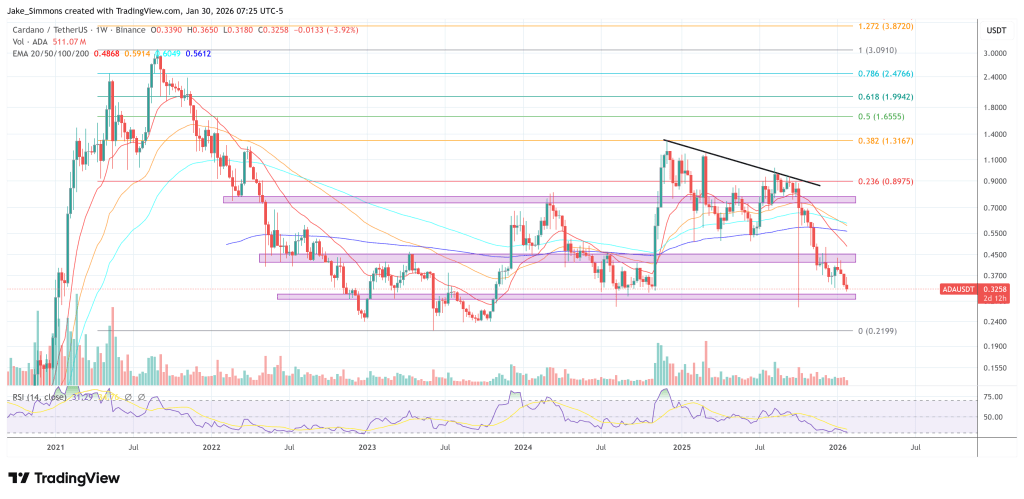
ADA looks for the next support zone, 1-week chart | Source: ADAUSDT on TradingView.com

Related Questions

QWhat is the name of the stablecoin product that Circle is bringing to Cardano, as announced by Charles Hoskinson?

AUSDCX

QWhich group, referred to as the 'Pentad', was involved in the negotiations with Circle on behalf of Cardano?

AThe Pentad consists of Input Output (IOHK), EMURGO, Cardano Foundation, Midnight Foundation, and Intersect.

QAccording to Hoskinson, what is a key advantage of the USDCX model for non-EVM chains like Cardano?

AA key advantage is the fast integration time, as it doesn't require a ton of custom work because Circle has already done similar integrations with other non-EVM chains like Stacks.

QWhat did Hoskinson cite as the main benefit for Cardano developers in this deal with Circle?

ADevelopers can build around a familiar dollar asset (USDCX) without needing to create bespoke plumbing for every application, and they gain access to Circle's distribution rails and liquidity network.

QHow did Hoskinson characterize the current sentiment and market conditions during the announcement?

AHe described the backdrop as poor market conditions and sour sentiment, which has fueled broader skepticism around Cardano partnerships.

Related Reads

Why Do You Always Lose Money on Polymarket? Because You're Betting on News, While the Pros Read the Rules

Why do you always lose money on Polymarket? Because you bet on news, while the pros study the rules. This article explains how top traders ("che tou") profit by meticulously analyzing market rules, not just predicting events. Polymarket, a prediction market platform, often sees disputes over event outcomes due to ambiguous rule wording. For instance, a market asking "Who will be the leader of Venezuela by the end of 2026?" was misinterpreted by many who bet on Delcy Rodríguez, assuming she held power. However, the rules specified "officially holds" as the formally appointed, sworn-in individual. Since Nicolás Maduro was still recognized as president officially, he won the market—even being in prison. To resolve such disputes, Polymarket uses a decentralized arbitration system via UMA protocol. The process involves: 1. Proposal: Anyone can propose a market outcome by staking 750 USDC, earning 5 USDC if unchallenged. 2. Dispute: A 2-hour window allows challenges with a 750 USDC stake; successful challengers earn 250 USDC. 3. Discussion: A 48-hour period on UMA Discord for evidence and debate. 4. Voting: UMA token holders vote in two 24-hour phases (blind then public). Outcomes require >65% consensus and 5M tokens voted; otherwise, four re-votes occur before Polymarket intervention. 5. Settlement: Results are final and automatic. Unlike traditional courts, Polymarket’s system lacks separation between arbitrators and stakeholders—voters often hold market positions, creating conflicts of interest. This leads to herd mentality in discussions and non-transparent outcomes without explanatory rulings, preventing precedent formation. Thus, success on Polymarket hinges on deep rule interpretation, not just event prediction, exploiting gaps between reality and contractual wording.

marsbit35m ago

Why Do You Always Lose Money on Polymarket? Because You're Betting on News, While the Pros Read the Rules

marsbit35m ago

DeepSeek Funding: Liang Wenfeng's 'Realist' Pivot

DeepSeek, a leading Chinese AI company, has initiated its first external funding round, aiming to raise at least $300 million at a valuation of no less than $10 billion. This move marks a significant shift from its founder Liang Wenfeng’s previous idealistic stance of rejecting external capital to maintain independence. Despite strong financial backing from its parent company, quantitative trading firm幻方量化 (Huanfang Quant), which provided an estimated $700 million in revenue in 2025 alone, DeepSeek faces mounting challenges. Key issues include a 15-month gap in major model updates, delays in its flagship V4 release, and the loss of several core researchers to competitors offering significantly higher compensation. The company is also undergoing a strategic pivot by migrating its infrastructure from NVIDIA’s CUDA to Huawei’s Ascend platform, a move aligned with China’s push for technological self-reliance amid U.S. export controls. However, DeepSeek lags behind rivals like智谱AI and MiniMax—both now publicly listed—in areas such as product ecosystem, multimodal capabilities, and commercialization. The funding round, though relatively small in scale, is seen as a way to establish a market-validated valuation anchor, making employee stock options more competitive and facilitating talent retention. It also signals DeepSeek’s transition from a pure research-oriented organization to a commercially-driven player in the global AI ecosystem.

marsbit1h ago

DeepSeek Funding: Liang Wenfeng's 'Realist' Pivot

marsbit1h ago

Trading

Spot
Futures

Hot Articles

Discussions

Welcome to the HTX Community. Here, you can stay informed about the latest platform developments and gain access to professional market insights. Users' opinions on the price of S (S) are presented below.

活动图片