Cardano Lands Circle’s USDCX As Tier-One Stablecoin: Hoskinson

bitcoinistPublished on 2026-01-31Last updated on 2026-01-31

Abstract

Charles Hoskinson has announced that Circle's stablecoin, USDCX, is coming to Cardano following a signed deal between Circle and the Cardano-aligned group, the Pentad. Described as a "tier-one" stablecoin solution, USDCX will operate on non-EVM chains like Cardano through a one-to-one reserve model, mirroring USDC's liquidity. Hoskinson emphasized that integration is imminent, not aspirational, and will provide seamless access to Circle's distribution network and deep liquidity. He also highlighted privacy benefits and praised Circle as a professional partner. The move aims to meet long-standing community demand for a major stablecoin, with Hoskinson noting that existing Circle integrations on other chains should expedite deployment. He acknowledged market skepticism but reaffirmed focus on Cardano's development and partnerships. ADA was trading at $0.3258 at the time of the announcement.

Charles Hoskinson says a Circle-issued stablecoin product is headed to Cardano after what he described as “deep negotiations” between Circle and a Cardano-aligned negotiating group known as the Pentad (Input Output (IOHK), EMURGO, Cardano Foundation, Midnight Foundation, and Intersect). Speaking from Fukuoka on his Japan tour livestream titled “Circle and Pentad,” Hoskinson framed the deal as a long-awaited step toward bringing “tier one” stablecoin liquidity into Cardano’s DeFi stack.

USDCX To Launch On Cardano After Deal Signed

Hoskinson said the agreement is signed and positioned the integration as near-term rather than aspirational. “This is not something that’s six months out, ink is on paper, deal is signed,” he said, adding that integration work should happen “in short order.” The pitch is that Cardano gains access to Circle’s distribution rails and liquidity network, while developers can build around a familiar dollar asset without needing bespoke plumbing for every application.

What’s coming, per Hoskinson, is “USDCX,” which he described as effectively the same asset as USDC but deployed through a model Circle uses for non-EVM chains. “USDCX is basically same asset and how it works is there’s a one-to-one reserve,” he said. “So for the non-EV chains like Stacks and others there’s a mirroring effect that occurs [...] and then it’s easy through their network to access the same liquidity as USDC. So effectively it’s what we need.”

In Hoskinson’s telling, the practical implication is straightforward: Cardano users and applications get stablecoin functionality tied into Circle’s broader liquidity environment, without waiting for a native issuance path that has been a recurring community demand. “People were asking for a long, long time to get a tier one stable coin to Cardano,” he said. “This is how you do it and now we’re here. So we have access to Circle’s network, Circle’s protocol, Circle’s technology and the great liquidity of the Circle network as a whole.”

Hoskinson also emphasized what he called privacy benefits in the “USDCX” design, though he did not specify implementation details on the stream beyond noting “the added privacy benefits of USDCX and all the technologies therein.” He praised Circle as a counterparty, calling them “consummate professionals” and “tough negotiator[s],” and credited the Pentad for representing Cardano’s interests across the talks.

A key operational question for Cardano’s DeFi market is how quickly the asset becomes usable across the app layer and centralized exchange rails. Hoskinson acknowledged that distribution is not automatic just because a deal is signed.

“We have to make sure that we get USDCX integrated into all of the Cardano applications and so there’s a seamless user experience and a seamless user experience with exchanges so you can go from USDC and back without any additional steps or work,” he said, characterizing the remaining work as “a little bit more integration on our side,” but “not too much.”

He argued that Circle’s prior work on other non-EVM deployments should compress timelines. “That’s one of the advantages of this new USDCX is fast integration time,” Hoskinson said. “It doesn’t require a ton of custom work to get working with Cardano because they’ve already done these types of things with Stacks.”

The announcement lands against a backdrop Hoskinson described as poor market conditions and sour sentiment, which he suggested has fueled skepticism around Cardano partnerships more broadly. In a longer aside, he pushed back on the idea that integrations like these are perpetually “maybe” milestones.

“I do know that there are certain people that are skeptical [...] ‘Well, maybe [it] will come, maybe not. Who knows? We’ll wait and see,’” Hoskinson said. “I don’t know how else to convey than signing the deal, doing the integration work [...] but I understand that the skepticism comes from the market sentiment at the end of the day.”

Hoskinson used the same segment to reiterate that Cardano’s roadmap and partner strategy remains the controllable variable, even if macro headlines and political noise aren’t. “All we have agency over is what we build, who we partner with, and our strategy as a whole,” he said, before citing ongoing efforts including Leios, Hydra, Pentad’s integration push, and Midnight.

At press time, ADA traded at $0.3258.
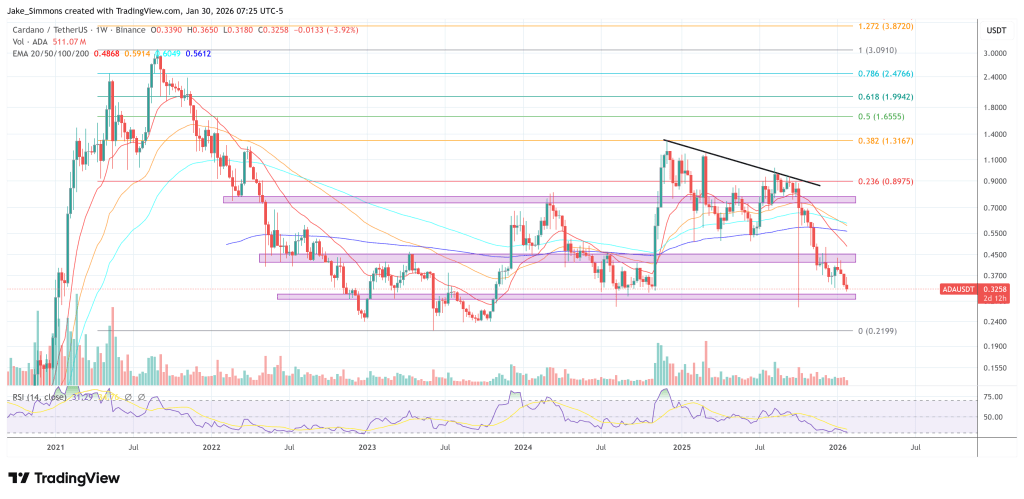
ADA looks for the next support zone, 1-week chart | Source: ADAUSDT on TradingView.com

Trending Cryptos

Related Questions

QWhat is the name of the stablecoin product that Circle is bringing to Cardano, as announced by Charles Hoskinson?

AUSDCX

QWhich group, referred to as the 'Pentad', was involved in the negotiations with Circle on behalf of Cardano?

AThe Pentad consists of Input Output (IOHK), EMURGO, Cardano Foundation, Midnight Foundation, and Intersect.

QAccording to Hoskinson, what is a key advantage of the USDCX model for non-EVM chains like Cardano?

AA key advantage is the fast integration time, as it doesn't require a ton of custom work because Circle has already done similar integrations with other non-EVM chains like Stacks.

QWhat did Hoskinson cite as the main benefit for Cardano developers in this deal with Circle?

ADevelopers can build around a familiar dollar asset (USDCX) without needing to create bespoke plumbing for every application, and they gain access to Circle's distribution rails and liquidity network.

QHow did Hoskinson characterize the current sentiment and market conditions during the announcement?

AHe described the backdrop as poor market conditions and sour sentiment, which has fueled broader skepticism around Cardano partnerships.

Related Reads

Global Stock Market's Storm Center: South Korea's Stock Market De-leveraging Is Largely Complete

Storm's Eye: South Korean Market De-leveraging Nears Completion The recent sharp correction in South Korean equities, with the KOSPI index dropping 32% from its June high, has been a key trigger for global tech stock volatility. The core driver was not a fundamental shift but a forced de-leveraging process within the market's unique structure, which is now largely complete. Two main leverage channels amplified the sell-off: 1. **Leveraged ETFs:** Their size, proportionally four times larger than in the U.S., peaked near $50 billion. Their mandatory daily rebalancing mechanism created a vicious cycle of "price drop → forced selling → further drop." Approximately 75% of this excess has been unwound, shrinking to $26 billion, with regulatory curbs now blocking new inflows. 2. **Hedge Fund Leverage:** Using swaps to magnify exposure, hedge funds saw their net long positioning fall by over 50% from peak levels. The most intense phase of this institutional de-leveraging is over. In contrast, **retail margin debt** poses minimal systemic risk. At 0.5% of market cap, it is far lower than in the U.S. or China, lacks automatic triggers, and is concentrated in smaller stocks. The conclusion: the high-leverage structures most prone to "chain-reaction selling" have been substantially cleared. The market is transitioning from a liquidity-driven crash to one priced more on fundamentals. The article argues that the AI trend—centered on Korean memory chips—remains intact. This episode represents a painful but necessary clearing of crowded trades, not the end of the AI revolution. For investors, the key question is conviction in the long-term AI direction; if the trend is real, current volatility is a cost of entry, not a terminal risk.

链捕手1h ago

Global Stock Market's Storm Center: South Korea's Stock Market De-leveraging Is Largely Complete

链捕手1h ago

The Eternal Fragments of Money: Third-Party Payment Has No First Principle

"The Enduring Fragments of Money: Third-Party Payments Lack a First Principle" Stripe is reportedly attempting to acquire PayPal, marking a significant shift reminiscent of PayPal's merger with the original X.com 30 years ago. The article analyzes Stripe's strategic challenges and the broader payments industry landscape. Despite its initial success with a developer-friendly API model, Stripe missed its optimal IPO window during the pandemic and has since seen its valuation decline. Its attempts to expand through acquisitions and new ventures, particularly in stablecoins (like its OUSD project) and Agent-focused payments (ACP/MPP protocols), have faced headwinds. The author argues that the payment industry remains highly fragmented and is ultimately an adjunct to the traditional banking system. This structure limits the potential for any single player, including Stripe, to achieve complete dominance. While stablecoins and the future rise of autonomous Agent economies present potential growth avenues, they are not yet mainstream and still require integration with the existing financial system. For now, Agent-based transactions are largely used for speculative "volume boosting" rather than substantive business applications. Stripe's current move to acquire PayPal is seen as an attempt to bolster its weak consumer-facing (C-side) business after its stablecoin-focused strategies faltered. Meanwhile, PayPal is described as structurally outdated, unable to revive itself through new products like Venmo or PYUSD. The future of payments may lie not in payments themselves but in value-added services like more efficient settlement networks. The author suggests that companies like Stripe and Circle, which are building their own blockchains (Tempo, Arc) and stablecoins, are positioning themselves to eventually profit from high-efficiency settlement systems. These new networks could potentially bypass some traditional banking layers. In conclusion, the article posits that third-party payment is a perpetually fragmented battlefield where scale alone cannot ensure victory. Players must find new models, focusing on efficiency to compete with the entrenched banking system. Stripe's acquisition of PayPal represents a bet on this uncertain future.

链捕手1h ago

The Eternal Fragments of Money: Third-Party Payment Has No First Principle

链捕手1h ago

Trading

Spot

Hot Articles

Discussions

Welcome to the HTX Community. Here, you can stay informed about the latest platform developments and gain access to professional market insights. Users' opinions on the price of S (S) are presented below.

活动图片