Brazil's live orchestra to turn Bitcoin price moves into music

cointelegraphPublished on 2025-12-23Last updated on 2025-12-23

Abstract

An experimental orchestral project in Brazil has received approval to raise up to 1.09 million reais ($197,000) through a tax-incentive program to convert Bitcoin price movements into live music. The performance, to be held in Brasília, will use an algorithm to translate real-time BTC price data and technical indicators into musical elements like melody, rhythm, and harmony. This aims to provide an audible representation of Bitcoin’s market volatility, blending traditional orchestral instruments with data-driven composition. The project builds on earlier algorithmic art experiments, such as Matt Kane’s Bitcoin-responsive digital artwork and Refik Anadol’s data-based immersive works. Fundraising must be completed by December 31.

An experimental orchestral project in Brazil aims to convert Bitcoin price data into live music, after receiving approval to raise funds through one of the country’s tax-incentive programs for cultural initiatives.

According to Brazil's Federal Register, the authorization allows the project to seek up to 1.09 million reais ($197,000) from private companies and individual donors for an instrumental concert that uses financial data to generate music, drawing on concepts from art, mathematics, economics and physics.

The publication does not specify whether any blockchain or onchain infrastructure will be used in the performance. The performance will take place at the country's federal capital, Brasília.

The project description says it will convert monetary figures into musical notation by using an algorithm to track Bitcoin (BTC) price movements and related technical data in real time during the performance. These data inputs are intended to guide melody, rhythm and harmony as the orchestra plays live.

Excerpt from Brazil's official government gazette. Source: Diário Oficial da União


The approach is designed to give audiences an audible representation of Bitcoin’s volatility by translating market behavior into sound, blending traditional orchestral instruments with data-driven composition.

The approval confirms that the project met the requirements of Brazil’s Rouanet Law and cleared technical review, formally allowing sponsors to deduct contributions from taxes.

Fundraising must be completed by Dec. 31, with the initiative classified under the “Instrumental Music” category, which determines how tax incentives apply.

Related: AI can compose good music, but humanity still holds the creative baton

Earlier experiments in algorithmic crypto art

The Brazil initiative builds on earlier experiments in algorithmic art that have treated crypto-native and other real-world data streams as raw material for creative expression.

In 2020, a San Francisco–based group working in programmable digital art unveiled an artwork designed to change its appearance in line with Bitcoin’s price movements. The project, Right Place & Right Time by artist Matt Kane, used BTC market data as a live input, allowing shifts in the cryptocurrency’s value to drive visual changes in the piece.

The work was released through Async Art, a platform known for programmable NFTs, where Kane structured the artwork into a central “Master” image composed of multiple independent layers. Each layer responded to Bitcoin price action, with changes in the data influencing elements such as scale, rotation and positioning over time.
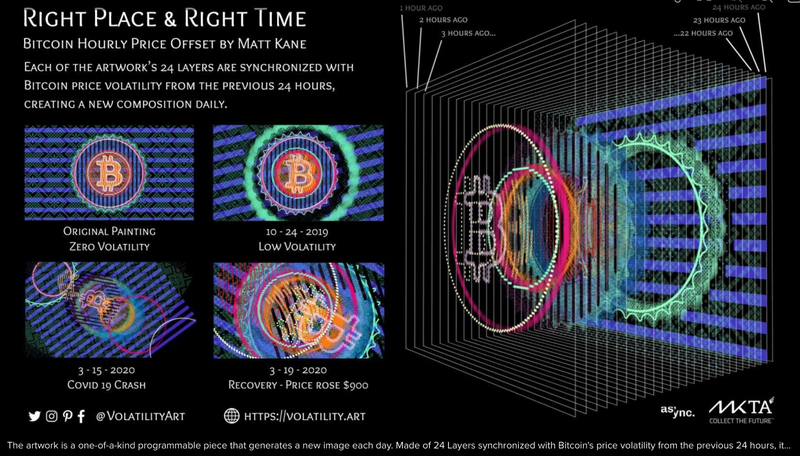
A one-of-a-kind programmable artwork that generates a new image daily, with 24 layers synced to Bitcoin’s price volatility. Source: Asynchronous Art

Another artist working in a similar vein is Refik Anadol, whose practice uses artificial intelligence, algorithms and large datasets to produce immersive installations that translate sources ranging from environmental data to archival records into continuously evolving visual works.

The artist has released several non-fungible projects in recent years, including Winds of Yawanawá, an NFT collection created and launched in July 2023 as a collaboration with the Yawanawá Indigenous community of the Brazilian Amazon, combining real-time environmental data and traditional art into a generative digital series.
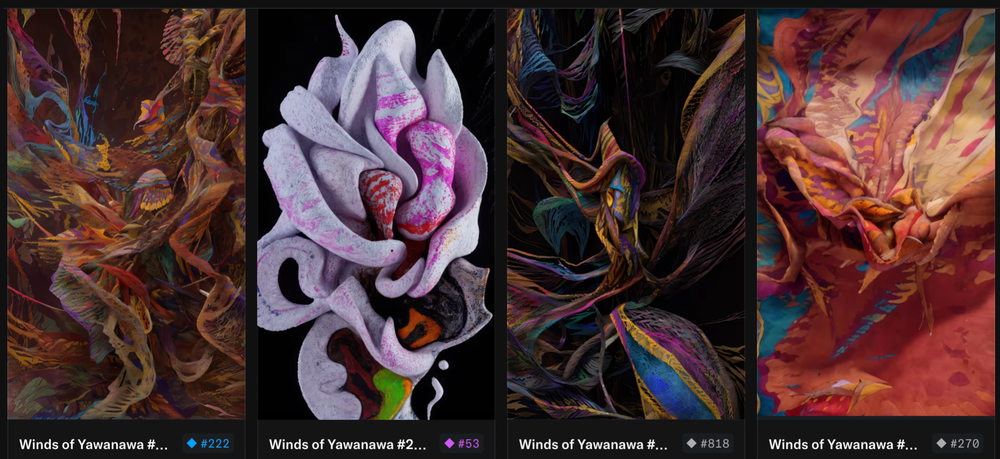
Winds of Yawanawa NFTs listed on OpenSea marketplace. Source: Opensea

Magazine: Quantum attacking Bitcoin would be a waste of time: Kevin O’Leary

Trending Cryptos

Related Questions

QWhat is the main goal of the Brazilian orchestral project mentioned in the article?

AThe main goal is to convert Bitcoin price data into live music during an instrumental concert, using an algorithm to translate real-time BTC price movements and technical data into musical elements like melody, rhythm, and harmony.

QHow much funding is the project authorized to raise, and under which Brazilian law?

AThe project is authorized to raise up to 1.09 million reais ($197,000) under Brazil's Rouanet Law, which allows sponsors to deduct contributions from taxes for cultural initiatives.

QWhat earlier artistic experiment involving Bitcoin's price data is referenced in the article?

AThe article references Matt Kane's 2020 programmable artwork 'Right Place & Right Time,' which used Bitcoin's price movements to drive visual changes in a digital art piece released through the Async Art platform.

QHow does the project intend to represent Bitcoin's market behavior to the audience?

AIt aims to give an audible representation of Bitcoin's volatility by translating market behavior into sound through a live orchestra performance, blending traditional instruments with data-driven composition.

QWhat is the deadline for the project to complete its fundraising, and under which category is it classified?

AFundraising must be completed by December 31, and the initiative is classified under the 'Instrumental Music' category, which determines how tax incentives apply.

Related Reads

Citrini Research: Taking Stock of 5 Major Investment Themes Overshadowed by the AI Trade

Citrini Research identifies five under-the-radar investment themes potentially overshadowed by the dominant AI trade. With capital and analyst attention overwhelmingly focused on AI infrastructure, these overlooked areas present alpha opportunities as market dynamics shift. **Theme 1: Airlines** – Despite strong fundamentals, stocks like Delta and United have been penalized for 18 months due to macro concerns (tariff-inflation, oil prices), not profitability. A rebound is expected as these headwinds fade, aided by trends like premiumization and the 2026 World Cup. **Theme 2: Senior Housing** – A pure demographic play. The U.S. population over 80 is projected to grow 56% in the next decade, drastically outpacing supply. This creates a compelling need for facilities, benefiting REITs like Welltower and operators like Brookdale. **Theme 3: Live Events & Entertainment** – "Being there" is becoming a luxury. This sector has outperformed even tech over the past decade. Companies like TKO Group (WWE/UFC), Cinemark, and IMAX are capitalizing on demand for premium, in-person experiences. **Theme 4: Exchange Competition** – CME Group's ~98% monopoly in U.S. interest rate derivatives faces its first real challenge from FMX Futures Exchange. Backed by major Wall Street banks, FMX offers lower fees and margin savings. While CME's deep liquidity remains an advantage, FMX provides a competitive alternative. **Theme 5: Fintech Recovery** – Heavily sold off in 2026, fintech stocks like SoFi, Robinhood, and Upstart are showing signs of a rebound based on improving fundamentals—SoFi's stablecoin launch, Robinhood's transformation into a "financial super app," and Upstart's renewed AI lending narrative—rather than a change in sector outlook. The report advises maintaining some AI exposure but diversifying into these neglected "small themes" where mispricing exists due to a simple shortage of investor attention.

marsbit2m ago

Citrini Research: Taking Stock of 5 Major Investment Themes Overshadowed by the AI Trade

marsbit2m ago

21Shares Mid-Year Key Report: Bitcoin's Four-Year Cycle Remains Intact, Stablecoins and Tokenization Emerge as New Growth Engines

21Shares Mid-Year Report 2026: Bitcoin Cycle Intact, Stablecoins & Tokenization Emerge as New Engines This mid-year review assesses progress against 21Shares' ten predictions for 2026. While the overarching shift from narrative to fundamentals holds, performance varies. Key findings show Bitcoin's four-year cycle remains evident despite market maturation. Global crypto ETP AUM has declined to ~$140B, lagging the $400B target, though product innovation continues. Stablecoin supply surpassed $320B, demonstrating non-cyclical demand but falling short of the $1T forecast due to slower regulatory clarity. DeFi TVL, stalled at ~$140B, was hindered by major security incidents. Corporate crypto treasuries hold ~1.28M BTC ($100B), with consolidation pressuring weaker players. Prediction markets are on track, with $57.5B volume already surpassing half the $100B annual target. AI agent infrastructure is ready, but adoption is early. Ethereum L2 consolidation is underway, with the top 5 capturing nearly 90% of activity. Compliant token launches have a platform but lack mainstream volume. Tokenized RWAs total ~$31B on public chains, but institutional pipeline growth is strong. In summary, fundamentals like stablecoins, tokenization, and prediction markets are advancing, but targets require faster adoption or price appreciation. The market is maturing, yet cyclical patterns persist.

marsbit11m ago

21Shares Mid-Year Key Report: Bitcoin's Four-Year Cycle Remains Intact, Stablecoins and Tokenization Emerge as New Growth Engines

marsbit11m ago

Super Spiral Mega-Boom, Micron's Earnings Report Rekindles the Semiconductor Bull Run

On June 25, 2026, Micron Technology released its blockbuster Q3 FY2026 results, significantly exceeding market expectations and reigniting confidence in the semiconductor bull market. Revenue soared to $41.456 billion (vs. ~$35.4B expected), up 346% year-over-year, while GAAP net profit surged nearly 15 times to $28.243 billion. Guidance for Q4 was even more striking, with projected revenue of approximately $50 billion, far surpassing prior estimates. The report highlighted that the AI boom is now fueling growth across Micron's entire product stack, not just HBM. Cloud memory, core data center, SSD, mobile, and automotive businesses all saw revenue growth exceeding 250-600%, with margins hovering around 80%. While HBM4 is already in volume shipment and 2026 capacity is sold out, AI-driven demand is also tightening supply for traditional DRAM and NAND, sustaining a strong pricing cycle. A pivotal development is Micron's shift toward a "demand-first" model. The company disclosed 16 long-term strategic customer agreements (SCAs), most spanning 5 years to 2030, covering about 20% of DRAM and one-third of NAND shipments. These are take-or-pay contracts, with 14 agreements already securing roughly $100 billion in guaranteed future revenue and $22 billion in customer performance assurances. To fulfill this locked-in demand, Micron plans substantial capacity expansion, with Q4 capital expenditure projected at ~$10 billion. This investment, backed by concrete long-term orders rather than cyclical speculation, marks a historic change for the memory industry. Following the earnings release, Micron's stock surged 16% after-hours, lifting the broader semiconductor sector globally. The report served as a powerful signal that AI infrastructure build-out is accelerating, with memory positioned as a central protagonist in the ongoing narrative.

Odaily星球日报54m ago

Super Spiral Mega-Boom, Micron's Earnings Report Rekindles the Semiconductor Bull Run

Odaily星球日报54m ago

Trading

Spot
Futures

Hot Articles

Discussions

Welcome to the HTX Community. Here, you can stay informed about the latest platform developments and gain access to professional market insights. Users' opinions on the price of S (S) are presented below.

活动图片