Stock Price Hits New High! Corning Targets CPO Optical Interconnect Market

marsbitPublished on 2026-06-25Last updated on 2026-06-25

Abstract

TL;DR Corning's stock recently hit a new high, driven partly by investor interest in its role within AI data center optical interconnects. At a recent conference, Corning showcased its GlassBridge technology, a glass-based optical bridge designed to connect fibers to photonic integrated chips (PICs). This component targets challenges in Co-Packaged Optics (CPO) architectures by aiming to reduce coupling loss and simplify the precise alignment needed between optical fibers and nanoscale chip waveguides. The core issue GlassBridge addresses is the significant dimensional mismatch between fibers and PICs, which causes signal loss and assembly complexity. Corning leverages its glass and fiber expertise to create a platform it claims offers low coupling loss (demonstrating 1.5dB) and supports passive alignment. The broader vision extends to glass-based substrates with through-glass vias for advanced CPO packaging. While positioning itself as a solutions provider from cables to chip-level interconnects, Corning's GlassBridge is currently a technological showcase. Its path to widespread adoption in AI servers depends on overcoming hurdles in mass production yield, cost, thermal management, and crucially, validation and integration into future customer platforms from major cloud and chip companies competing with alternative solutions like silicon photonics.

TL;DR

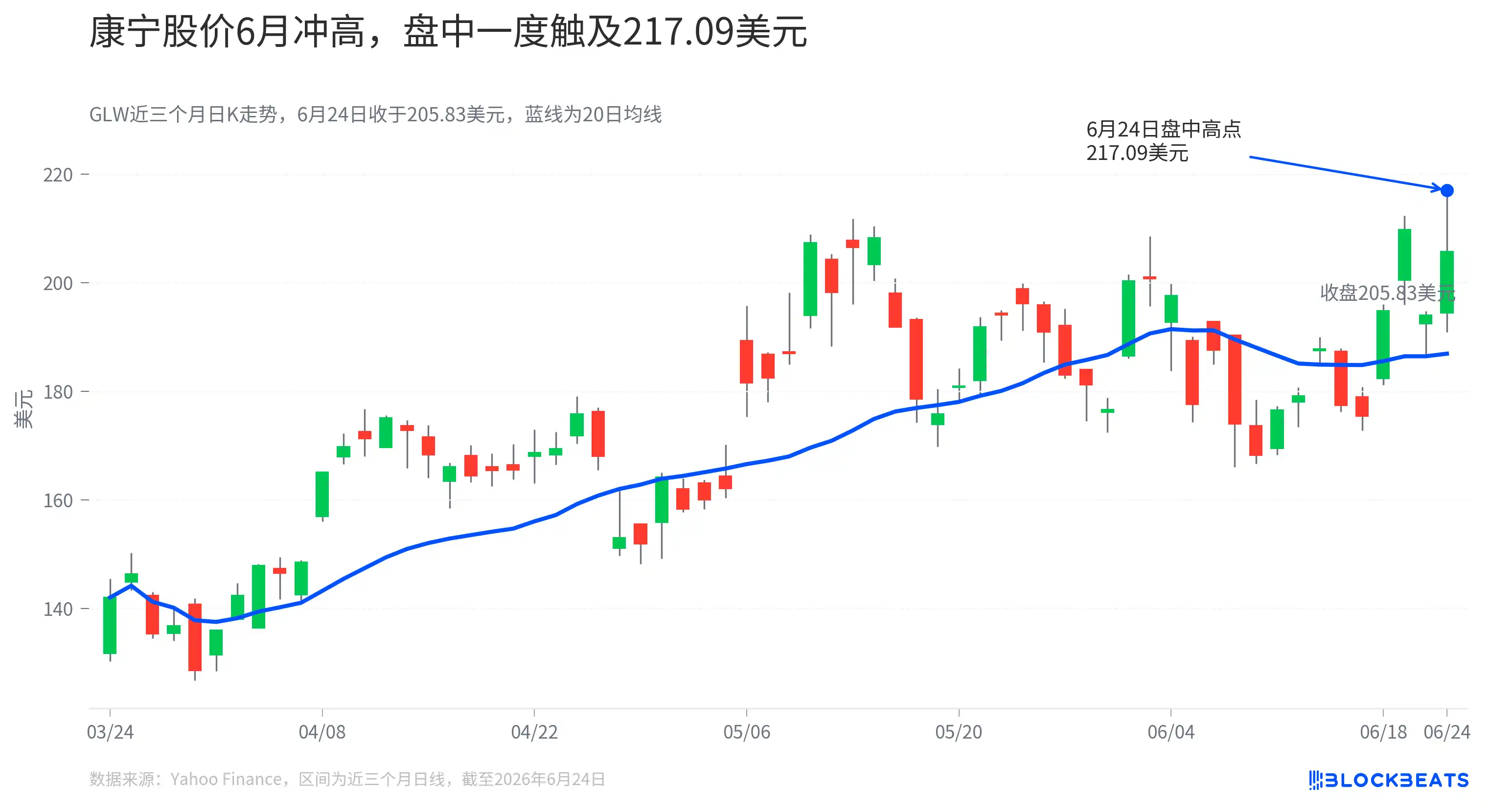
Corning's stock price is already at a high level. As of the close of U.S. trading on June 24, Corning (GLW) closed at $205.83, up about 6.1% for the day, with an intraday high of $217.09. The demand for AI data center optical interconnect is one of the core reasons the market is reassessing this established glass and fiber optics company.
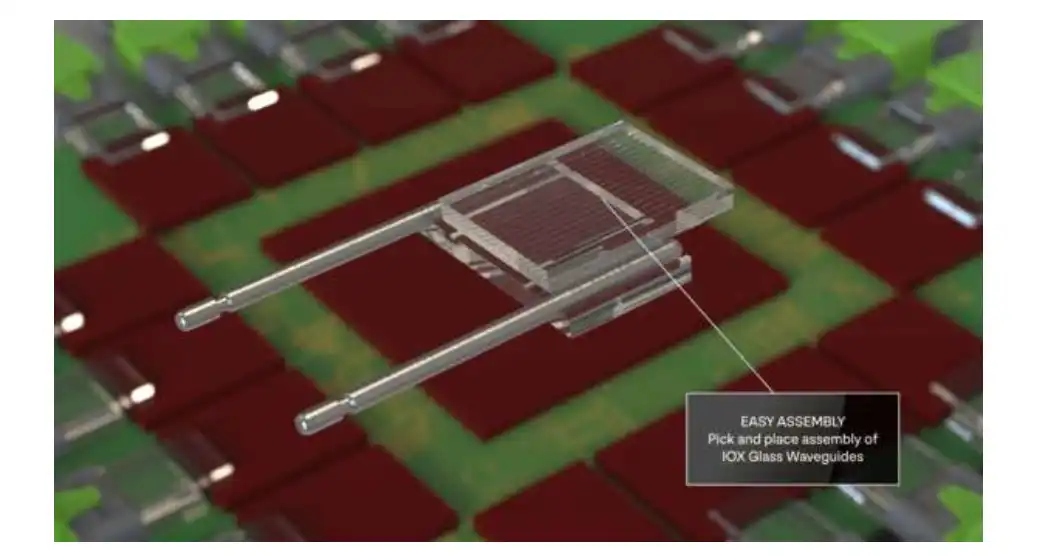
According to materials from the Seoul AI Data Center Optical Communication Conference on June 24, Corning showcased the GlassBridge glass-based optical bridge, attempting to advance fiber connections to near the photonic integrated circuit. Corning's official product page positions it as a "fiber-to-PIC connector platform" for scenarios like NPO, CPO, and high-density photonic modules.

It belongs to optical interconnect components that are closer to the chip, positioned deeper than traditional pluggable optical modules. As AI data center GPU clusters grow larger, the pressure of data movement between chips, servers, and racks increases. Electrical connections and traditional optical connections face bottlenecks in density, power consumption, latency, and assembly complexity. CPO, or Co-Packaged Optics, aims to address precisely this issue of pushing optical connections closer to the chip.

A key aspect of Corning's recent highlighting of GlassBridge is advancing the company's long-accumulated expertise in glass and fiber optics into the chip-level packaging and interconnect domain. Public documentation states that this platform, based on glass and wafer-level IOX ion-exchange waveguides, has demonstrated O-band fiber-to-photonic chip coupling performance of 1.5 dB, and supports passive alignment, detachability, and high-density connections.
The Glass Bridge Aims to Solve the "Misalignment" Between Fiber and Chip

Optical interconnect might sound like simply attaching an optical fiber to a chip, but the real challenge lies in the scale difference.

Waveguides on a photonic chip are typically only a few hundred nanometers wide, while the core diameter of an optical fiber is on the order of several micrometers. When signals travel from the fiber into the photonic chip, any deviation in the optical path, angle, or position introduces coupling loss. For high-density AI servers, this simultaneously impacts link efficiency, assembly, testing, and packaging difficulty.

GlassBridge's approach involves pre-forming optical pathways in glass to guide fiber signals to the photonic chip interface. Public documentation lists customizable PIC pitches including 40μm, 80μm, 127μm, and 165μm diameters. Compared to directly aligning a fiber array to the chip, this type of glass bridge aims to reduce assembly difficulty and eliminate some intermediate connection stages.

The 1.5 dB figure is the most notable performance metric highlighted this time, but it should still be understood as a demonstration figure from public documentation, not equivalent to having passed large-scale mass production validation. Before entering real data centers, this component must still undergo validation for packaging yield, long-term reliability, thermal stability, and ease of maintenance.

The Closer CPO Gets to the Chip, the Higher the Packaging Difficulty

CPO is valued by AI data centers because it has the potential to reduce the power consumption and latency of high-bandwidth interconnects. In traditional network connections, optical modules are typically plugged into switch or server panels, requiring electrical signals to travel a distance between the chip and the module. As the bandwidth demands of AI clusters continue to rise, this electrical connection becomes more costly and power-hungry.

Integrating optical devices into the package or near the chip can theoretically shorten the signal path and increase bandwidth density. However, the closer to the chip, the less the technical difficulty resembles that of ordinary optical modules and the more it resembles advanced packaging engineering. Photoelectric conversion, fiber coupling, thermal management, packaging materials, assembly precision, and manufacturability all have to be addressed within the same system.

Corning's showcased next-generation CPO glass-based architecture integrates glass substrates, optical waveguides, and through-glass vias (TGV) into a single concept and supports flip-chip mounting of photonic devices. The key change is that Corning is attempting to advance glass from a transmission material to a packaging platform position.

This also explains why GlassBridge appears alongside glass-core packaging. Glass materials offer advantages in dimensional stability, optical properties, and processability, making them suitable for carrying high-density optical pathways. However, the ultimate adoption of advanced packaging still depends on mass production yield, cost curves, supply chain equipment, and customer validation cycles.

Corning Wants to Sell an Optical Interconnect Solution

GlassBridge sits within Corning's broader AI data center optical communication strategy. In its OFC 2026 press release, Corning already showcased optical fibers, cables, connectors, and CPO-related solutions for AI data centers. The GlassWorks AI platform integrates optical fibers, cables, connectors, Fiber Array Units (FAU), and alignment components into a comprehensive AI data center optical communication solution, covering inter-rack and campus-wide connections.

This reflects Corning's evolving position within AI infrastructure from a "fiber and cable supplier" to an optical interconnect supplier moving closer to the system's interior. AI data center construction is driving up demand for optical fibers, connectors, and high-speed interconnects, while CPO and glass-core packaging are pushing demand even closer to the chip.

Customer and capacity plans are the foundation for Corning's advancement on this path. Corning is collaborating with GlobalFoundries on the GF Fotonix platform to develop detachable fiber connectivity solutions targeting high-bandwidth, low-power optical connections for AI data centers. The company has also signed a multi-year agreement with Meta worth up to $6 billion and announced a long-term commercial and technical collaboration with NVIDIA, involving the expansion of U.S. AI infrastructure manufacturing capacity.

However, this context cannot be directly equated with GlassBridge having secured large-scale deployment orders. The current materials do not disclose the component's mass production timeline, final yield, customer list, revenue contribution, or a clear timeline for integration into which generation of switch chips, AI servers, or packaging platforms.

For the Glass Route to Move Forward, It Still Awaits Customer Platform Validation

Corning is now presenting the intersection of glass materials, fiber connectivity, and advanced packaging to the AI data center market. If GlassBridge can achieve low loss, easy assembly, and manufacturability simultaneously in high-density interconnects, it could become a key component within CPO packaging.

The limitations are clear. Current public information points more towards a product platform and technology demonstration; the mass production timeline, yield, cost competitiveness, and major customer deployment cadence have not been disclosed. Route competition is also not over, with AI data center optical interconnects still seeing parallel advancement of multiple schemes including silicon photonics, glass-based packaging, and hybrid interconnect architectures.

The final choice of route by cloud providers and chipmakers will depend simultaneously on individual coupling loss metrics, overall system design, power budgets, supply chain stability, and maintainability. GlassBridge appears more like a step by Corning into AI chip-level optical interconnect; glass-based CPO still requires more customer validation before it can be considered a winning solution.

Related Questions

QWhat is the key product Corning introduced targeting the CPO market for AI data centers?

ACorning introduced the GlassBridge, a glass-based optical bridge connector platform positioned as a 'fiber-to-PIC connector platform' for NPO, CPO, and high-density photonic modules.

QWhat performance metric for the GlassBridge platform is highlighted in the article as a key figure of merit?

AA key performance metric highlighted is a demonstrated O-band fiber-to-photonic chip coupling loss of 1.5 dB.

QWhat major technical challenge does the GlassBridge platform aim to address in CPO systems?

AIt aims to address the challenge of alignment between optical fibers and photonic chips, overcoming the scale difference where fiber cores are micrometers wide while chip waveguides are only hundreds of nanometers wide, which can cause coupling loss.

QWhich major companies has Corning formed partnerships with, as mentioned in the article, to support its AI infrastructure initiatives?

ACorning has partnerships with GlobalFoundries (on the GF Fotonix platform), Meta (a multi-year agreement worth up to $6 billion), and NVIDIA (a long-term commercial and technology collaboration).

QAccording to the article, what is the main factor that will determine the success of Corning's glass-based CPO approach?

AIts success will primarily depend on customer platform validation, which includes factors like mass production yield, cost competitiveness, supply chain stability, and meeting requirements for full system design, power budget, and maintainability.

Related Reads

Did DeepSeek Intentionally Make an Unfriendly Agent?

DeepSeek is shifting its strategy from being a low-cost model provider to building a foundational ecosystem for AI agents. This pivot is marked by two recent moves: increasing the price of its flagship V4 Pro model and launching the DeepSeek Harness agent framework. Previously, DeepSeek's success was built on creating powerful, affordable models and open-sourcing them to drive adoption. Now, the focus is moving "beyond the model" to the runtime environment where agents operate. Harness is key to this new approach. Unlike integrated agent products from competitors, Harness deconstructs the agent stack—separating the model, tools, skills, workflows, and UI into modular, replaceable components. Its core innovation is the Cordis kernel, which enables dynamic loading, unloading, and management of plugins, allowing agents to modify their own capabilities during execution. Significantly, Harness does not lock users into DeepSeek's models; it allows integration with third-party models. This suggests DeepSeek's ambition is not to control the model layer but to establish the standard runtime environment for future agents—akin to an operating system for the agent era. The V4 Pro price increase aligns with this shift: the model transitions from a loss-leading acquisition tool to a core revenue engine within a broader ecosystem. Harness is currently complex and developer-focused, prioritizing ecosystem builders over end-users. Its success will be measured not by immediate user numbers, but by the plugins, agents, and platforms built upon it. DeepSeek's long-term bet is that controlling the agent runtime will be more valuable than merely providing the underlying models, potentially redefining how AI agents are created and evolved.

marsbit4m ago

Did DeepSeek Intentionally Make an Unfriendly Agent?

marsbit4m ago

Metrics Ventures Market Observation: Talk is Cheap

This monthly market analysis extends its timeline to incorporate critical July comments from the Fed Chair, noting that bond markets have already priced in perceived policy shortcomings. The report observes a growing divergence: equity markets, after some deleveraging, continue a "trust-based" rally, while bond and currency markets signal persistent distrust. Precious metals bottoming suggests a central bank consensus that the era of "competitive currency devaluation" is ending, with verbal interventions losing power. Looking forward to Q3-Q4, the analysis remains bullish on supply-constrained global resources like copper and power, as well as gold, which prices ongoing monetary失信. It argues that digital assets are unlikely to see major outperformance until excess liquidity is released and AI growth rates are fully priced. Key market views include: 1. Commodities like gold remain primary liquidity absorbers over Bitcoin, with recent consolidation seen as healthy. 2. The bull trend for RMB-denominated assets (e.g., STAR 50 Index) is firmly established. 3. Key resource country indices and currencies are near inflection points, with spot copper already at new highs. The report suggests resource equities, particularly in China's market, are at the end of their consolidation phase, offering attractive valuations with embedded optionality on rising metal prices. It highlights the predictive significance of recent US-Japan FX interventions and Treasury-Fed dynamics, suggesting a shift towards less communication and data management to maintain stability. A long position in resource assets is presented as a positive expected-value strategy over a multi-year horizon.

marsbit2h ago

Metrics Ventures Market Observation: Talk is Cheap

marsbit2h ago

The Value, Growth, and Risks of Prediction Markets

The article discusses the explosive growth and complex nature of prediction markets in the United States, focusing on their value, risks, and regulatory challenges. Key drivers include sports betting, which fueled a 1795% year-over-year trading volume increase in Q2 2026, with platforms like Kalshi and Polymarket dominating. These markets offer significant potential as superior hedging tools for businesses and more efficient price discovery mechanisms than traditional polls or derivatives for events like Fed rate decisions, elections, or GPU prices. They also serve as customer acquisition channels for platforms like Robinhood. However, major challenges persist. A central conflict exists between federal regulators (CFTC), which classify event contracts as derivatives under its jurisdiction, and state authorities, which view sports-related contracts as illegal gambling, leading to numerous lawsuits. There is significant consumer protection risk: data shows most retail users lose money to professional traders, platforms market high-risk products like parlays, and protections (e.g., age limits, addiction help) are weaker than in state-regulated sports betting. The "self-certification" process allows rapid contract launches but creates regulatory uncertainty. The author argues prediction markets are fundamentally "better markets" but currently fail to provide adequate consumer safeguards. Proposals include integrating protection mechanisms (cooling-off periods, position limits), aligning risk warnings with product risks, creating paths from speculation to long-term investing, and applying specific consumer protections and taxes to sports contracts. The piece concludes by urging stakeholders to address these issues before a potential regulatory backlash undermines the markets' legitimate utility.

marsbit2h ago

The Value, Growth, and Risks of Prediction Markets

marsbit2h ago

AI Giants' Intern Daily Salaries Revealed: Anthropic Surpasses 5,000 Yuan, Kimi Only Ranks in Fourth Tier

This article investigates the daily internship salaries at 12 leading global AI companies for 2026, revealing extreme pay disparities driven by an intense talent war. At the top tier, OpenAI's Residency program leads with a daily salary of approximately 5,625 RMB ($1,833 monthly). Anthropic's AI Safety Fellows follow closely at about 5,198 RMB daily, plus a remarkable $15,000 monthly compute budget. Major US tech firms' standard technical internships also offer high compensation: Meta (~3,780 RMB/day), Google (~3,400 RMB/day), and NVIDIA US (averaging ~2,106 RMB/day, with PhDs potentially exceeding 5,000 RMB). Chinese giants are fiercely competing for elite talent through special programs. ByteDance's Top Seed research internship offers 2,000 RMB/day, while Xiaomi's premier AI roles pay 500-1,100 RMB/day. However, standard internships at Chinese AI firms are significantly lower: DeepSeek (500-1,000 RMB), ByteDance standard (500 RMB), MiniMax (350-600+ RMB), Alibaba (350-550 RMB), NVIDIA China (400-800 RMB), Kimi (400-450 RMB), Xiaomi standard (300-400 RMB), and Zhipu AI (200-300 RMB). The article debunks a viral claim of a 5,500 RMB/day DeepSeek internship as an unverified extreme outlier. Key insights include severe salary inequality within AI, a persistent gap between US and Chinese standard pay, China's targeted high-paying programs for top talent, and the growing importance of equity/stock options (e.g., at Zhipu, MiniMax, Kimi) alongside cash compensation. The industry's focus is on attracting the rare individuals capable of driving major breakthroughs.

Odaily星球日报3h ago

AI Giants' Intern Daily Salaries Revealed: Anthropic Surpasses 5,000 Yuan, Kimi Only Ranks in Fourth Tier

Odaily星球日报3h ago

Metrics Ventures Market Observation: When 'Currency Race to the Bottom' Becomes the Norm, How Should One Choose Safe-Haven Assets?

Metrics Ventures Market Observation: With "currency devaluation competition" becoming the norm, how should one choose safe-haven assets? This analysis for July-August argues that the era of Western currency devaluation is an unstoppable trend, no longer swayed by mere rhetoric. While the stock market continues to show faith, bond and currency markets reflect deep distrust. Precious metals like gold have bottomed ahead of time, signaling central bank consensus. Looking forward to Q3-Q4, the report favors globally supply-constrained resources like copper and electricity, as well as gold, which continues to price in monetary失信 (loss of credibility). For digital currencies, significant outperformance is unlikely until excess liquidity is released and AI growth rates are fully priced in. Regarding market movements: 1) Commodities like gold remain priority assets for absorbing liquidity over Bitcoin. 2) The bullish trend for RMB-denominated assets (e.g., STAR 50 Index) remains intact. 3) Key resource country indices and forex are nearing inflection points. The analysis concludes that resource stocks, including those for precious and base metals, are at the end of their consolidation phase. Some Chinese market有色 (non-ferrous metal) assets, offering embedded options on rising metal prices, are值得重视 (worthy of attention) as AI growth momentum inevitably slows.

marsbit4h ago

Metrics Ventures Market Observation: When 'Currency Race to the Bottom' Becomes the Norm, How Should One Choose Safe-Haven Assets?

marsbit4h ago

Trading

Spot
活动图片