BNB Chain 2025 Year-End Review: Self-Transcendence, Trading Everything

marsbitPublished on 2026-01-09Last updated on 2026-01-09

Abstract

BNB Chain 2025 Year-End Review: Self-Transformation and Trading Everything In 2025, BNB Chain underwent a qualitative transformation, evolving from a low-cost alternative to a robust infrastructure capable of handling real-world financial and payment scenarios. Key achievements include a 40.5% growth in TVL, a 100% increase in on-chain stablecoin market cap to $14.7 billion, and over $1.8 billion in RWA assets. The network maintained zero downtime despite high transaction loads, processing a record 31 million daily transactions. Technical upgrades through Lorentz and Maxwell hard forks reduced block time to sub-second levels and increased throughput to 133 million gas/second, significantly improving speed, reducing MEV attacks by 95%, and lowering costs. These enhancements enabled high-frequency applications like stablecoin payments and DEX interactions, driving daily active addresses to 4.4 million, the highest among blockchains. Stablecoin adoption flourished, with BNB Chain becoming a leading network for efficient, low-cost payments. Initiatives like United Stables' multi-collateral model and a $1 billion Builder Fund fostered ecosystem growth. RWA integration accelerated with major institutions like BlackRock and Franklin Templeton tokenizing assets on-chain, leveraging BNB Chain’s user base and liquidity for deeper adoption. BNB Chain’s 2025 progress validated its capacity as reliable infrastructure under sustained demand, setting the stage for 2026 goals: enhancing ...

In recent days, with the listing effect of Binance, Meme tokens on BSC have once again gained market attention. The massive wealth effect and traffic have refocused the market on this five-year-old public chain. However, looking beyond the surface and re-examining, what we see is actually a qualitative transformation of an ecosystem.

If the initial BNB Chain in 2020 primarily accumulated its initial users and transactions from the spillover due to high gas fees and low efficiency on ETH, then 2025 was a critical year for BNB Chain to proactively achieve self-transcendence.

Looking back on this year, BNB Chain is no longer just a cheaper alternative but has begun to possess the fundamental capability to stably and sustainably host real financial and payment scenarios.

New highs were reached in users, liquidity, and trading volume. TVL grew by 40.5%, the on-chain stablecoin market cap increased by over 100% to $14 billion, and RWA asset scale exceeded $1.8 billion.

From the results, the on-chain activity of BNB Chain is not a short-term burst but shows a continuous and stable growth trend.

Core scenarios such as annual transactions, stablecoins, payments, and RWA maintained high-frequency usage. The network had to operate continuously under long-term high load, rather than relying on occasional peaks to prove its performance. It was in this real production environment that BNB Chain withstood the test, achieving zero downtime for the year and maintaining stable operation amidst high-intensity transactions and asset transfers.

Supporting these figures is not a single technological breakthrough but a year-long continuous advancement in underlying engineering capabilities. In 2025, BNB Chain underwent deep iterations of its underlying protocols and clients. Block time and throughput capacity were systematically restructured, endowing the chain itself with high concurrency, low latency, and long-term scalable execution capabilities. Block time was compressed from the previous 3-second level to sub-second levels, finality was significantly advanced, and network bandwidth was expanded to over 133 million gas/second, enabling the chain to continuously handle daily loads as high as 5 trillion gas in high-concurrency environments. Coupled with the seamless integration of the stablecoin payment network and the large-scale introduction of compliant RWA assets, this helped BNB Chain achieve key leaps in technology, assets, and ecology.

Driven by multiple factors, BNB Chain has been able to touch the threshold of infrastructure for billions of users. Moreover, it is no longer just serving crypto-native users but has begun to provide a blockchain foundation that can be accepted and used by the broader public and the real financial system.

The significance of 2025 for BNB Chain lies not in any single extreme metric, but in validating one thing: under real, sustained, high-intensity usage conditions, a public chain can be operated as infrastructure, rather than remaining in the theoretical performance stage. It is this experience that forms the practical foundation for the 2026 technical roadmap—higher TPS, lower latency, fairer execution, and more完善的 middleware and development tools.

2025: With the Highest Daily Active Users, Is Technology Still Important?

During the AMA at BNB Chain's fifth-anniversary celebration, CZ stated that attracting more Web3 users requires powerful and attractive products for projects.

This statement aptly summarizes the strategic主线 (main thread) of BNB Chain's development throughout 2025.

Going back to the beginning of 2025, in the context of modularization significantly reducing costs and L2s being everywhere, BNB Chain's narrative was not particularly sexy, and its moat was not wide. BNB Chain did not rush to chase trends but focused on underlying technological restructuring, laying the groundwork for its explosion in the second half of the year and its climb to the top in daily active users.

Through the Lorentz and Maxwell hard forks, BNB Chain's block time was compressed from 3 seconds to 0.75 seconds, and with the upcoming Fermi fork, further down to 0.45 seconds. Network throughput capacity increased to the level of 133 million gas/s, transaction confirmation time entered the sub-2-second range, MEV sandwich attacks were reduced by 95%, and transaction costs were significantly lowered in high-concurrency environments.

For some users, these changes might seem like mere parameter improvements—'faster'. But in practical operation, the shortening of block time made high-frequency interactive applications usable for the first time. The increase in throughput capacity meant the chain no longer had to throttle during sudden traffic spikes. The reduction in confirmation time and fees directly changed the psychological expectation of whether on-chain operations are worth it for ordinary users.

In other words, the work in the first half of the year solved a core contradiction for BNB Chain: how to achieve performance comparable to centralized servers without sacrificing decentralization.

The effects were also evident. High-frequency behaviors such as stablecoin trading, DEX interactions, and on-chain transfers grew rapidly. BNB Chain became one of the public chains with the highest number of daily active addresses during multiple time windows. The latest data from Token Terminal shows that BNB Chain's daily active addresses reached 4.4 million, ranking at the top among blockchains. The average daily number of on-chain transactions in 2025 stabilized at tens of millions, hitting a historical high of 31 million transactions in a single day in October, a 150% year-on-year increase in peak value. Meanwhile, TVL increased by 40.5% year-on-year, the stablecoin market cap on-chain doubled, peaking at $14 billion.
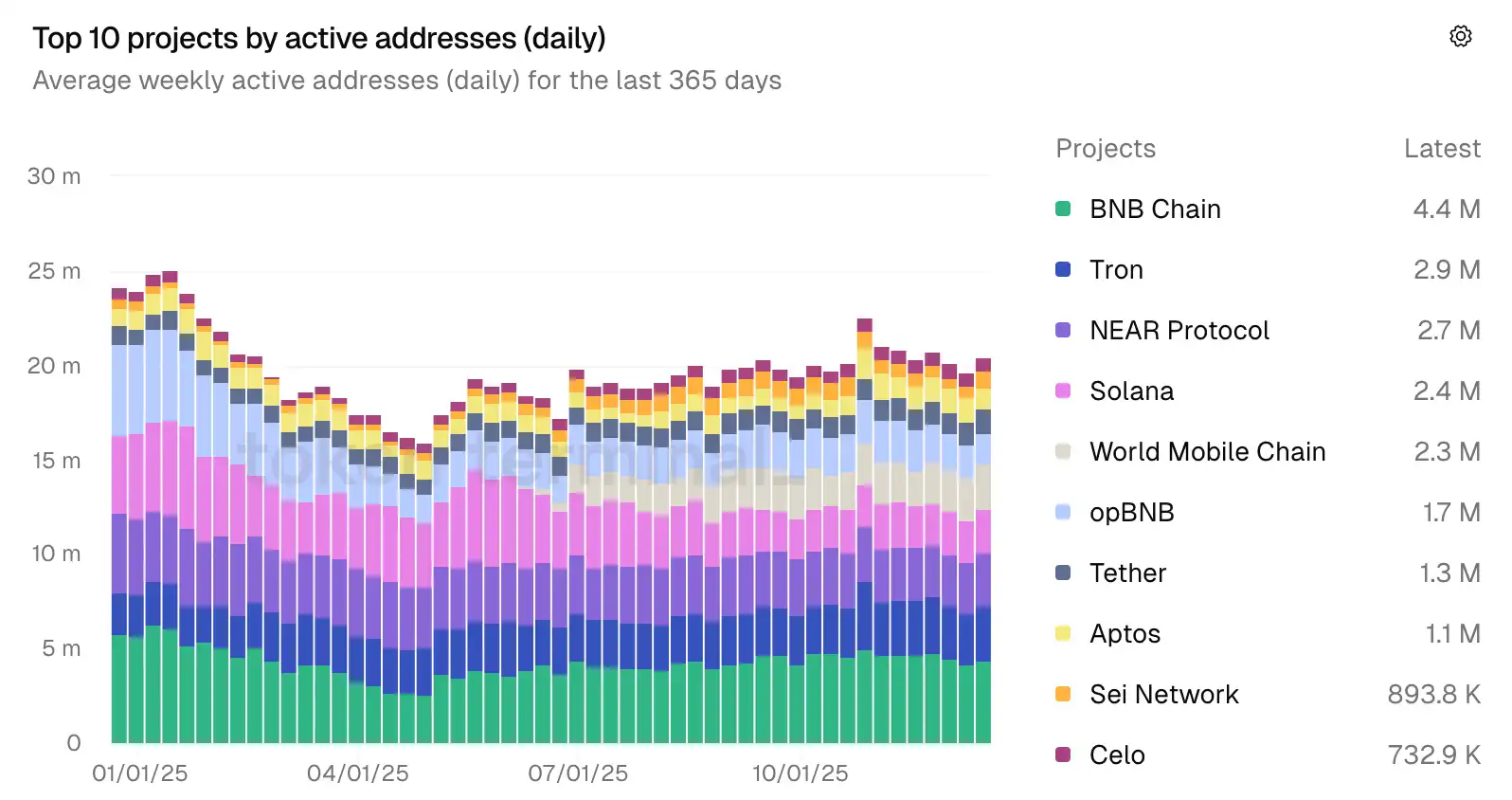
Entering the second half of 2025, BNB Chain quickly switched modes, transitioning from an engineer to a product manager. Leveraging the solid foundation laid in the first half, it successfully accommodated massive stablecoin payment and RWA demands.

$14.7 Billion in Stablecoins and 4 Million Daily Active Users

If crypto before 2024 was driven by speculation, then 2025 transformed into an era dominated by utility, primarily stablecoins. This year, USDC issuer Circle went public, and Franklin Templeton, with $1.6 trillion in assets under management, launched JUSD.

Stablecoins are evolving from mere trading mediums into channels connecting traditional finance and the Web3 world. Stablecoins are no longer just tools for DeFi but are beginning to assume roles closer to real-world payments and capital turnover.

In this transformation, BNB Chain, with its 2-second settlement and transaction fees as low as $0.005, became the fastest-growing platform. Latest data shows that the value of stablecoins on the BNB Chain network exceeds $14.7 billion, with BSC and opBNB serving over 4 million daily active users.
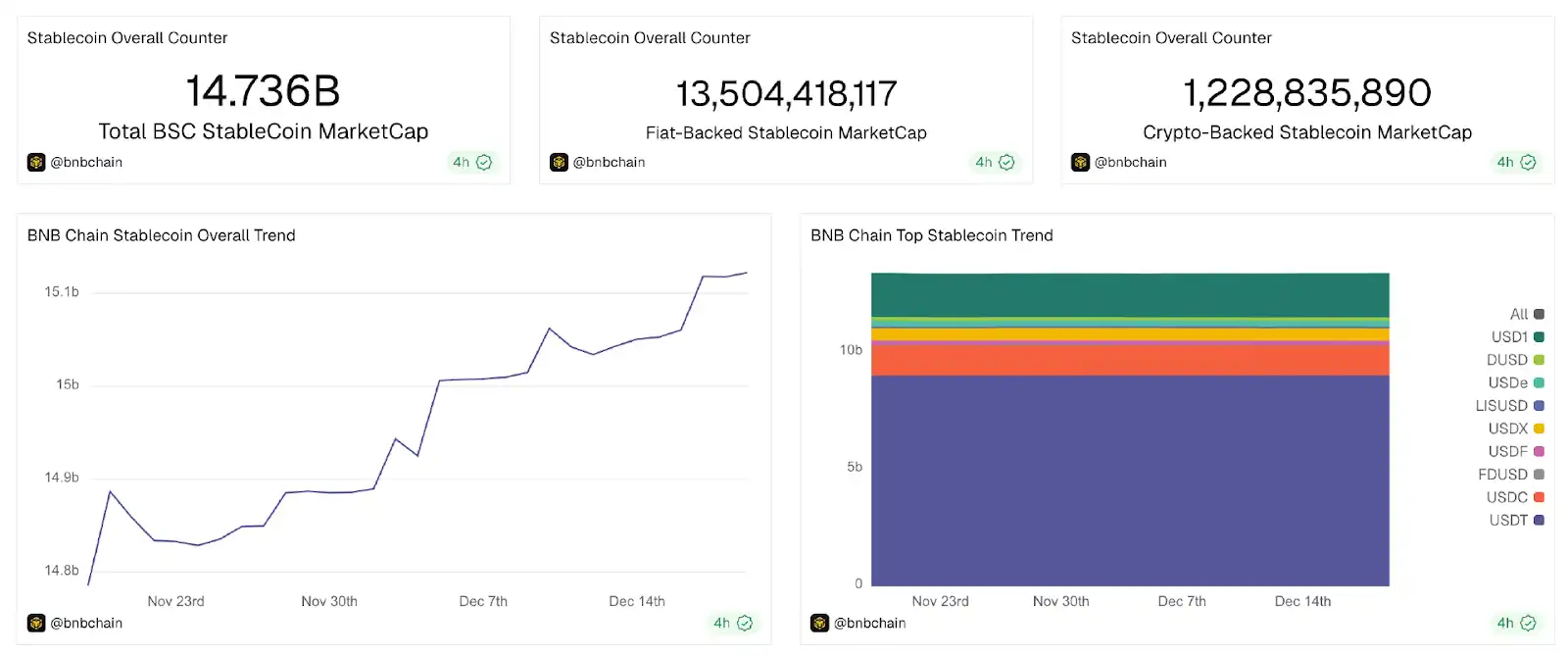
The adoption of stablecoins depends not only on the assets themselves but also on their operating environment. If stablecoins are to serve billions of users, the underlying chain must be cheap, fast, and seamless. The upgrades BNB Chain implemented in the first half laid the foundation for stablecoin普及 (popularization).

Through gas-free transactions, opBNB, and other scaling solutions, the cost of stablecoin transfers was compressed to near zero, significantly lowering the barrier to using stablecoins for payments. On BSC and opBNB, stablecoin transfers are completed almost instantly, providing a near-Web2 experience for on-chain payments, salary disbursements, and merchant settlements.

The supply of stablecoins on BNB Chain has doubled to approximately $14 billion, making it one of the most active stablecoin networks globally. Against this backdrop, the stablecoin ecosystem itself began to change. United Stables chose to natively issue its stablecoin, U, on BNB Chain. Unlike traditional stablecoins reliant on a single collateral asset, U employs a multi-stablecoin reserve model, allowing mainstream dollar stablecoins including USDT, USDC, and USD1 to be directly used as collateral to mint U.

From an ecological perspective, the introduction of U is not an isolated event but a natural outcome of the maturation of BNB Chain's stablecoin system. As the scale of on-chain stablecoins continues to expand and address activity keeps increasing, the demand for unified liquidity and higher capital efficiency also grows. United Stables' multi-collateral model is a response to this demand. Its design reduces the efficiency loss caused by repeatedly splitting different stablecoins, helps consolidate on-chain liquidity, and simplifies the usage path of funds in trading, payments, and DeFi applications.

Another landmark event in 2025 was Abu Dhabi's MGX investing $2 billion in Binance through the stablecoin USD1. USD1 is a dollar-pegged stablecoin supported by the Trump family's World Liberty Financial, backed by highly liquid asset reserves and deployed on mainstream blockchains like BNB Chain and ETH.

This investment sent a clear signal: stablecoins are no longer confined to the crypto industry but have become a tool connecting traditional capital with on-chain finance. And BNB Chain is an important carrier network for this channel.

Furthermore, BNB Chain, in collaboration with YZi Labs, launched a massive $1 billion Builder Fund to accelerate the development of existing and future developers on BNB Chain, particularly those building applications that can make stablecoins truly流动起来 (flow). The fund provides not only capital but also technical incubation and compliance consulting.

According to the development blueprint disclosed by BNB Chain, sectors such as on-chain payroll systems, programmable vaults, stablecoin-native credit cards, invoice tokenization, CBDC bridging and custody, green finance, and supply chain automation are poised for explosive growth. These upcoming booming sectors share common characteristics: they are efficient, automated, and globally accessible, rather than focusing on crypto attributes. The positioning of stablecoins therein is closer to a universal unit of the digital economy, and BNB Chain aims to become the underlying operating system hosting these functions.

It is worth noting that the growth of the stablecoin ecosystem on the BNB Chain network is not an isolated爆发 (outbreak) but is deeply intertwined with RWA.

BNB Chain and RWA Mutually Enable Each Other

This year, we no longer debate the feasibility of asset tokenization. Traditional financial giants like BlackRock, CMBI (China Merchants Bank International), VanEck, and Franklin Templeton are moving hundreds of billions of dollars in assets on-chain. In this on-chain movement, BNB Chain,凭借 (relying on) its massive user base and ecological strategy, has become one of the largest infrastructures承载 (hosting) RWA capital.

BlackRock deployed its USD Institutional Digital Liquidity Fund, BUIDL Fund, to BNB Chain with technical support from Securitize and Wormhole. Moreover, this fund can also be used as collateral on the Binance exchange. This means on-chain funds are no longer obscure financial products but have become a liquidity layer for the crypto market.

CMBI tokenized its US dollar money market fund, with assets under management exceeding $3.8 billion, on BNB Chain. It is reported that this fund ranks first among its peers in the Asia-Pacific region according to Bloomberg. Investors can subscribe to shares on BNB Chain using stablecoins.

The deployment of a series of RWA assets on BNB Chain is not a one-sided benefit but a deeper two-way promotional relationship. RWA and BNB Chain are forming a positive feedback flywheel that complements and amplifies each other.

Asset tokenization is only the first step. Without sufficient trading depth and turnover, these tokens are merely on-chain digital certificates, unable to unleash real financial value. Illiquidity is the biggest pain point hindering the large-scale爆发 (explosion) of RWA.

As a mature ecosystem, BNB Chain provides three key elements for RWA assets: high throughput, low fees, and a庞大的 (massive) user base. Compared to other expensive public chains (public chains), BNB Chain's low gas fees and high TPS make high-frequency trading and instant settlement possible, significantly lowering the barrier for user participation in RWA investments. Simultaneously, BNB Chain users are among the most active groups in Web3, meaning RWA assets can directly reach a vast pool of potential investors upon launch.

In fact, CZ had already revealed the key to RWA's prosperity on BNB Chain during the BNB Chain 5th-anniversary AMA: without users, there are no trades; without trades, there is no liquidity.

When Ondo Global Markets announced the introduction of 100+ US stocks and ETFs to BNB Chain, with deep integration into Binance Wallet, a剧烈的化学反应 (violent chemical reaction) occurred in the market. Thanks to BNB Chain's large number of daily active users, the trading volume of Ondo's tokenized stocks surged from a previous single-day peak of $84 million to $170 million.

Standing at the beginning of 2026 and looking back on the entirety of 2025, this was a milestone year for BNB Chain. It moved from participating in public chain competition with performance and cost, towards benchmarking itself against global traditional finance and internet payment systems with real usage scale, stable operational capability, and compliant accessibility. Over the past year, zero downtime under sustained high load, the规模化增长 (scaled growth) of stablecoins and RWA, and the systematic optimization of underlying performance and cost structure collectively proved that BNB Chain is no longer in the stage of technological feasibility.

Looking forward, BNB Chain's development focus will no longer be solely on chasing higher metrics but on further improving execution quality and user experience on top of the existing scale—faster confirmation speeds, lower usage costs, a fairer trading environment, and middleware and tool systems more friendly to complex scenarios like stablecoins, RWA, payments, and AI.

Looking ahead to 2026, BNB Chain's goal is to truly solidify sub-second performance, global payment capability, and compliant asset hosting into a default capability, enabling developers to build applications with near-Web2 experience on top of it, and allowing ordinary users to utilize blockchain services without perceiving the underlying complexity. When blockchain is no longer seen as a new technology but naturally integrates into daily economic activities like the internet or payment systems, the大规模采用 (mass adoption) of Web3 will truly arrive. And 2025 was a decisive step taken by BNB Chain in this direction.


Related Questions

QWhat were the key performance indicators (KPIs) that demonstrated BNB Chain's growth in 2025?

AKey KPIs included a 40.5% growth in TVL, over 100% growth in on-chain stablecoin market cap reaching $14 billion, RWA asset scale exceeding $1.8 billion, daily active addresses peaking at 4.4 million, and a record 31 million daily transactions.

QHow did BNB Chain's technical upgrades in 2025 improve its performance?

AThrough the Lorentz and Maxwell hard forks, BNB Chain reduced block time from 3 seconds to 0.75 seconds, increased network throughput to over 133 million gas/second, achieved sub-2-second transaction finality, reduced MEV sandwich attacks by 95%, and significantly lowered transaction costs in high-concurrency environments.

QWhat role did stablecoins play on BNB Chain in 2025, and what was a significant development in its stablecoin ecosystem?

AStablecoins evolved into a channel connecting traditional finance and Web3, with the on-chain value exceeding $14.7 billion. A significant development was the native issuance of the multi-collateral stablecoin 'U' by United Stables on BNB Chain, which uses a basket of major dollar stablecoins (like USDT, USDC) as collateral to improve capital efficiency and unify liquidity.

QHow did the integration of Real World Assets (RWA) and BNB Chain create a mutually beneficial relationship?

ABNB Chain's high throughput, low fees, and large user base provided the necessary liquidity and accessibility for RWA assets. In turn, major institutions like BlackRock (with its BUIDL Fund) and CMB International brought billions in traditional assets onto the chain, boosting transaction volume and cementing BNB Chain's role as key infrastructure for tokenized real-world assets.

QWhat was the overarching strategic goal for BNB Chain in 2025, as highlighted by CZ?

AThe overarching strategic goal, as highlighted by CZ during the 5th-anniversary AMA, was to attract more Web3 users by building powerful and attractive products, focusing on underlying technology重构 (restructuring) and utility (like stablecoin payments and RWA) rather than chasing short-term hype.

Related Reads

You Bet on the News, the Pros Read the Rules: The True Cognitive Gap in Losing Money on Polymarket

The article explains that the key to profiting on Polymarket, a prediction market platform, lies not just predicting real-world events correctly, but in meticulously understanding the specific rules that govern how each market will be resolved. It illustrates this with examples, such as a market on Venezuela's 2026 leader, where the official rules defining "officially holds" the office overruled the intuitive answer of who was in practical control. Other examples include debates over the definition of a "token" or what constitutes an "agreement." The core argument is that a "reality vs. rules" gap creates pricing discrepancies that savvy traders ("车头" or "whales") exploit. The platform has a formal dispute resolution process managed by UMA token holders to settle ambiguous outcomes. This process involves proposal submission, a challenge window, a discussion period, and a final vote. However, the article highlights a critical flaw in this system compared to a traditional court: the lack of separation between the arbiters (UMA voters) and the interested parties (traders with financial stakes in the outcome). This conflict of interest undermines the discussion phase, leads to herd mentality, and results in opaque final decisions without explanatory rulings. Consequently, the system lacks a body of precedent, making it difficult for users to learn from past disputes. The ultimate takeaway is that success on Polymarket requires a lawyer-like scrutiny of the rules to identify and capitalize on the cognitive gap between how events appear and how they are contractually defined for settlement.

marsbit1h ago

You Bet on the News, the Pros Read the Rules: The True Cognitive Gap in Losing Money on Polymarket

marsbit1h ago

Trading

Spot
Futures

Hot Articles

What is BNB WHALES

Understanding BNB Whales: A Deep Dive into the Cryptocurrency Landscape Introduction to BNB Whales In the vibrant world of cryptocurrencies, new projects regularly emerge, often promising innovative solutions and unique experiences. One such project is BNB Whales, launched in 2023 and built on the BNB Smart Chain (BEP20). BNB Whales sets out to establish a distinctive presence within the cryptocurrency ecosystem, focusing on creating an engaging platform that combines the benefits of blockchain technology with social and gaming interactions. This article aims to delve deeper into BNB Whales, exploring its core components, mechanics, and developmental trajectory. What are BNB Whales? BNB Whales is a cryptocurrency initiative that seeks to provide a diverse range of features and opportunities for its users in the burgeoning Web3 environment. Utilizing the BEP20 standard, the project operates with a total token supply of 100 trillion (100,000,000,000,000,000). Despite this significant figure, it is noteworthy that no tokens are currently in circulation, indicating that the project may still be in its early developmental stages. The primary goal of BNB Whales is to create a platform where users can participate in various interactive activities while benefiting from the security and transparency afforded by blockchain technology. By fostering a unique and engaging environment, BNB Whales aims to build a strong community of users who are invested in the project and its development. Who is the Creator of BNB Whales? The identity of the creator of BNB Whales remains undisclosed at this time, presenting a challenge for those looking to understand the project's founding principles and visionary insights. This absence of publicly available information regarding the project's leadership may raise questions among potential investors and users about its governance and accountability structure. Who are the Investors of BNB Whales? As BNB Whales continues to evolve, information concerning specific investors or support from investment foundations is currently unavailable. The project’s official documentation, including its whitepaper, does not disclose either individual or institutional financial backers. The lack of transparency in this regard can sometimes raise questions about the legitimacy and sustainability of new projects within the cryptocurrency ecosystem. How Does BNB Whales Work? BNB Whales operates on the BNB Smart Chain utilizing the BEP20 standard, which is known for its efficiency and low transaction fees, attracting a variety of developers and projects. The unique aspect of BNB Whales lies in its focus on creating a community-driven platform. While precise operational details are scarce, the project emphasizes interaction and engagement, potentially incorporating gamified elements into its offerings. The emphasis on community is pivotal, as it aligns with prevailing trends in the cryptocurrency space, where user input and participation often dictate a project's success. Further innovation may be anticipated, but at present, the specific mechanisms and features that differentiate BNB Whales from other crypto initiatives remain to be fully elucidated. Without detailed information regarding its functionality, it is challenging to evaluate the project's differentiators comprehensively. Timeline of BNB Whales The development of BNB Whales has unfolded across key milestones, marking its journey in the cryptocurrency landscape. Below is a timeline of significant events pertaining to the project: 2023: Launch of BNB Whales, marking the project's entry into the market. 2023: Publication of the project's whitepaper, which lays out the overarching goals and operational framework. Ongoing: BNB Whales continues to develop its features, aiming to build a robust user base and expand its offerings. Key Points About BNB Whales Platform: BNB Smart Chain (BEP20) Total Supply: 100 trillion tokens (100,000,000,000,000,000) Circulating Supply: 0 tokens (indicating a nascent stage) Project Goal: To foster an engaging cryptocurrency platform for interaction and community building. Creator: Unknown Investors: Not disclosed Operational Status: Active with ongoing development and expansion Conclusion As BNB Whales navigates the competitive cryptocurrency landscape, it offers a glimpse into the potential of community-driven projects built on the foundations of blockchain technology. By focusing on engagement and interaction, the initiative stands at the forefront of innovation in the Web3 space. However, the project's success ultimately hinges on the clarity of its operational mechanics, the disclosure of its governance, and the establishment of a solid user community. For potential users and investors alike, BNB Whales represents a case study in the evolving nature of cryptocurrency projects—one that illustrates both the exciting possibilities and the complexities associated with new initiatives. As the landscape continues to evolve, it will be essential to monitor BNB Whales' progress and its impact on the broader cryptocurrency ecosystem.

3.1k Total ViewsPublished 2024.04.01Updated 2024.12.03

What is BNB WHALES

What is PONKE BNB

Ponke BNB: A New Approach in the Cryptocurrency Space Introduction Ponke BNB, a newcomer in the cryptocurrency arena, was launched in 2024 and operates on the BNB Smart Chain (BEP20) platform. This innovative project seeks to build a distinctive and engaged community, focusing on sustainable reward generation. As the cryptocurrency landscape evolves, Ponke BNB aims to address critical issues surrounding reward sustainability, making it a project worth observing for enthusiasts and investors alike. What is Ponke BNB? At its core, Ponke BNB is a cryptocurrency designed specifically for the BNB Smart Chain ecosystem. Boasting an immense total supply of 370,000,000,000,000,000 tokens, it is worth noting that currently, there are no tokens in circulation. The guiding mission of Ponke BNB is to foster a sustainable reward system that mitigates the challenges associated with rewards depletion, a common pitfall in many cryptocurrencies today. The mechanics of Ponke BNB's functionality centre around encouraging user participation, while simultaneously providing rewards that can stand the test of time. The unique structure of its reward system is aimed at ensuring longevity and stability, addressing essential market concerns. Who is the Creator of Ponke BNB? Despite extensive exploration, the identity of Ponke BNB's creator remains unknown. There is a notable absence of publicly available information regarding the project’s founder or its development team. This anonymity, while not uncommon in the cryptocurrency space, raises some questions about transparency and accountability in project management. Who are the Investors of Ponke BNB? Similar to the lack of clarity surrounding its creator, there is no public information available regarding any investment foundations or organizations that support Ponke BNB. This absence of investor data can often breed uncertainty among prospective investors, who typically prefer a clear understanding of the backing behind cryptocurrencies they consider engaging with. How Does Ponke BNB Work? Ponke BNB stands out through its inventive two-layered sustainable reward generating system. This system is built to tackle the issue of rewards depletion effectively. By engaging users and creating a vibrant community, Ponke BNB seeks to provide a stable and enjoyable environment, which emphasizes user interaction and rewards. The operation framework of Ponke BNB encourages participation through various activities and challenges that are designed to incentivise users while ensuring that the reward system remains sustainable. It aims to stimulate the community and promote an engaging atmosphere where members can feel valued and appreciated. Timeline of Ponke BNB The evolution of Ponke BNB can be summarized through a few key milestones: 2024: The inception of Ponke BNB on the BNB Smart Chain (BEP20) platform marked a significant entry into the cryptocurrency market. 2024: The release of the project’s whitepaper and official website provided comprehensive insights into Ponke BNB’s goals and objectives, forming the foundation for its community-driven approach. Key Features of Ponke BNB Ponke BNB is built on several key features that set it apart from other cryptocurrency projects: Sustainable Reward System The two-layered reward system is designed to foster engagement, prevent depletion of rewards, and ensure the longevity of returns for participants in the Ponke BNB ecosystem. Community Engagement The project places a strong emphasis on active community engagement, driving participation through activities designed to create a social and collaborative environment. This community-centric approach empowers users to have a hand in shaping the project's future directions. BNB Smart Chain Integration Operating on the BEP20 platform, Ponke BNB is reinforced by the security and efficiency offered by the BNB Smart Chain. Users benefit from fast and cost-effective transactions, positioning Ponke BNB well within the broader cryptocurrency ecosystem. Conclusion In summary, Ponke BNB is an emergent cryptocurrency project aiming to carve a niche for itself in the growing digital currency landscape. With its focus on a sustainable reward system and community engagement, it presents a fresh outlook in an otherwise volatile sector. While uncertainties linger concerning the project's creators and investors, Ponke BNB continues to strive for transparency and innovation. As the cryptocurrency market continues to develop, Ponke BNB’s principles of sustainability and community-driven dynamics place it in a promising light for future observers and participants alike.

2.9k Total ViewsPublished 2024.04.01Updated 2024.12.03

What is PONKE BNB

What is BNB CARD

Understanding BNB Card: Revolutionizing Digital Identity in Web3 In the rapidly evolving landscape of blockchain technology and cryptocurrency, the BNB Card or $BNBCARD stands out as a noteworthy project. This community-driven utility meme token leverages the BNB Smart Chain (BSC), aiming to integrate meme culture with innovative digital identity solutions. As more users dive into the realms of decentralization, it is crucial to dissect what BNB Card offers, its operational nuances, and its potential market impact. What is BNB Card ($BNBCARD)? At its core, BNB Card represents a meme token with substantial utility. It is designed to empower users by enabling the creation of personalized digital identity cards that are both expressive and functional. The project encapsulates several key features: Customizable ID Cards: Users have the ability to design Binance-themed digital ID cards, providing them with a platform for self-expression and enhanced community interaction. Decentralized Framework: Developed on the BSC, BNB Card emphasizes key attributes such as security, transparency, and user sovereignty. The decentralized nature of the framework allows for transactions that are both efficient and secure. Community-Centric Model: The emphasis on grassroots participation rather than laboratory-driven financial models creates an engaging environment for its users. By leveraging the inherent virality of meme culture, BNB Card fosters a robust community movement. The primary goal of BNB Card is to democratize digital identity tools in Web3, offering accessible solutions that benefit the users without the encumbrances typically associated with traditional identity management systems. Creator and Investors When exploring the identity behind BNB Card, it is important to note that no singular creator is explicitly credited. Instead, the project appears to be community-driven, suggesting a collective effort inspired by the notion of Binance's “Early Builder Card.” This organic development approach is common among projects within the meme token spectrum, where development is often influenced by the community's passion rather than a central authority. In terms of investment, the absence of publicly disclosed institutional backers further highlights the project's grassroots foundation. It thrives on organic community support, reflecting a usual characteristic of meme-driven projects that often engage their audience through social channels rather than formal investment routes. How It Works BNB Card employs several mechanisms that delineate its functioning and innovative spirit: Token Utility: The BNBCARD token allows users access to a suite of ID creation tools while also providing a platform for community governance. The token serves as the linchpin that enables these functionalities. Blockchain Integration: By utilizing the BSC, BNB Card ensures compatibility with Ethereum Virtual Machine (EVM)-based applications. This integration provides users with the benefits of low transaction fees while enhancing accessibility. DIY Ecosystem: Central to BNB Card’s appeal is its do-it-yourself (DIY) approach to digital identity card generation. This participatory element encourages users to engage in creative expression, fostering an inclusive culture that thrives on contribution and collaboration. Timeline Chronology is vital to understanding BNB Card's trajectory. Important milestones in the project’s history include: March 18, 2025: BNB Card was listed on LBank, marking a significant step in its exchange journey and opening doors for liquidity and user accessibility. March 19, 2025: A pivotal moment occurred as the token experienced an astronomical surge of 26,000% within 24 hours, garnering attention for its potential and the community’s enthusiasm. Ongoing Developments: The project is continuously expanding its partnerships with decentralized exchanges (DEXs) like PancakeSwap, further enhancing liquidity and user engagement. Innovation and Differentiation Understanding what sets BNB Card apart involves deeper exploration into its innovative framework: Meme-Utility Hybrid: BNB Card successfully merges the playful allure of meme culture with practical applications in digital identity management. This niche approach effectively caters to a broad demographic, appealing to both tech-savvy users and those new to crypto. Decentralized Governance: Operating devoid of centralized control allows the project to harness community input directly. The collective decision-making process buoyed by community involvement empowers users, ensuring their voices contribute to the development and direction of the project. Scalability: BNB Card stands to benefit immensely from the 2025 roadmap upgrades to the BNB Chain, which include enhancements such as increased transaction speeds and the integration of artificial intelligence tools. These improvements position the project advantageously within a highly competitive environment. Conclusion BNB Card is emblematic of a new wave of digital identity solutions within the Web3 ecosystem. By blending fun, community engagement, and practical utility, it invites users to participate actively in shaping their digital personas. As the project navigates the dynamic cryptocurrency landscape, its success will likely hinge on maintaining strong community support while adapting to technological advancements and user needs. The integration of decentralization with meme culture serves not only as a means for user-driven engagement but also as a foundation for the evolving narrative surrounding digital identity in the age of blockchain. In summation, BNB Card not only exemplifies the convergence of creativity and utility within the crypto space but also underscores the importance of community in steering the future of decentralized technologies.

3.4k Total ViewsPublished 2025.03.26Updated 2025.03.26

What is BNB CARD

Discussions

Welcome to the HTX Community. Here, you can stay informed about the latest platform developments and gain access to professional market insights. Users' opinions on the price of BNB (BNB) are presented below.

活动图片