Bitcoin's Short-Term Bear-to-Bull Transition: Will History Repeat Itself? | Invited Analysis

Odaily星球日报Published on 2026-01-19Last updated on 2026-01-19

Abstract

Summary of Bitcoin Market Analysis by Conaldo (Odaily Guest Analyst): This weekly trading report provides a technical analysis of Bitcoin's recent price action and outlines short-term trading strategies. The analyst, leveraging proprietary quantitative models (Momentum Quant, Sentiment Quant, and Spread Trading models), reviews the past week and forecasts the upcoming period. **Key Points & Performance:** * **Strategy Execution:** A single short-term, leveraged (1x) trade was executed last week, resulting in a -1.07% return. The trade was closed according to strict risk management rules after the market moved against the initial short signal. * **Price Validation:** The previous week's core prediction was validated as BTC's price successfully broke through the key resistance zone of $94,500-$95,000, reaching a high near $97,963. * **Current Market Structure:** The weekly chart analysis indicates the overall trend remains bearish, requiring caution. The daily chart shows a recent rebound with initial signs of bullish momentum, though its sustainability is not yet confirmed. **Technical Outlook & Key Levels (Jan 19-25):** * **Critical Zone:** The $94,500-$95,000 area is identified as the crucial level to watch for determining short-term direction. * **Resistance Levels:** Key resistance areas are $94,500-$95,000, $97,500-$99,500, and a major level near $102,000 (the 21-week moving average). * **Support Levels:** Key support areas are $89,500-$91,000, $86,000-$86,...

Odaily invited market analyst Conaldo, a Master of Financial Statistics from Columbia University, who has focused on quantitative trading in U.S. stocks since college and gradually expanded into digital assets such as Bitcoin. He has developed a systematic quantitative trading model and risk control system through practical experience; possesses keen data insight into market fluctuations, and is committed to continuous growth in the professional trading field, pursuing steady returns. He will delve into BTC technical, macroeconomic, and capital flow changes weekly, review and showcase practical strategies, and preview noteworthy upcoming events for reference.
Trading Weekly Report Core Summary:

• Strategy Execution (Short-term): Last week's trading strictly followed the established strategy, completing one short-term operation (1x leverage) with a return of -1.07%. (See Figure 1)

• Core View (Short-term) Validation: The core view proposed last week has been precisely validated by the market. Over the past week, the price broke through the key resistance range of $94,500~$95,000 and is currently confirming its validity. The price reached a high of $97,963, differing by less than 0.5% from the given resistance lower bound of $97,500, once again confirming our ability to judge key points.

• Market Outlook for the Coming Weeks: Is Bitcoin about to transition from a bear market to a bull market? Is the current market a rebound or a reversal? The 21-week moving average may become the market's bull-bear dividing line in the future. (Detailed explanation in Figure 4)

The following will review market predictions, strategy execution, and specific trading processes in detail.

I. Bitcoin Market Review Last Week: (01.12~01.18)

1. Last Week's Short-term Operation Review: As shown in (Figure 1)

We strictly followed the trading signals from our self-built spread trading model and momentum quantitative model, combined with market trend predictions, to complete one short-term operation. This trade resulted in a loss of 1.07%.

Specific trade details and review are as follows:

Bitcoin 30-minute K-line chart: (Momentum Quantitative model + Spread Trading model)
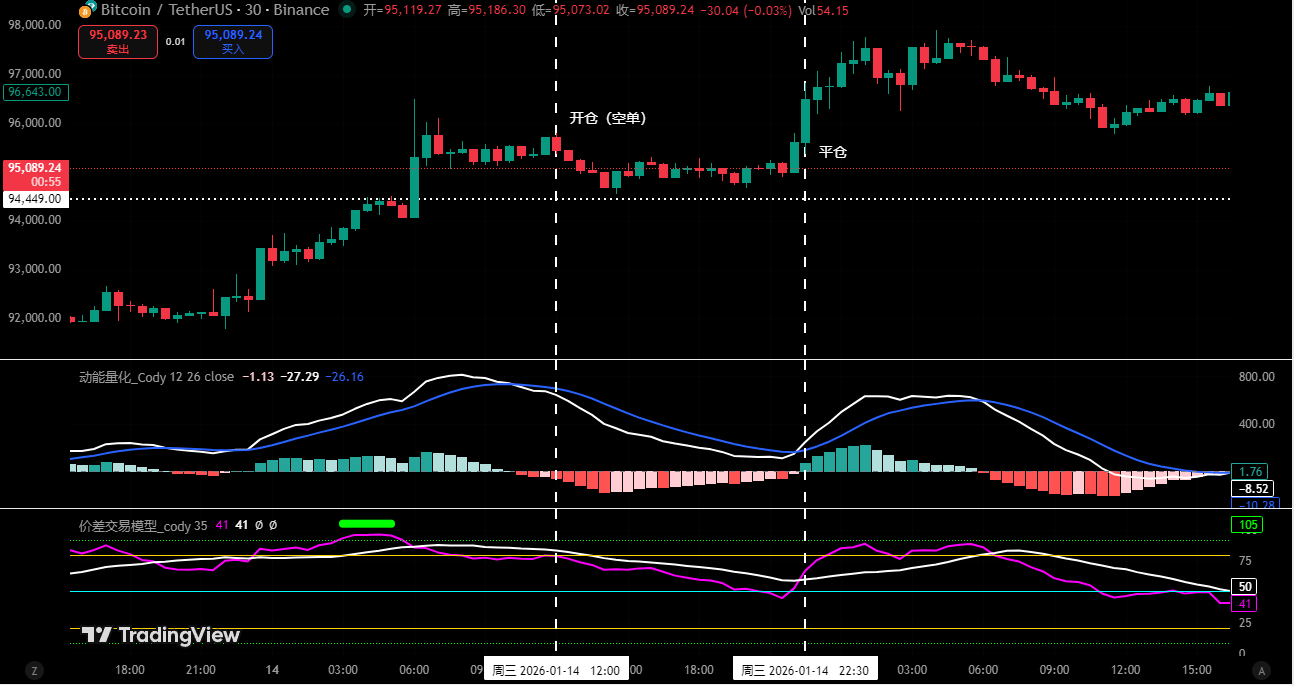
Figure 1

1. Trade Details Summary: (No leverage)

2. Short-term Trade Review:

• First Trade (Loss 1.07%): This operation executed Plan A (Selling short at resistance) strategy: When the price rose to the key resistance area of $94,500~$95,000 and showed signs of resistance, the spread trading model simultaneously triggered a top signal (green dot), forming double confirmation. Accordingly, we established a 30% short position at $95,460 as planned; however, the market deviated from expectations, finding support near $94,500 and turning upward. When the momentum quantitative model and spread trading model triggered a bottom signal again, we immediately stopped loss and exited at $96,493. Although this trade resulted in a loss, we strictly adhered to the operational discipline of "trading upon signal trigger, risk control first", achieving unity of knowledge and action.

2. Last Week's Trend Prediction and Operation Strategy Review:

1. Last week clearly stated: Maintain oscillation within the $84,000~$94,500 range, focusing on directional choices and validity at both ends of the range.

2. Key point review: Resistance at $94,500~$95,000 area, important resistance near $97,500~$99,500; support at $89,500~$91,000 area.

2. Operation Strategy Review:

• Midline Strategy: If the price successfully breaks through and stabilizes above $94,500, close all midline positions (short positions) and hold coins观望.

• Short-term Strategy: If maintaining oscillation within the $84,000~$94,500 range, execute operations according to Plan A:

• Open Position: When rebounding to the $94,500~$95,000 area combined with model top signals, establish a 30% short position.

• Risk Control: Initial stop loss for short positions set about 1.5% above the entry price (i.e., 1.015 * entry price).

• Close Position: When falling near core support levels combined with model signals, gradually close positions to take profits.

II. Analyzing Bitcoin's Price Structure from a Technical Perspective: Comprehensive Judgment Based on Multiple Models and Dimensions

Combining market movements, the author conducts an in-depth analysis of Bitcoin's price structure from multiple models and dimensions based on a self-built trading system.

Bitcoin Weekly K-line chart: (Momentum Quantitative Model + Sentiment Quantitative Model)
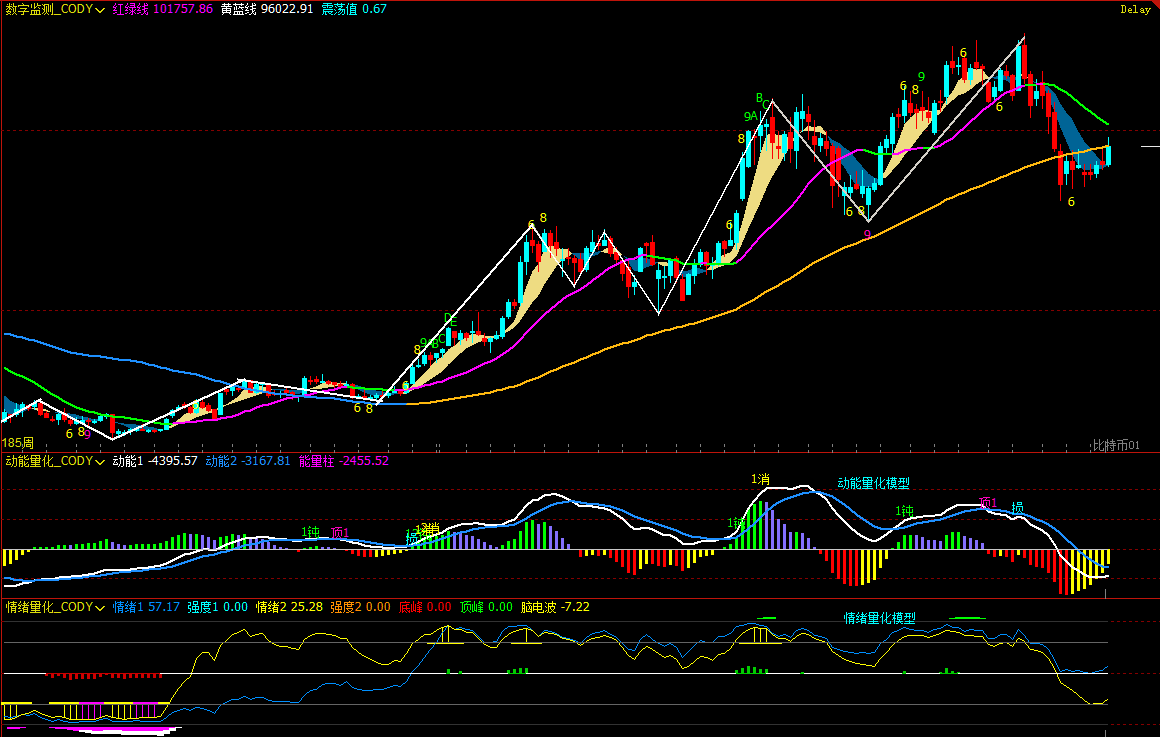
Figure 2

1. As shown in (Figure 2), analysis from the weekly chart:

Momentum Quantitative Model: Technical indicators show, continuing the pattern of previous weeks, the momentum lines are gradually converging, while the negative energy bars continue to shrink. However, the current signals do not confirm a reversal of the bearish trend.

Momentum Quantitative Model indicates: Price decline index: High

Sentiment Quantitative Model: Blue sentiment line value 57.17, strength zero; yellow sentiment line value 25.28, strength zero, peak value is 0.

Sentiment Quantitative Model indicates: Price pressure and support index: Neutral

Digital Monitoring Model: The price has been below the bull-bear (yellow-blue line) dividing line for 9 weeks. Last week, the bulls once again冲击 this line, closing near below.

Digital Monitoring Model indicates: Monitoring (top/bottom) digital signals have not appeared; weekly K-line closed as a medium阳线, gain about 2.92%.

The above data suggests: Bitcoin weekly chart is in a bearish trend, be wary of oscillation adjustment risks.

Bitcoin Daily K-line chart: (Momentum Quantitative Model + Sentiment Quantitative Model)
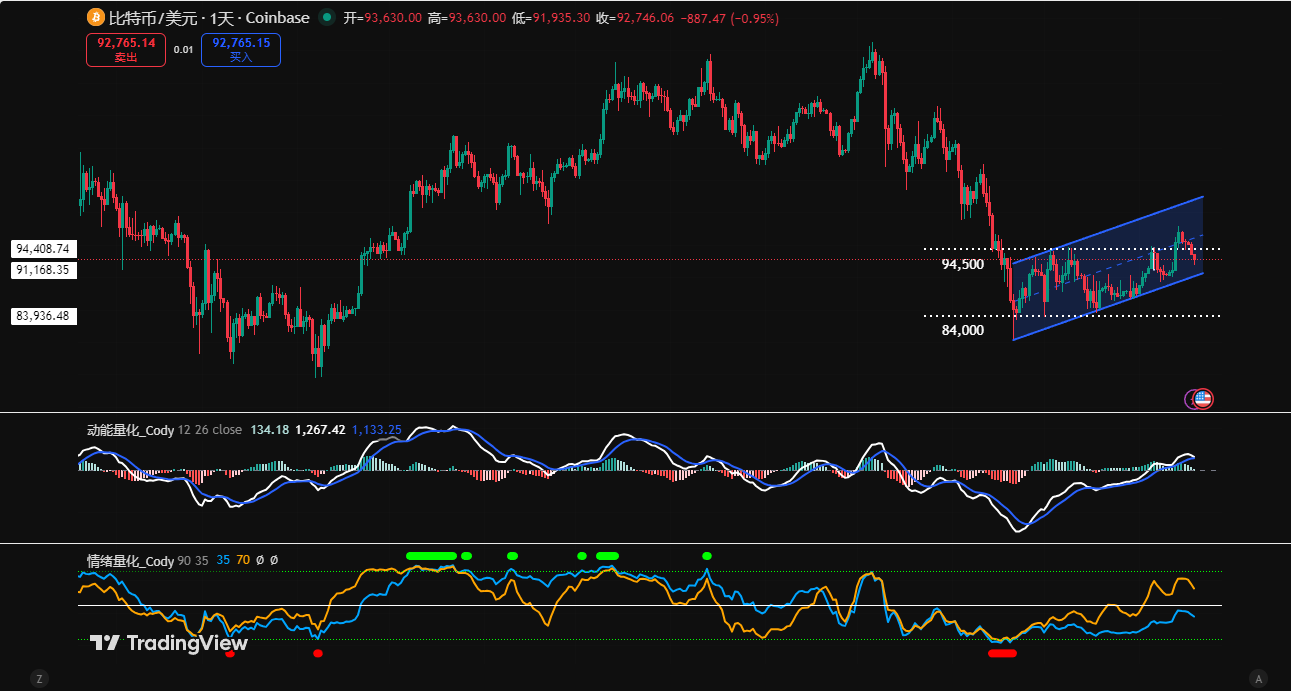
Figure 3

2. As shown in (Figure 3), analysis from the daily chart:

Momentum Quantitative Model: Last week overall showed a "first rise then fall" pattern. In the first half of the week, the price accelerated its rebound, the momentum line stood above the zero axis, and the positive energy bars rapidly expanded; but in the latter half, the energy bars明显萎缩, the momentum lines converged again, slowly approaching the zero axis.

Momentum Quantitative Model indicates: Daily chart bullish momentum shows exhaustion, focus on the gain/loss of the zero axis.

Sentiment Quantitative Model: After last week's daily close, blue sentiment line value 38, strength zero; yellow sentiment line value 76, strength zero.

Sentiment Quantitative Model indicates: Pressure and support index: Neutral

The above data suggests: The daily level rebound continues, the market initially shows a bullish pattern, but validity needs confirmation. Next, focus on the battle between bulls and bears over the zero axis.

III. This Week's Market Prediction: (01.19~01.25)

1. This Week's Core View: Focus on the gain/loss of the $94,500~$95,000 area.

Resistance Effective: If the price rebounds to this area and confirms resistance, it is expected to maintain oscillation within the $84,000~$94,500 range, with the subsequent first test target at the $89,500~$91,000 area.

Effectively Stabilized: If it can strongly stabilize above this area, the price is expected to oscillate and rebound, but the height is limited.

2. Core Resistance Levels:

• First Resistance Area: $94,500~$95,000 area (previous box edge)

• Second Resistance Area: $97,500~$99,500 area (previous oscillation center)

• Important Resistance Level: Near $10,200 (near the 21-week moving average)

3. Core Support Levels:

• First Support Level: $89,500~$91,000 area (previous筹码密集成交区)

• Second Support Level: $86,000~$86,500 area (previous important support level)

• Important Support Level: Near $84,000 (previous box lower edge)

IV. This Week's Operation Strategy (Excluding Sudden News Impact): (01.19~01.25)

1. Midline Strategy: No position, market trends may oscillate and fluctuate,暂时持币观望.

2. Short-term Strategy: Use 30% of position, set stop loss points, based on support and resistance levels, look for "spread" opportunities. (Using 30 minutes as the operation cycle).

3. In operation, focus on the gain/loss of the $94,500~$95,000 area. To dynamically respond to market changes combined with real-time model signals, we have prepared two short-term operation plans, A/B:

Plan A: If the price stabilizes above the $94,500~$95,000 area:

• Open Position: After the price breaks through the $94,500~$95,000 area and shows stabilization signals, combined with model bottom signals, establish a 30% long position.

• Risk Control: Initial stop loss for long positions set about 1.5% below the entry price (i.e., 0.985 * entry price).

• Close Position: When rebounding near core resistance levels combined with model signals, gradually close positions to take profits.

Plan B: If the price effectively breaks below the $94,500~$95,000 area:

• Open Position: If the rebound confirms a effective break below this area, establish a 30% short position.

• Risk Control: Initial stop loss for short positions set about 1.5% above the entry price (i.e., 1.015 * entry price).

• Close Position: When falling near $86,500 combined with model signals, gradually close positions to take profits.

Bitcoin Weekly K-line Chart: Comparative Analysis of Historical Price Structure (2021.11 VS 2025.10)
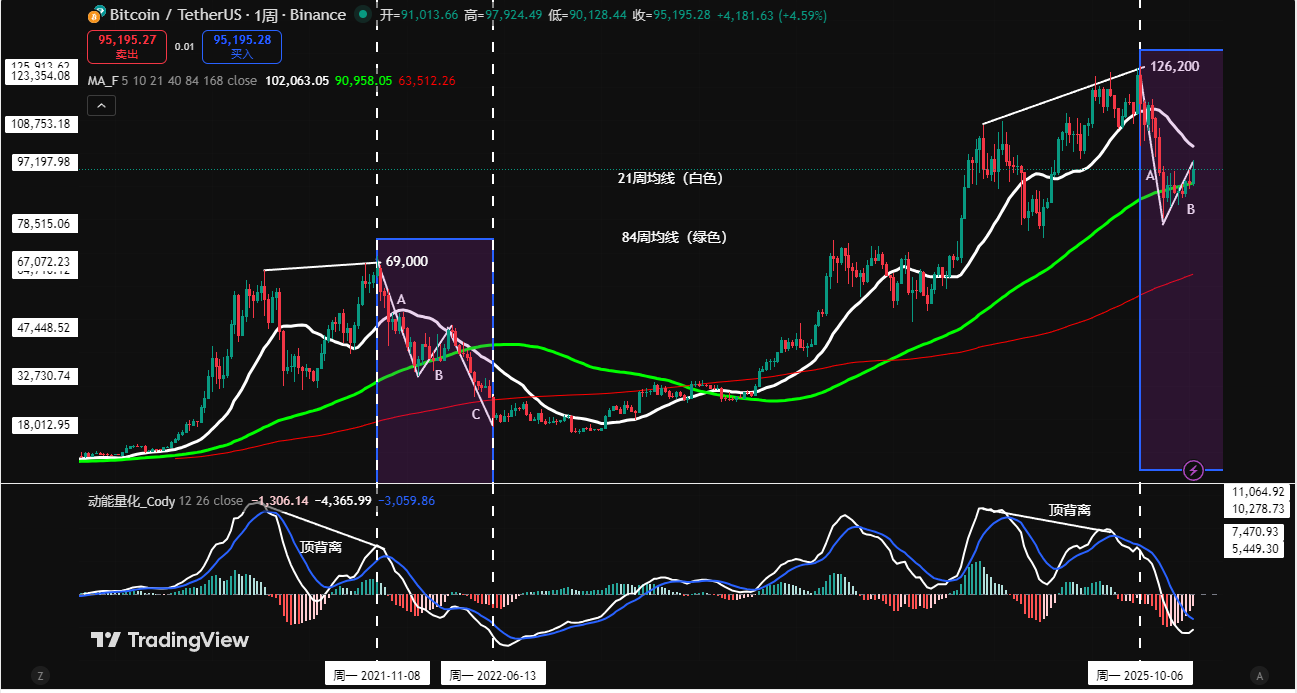
Figure 4

Note: In the above figure, 21-week moving average (white), 84-week moving average (green)

V. How Will History Repeat? Similarities, Differences, and Lessons from Two Rounds of Weekly Level Adjustments:
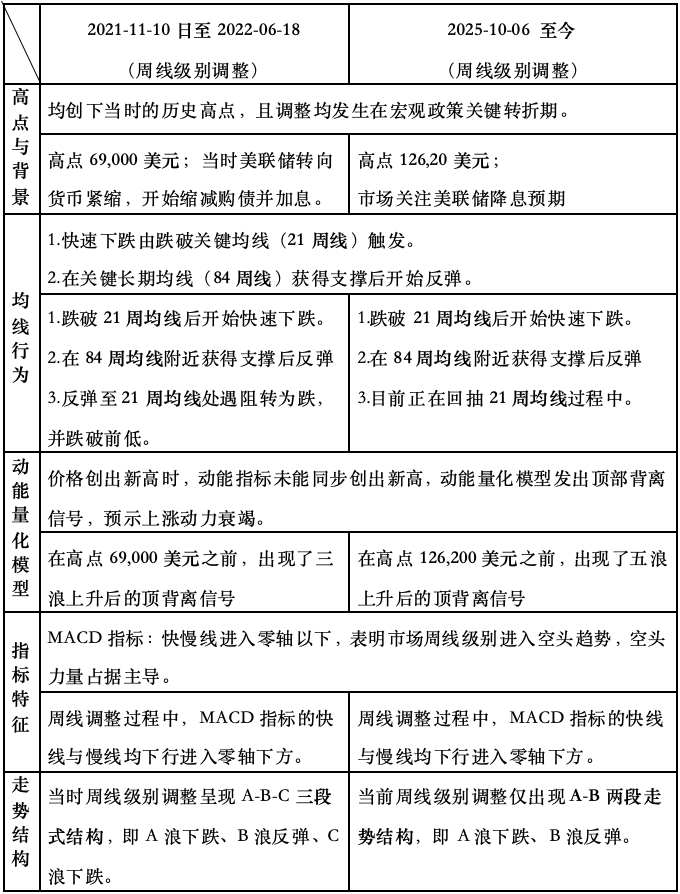
In summary, we can extract the following core insights:

1. The current weekly level is in a bearish trend, which limits the space for daily rebounds.

2. In the coming weeks, whether the price can effectively break through and stabilize above the 21-week moving average will become the market's focus. If the price fails to form an effective breakthrough when rebounding to this moving average, the market may repeat the historical adjustment pattern, even breaking below the $80,000 mark.

3. Whether the weekly level MACD indicator can show signs of stopping decline and stabilizing, and the momentum line effectively crosses above the zero axis, becomes a key basis for judging whether the market trend has reversed.

VI. Special Notes:​​

1. When opening a position: Immediately set the initial stop loss level.

2. When profit reaches 1%: Move the stop loss to the entry price (break-even point) to ensure capital safety.

3. When profit reaches 2%​​: Move the stop loss to the 1% profit level.

4. Continuous tracking: Thereafter, for every additional 1% profit, move the stop loss同步 by 1%, dynamically protecting and locking in profits.

Financial markets change rapidly, all market analysis and trading strategies require dynamic adjustment. All views, analytical models, and operation strategies involved in this article are derived from personal technical analysis, for personal trading log purposes only, and do not constitute any investment advice or operational basis. The market has risks, investment needs caution, DYOR.


Related Questions

QWhat was the outcome of the short-term trading operation executed last week according to the article?

AThe short-term trading operation resulted in a loss of 1.07%.

QWhat is the key price zone that the article identifies as crucial for Bitcoin's price action this week?

AThe crucial price zone for Bitcoin's price action this week is $94,500 to $95,000.

QAccording to the analyst's models, what is the current trend on the weekly chart for Bitcoin?

AThe weekly chart is currently in a bearish trend, indicating a high probability of a price decline.

QWhat historical indicator does the article suggest is a critical focal point for determining a potential market reversal?

AThe 21-week moving average is suggested as a critical focal point for determining a potential market reversal.

QWhat are the two trading models mentioned as the basis for the analyst's trading signals?

AThe two trading models mentioned are the Spread Trading Model and the Momentum Quant Model.

Related Reads

Why Do You Always Lose Money on Polymarket? Because You're Betting on News, While the Pros Read the Rules

Why do you always lose money on Polymarket? Because you bet on news, while the pros study the rules. This article explains how top traders ("che tou") profit by meticulously analyzing market rules, not just predicting events. Polymarket, a prediction market platform, often sees disputes over event outcomes due to ambiguous rule wording. For instance, a market asking "Who will be the leader of Venezuela by the end of 2026?" was misinterpreted by many who bet on Delcy Rodríguez, assuming she held power. However, the rules specified "officially holds" as the formally appointed, sworn-in individual. Since Nicolás Maduro was still recognized as president officially, he won the market—even being in prison. To resolve such disputes, Polymarket uses a decentralized arbitration system via UMA protocol. The process involves: 1. Proposal: Anyone can propose a market outcome by staking 750 USDC, earning 5 USDC if unchallenged. 2. Dispute: A 2-hour window allows challenges with a 750 USDC stake; successful challengers earn 250 USDC. 3. Discussion: A 48-hour period on UMA Discord for evidence and debate. 4. Voting: UMA token holders vote in two 24-hour phases (blind then public). Outcomes require >65% consensus and 5M tokens voted; otherwise, four re-votes occur before Polymarket intervention. 5. Settlement: Results are final and automatic. Unlike traditional courts, Polymarket’s system lacks separation between arbitrators and stakeholders—voters often hold market positions, creating conflicts of interest. This leads to herd mentality in discussions and non-transparent outcomes without explanatory rulings, preventing precedent formation. Thus, success on Polymarket hinges on deep rule interpretation, not just event prediction, exploiting gaps between reality and contractual wording.

marsbit1h ago

Why Do You Always Lose Money on Polymarket? Because You're Betting on News, While the Pros Read the Rules

marsbit1h ago

DeepSeek Funding: Liang Wenfeng's 'Realist' Pivot

DeepSeek, a leading Chinese AI company, has initiated its first external funding round, aiming to raise at least $300 million at a valuation of no less than $10 billion. This move marks a significant shift from its founder Liang Wenfeng’s previous idealistic stance of rejecting external capital to maintain independence. Despite strong financial backing from its parent company, quantitative trading firm幻方量化 (Huanfang Quant), which provided an estimated $700 million in revenue in 2025 alone, DeepSeek faces mounting challenges. Key issues include a 15-month gap in major model updates, delays in its flagship V4 release, and the loss of several core researchers to competitors offering significantly higher compensation. The company is also undergoing a strategic pivot by migrating its infrastructure from NVIDIA’s CUDA to Huawei’s Ascend platform, a move aligned with China’s push for technological self-reliance amid U.S. export controls. However, DeepSeek lags behind rivals like智谱AI and MiniMax—both now publicly listed—in areas such as product ecosystem, multimodal capabilities, and commercialization. The funding round, though relatively small in scale, is seen as a way to establish a market-validated valuation anchor, making employee stock options more competitive and facilitating talent retention. It also signals DeepSeek’s transition from a pure research-oriented organization to a commercially-driven player in the global AI ecosystem.

marsbit2h ago

DeepSeek Funding: Liang Wenfeng's 'Realist' Pivot

marsbit2h ago

Trading

Spot
Futures

Hot Articles

What is $BITCOIN

DIGITAL GOLD ($BITCOIN): A Comprehensive Analysis Introduction to DIGITAL GOLD ($BITCOIN) DIGITAL GOLD ($BITCOIN) is a blockchain-based project operating on the Solana network, which aims to combine the characteristics of traditional precious metals with the innovation of decentralized technologies. While it shares a name with Bitcoin, often referred to as “digital gold” due to its perception as a store of value, DIGITAL GOLD is a separate token designed to create a unique ecosystem within the Web3 landscape. Its goal is to position itself as a viable alternative digital asset, although specifics regarding its applications and functionalities are still developing. What is DIGITAL GOLD ($BITCOIN)? DIGITAL GOLD ($BITCOIN) is a cryptocurrency token explicitly designed for use on the Solana blockchain. In contrast to Bitcoin, which provides a widely recognized value storage role, this token appears to focus on broader applications and characteristics. Notable aspects include: Blockchain Infrastructure: The token is built on the Solana blockchain, known for its capacity to handle high-speed and low-cost transactions. Supply Dynamics: DIGITAL GOLD has a maximum supply capped at 100 quadrillion tokens (100P $BITCOIN), although details regarding its circulating supply are currently undisclosed. Utility: While precise functionalities are not explicitly outlined, there are indications that the token could be utilized for various applications, potentially involving decentralized applications (dApps) or asset tokenization strategies. Who is the Creator of DIGITAL GOLD ($BITCOIN)? At present, the identity of the creators and development team behind DIGITAL GOLD ($BITCOIN) remains unknown. This situation is typical among many innovative projects within the blockchain space, particularly those aligning with decentralized finance and meme coin phenomena. While such anonymity may foster a community-driven culture, it intensifies concerns about governance and accountability. Who are the Investors of DIGITAL GOLD ($BITCOIN)? The available information indicates that DIGITAL GOLD ($BITCOIN) does not have any known institutional backers or prominent venture capital investments. The project seems to operate on a peer-to-peer model focused on community support and adoption rather than traditional funding routes. Its activity and liquidity are primarily situated on decentralized exchanges (DEXs), such as PumpSwap, rather than established centralized trading platforms, further highlighting its grassroots approach. How DIGITAL GOLD ($BITCOIN) Works The operational mechanics of DIGITAL GOLD ($BITCOIN) can be elaborated on based on its blockchain design and network attributes: Consensus Mechanism: By leveraging Solana’s unique proof-of-history (PoH) combined with a proof-of-stake (PoS) model, the project ensures efficient transaction validation contributing to the network's high performance. Tokenomics: While specific deflationary mechanisms have not been extensively detailed, the vast maximum token supply implies that it may cater to microtransactions or niche use cases that are still to be defined. Interoperability: There exists the potential for integration with Solana’s broader ecosystem, including various decentralized finance (DeFi) platforms. However, the details regarding specific integrations remain unspecified. Timeline of Key Events Here is a timeline that highlights significant milestones concerning DIGITAL GOLD ($BITCOIN): 2023: The initial deployment of the token occurs on the Solana blockchain, marked by its contract address. 2024: DIGITAL GOLD gains visibility as it becomes available for trading on decentralized exchanges like PumpSwap, allowing users to trade it against SOL. 2025: The project witnesses sporadic trading activity and potential interest in community-led engagements, although no noteworthy partnerships or technical advancements have been documented as of yet. Critical Analysis Strengths Scalability: The underlying Solana infrastructure supports high transaction volumes, which could enhance the utility of $BITCOIN in various transaction scenarios. Accessibility: The potential low trading price per token could attract retail investors, facilitating wider participation due to fractional ownership opportunities. Risks Lack of Transparency: The absence of publicly known backers, developers, or an audit process may yield skepticism regarding the project's sustainability and trustworthiness. Market Volatility: The trading activity is heavily reliant on speculative behavior, which can result in significant price volatility and uncertainty for investors. Conclusion DIGITAL GOLD ($BITCOIN) emerges as an intriguing yet ambiguous project within the rapidly evolving Solana ecosystem. While it attempts to leverage the “digital gold” narrative, its departure from Bitcoin's established role as a store of value underscores the need for a clearer differentiation of its intended utility and governance structure. Future acceptance and adoption will likely depend on addressing the current opacity and defining its operational and economic strategies more explicitly. Note: This report encompasses synthesised information available as of October 2023, and developments may have transpired beyond the research period.

363 Total ViewsPublished 2025.05.13Updated 2025.05.13

What is $BITCOIN

Discussions

Welcome to the HTX Community. Here, you can stay informed about the latest platform developments and gain access to professional market insights. Users' opinions on the price of BTC (BTC) are presented below.

活动图片