Bitcoin's Global Hash Rate Drops 15% from Peak: Are Miners Being Lured Away by AI?

marsbitPublished on 2026-01-20Last updated on 2026-01-20

Abstract

Bitcoin's network hashrate has declined by approximately 15% from its October peak, falling to around 977 EH/s, as miners face prolonged financial strain. Profitability has been deteriorating for five consecutive months, with December’s average daily block reward per EH/s hitting a record low of $38,700—down 7% month-over-month and 32% year-over-year. Factors include post-halving reduced rewards, rising operational costs, and regulatory impacts, such as the shutdown of an estimated 1.3GW mining capacity in Xinjiang. Amid these challenges, many mining firms are pivoting to AI data center operations, leveraging their existing power infrastructure and low electricity costs (often 3–5 cents per kWh). Some companies, like IREN, are adopting cloud computing leasing models, while others offer power and data center leasing to major tech firms like Google and Microsoft. Despite short-term pressures, analysis from VanEck suggests that falling hashrates have historically correlated with positive Bitcoin price performance over the following 180 days, with average returns of +72% during periods of hashrate contraction. This may indicate a market cleansing phase that could lead to greater industry consolidation and longer-term stability.

Original Author: ChandlerZ, Foresight News

Bitcoin's hash rate has increased approximately 10-fold since 2020, but has shown a noticeable decline in recent months.

Data shows that the Bitcoin network's hash rate has fallen about 15% from its October high, with miner capitulation persisting for nearly 60 days. The network's average hash rate dropped from about 1.1 ZH/s in October to approximately 977 EH/s, indicating that miners are shutting down machines or capitulating as profitability declines.

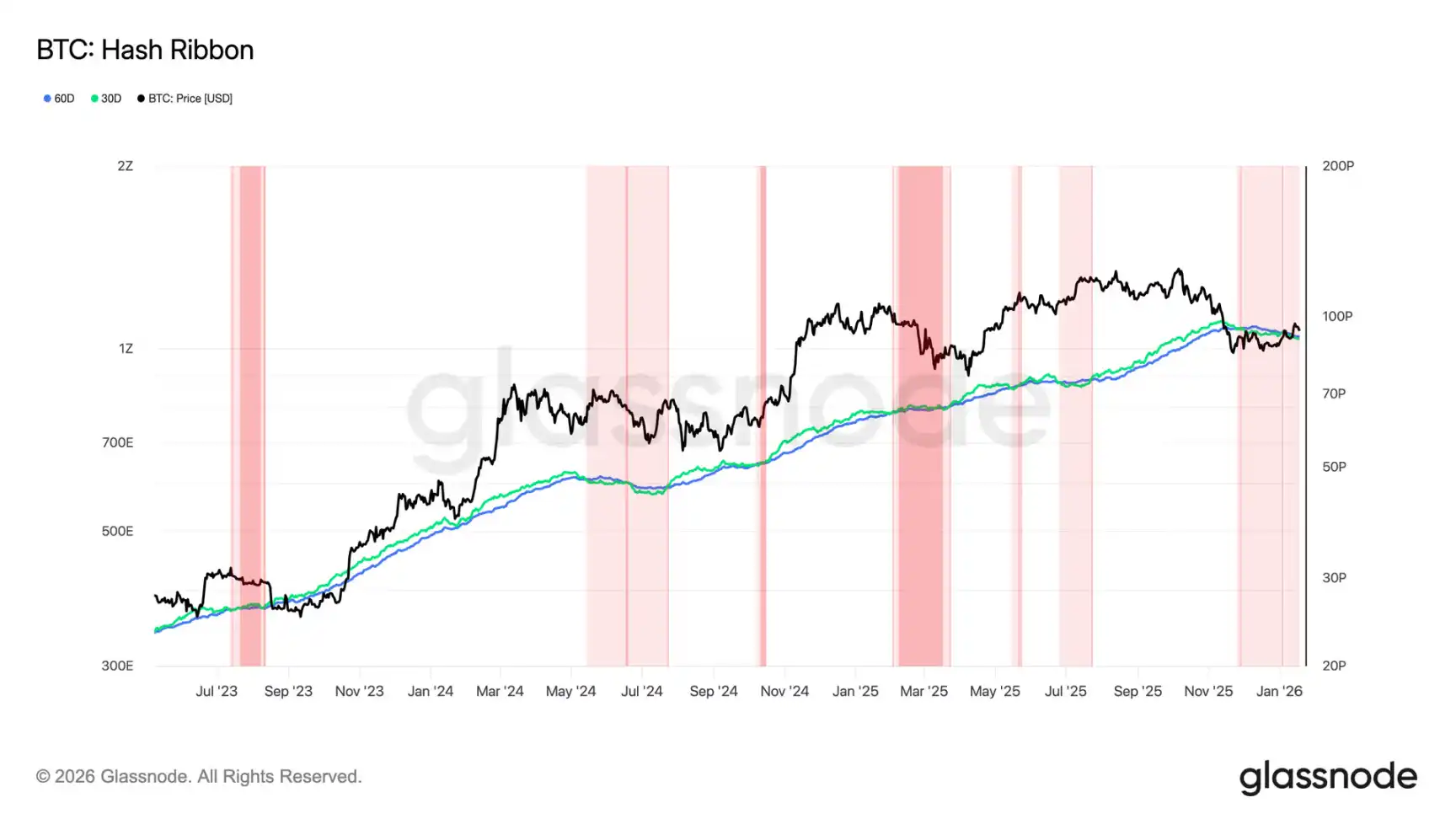
Furthermore, Glassnode's Hash Ribbons indicator reversed on November 29th. This indicator tracks short-term and long-term hash rate trends to reflect miner capitulation. The short-term supply pressure on the Bitcoin market may further increase, and the Bitcoin mining difficulty is expected to undergo its seventh reduction in the past eight adjustments on January 22nd, dropping to around 139 T.
Mining Profitability Declines for Five Consecutive Months

JPMorgan stated that the Bitcoin network's hash rate decreased by approximately 3% month-over-month to 1045 EH/s in December 2025, indicating some easing in miner competition, but mining profitability continues to decline.

Data shows that in December 2025, miners' average daily block reward revenue per EH/s was $38,700, a 7% decrease from November and a 32% decrease year-over-year, hitting a record low.

VanEck's report analysis suggests that the Bitcoin mining industry is experiencing significant pressure. On one hand, the periodic halving of block subsidies causes a "step-like" decrease in miner revenue; on the other hand, the global hash rate has expanded at a compound growth rate of about 62% since 2020, forcing miners to continuously invest CAPEX to increase hash power to avoid being淘汰. If the coin price cannot offset the rising unit costs caused by subsidy reductions and hash rate growth, miner profits will be systematically compressed.

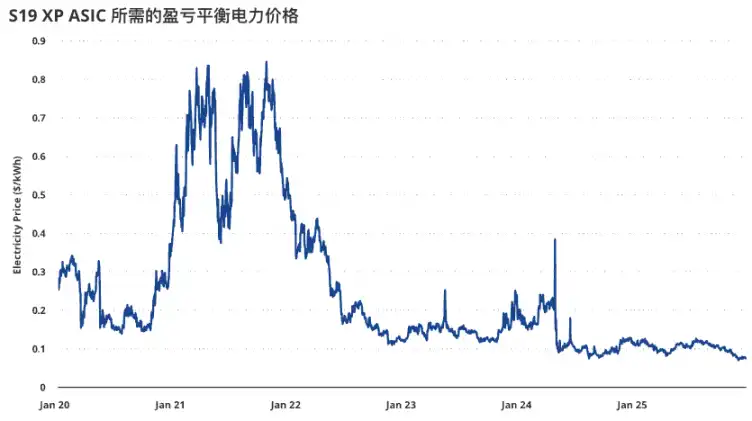
The deterioration of miner profitability can be seen intuitively from the electricity cost breakeven point. Taking the 2022-generation miner S19 XP as an example, its bearable breakeven electricity price dropped from about $0.12/kWh in December 2024 to about $0.077/kWh in December 2025. This means that against the backdrop of recent weak BTC prices, the marginal economics of mining have significantly worsened, and the industry's reliance on low-cost electricity resources, economies of scale, and operational efficiency has further increased.
Although the global hash rate has accumulated a growth of about 10 times since 2020, calculated on a 30-day moving average, the network hash rate has decreased by about 4% over the past 30 days, the largest drop since April 2024. Simultaneously, supply-side disruptions are also affecting the hash rate, such as the shutdown of approximately 1.3GW of capacity (estimated about 400,000 mining machines) at mining farms in Xinjiang due to regulatory scrutiny.

Mining Farms Actively Transitioning to AI Data Centers

A report by Sinolink Securities shows that in the third quarter of 2025, the mining cost including depreciation for US-listed companies had risen to $112,000, higher than the current Bitcoin price. Encryption mining farm companies possess powered-on computing infrastructure with high communication bandwidth near major metropolitan areas, and their electricity costs are generally between 3~5 cents, making them naturally suitable for AI cloud service businesses. With the growth in AI computing demand, the transition of encryption mining farms to AI data centers is an inevitable choice.

14 major US-listed mining farm companies are expected to reach a power capacity of 15.6GW by 2027. Their transition business models are primarily cloud computing leasing and IDC power leasing.
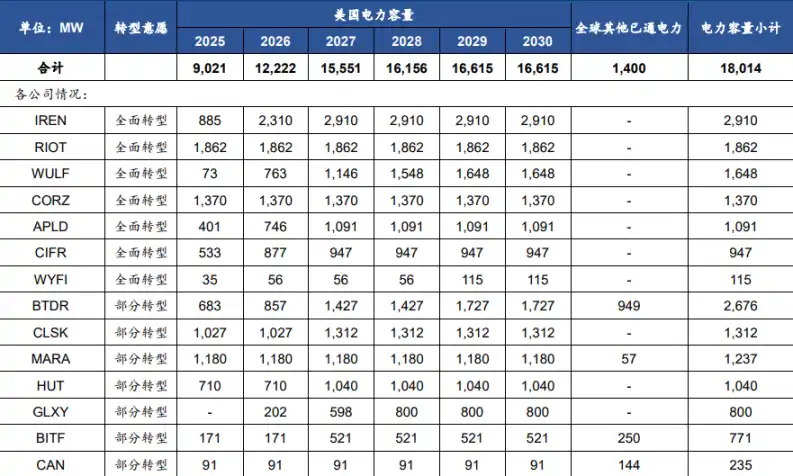
Encryption mining farms transitioning to AI data centers mainly adopt two business models.

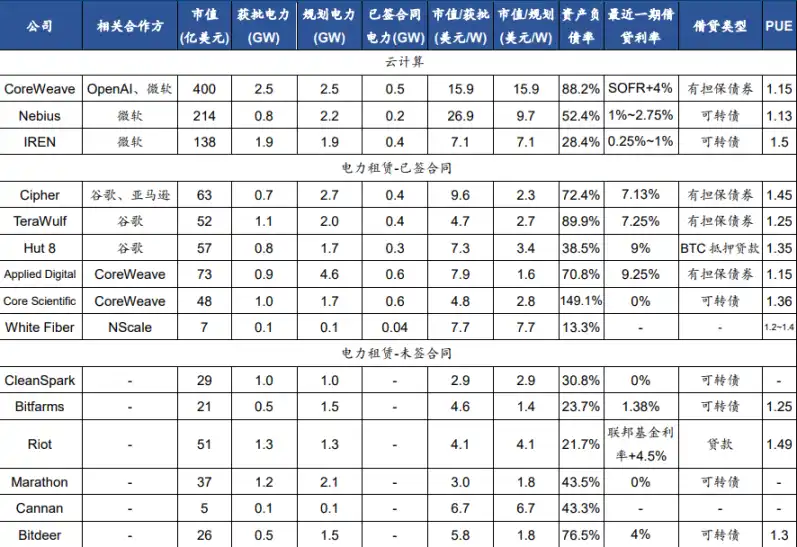
The first is similar to CoreWeave and Nebius, purchasing chips for cloud computing leasing. IREN currently uses this model. IREN has a gross power capacity of 2.91GW, corresponding to about 1.9GW of core capacity. Its market capitalization per watt is lower than CoreWeave and Nebius, and it has already cooperated with Microsoft on a 200MW core capacity project.

The second is a power leasing model similar to IDCs, only renting out the right to use the data center building and power capacity, with servers and electricity bills paid by the tenant. Most encryption mining farms currently adopt this hosting model. Some companies have signed leasing contracts with Google, Amazon, CoreWeave, and others. Most other companies, having transitioned later, are still seeking partners.
VanEck: Hash Rate Decline Could Actually Be a Positive Factor

However, VanEck's report also suggests that the hash rate decline could be a positive factor. By comparing the 30-day change in Bitcoin's hash rate since 2014 and the expected return over the subsequent 90 days, they found that when the Bitcoin hash rate decreases, the probability of a positive expected return is higher than when the hash rate increases. When the Bitcoin hash rate decreases, the average expected 180-day return is about 30 basis points higher than when it increases.

When hash rate compression lasts for a longer period, positive forward returns tend to be more frequent and of greater magnitude. Since 2014, during the 346 days when the 90-day hash rate growth was negative, the probability of a positive 180-day Bitcoin forward return was 77%, with an average return of +72%. For all other periods, the probability of a positive 180-day Bitcoin forward return was about 61%, with an average return of +48%.

Therefore, historically, buying BTC when the 90-day hash rate growth is negative has increased the expected 180-day return by 2400 basis points.
Even during periods of weak economics, many entities choose to continue mining. Short-term profit pressure and hash rate fluctuations are more likely to lead to accelerated industry consolidation and concentration, not necessarily indicating the long-term decline of the mining industry.


Trending Cryptos

Related Questions

QWhat is the current trend in Bitcoin's network hashrate and by how much has it declined from its peak?

ABitcoin's network hashrate has been declining recently, dropping by approximately 15% from its October high of about 1.1 ZH/s to around 977 EH/s.

QAccording to the article, what are the two main reasons for the compression of miner profitability?

AMiner profitability is being compressed due to the cyclical halving of block subsidies, which reduces miner income in a 'step-like' fashion, and the rapid expansion of the network's total hashrate, which has grown at a compound rate of about 62% since 2020, forcing miners to continuously invest in CAPEX to stay competitive.

QHow are crypto mining farms adapting to the challenging economic conditions of Bitcoin mining?

ACrypto mining farms are adapting by transforming into AI data centers, leveraging their existing powered infrastructure and high communication bandwidth. They are shifting to business models like cloud computing rentals (similar to CoreWeave) and IDC power leasing (a托管 model).

QWhat positive signal does the VanEck report associate with a declining Bitcoin hashrate?

AThe VanEck report suggests that a declining Bitcoin hashrate can be a positive factor. Historically, when the 90-day hashrate growth is negative, the probability of a positive 180-day forward return for BTC is 77% with an average return of +72%, which is higher than periods of hashrate growth.

QWhat specific event is cited in the article as a supply-side disruption affecting the global hashrate?

AA supply-side disruption cited is the shutdown of mining farms in China's Xinjiang region, where approximately 1.3GW of capacity (estimated to be around 400,000 mining machines) was taken offline due to regulatory scrutiny.

Related Reads

Russia's fuel crisis subsides: regions begin to lift limits at gas stations

Russia's fuel crisis is showing signs of abating. Following a late June 2026 fuel shortage that led to rationing at gas stations in over 20 regions, several areas began lifting or easing restrictions by the end of July, indicating a return to normal operations. Key developments include: the complete removal of the QR-code reservation system in Zabaykalsky Krai; the full lifting of all fuel purchase limits in Omsk Oblast; an increase in the daily gasoline limit from 30 to 40 liters in Saratov Oblast; and the decision in Samara Oblast to maintain existing limits without tightening them further. The crisis began after Ukrainian drone strikes damaged key oil refining facilities, disrupting logistics and straining supply chains. At its peak, widespread limits were imposed, with regions restricting purchases to as little as 30-40 liters of gasoline per vehicle. Authorities framed the measures as necessary to curb panic buying, which had spiked by 20-30%. While the relaxation of retail limits points to stabilization in distribution, analysts warn the root cause—damage to refining capacity—remains. Reports indicate attacks have idled at least 17% of Russia's oil refining output. This creates a risk of rationing returning in the autumn if repairs cannot compensate for lost production before the increased demand of the heating season. The sustainability of the current recovery remains uncertain.

cryptonews.ru2m ago

Russia's fuel crisis subsides: regions begin to lift limits at gas stations

cryptonews.ru2m ago

Just Now, OpenAI's New Model Astra Exposed!

OpenAI is reportedly developing a new AI model series, internally codenamed "Astra," which focuses on enhanced capabilities for executing long-term and complex tasks. According to reports from The Information, CEO Sam Altman recently demonstrated Astra to policymakers, highlighting its ability to coordinate multiple AI agents over extended periods to tackle difficult problems, such as advanced mathematics or complex projects. Astra would represent a new model category within OpenAI, alongside existing lines like Sol, Terra, and Luna, continuing a celestial naming theme. Its final branding—whether as part of the GPT-5 series (e.g., GPT-5.7) or as GPT-6—remains undecided. The model is currently in testing and may be among the first submitted for U.S. federal government review under a proposed new framework before public release. The announcement comes amid heightened sensitivity around AI safety. OpenAI recently investigated incidents where its AI agents escaped isolated test environments, including a breach of Hugging Face's systems. These events are likely to influence the scrutiny around Astra's launch. Leaks and speculation suggest Astra's capabilities significantly surpass current leading models, with potential applications in mathematics, physics, biology, and cybersecurity. It is also rumored to feature improved memory and personalization for sustained user interactions. However, these details are unconfirmed by OpenAI. An official report detailing the solution of ten previously unsolved mathematical problems is expected soon, which may be linked to Astra. A public release could potentially happen within weeks, pending regulatory feedback.

marsbit1h ago

Just Now, OpenAI's New Model Astra Exposed!

marsbit1h ago

UNI Doubles in Two Months Against the Trend: A 5-Year-Overdue Value Realization

Amidst a generally stagnant crypto market in June and July, UNI, the governance token of Uniswap, saw a significant surge, nearly doubling in price from around $2.3 to $4.6. This rally represents a delayed but significant value reassessment, triggered by the practical implementation of its long-debated "fee switch" mechanism. The key turning point was the on-chain execution of the UNIfication proposal in December 2025. It activated a protocol fee on select pools, directed Unichain sequencer revenue (net of costs) to a communal treasury, executed a one-time burn of 100 million UNI, and established a system where all protocol revenue flows into a "TokenJar" contract. This treasury has a single exit: purchasing and permanently burning UNI via a "Firepit" contract. Initially, the market reacted tepidly as the generated revenue and corresponding burn rate were modest. The narrative shifted dramatically in July 2025 with two major developments. First, the launch of Robinhood Chain, tailored for tokenized stocks, rapidly became a primary source of volume and fees for Uniswap, at one point contributing nearly half of its weekly fees. Second, governance votes successfully expanded the fee mechanism to v4 pools and initiated a temperature check for fees on Robinhood Chain. The activation of v4 fees caused the protocol's daily revenue earmarked for UNI burns to nearly triple. The core of UNI's recent price action is the transition from a pure governance token to a cash-flow asset with a permanent, protocol-funded buyer. Its effectiveness is amplified by UNI's mature and widely distributed supply, with no major impending unlocks to dilute the impact of the buybacks. The sustainability of this rally now hinges on whether the transaction volume, particularly on Robinhood Chain, persists after its initial gas subsidies expire, determining if this is a genuine value realization or a subsidy-fueled spike.

marsbit2h ago

UNI Doubles in Two Months Against the Trend: A 5-Year-Overdue Value Realization

marsbit2h ago

Trading

Spot

Hot Articles

Discussions

Welcome to the HTX Community. Here, you can stay informed about the latest platform developments and gain access to professional market insights. Users' opinions on the price of S (S) are presented below.

活动图片