Bitcoin Stabilizes At $68K as Fund Flow Ratios Signal An Institutional Standstill

bitcoinistPublished on 2026-02-27Last updated on 2026-02-27

Abstract

Bitcoin is testing the $69,000 resistance level after rebounding from $64,000, though the broader market shows limited conviction. Analyst Darkfost notes that February is set to record the lowest spot trading volumes of 2024, indicating a defensive market posture rather than expansion. Major exchanges like Binance, Gate.io, and Bybit have seen significant volume declines since October, reflecting reduced participation and systemic caution. Shrinking spot volumes suggest weaker conviction and delayed trend formation, as sustained recoveries typically require expanding spot demand. The market's direction hinges on whether spot activity stabilizes or continues to contract amid ongoing liquidity constraints.

Bitcoin is currently testing the $69,000 level as resistance after rebounding from the $64,000 zone, attempting to recover from its recent corrective phase. While the short-term momentum appears constructive, broader market conditions suggest that conviction remains limited. The move higher is unfolding in an environment characterized by reduced participation and compressed liquidity.

According to top analyst Darkfost, February is on track to close as the month with the lowest Bitcoin spot trading volumes since the beginning of 2024. This contraction in activity coincides with BTC revisiting price levels last observed last year, reinforcing the perception of a market stuck in a defensive posture rather than entering a renewed expansion phase.

Despite the slowdown, Binance continues to dominate spot trading with nearly $75 billion in monthly volume, significantly ahead of Gate.io at $25 billion and Bybit at $20 billion. However, overall liquidity across the crypto market remains constrained, particularly following the October 10 shock that saw open interest decline by more than 70,000 BTC — roughly $8 billion in notional value.

Spot Volume Contraction Signals Market Caution

The ongoing decline in spot trading activity provides a useful lens for understanding current Bitcoin market dynamics. Darkfost notes that participation across major exchanges has fallen markedly since the October peak, with aggregate spot volumes roughly halved. Binance’s monthly volume has dropped from about $198 billion to $75 billion, Gate.io from $53 billion to $25 billion, and Bybit from $41 billion to roughly $20 billion. The fact that this pattern spans multiple leading venues suggests a systemic shift rather than exchange-specific behavior.
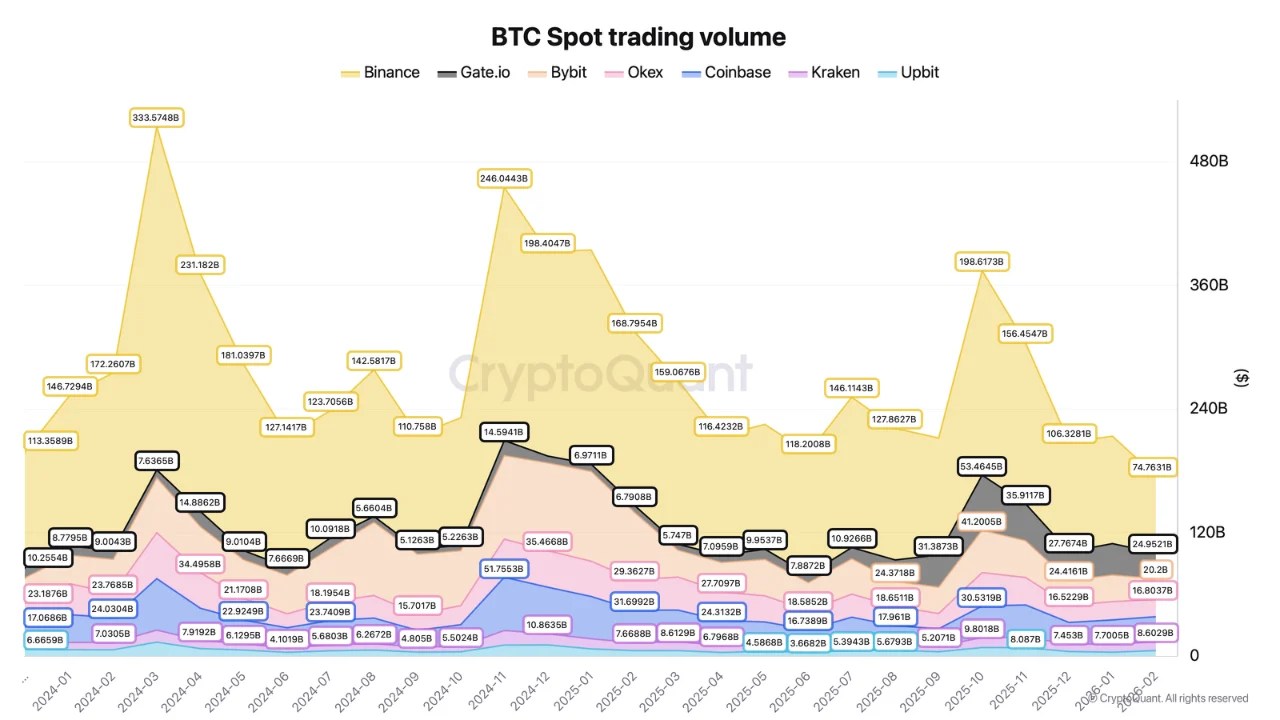
Bitcoin Spot Trading Volume | Source: CryptoQuant

From a market-structure perspective, shrinking spot volumes typically indicate reduced conviction. When liquidity thins, price moves can become less reliable because they are driven by smaller capital flows. This environment often coincides with consolidation phases, where both buyers and sellers adopt a wait-and-see approach rather than aggressively positioning.

Importantly, weaker spot participation can delay trend formation. Sustained bullish recoveries historically require expanding spot demand, as derivatives-driven rallies alone tend to lack durability. Conversely, declining spot flows may also reflect capital rotation toward other asset classes amid macro uncertainty.

The key variable will be whether spot participation stabilizes or begins to recover. A meaningful rebound in volumes would signal renewed confidence, whereas continued contraction would reinforce the current defensive market posture.


Trending Cryptos

Related Questions

QWhat is the current resistance level Bitcoin is testing, and from which zone did it rebound?

ABitcoin is currently testing the $69,000 level as resistance after rebounding from the $64,000 zone.

QAccording to the analyst Darkfost, what is significant about Bitcoin spot trading volumes in February 2024?

AFebruary is on track to close as the month with the lowest Bitcoin spot trading volumes since the beginning of 2024.

QWhich exchange dominates the spot trading market, and what is its approximate monthly volume?

ABinance dominates the spot trading market with nearly $75 billion in monthly volume.

QWhat does a decline in spot trading volume typically indicate from a market-structure perspective?

AShrinking spot volumes typically indicate reduced conviction and can make price moves less reliable as they are driven by smaller capital flows, often coinciding with consolidation phases.

QWhat event in October caused a significant decline in open interest, and what was the approximate notional loss?

AThe October 10 shock caused open interest to decline by more than 70,000 BTC, which is roughly $8 billion in notional value.

Related Reads

Global Stock Market's Storm Center: South Korea's Stock Market De-leveraging Is Largely Complete

Storm's Eye: South Korean Market De-leveraging Nears Completion The recent sharp correction in South Korean equities, with the KOSPI index dropping 32% from its June high, has been a key trigger for global tech stock volatility. The core driver was not a fundamental shift but a forced de-leveraging process within the market's unique structure, which is now largely complete. Two main leverage channels amplified the sell-off: 1. **Leveraged ETFs:** Their size, proportionally four times larger than in the U.S., peaked near $50 billion. Their mandatory daily rebalancing mechanism created a vicious cycle of "price drop → forced selling → further drop." Approximately 75% of this excess has been unwound, shrinking to $26 billion, with regulatory curbs now blocking new inflows. 2. **Hedge Fund Leverage:** Using swaps to magnify exposure, hedge funds saw their net long positioning fall by over 50% from peak levels. The most intense phase of this institutional de-leveraging is over. In contrast, **retail margin debt** poses minimal systemic risk. At 0.5% of market cap, it is far lower than in the U.S. or China, lacks automatic triggers, and is concentrated in smaller stocks. The conclusion: the high-leverage structures most prone to "chain-reaction selling" have been substantially cleared. The market is transitioning from a liquidity-driven crash to one priced more on fundamentals. The article argues that the AI trend—centered on Korean memory chips—remains intact. This episode represents a painful but necessary clearing of crowded trades, not the end of the AI revolution. For investors, the key question is conviction in the long-term AI direction; if the trend is real, current volatility is a cost of entry, not a terminal risk.

链捕手1h ago

Global Stock Market's Storm Center: South Korea's Stock Market De-leveraging Is Largely Complete

链捕手1h ago

Trading

Spot

Hot Articles

How to Buy FLOW

Welcome to HTX.com! We've made purchasing Flow (FLOW) simple and convenient. Follow our step-by-step guide to embark on your crypto journey.Step 1: Create Your HTX AccountUse your email or phone number to sign up for a free account on HTX. Experience a hassle-free registration journey and unlock all features.Get My AccountStep 2: Go to Buy Crypto and Choose Your Payment MethodCredit/Debit Card: Use your Visa or Mastercard to buy Flow (FLOW) instantly.Balance: Use funds from your HTX account balance to trade seamlessly.Third Parties: We've added popular payment methods such as Google Pay and Apple Pay to enhance convenience.P2P: Trade directly with other users on HTX.Over-the-Counter (OTC): We offer tailor-made services and competitive exchange rates for traders.Step 3: Store Your Flow (FLOW)After purchasing your Flow (FLOW), store it in your HTX account. Alternatively, you can send it elsewhere via blockchain transfer or use it to trade other cryptocurrencies.Step 4: Trade Flow (FLOW)Easily trade Flow (FLOW) on HTX's spot market. Simply access your account, select your trading pair, execute your trades, and monitor in real-time. We offer a user-friendly experience for both beginners and seasoned traders.

3.8k Total ViewsPublished 2024.03.29Updated 2026.06.02

How to Buy FLOW

Discussions

Welcome to the HTX Community. Here, you can stay informed about the latest platform developments and gain access to professional market insights. Users' opinions on the price of FLOW (FLOW) are presented below.

活动图片












