Bitcoin Rebounds Above $65,000 After Testing Support. WEEX Offers up to 400x BTC Perpetual Futures for a Two Way Market

TheNewsCryptoPublished on 2026-07-29Last updated on 2026-07-29

Abstract

Bitcoin has rebounded above $65,000 in late July after testing support near $60,000 earlier in the month, reigniting debate over the market's direction. Bulls see a potential base forming, while cautious traders await confirmation of a sustained recovery. With price action contested between overhead resistance and key support levels, sharp two-way moves are expected. Cryptocurrency exchange WEEX highlights the importance of flexible trading access in such conditions, offering tools like BTC/USDT perpetual futures with up to 400x leverage for both long and short positions, alongside deep liquidity and low fees. The platform also emphasizes risk management, noting that leverage amplifies both gains and losses, especially near volatile price levels.

Bitcoin has climbed back above $65,000 after dipping under $60,000 earlier in July. With the trend still contested, WEEX gives traders the tools to trade the swings long or short.

Bitcoin has staged a notable recovery in the second half of July, climbing back above $65,000 after a sharp pullback earlier in the month. The rebound has reopened a familiar debate. Bulls see a base forming above long term support, while more cautious traders want to see the move hold before calling an end to the downtrend. Global digital asset exchange WEEX says this kind of two way market is exactly where flexible, reliable access matters most.

As of July 27, 2026, Bitcoin was trading around $65,400, up about 1.4% over the prior 24 hours. The move marks a firm recovery from earlier in July, when the largest cryptocurrency slipped below the $60,000 mark under heavy selling. Even after the bounce, Bitcoin remains close to 50% below the record high of $126,080 set in October 2025, a reminder of how much ground the market gave up during the first half of the year. (See when will Bitcoin reclaim $100,000)

The correction had shown up clearly in fund flows. U.S. spot Bitcoin ETFs recorded about $4.06 billion in net outflows in June, the largest monthly redemption since the products launched in 2024, with hedge funds and brokerages leading the exit. Yet the structural bid never disappeared. Cumulative net inflows into the ETF complex still stand near $55 billion since launch, and firms including JPMorgan and Wells Fargo, along with several sovereign funds, were reported buyers at lower levels, treating the dip as an entry rather than a warning.

Price structure now frames the next move. The June open near $65,800 sits just overhead as the first hurdle bulls need to reclaim to confirm a trend change. On the downside, the $60,000 area that capped the recent sell off becomes the level to watch, with $55,000 the next reference point if it fails. Standard Chartered has kept its $100,000 year end target, while more cautious desks warn that a rejection here could invite another test of the lows. Until the range resolves, sharp moves in both directions are the base case.

“A rebound does not settle the argument, it sharpens it,” said a WEEX spokesperson. “Whether a user wants to ride the recovery, fade a move into resistance or hedge existing spot exposure, our job is to make that access clean, deep and reliable.”

On WEEX, users can trade BTC/USDT perpetual futures with up to 400x leverage, going long or short as conditions shift and hedging spot holdings during sharp swings. The market runs on deep liquidity, low fees and round the clock support, so positions can be managed at any hour as headlines break.

WEEX stresses that leverage amplifies losses as well as gains. High leverage near a contested support level can lead to fast liquidation if the market moves against an oversized position. Setting clear invalidation levels, using stops and sizing conservatively remain the first rules of surviving volatile markets. Bitcoin has repeatedly shown that both rallies and drawdowns can arrive faster than expected.

Risk notice: Crypto assets are highly volatile and can result in partial or total loss of capital. Leveraged futures magnify losses and can trigger liquidation, especially near contested price levels. This release is for informational purposes only and does not constitute investment advice.

About WEEX

Founded in 2018, WEEX has developed into a global crypto exchange with over 6.2 million users across more than 150 countries. The platform emphasizes security, liquidity, and usability, providing over 1,200 spot trading pairs and offering up to 400x leverage in crypto futures trading. In addition to the traditional spot and derivatives markets, WEEX is expanding rapidly in the AI era delivering real time AI news, empowering users with AI trading tools, and exploring innovative trade to earn models that make intelligent trading more accessible to everyone. Its 1,000 BTC Protection Fund further strengthens asset safety and transparency, while features such as copy trading and advanced trading tools allow users to follow professional traders and experience a more efficient, intelligent trading journey.

Follow WEEX on social media

  • X: @WEEX_Official
  • Instagram: @WEEX Exchange
  • Tiktok: @weex_global
  • Youtube: @WEEX_Official
  • Discord: WEEX Community
  • Telegram: WeexGlobal Group

Disclaimer: TheNewsCrypto does not endorse any content on this page. The content depicted in this Press Release does not represent any investment advice. TheNewsCrypto recommends our readers to make decisions based on their own research. TheNewsCrypto is not accountable for any damage or loss related to content, products, or services stated in this Press Release.


TagsPress ReleaseWEEX

Trending Cryptos

Related Questions

QAccording to the article, what was Bitcoin's price and percentage change as of July 27, 2026?

AAs of July 27, 2026, Bitcoin was trading around $65,400, up about 1.4% over the prior 24 hours.

QWhat is the key risk warning highlighted regarding trading Bitcoin futures with high leverage on WEEX?

AHigh leverage near a contested support level can lead to fast liquidation if the market moves against an oversized position. Leverage amplifies losses as well as gains.

QWhat does the article mention as the primary reason U.S. spot Bitcoin ETFs saw significant net outflows in June?

AU.S. spot Bitcoin ETFs recorded about $4.06 billion in net outflows in June, the largest monthly redemption since their launch, with hedge funds and brokerages leading the exit.

QWhat are the two key price levels mentioned that traders should watch for Bitcoin's next potential move?

AThe $65,800 area (the June open) is the first hurdle for bulls to reclaim. On the downside, the $60,000 area that capped the recent sell-off is the level to watch, with $55,000 as the next reference point if it fails.

QBesides futures trading, what are some of the other services or features offered by the WEEX exchange as described in the article?

AWEEX offers over 1,200 spot trading pairs, a 1,000 BTC Protection Fund, copy trading, advanced trading tools, real-time AI news, AI trading tools, and is exploring innovative trade-to-earn models.

Related Reads

E Fund "Quits Drinking"

"Yi Fang Da 'Gives Up Alcohol'" - Summary The article analyzes the recent portfolio adjustments of star fund manager Zhang Kun, focusing on his flagship funds, the Yi Fang Da Blue Chip Select and Yi Fang Da Quality Select. The key trend highlighted is a significant and ongoing reduction in exposure to the consumer sector, particularly liquor (baijiu) stocks like Kweichow Moutai and Wuliangye, which were once core holdings. This shift is driven by several factors: a downturn in the consumer sector's business cycle post-pandemic, with slowing earnings growth for major players; a change in consumer behavior towards value over premium brands; and high channel inventory pressures, especially in the liquor industry. These fundamentals have led to a prolonged phase of valuation contraction for consumer stocks. Concurrently, market capital has rotated aggressively towards the high-growth technology sector, especially AI-related chains, which have dominated fund inflows. This style shift has further diminished the attractiveness of traditional consumer "core assets" for many funds. As a result, Zhang Kun's funds have drastically cut their consumer stock allocations. For example, the Blue Chip Select's baijiu holding proportion has fallen from over 40% to around 20%, and its overall top 10 holdings concentration dropped sharply. This mirrors a broader trend in the active equity fund industry, where allocations to consumer staples have plummeted to multi-year lows while technology holdings have surged. The article concludes that while the consumer sector's valuations are now at historical lows, offering some margin of safety, the fundamental outlook remains challenging due to weak macro consumption recovery and intense internal competition. Therefore, the sector is likely to see only sporadic rebounds rather than a sustained recovery, continuing to weigh on the performance of funds still heavily invested in it. Zhang Kun's timely reduction of Korean semiconductor holdings in his Asia Select fund amid a market crash is also noted as a contrast to his domestic strategy.

marsbit7m ago

E Fund "Quits Drinking"

marsbit7m ago

Before the Second Attempt at Hong Kong IPO, Topstar 'Hands Out' 548 Million in Related-Party Orders

Tosda, an industrial robotics firm, is making its second attempt at a Hong Kong listing shortly after its first application lapsed. The company has undergone a significant strategic shift, pivoting away from its lower-margin intelligent energy and environmental management system (IEEMS) business to focus on core robotics and machinery. This "revenue-reduction, profit-growth" strategy saw revenue nearly halve from 2022 to 2025, but resulted in a sharp turnaround to profitability, with a 1147% year-on-year increase in Q1 2026 net profit. This restructuring involved spinning off the IEEMS business, leading to a substantial jump in related-party transactions. Following the departure of a former executive, two newly associated companies are expected to handle up to 548 million RMB worth of IEEMS orders in 2026, with Tosda acting as a platform charging a 3% management fee. While profitability has improved, several financial concerns remain. Accounts receivable collection cycles have lengthened, inventory—particularly for robots—has surged significantly despite falling revenue, and the company faces challenges in overseas market expansion. Notably, overseas business currently has a lower gross margin than domestic operations. The company was also recently reprimanded by regulators for accounting inaccuracies related to revenue recognition and bad debt provisions. The success of its strategic pivot and its second listing attempt will depend on managing these financial risks, the transparency of its new business model, and the long-term performance of its core robotics segment.

marsbit18m ago

Before the Second Attempt at Hong Kong IPO, Topstar 'Hands Out' 548 Million in Related-Party Orders

marsbit18m ago

Is the AI Bull Market in Jeopardy? Philadelphia Semiconductor Index Breaks Below Key Support at 11,200 Points

The Philadelphia Semiconductor Index (SOX) faces a critical technical and fundamental test. It recently breached a key short-term support level around 11,200 points—a level that held in mid-July—and closed below it. Technical indicators have deteriorated, with the 21-day moving average crossing below the 50-day, signaling bearish momentum. Should the 11,200 support fail, the next major support is the 200-day moving average. The sell-off, which saw memory chip stocks like Micron and Western Digital plunge over 10%, stems from growing concerns about the cyclicality and quality of AI demand. Market participants question the sustainability of the AI capital expenditure boom, highlighted by divergences between the capital expenditures of mega-cap tech firms and semiconductor index performance. However, some positive structural shifts are emerging. Institutional positioning has normalized, unwinding the previously crowded "long semiconductors, short Mag 7" trade, leaving cleaner positioning. Seasonal tailwinds are also approaching, as the NDX historically performs well after this period, potentially supporting a rebound if retail inflows resume. The core question is whether the SOX can hold the 11,200 support. A failure could trigger further declines toward the 200-day moving average, while a successful defense, combined with lighter positioning and seasonal support, could offer a recovery window for the sector.

marsbit18m ago

Is the AI Bull Market in Jeopardy? Philadelphia Semiconductor Index Breaks Below Key Support at 11,200 Points

marsbit18m ago

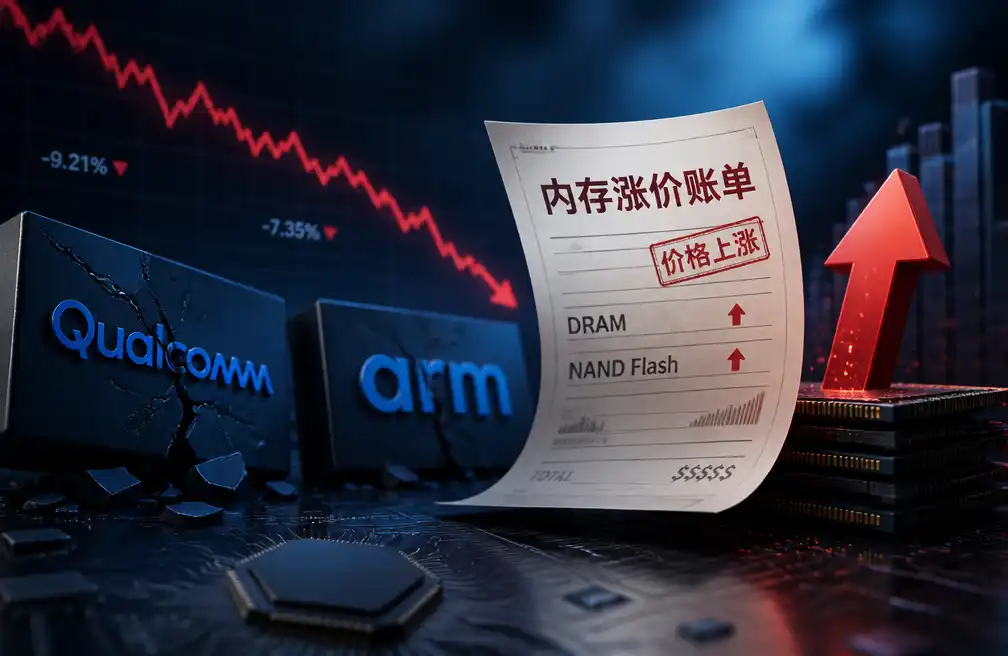
Qualcomm and Arm Fall Together: The Bill for Memory Price Hikes Finally Arrives at Mobile Chip Companies

After posting Q2 FY2026 results, Qualcomm and Arm both saw their shares decline, reflecting the impact of memory price increases on the smartphone chip sector. Qualcomm's revenue of $9.95B slightly beat expectations, but EPS of $2.21 fell short. More concerning was its guidance for next quarter, with EPS projections below analyst estimates. The company directly attributed a >$1.50 per share annual EPS headwind to rising memory costs and supply constraints in Android phones, prompting planned price hikes. While automotive revenue grew 61% and is approaching one-third of phone revenue, the mobile segment declined 20%. Qualcomm also confirmed a significant reduction in its modem share for the upcoming iPhone and outlined a plan for data center revenue to replace all Apple-related income by FY2027. Arm's results surpassed expectations with revenue of $1.29B and EPS of $0.45, and its guidance was also strong. However, its stock fell. Key concerns included royalty revenue failing to set a new record and a downward revision to full-year royalty growth guidance from ~20% to the high-teens, citing weak smartphone demand and high memory prices. Despite robust growth in its data center business, Arm's premium valuation (over 100x forward P/E) means even beating expectations isn't enough to push the stock higher, as any sign of uncertainty is magnified. Ongoing global antitrust investigations add another risk factor. The situation highlights a broader shift. Memory price surges, which boosted Samsung's profits, are now pressuring chip designers. Meanwhile, the semiconductor sector saw significant corrections in July, with the hardest-hit stocks often being those with the biggest AI-driven gains year-to-date. Qualcomm, lacking such a premium, was an exception.

marsbit33m ago

Qualcomm and Arm Fall Together: The Bill for Memory Price Hikes Finally Arrives at Mobile Chip Companies

marsbit33m ago

Trading

Spot

Hot Articles

What is $BITCOIN

DIGITAL GOLD ($BITCOIN): A Comprehensive Analysis Introduction to DIGITAL GOLD ($BITCOIN) DIGITAL GOLD ($BITCOIN) is a blockchain-based project operating on the Solana network, which aims to combine the characteristics of traditional precious metals with the innovation of decentralized technologies. While it shares a name with Bitcoin, often referred to as “digital gold” due to its perception as a store of value, DIGITAL GOLD is a separate token designed to create a unique ecosystem within the Web3 landscape. Its goal is to position itself as a viable alternative digital asset, although specifics regarding its applications and functionalities are still developing. What is DIGITAL GOLD ($BITCOIN)? DIGITAL GOLD ($BITCOIN) is a cryptocurrency token explicitly designed for use on the Solana blockchain. In contrast to Bitcoin, which provides a widely recognized value storage role, this token appears to focus on broader applications and characteristics. Notable aspects include: Blockchain Infrastructure: The token is built on the Solana blockchain, known for its capacity to handle high-speed and low-cost transactions. Supply Dynamics: DIGITAL GOLD has a maximum supply capped at 100 quadrillion tokens (100P $BITCOIN), although details regarding its circulating supply are currently undisclosed. Utility: While precise functionalities are not explicitly outlined, there are indications that the token could be utilized for various applications, potentially involving decentralized applications (dApps) or asset tokenization strategies. Who is the Creator of DIGITAL GOLD ($BITCOIN)? At present, the identity of the creators and development team behind DIGITAL GOLD ($BITCOIN) remains unknown. This situation is typical among many innovative projects within the blockchain space, particularly those aligning with decentralized finance and meme coin phenomena. While such anonymity may foster a community-driven culture, it intensifies concerns about governance and accountability. Who are the Investors of DIGITAL GOLD ($BITCOIN)? The available information indicates that DIGITAL GOLD ($BITCOIN) does not have any known institutional backers or prominent venture capital investments. The project seems to operate on a peer-to-peer model focused on community support and adoption rather than traditional funding routes. Its activity and liquidity are primarily situated on decentralized exchanges (DEXs), such as PumpSwap, rather than established centralized trading platforms, further highlighting its grassroots approach. How DIGITAL GOLD ($BITCOIN) Works The operational mechanics of DIGITAL GOLD ($BITCOIN) can be elaborated on based on its blockchain design and network attributes: Consensus Mechanism: By leveraging Solana’s unique proof-of-history (PoH) combined with a proof-of-stake (PoS) model, the project ensures efficient transaction validation contributing to the network's high performance. Tokenomics: While specific deflationary mechanisms have not been extensively detailed, the vast maximum token supply implies that it may cater to microtransactions or niche use cases that are still to be defined. Interoperability: There exists the potential for integration with Solana’s broader ecosystem, including various decentralized finance (DeFi) platforms. However, the details regarding specific integrations remain unspecified. Timeline of Key Events Here is a timeline that highlights significant milestones concerning DIGITAL GOLD ($BITCOIN): 2023: The initial deployment of the token occurs on the Solana blockchain, marked by its contract address. 2024: DIGITAL GOLD gains visibility as it becomes available for trading on decentralized exchanges like PumpSwap, allowing users to trade it against SOL. 2025: The project witnesses sporadic trading activity and potential interest in community-led engagements, although no noteworthy partnerships or technical advancements have been documented as of yet. Critical Analysis Strengths Scalability: The underlying Solana infrastructure supports high transaction volumes, which could enhance the utility of $BITCOIN in various transaction scenarios. Accessibility: The potential low trading price per token could attract retail investors, facilitating wider participation due to fractional ownership opportunities. Risks Lack of Transparency: The absence of publicly known backers, developers, or an audit process may yield skepticism regarding the project's sustainability and trustworthiness. Market Volatility: The trading activity is heavily reliant on speculative behavior, which can result in significant price volatility and uncertainty for investors. Conclusion DIGITAL GOLD ($BITCOIN) emerges as an intriguing yet ambiguous project within the rapidly evolving Solana ecosystem. While it attempts to leverage the “digital gold” narrative, its departure from Bitcoin's established role as a store of value underscores the need for a clearer differentiation of its intended utility and governance structure. Future acceptance and adoption will likely depend on addressing the current opacity and defining its operational and economic strategies more explicitly. Note: This report encompasses synthesised information available as of October 2023, and developments may have transpired beyond the research period.

1.1k Total ViewsPublished 2025.05.13Updated 2025.05.13

What is $BITCOIN

Discussions

Welcome to the HTX Community. Here, you can stay informed about the latest platform developments and gain access to professional market insights. Users' opinions on the price of BTC (BTC) are presented below.

活动图片