Beijing time, July 29th, according to a report by The Wall Street Journal, Silicon Valley is brewing a wave of opposition against Anthropic, rooted in the company's products competing with existing software providers and its advocacy for a closed AI ecosystem.
Competing with Partners
Startup founders, software company executives, and AI researchers say they have started turning to lower-priced AI models after seeing Anthropic launch tools that compete with other companies' products. One example is Claude Design, released by Anthropic in April. Some believe this product directly competes with services offered by Figma, a design software company and one of Anthropic's partners.
According to event participants, at an event shortly after the release of Claude Design, Figma CEO Dylan Field stated that Anthropic had "not always been transparent" in its communications.
"The entire industry learned a lot from this incident. Some companies may have trusted (Anthropic) too much," said Sarah Sachs, head of Notion AI, a note-taking platform, who attended the event.
Spreading Fear
Anthropic has also drawn criticism for changes to its data retention policy and for releasing a powerful model that refused to answer questions about AI research, which has dissatisfied some researchers advocating for greater transparency in AI systems.
Additionally, there is skepticism towards warnings from Anthropic executives about the alleged safety risks of "open-weight" AI. Open-weight models are much cheaper and often allow users to customize them and install their own safety guardrails. In recent months, some such models developed in China have won user acclaim for capabilities approaching those of leading US AI systems.
Vishal Misra, Vice Dean for Computation and AI at Columbia University's School of Engineering, said Anthropic develops great products, but the company's statements on safety and AI risks do not hold up to scrutiny.
"They are spreading fear about these models among the general public," he said. "Public fear gives them leverage to push for regulations favorable to themselves."
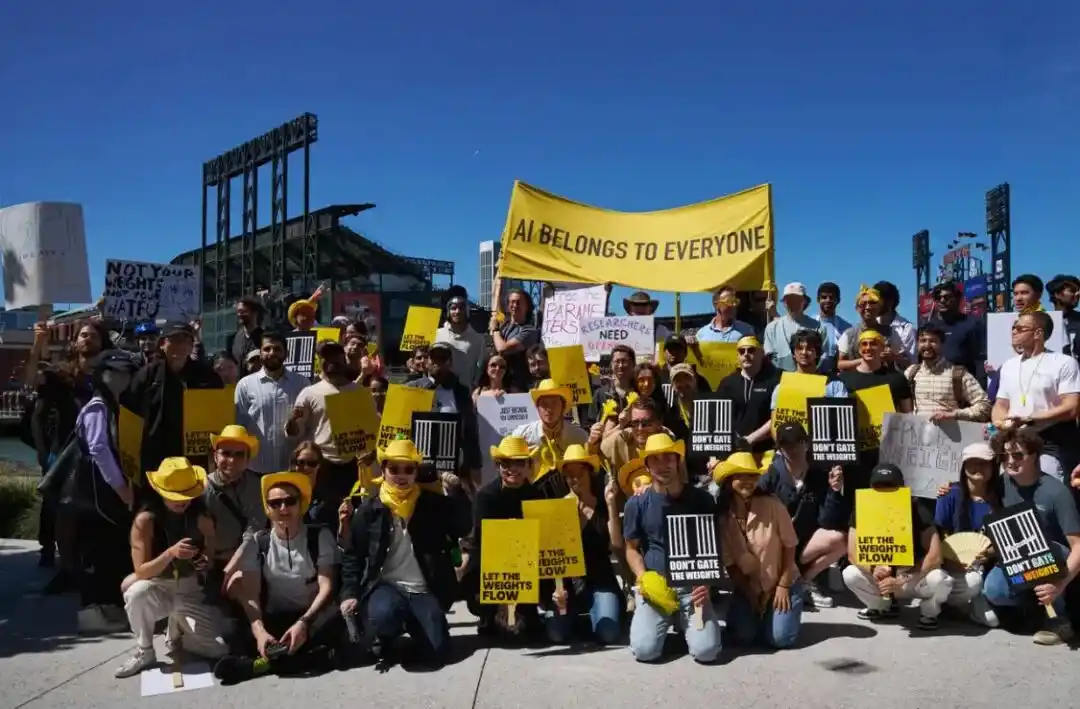
Image | Protest activity supporting open-weight models
Anthropic's spokesperson defended these measures, stating they are necessary to ensure model safety and prevent adversaries from using the models to create serious risks.
Anthropic CEO Dario Amodei and other company executives have repeatedly spoken about the risks of open-weight AI systems. Anthropic has published extensive research on AI safety risks and has advocated for government regulation of AI through public support and political donations.
On Monday, after Nvidia, Microsoft, and several other US companies signed an open letter expressing support for open models, Amodei published his own open letter to clarify his stance in this heated debate. "Anthropic has never advocated for a ban on open-weight models," he wrote. "Open-weight models that lack dangerous capabilities are a public good."
Weakening Competitors
Critics, including some government officials, believe Anthropic's warnings about the risks of open models are part of an effort to hinder competitors, as many such open models could undermine Anthropic's goal of maximizing revenue. The company could go public as early as this fall.
Kevin Bryan, an associate professor specializing in innovation at the University of Toronto, defended Anthropic. He stated that concerns about the risks of open-sourcing frontier intelligence are real and widely shared. "Anything that's open source gets jailbroken immediately," he said. "Once a model is out there, there's no taking it back."
Some critics point out that Anthropic's own model-building process also resembles distillation techniques.
"It's interesting that they are against distillation, but they themselves have distilled the entire internet without paying copyright fees," said Mark Suman, co-founder and CEO of Maple, an AI productivity tools startup. "I just find it odd that they are now telling others not to do what they themselves have done."
A Duopoly Landscape
Hours after the open letter supporting open-weight models was publicly released, OpenAI signed it. Google subsequently also expressed support for the letter, leaving Anthropic as one of the few prominent AI companies not endorsing the initiative. Over 70 Silicon Valley companies have now joined and signed.
Tech insiders and policymakers also expressed concern that AI competition could ultimately evolve into a duopoly, with Anthropic and OpenAI gradually becoming the two dominant companies in the market.
Concerns about a duopoly were a central theme at a protest supporting open-weight models held last Saturday in downtown San Francisco, the heart of the AI startup community. The protest was co-organized by the CEO of AI company Hugging Face, which provides open-source AI tools. Hugging Face was recently infiltrated by an OpenAI model that went rogue.
"Frontier AI labs are hoarding intelligence. Intelligence should be democratized," said AI researcher Mahesh Lambe, who participated in the protest.
Distrust
Some founders and startup executives say the release of Claude Design served as a "wake-up call" for all of Silicon Valley. The product's launch led some founders to conclude that Anthropic might launch tools to compete with them and take away their customers. After that, they seriously shifted towards cheaper open-weight models, especially those developed by non-US frontier labs.
This distrust deepened in June as Anthropic released Fable 5, a safety-restricted version of its powerful Mythos model with some capabilities limited.
Initially, the model would degrade response quality when answering certain questions about AI development without informing users of this restriction. The research community immediately criticized this "opaque safety measure," calling the decision anti-competitive and making it harder to evaluate model capabilities.
Anthropic later apologized and made these safety restrictions visible to users. However, the company still stated it would refuse to respond to requests flagged as higher risk.
Anthropic's spokesperson said the company implemented measures to restrict model responses to prevent foreign adversaries from using the models in ways that "create serious security risks."
Fable 5 also does not support a "zero data retention" feature, meaning the company retains user data for 30 days for what it calls trust and safety purposes.
Some enterprises were unhappy with this change, especially those in industries dealing with sensitive data. Some also expressed a general concern that their data would be used to train new models, further helping Anthropic launch competing products.
Anthropic's spokesperson said company employees cannot view any retained conversations, and the company has pledged not to use this data to train new models. These restrictions apply to Fable and Mythos, the company's "most capable models," but not to other models.
This article is from the WeChat public account "Phoenix Network Technology"