Is the AI Bull Market in Jeopardy? Philadelphia Semiconductor Index Breaks Below Key Support at 11,200 Points

marsbitPublished on 2026-07-30Last updated on 2026-07-30

Abstract

The Philadelphia Semiconductor Index (SOX) faces a critical technical and fundamental test. It recently breached a key short-term support level around 11,200 points—a level that held in mid-July—and closed below it. Technical indicators have deteriorated, with the 21-day moving average crossing below the 50-day, signaling bearish momentum. Should the 11,200 support fail, the next major support is the 200-day moving average. The sell-off, which saw memory chip stocks like Micron and Western Digital plunge over 10%, stems from growing concerns about the cyclicality and quality of AI demand. Market participants question the sustainability of the AI capital expenditure boom, highlighted by divergences between the capital expenditures of mega-cap tech firms and semiconductor index performance. However, some positive structural shifts are emerging. Institutional positioning has normalized, unwinding the previously crowded "long semiconductors, short Mag 7" trade, leaving cleaner positioning. Seasonal tailwinds are also approaching, as the NDX historically performs well after this period, potentially supporting a rebound if retail inflows resume. The core question is whether the SOX can hold the 11,200 support. A failure could trigger further declines toward the 200-day moving average, while a successful defense, combined with lighter positioning and seasonal support, could offer a recovery window for the sector.

The U.S. stock semiconductor sector stands at a dual crossroads of both technical and fundamental factors.

While the SOX Index teeters at a critical support level, multiple pressures including questions about the quality of AI demand have heightened market alertness regarding the next moves for tech stocks.

On Tuesday, July 28th, Eastern U.S. time, the SOX Index fell over 6.5% in early trading to drop below 10,800 points, hitting a fresh intraday low. Losses narrowed by the afternoon, with the index closing down approximately 4.5%. Memory chip stocks continued their heavy slide that day. SanDisk (SNDK) plunged over 10% intraday, while Micron (MU), SK Hynix ADR (SKHY), Western Digital (WDC), and Seagate Technology (STX) all saw declines exceeding 10%. Performance among AI chip giants was mixed, with AMD (AMD) also dropping over 10% intraday, while Nvidia (NVDA) fell nearly 2% in the morning before turning slightly positive.
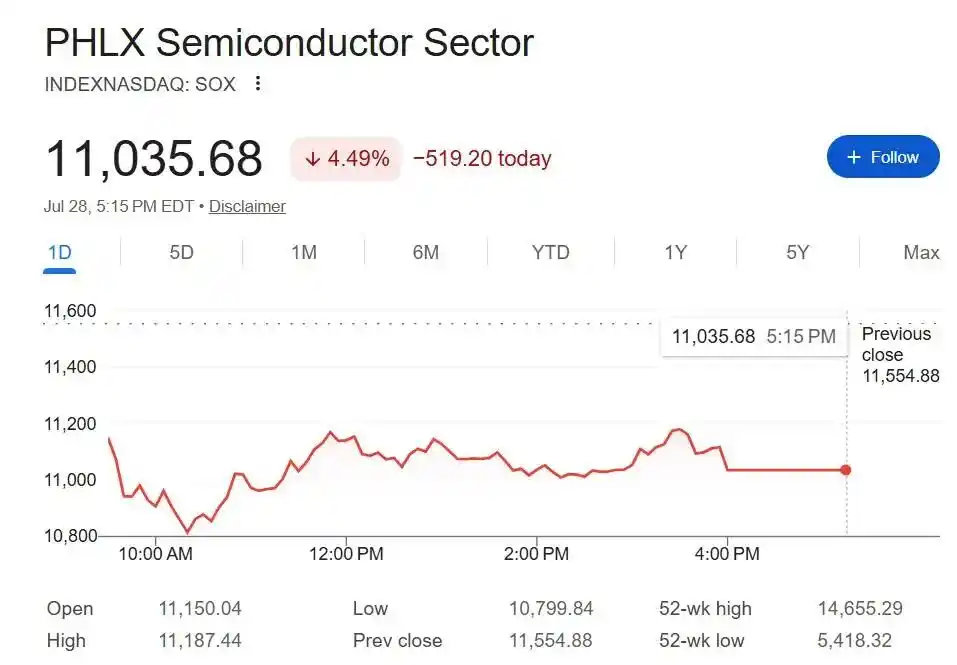
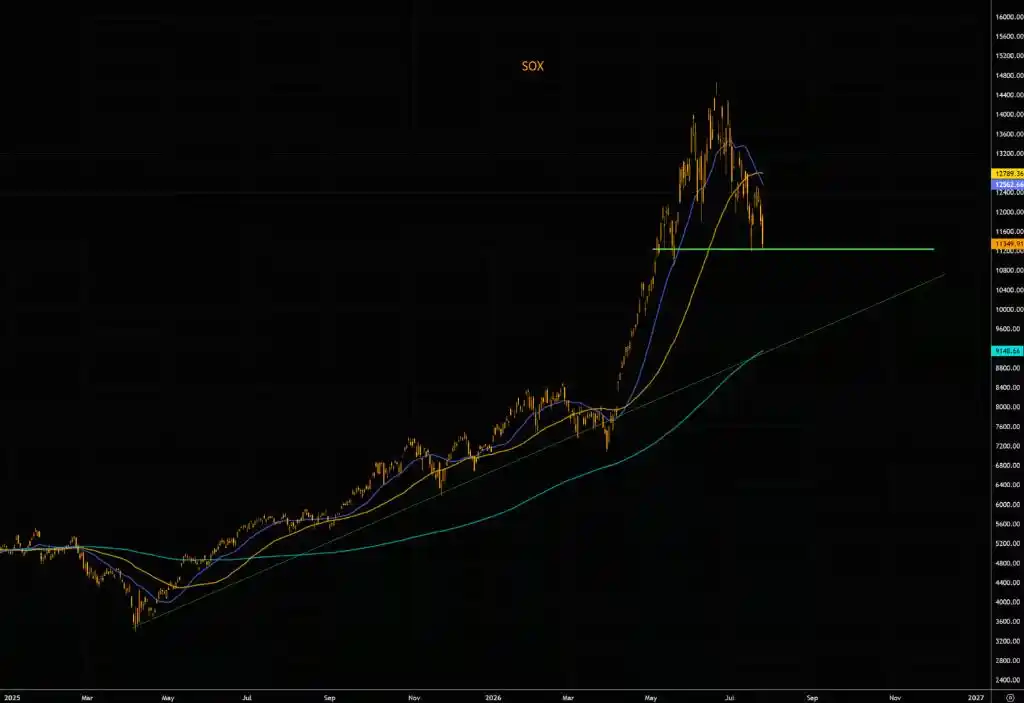
As chip stocks broadly continued to underperform the broader market, the SOX Index broke below the short-term key support near 11,200 points intraday and closed below this level. This level had successfully held during the sell-off on July 17th. However, technical indicators have continued to deteriorate since then—the 21-day moving average has crossed below the 50-day moving average, forming a short-term bearish signal. Concurrently, renewed concerns about the cyclicality of AI capital expenditures are weighing further on investor sentiment.
The semiconductor sector propelled global markets higher in the first half of this year, fueled by investor bets that it would be the primary beneficiary of the massive wave of AI spending. However, as many of these positions have been unwound, the sector has borne the brunt of the intense selling pressure in recent weeks.

Venu Krishna, Head of U.S. Equity Strategy at Barclays, commented: "Concerns around funding uncertainty, increased capital expenditures, and the free cash flow profiles of large tech companies have come into focus for the market."

Marija Veitmane, Head of Equity Research at State Street, described the sell-off as a "spiral." She noted, "The market is concerned about additional leverage and capex, and the sustainability of that spend. Negative momentum is building." However, she added, "Looking at the companies that have reported so far, demand is still incredibly strong... For us, this is a good opportunity to buy the dip."

From a market structure perspective, institutional positioning has normalized. The previously crowded 'long semiconductors, short Mag 7' trade has largely been cleared out, resulting in cleaner positioning. Seasonal factors are also turning favorable, as historically the NDX tends to perform strongly after the current point in time. However, technical fragility and fundamental uncertainty mean that whether this potential support can translate into a substantial rebound remains highly uncertain.

01 Critical Support Teetering, Technicals Continue to Deteriorate

The SOX Index is currently testing the significant short-term support level of 11,200 points. This level served as key support during the sharp sell-off on July 17th, but the technical picture has noticeably weakened since that rebound.

The 21-day moving average crossing below the 50-day moving average constitutes a short-term bearish signal.

More concerning, if the 11,200-point level is decisively breached, there is virtually no meaningful support until the 200-day moving average, which currently coincides with the longer-term uptrend line. This suggests the index could face significant downside risk if support fails.

02 Positioning Unwinding Coupled with Seasonal Support, Prerequisites for a Rebound Emerging

Despite technical pressure, some positive shifts are occurring in market structure.

According to Vanda data, institutional positioning has returned to normal levels, and retail participation has also cooled significantly compared to earlier this summer. The previously highly crowded "long semiconductors, short Mag 7" trade has been largely digested and unwound, resulting in a clearer overall positioning structure.
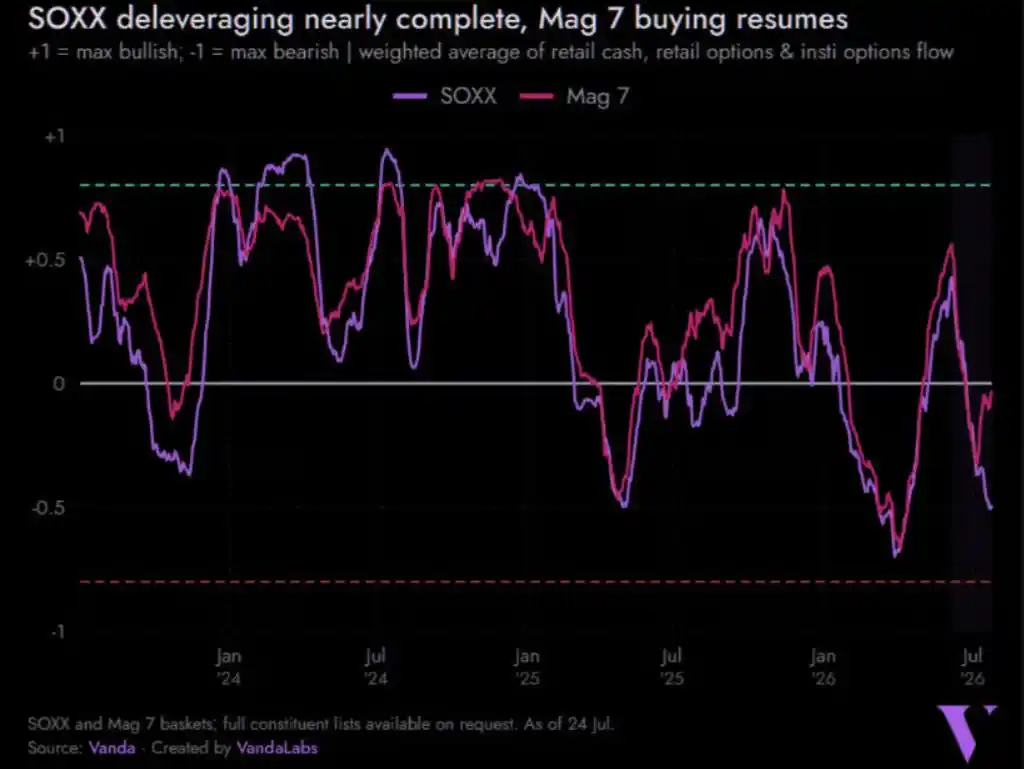
At the same time, seasonal factors are turning favorable. Historical data shows the NDX tends to perform well after this point in the calendar, with July often being a month prone to short squeezes. If seasonal inflows from retail capital begin to pick up in the coming weeks, the overall environment for tech stocks could gradually improve.

03 AI Demand Quality Questioned, Capital Cyclicality Raises Alarms

Technical fragility and fundamental uncertainty are reinforcing each other. According to Bloomberg, Nvidia's latest financing discussions and strategic investment moves have reignited market concerns about the cyclicality of the AI build-out cycle—namely, that capital is funding the customers buying AI hardware, creating a self-perpetuating financial loop.

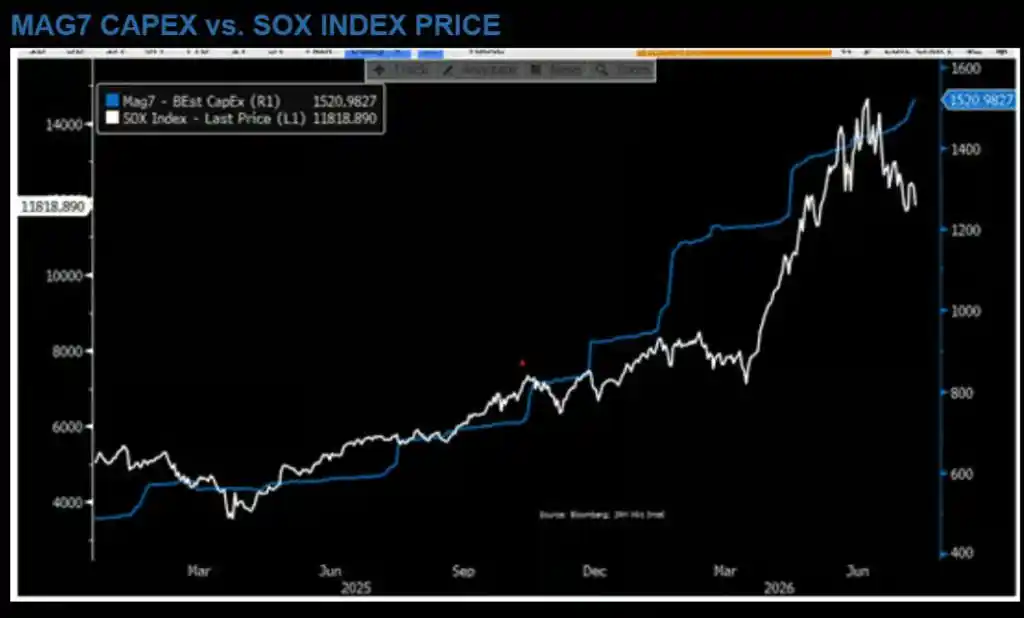
Concurrently, the performance of hyperscale cloud providers relative to the Nasdaq 100 Index has significantly lagged. According to Goldman Sachs data, this relative weakness has reached historically extreme levels. Data from Bloomberg and JPMorgan also show that the short-term divergence between Mag 7 capital expenditures and the SOX Index has widened to an abnormal degree. This growing gap is raising more questions about the sustainability of demand for AI hardware.
04 South Korea's KOSPI Rally Sparks Historical Comparisons, but Fundamental Support Differs

In surrounding markets, the strong rally in the KOSPI has raised caution among some market participants.

A key distinction is that the current rally has a firmer earnings foundation—the recovery in the memory cycle provides substantive performance support for South Korean tech companies.

However, if market sentiment runs too far ahead of fundamentals, the risks highlighted by historical experience should not be ignored.

05 Multiple Variables Intertwined, Whether SOX Holds Support is Key

In summary, the semiconductor sector currently faces a complex situation with mixed signals: weakening technicals, questions over AI demand quality, and accelerated Chinese competition coexist with positioning unwinding, seasonal support, and potential attractiveness after valuation corrections.

Regarding tech volatility, while the VXN/VIX ratio has retreated from recent highs, it remains in a range indicating elevated pressure on tech stocks.

The core variable in the current situation is whether the SOX can hold the 11,200-point support. If this level is lost, the next meaningful support will be the 200-day moving average. If it holds and stabilizes, seasonal capital inflows and the leaner structure following the positioning unwinding could provide a window for tech stocks to recover.

This article does not constitute personal investment advice and does not represent the platform's views. The market carries risks; investment requires caution. Please make independent judgments and decisions.

This article is from the WeChat public account "Wall Street Insights Max," by authors: Bu Shuqing and Li Dan.


Related Questions

QWhat is the current situation with the Philadelphia Semiconductor Index (SOX) in terms of a key technical support level?

AThe SOX index has breached and closed below a key short-term technical support level near 11,200 points, a level that previously held during the sell-off on July 17.

QWhich specific companies in the semiconductor sector were mentioned as being hit particularly hard in the recent sell-off?

AStorage chip stocks were severely hit: SanDisk (SNDK) fell over 10% intraday, while Micron (MU), SK Hynix ADR (SKHY), Western Digital (WDC), and Seagate Technology (STX) all saw declines exceeding 10% at one point. AMD also dropped over 10% intraday.

QAccording to the article, what are two main concerns from a fundamental perspective that are pressuring the semiconductor/AI sector?

AThe two main fundamental concerns are: 1) Questions about the quality and sustainability of AI hardware demand, and 2) Renewed worries about the cyclicality of the AI capital expenditure cycle, fueled by news of Nvidia's financing discussions which suggest a potential self-funding loop for AI hardware purchases.

QWhat positive factors does the article mention that could potentially support a rebound in the sector?

AThe article mentions two potential positive factors for a rebound: 1) Market positioning has become cleaner as the crowded 'long semiconductors, short Mag 7' trade has largely been unwound, and 2) Seasonal factors are turning favorable, with historical data showing the NDX often performs strongly after this point, and July is typically a month prone to short squeezes.

QWhat is identified as the critical variable for the near-term direction of the semiconductor sector?

AThe critical variable is whether the SOX index can hold the 11,200-point support level. If it fails, the next meaningful support is the 200-day moving average. If it holds and stabilizes, seasonal fund inflows and the cleaner market structure could provide a window for recovery.

Related Reads

Low Investment Isn't Apple's Immunity Pass

While Meta and Google face investor scrutiny over ballooning AI capital expenditures, Apple's minimal AI investment has paradoxically become a strength. Its market cap recently reclaimed the global top spot, surpassing $5 trillion. The irony is deep: Apple's own AI efforts have lagged, with "Apple Intelligence" delayed and core talent lost, forcing reliance on partners like Google Gemini and Alibaba's Qianwen. Its Q3 FY2026 (Q2 CY) earnings initially seemed stellar. Revenue hit $109.4B (up 16% YoY), with iPhone and Mac sales, growing 22% and 29% respectively, driving most of the growth. However, the stock fell over 8% post-earnings. The primary concern was a weaker Q4 revenue growth forecast of 9-11%, below expectations, due to looming supply chain constraints. Apple is feeling the indirect cost of the AI boom. Soaring memory and chip prices, fueled by massive data center investments from Microsoft, Amazon, and others, are forcing Apple to raise Mac and iPad prices significantly. The upcoming iPhone launch is also expected to see substantial price hikes. Despite avoiding heavy AI infrastructure spending—its capital expenditures are actually down 28%—Apple cannot escape the industry-wide supply and cost pressures. While Apple's operating cash flow remains robust, its substantial R&D spending (up 32% YoY) has yet to yield major AI breakthroughs. As Tim Cook prepares to step down as CEO, Apple faces a challenging transition: balancing its premium hardware success against the strategic and cost pressures of the AI era it has so far cautiously navigated.

marsbit13m ago

Low Investment Isn't Apple's Immunity Pass

marsbit13m ago

PA Graphics Explanation | One Chart to Understand the Major Web3 Events in August 2026

**PANews Crypto Calendar: Key Web3 Events in August 2026** PANews introduces its revamped crypto calendar, featuring comprehensive coverage, flexible filtering, and easy export options. The market in August will be shaped by multiple key events across macroeconomics, regulation, tokenomics, and project developments: * **Macro & Policy:** Key US economic data releases (July Non-Farm Payrolls, CPI), the Federal Reserve meeting minutes, and the Jackson Hole Economic Symposium will be in focus. On the regulatory front, the US Senate plans to release a new draft of the *CLARITY Act*, while the EU's expanded crypto ban against Belarus comes into effect. * **Token Unlocks:** Significant token unlocks are scheduled for assets including ENA, AVAX, CONX, ZRO, and KAITO, which may influence market volatility. * **Project Updates & Shutdowns:** Several services, including Exchange Art, Ctrl Wallet, Zapper, NFTfi, and Summer.fi, are set to cease operations or undergo major adjustments. Users are advised to manage their assets accordingly. * **Corporate Activity:** Q2 earnings reports from companies like SpaceX, Circle, and Nvidia are due. Unitree Robotics will initiate its IPO subscription on the STAR Market, and Moonshot AI plans to begin a Pre-IPO financing round. * **Industry Events:** Major conferences such as Bitcoin Asia 2026 and the 2026 Digital Expo will take place. The overarching market narrative for August will revolve around macroeconomic expectations, regulatory developments, token unlock schedules, and ongoing industry consolidation.

marsbit23m ago

PA Graphics Explanation | One Chart to Understand the Major Web3 Events in August 2026

marsbit23m ago

Wall Street's Most Famous 'Cassandra' Now Has His Sights Set on Nvidia

Michael Burry, the famed "Big Short" investor, has once again captured Wall Street's attention with a series of short positions against major tech and semiconductor stocks, most notably Nvidia. In late June and July, through his "Cassandra Unchained" newsletter, Burry disclosed short bets against Nvidia, Tesla, Applied Materials, Caterpillar, the SOXX semiconductor ETF, and later, Micron Technology. His core thesis revolves around potential distortions in the AI infrastructure boom, specifically questioning whether extended depreciation schedules (e.g., 6 years vs. a realistic 2-3 years for AI chips) by cloud giants like Microsoft and Google artificially inflate profits. He also raises concerns about possible "off-balance-sheet circular financing," where chip demand might be propped up by vendor-backed funding to clients. Nvidia's stock experienced volatility following these disclosures, briefly dipping but largely holding near Burry's reported entry points, leaving his positions roughly flat or slightly underwater as of late July. This move is part of a pattern for Burry, whose track record since his legendary 2008 bet is mixed. He has faced notable losses, such as on Tesla in 2021, while scoring on broader market turns like the 2020 pandemic crash. His methodology focuses intensely on free cash flow and scrutinizing original financial documents to spot overvaluation and structural risks, but it often struggles with timing the market. The article contrasts Burry's stance with other prominent investors. Steve Eisman, another "Big Short" figure, is not shorting Nvidia, citing strong fundamentals but expressing nervousness about sustainability. Jim Chanos agrees with the broad "accounting mismatch" concern—comparing it to the dot-com bubble—but targets financial leverage in private equity firms rather than the chip stocks themselves. While Nvidia's short interest remains relatively low at 1.3-1.4% of float, the massive stock size means absolute short losses have been significant, exceeding $5 billion earlier this year. The piece concludes that for ordinary investors, the key takeaway is not replicating specific short bets but learning from the critical frameworks these investors use: questioning rosy accounting, identifying structural vulnerabilities, and maintaining skepticism during market euphoria, even if pinpointing the exact catalyst for a downturn remains elusive.

marsbit48m ago

Wall Street's Most Famous 'Cassandra' Now Has His Sights Set on Nvidia

marsbit48m ago

Weekly Selection丨Epic Stock Market Volatility, Changxin Tech's IPO Reshapes Storage Landscape, Saylor Aims to Re-Anchor STRC Around September 8th

PANews Weekly Digest: Market Turmoil, Tech Breakthroughs, and Crypto Developments. The week saw significant volatility across global markets. South Korea's KOSPI index experienced extreme turbulence, including multiple trading halts, largely driven by sharp declines in AI hardware stocks like SK Hynix. In contrast, China's Changxin Xinqiao (CXC) achieved a landmark IPO with a market cap surpassing 4 trillion yuan, marking a major success for the domestic DRAM industry after a decade of losses. In the crypto and Web3 space, several key narratives emerged. AI is driving demand for new infrastructure, with projects like AI agent wallets and programmable payments gaining traction, attracting interest from firms like Coinbase. The Bitcoin mining sector is pivoting, with companies like MARA focusing on energy management as electricity becomes a core AI-era asset. Meanwhile, the RWA (Real World Assets) sector faces a "utilization puzzle," with hundreds of billions in on-chain assets remaining dormant. Notable market movements included a historic single-day surge of over 17% for the KOSPI index and a significant migration of $16.5 billion in staked ETH within the Lido ecosystem. Michael Saylor announced a target to re-peg the STRC stablecoin around September 8th. Other highlights include discussions on Ethereum's ambitious 2030 roadmap for scaling and privacy, analysis showing high protocol revenues not always translating to token price gains, and warnings from Citi about potential extreme commodity price shocks by late 2026.

marsbit54m ago

Weekly Selection丨Epic Stock Market Volatility, Changxin Tech's IPO Reshapes Storage Landscape, Saylor Aims to Re-Anchor STRC Around September 8th

marsbit54m ago

When the Market Begins to Question AI Capex: A Full Analysis of Q2 Earnings Reports from Five Tech Giants

In late July 2026, five major US tech giants—Alphabet, Intel, Microsoft, Meta, and Apple—released their Q2 earnings reports. While all companies exceeded revenue and profit expectations, driven by strong AI-related business growth, investor reactions diverged sharply due to concerns over escalating AI capital expenditures (capex) and their impact on free cash flow. Alphabet reported strong revenue growth and a surging cloud business, but its stock fell after announcing a doubled year-on-year capex and negative quarterly free cash flow for the first time. Intel posted its strongest revenue growth in over 15 years, but its stock experienced volatile trading after significantly raising its full-year capex guidance. Microsoft saw its stock surge after beating estimates and, crucially, lowering its capex forecast while projecting positive free cash flow. Meta faced the most severe sell-off as its profits declined despite revenue beats, with free cash flow plunging over 90% and its capex guidance raised. Apple reported record June-quarter results, but its stock plummeted after providing Q4 revenue guidance that fell short of expectations, citing supply chain constraints and forex headwinds. The overall takeaway is that the market's focus has shifted from validating AI demand to scrutinizing the timeline for returns on massive AI investments. Companies demonstrating a clearer path to managing capex and preserving free cash flow, like Microsoft, were rewarded, while those signaling continued aggressive spending faced investor skepticism.

Odaily星球日报1h ago

When the Market Begins to Question AI Capex: A Full Analysis of Q2 Earnings Reports from Five Tech Giants

Odaily星球日报1h ago

Trading

Spot
活动图片