Bitcoin rallies fail at $94K despite Fed policy shift: Here’s why

cointelegraphPublished on 2025-12-11Last updated on 2025-12-11

Abstract

Bitcoin's price struggled to break above $94,000 despite a 0.25% interest rate cut by the Federal Reserve, remaining near $90,000 due to weak bullish momentum. Analysts attribute the stagnation to a significant decline in liquidity, particularly from stablecoins, with ERC-20 stablecoin inflows dropping nearly 50% since August. This reduction in buying power means recent rebounds are driven by reduced sell pressure rather than strong accumulation. Key resistance lies between $94,000 and $98,000, but repeated rejections at $93,000 signal exhaustion. A break below $88,000 could trigger a bearish structure, potentially pushing BTC toward $84,000 or even $80,600. Bulls need a weekly close above $90,000–$93,000 to regain momentum.

Bitcoin’s (BTC) price action remained underwhelming this week after another failed attempt to reclaim the monthly volume-weighted average price (VWAP), with BTC consolidating near $90,000 following the Federal Reserve’s 0.25% interest rate cut. The market continued to reject any meaningful push above $93,000, thereby limiting bullish momentum.

Key takeaways:

  • One Bitcoin analyst said that liquidity contraction is suppressing Bitcoin’s upside, reducing demand relative to sell pressure.

  • $94,000 to $98,000 remained the critical liquidity pocket, but BTC must avoid forming a bearish break of structure below $88,000.
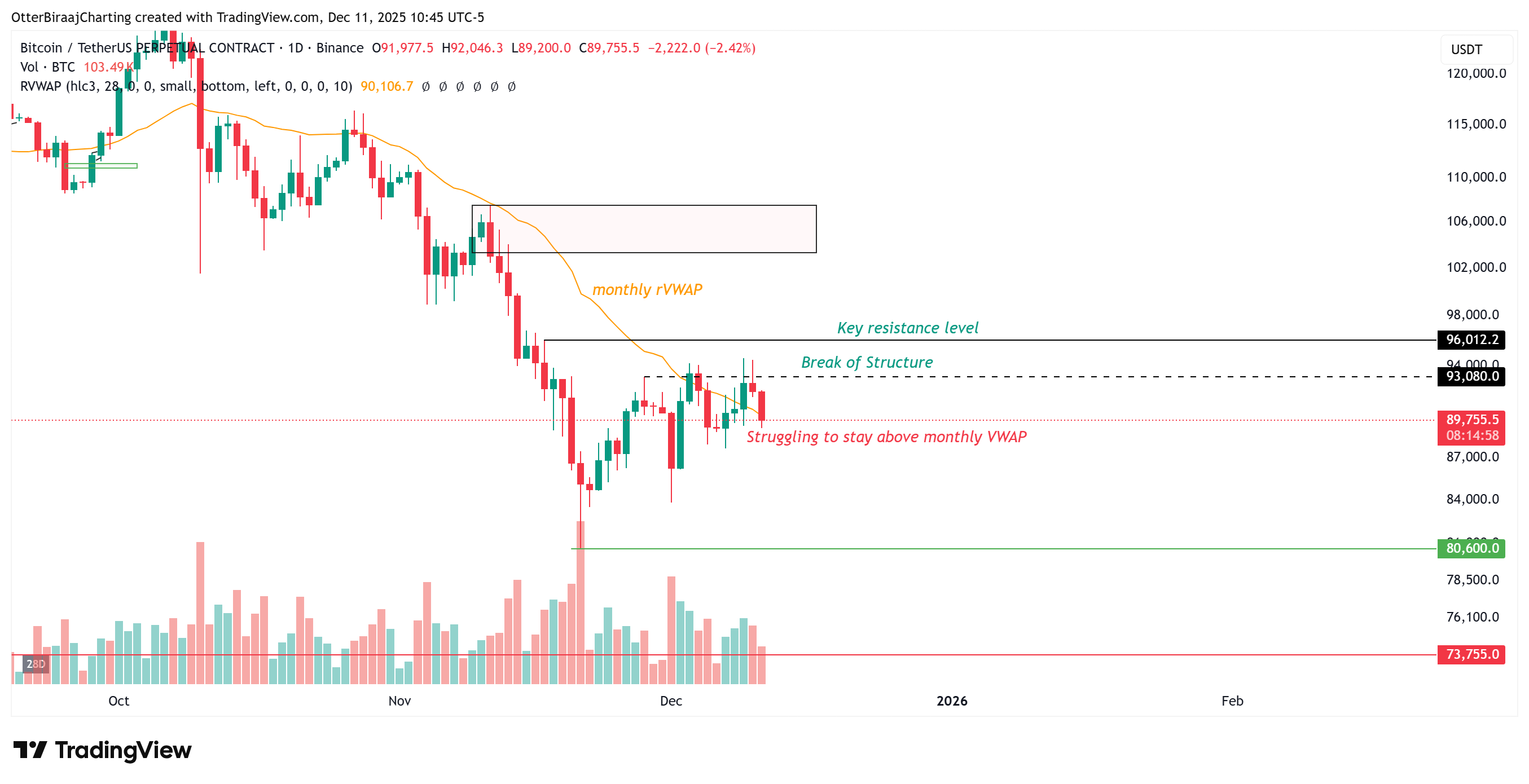
Bitcoin one-day chart. Source: Cointelegraph/TradingView

Liquidity compression dictates Bitcoin’s market behavior

According to crypto analyst Darkfost, Bitcoin’s struggle has little to do with sentiment swings and more to do with declining liquidity, specifically from stablecoins. Stablecoin inflows onto exchanges offer one of the most reliable signals of incoming capital, and right now that signal is flashing red.
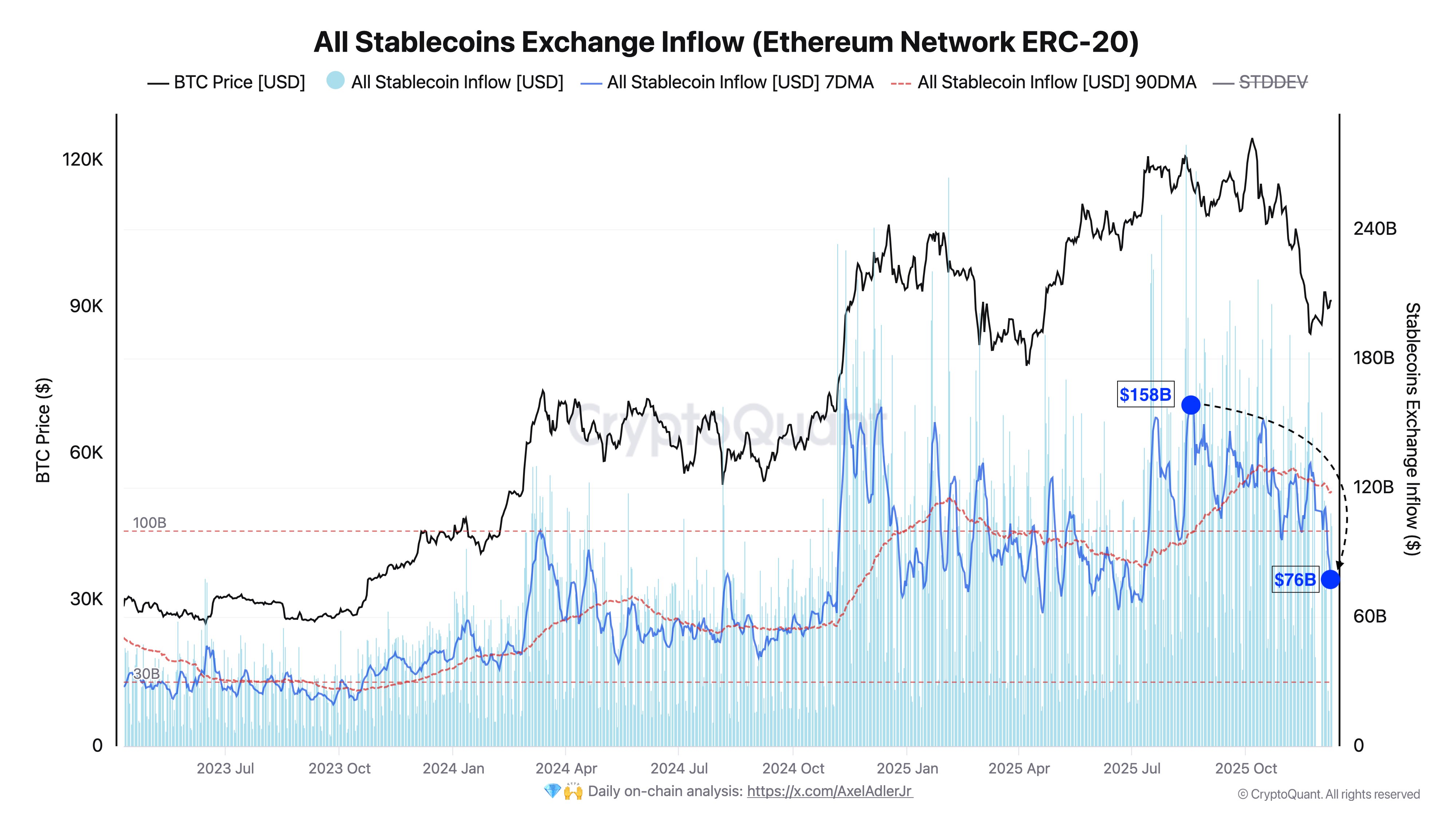
Stablecoin exchange inflows. Source: CryptoQuant

The data showed a significant liquidity contraction: ERC-20 stablecoin inflows have declined from $158 billion in August to approximately $76 billion this month, representing a nearly 50% drop. Even the longer-term 90-day average has slipped from $130 billion to $118 billion, confirming that the trend is not temporary but structurally deteriorating.

This decline translated directly into weaker buying power. Darkfost noted that recent rebounds are not driven by strong accumulation but by periods of reduced sell pressure, meaning the market lacks the inflows needed to sustain higher highs or defend key support levels. Until fresh liquidity returns, Bitcoin’s rallies are likely to remain shallow.

Meanwhile, trader DaanCrypto added that the broader liquidity map still indicated the $97,000–$98,000 region as the next significant magnet for price. But BTC has repeatedly failed to break $94,000, the first barrier that must be overtaken for volatility expansion.

Without that confirmation, the market remains vulnerable to sharp range reversions that continue to trap both longs and shorts.
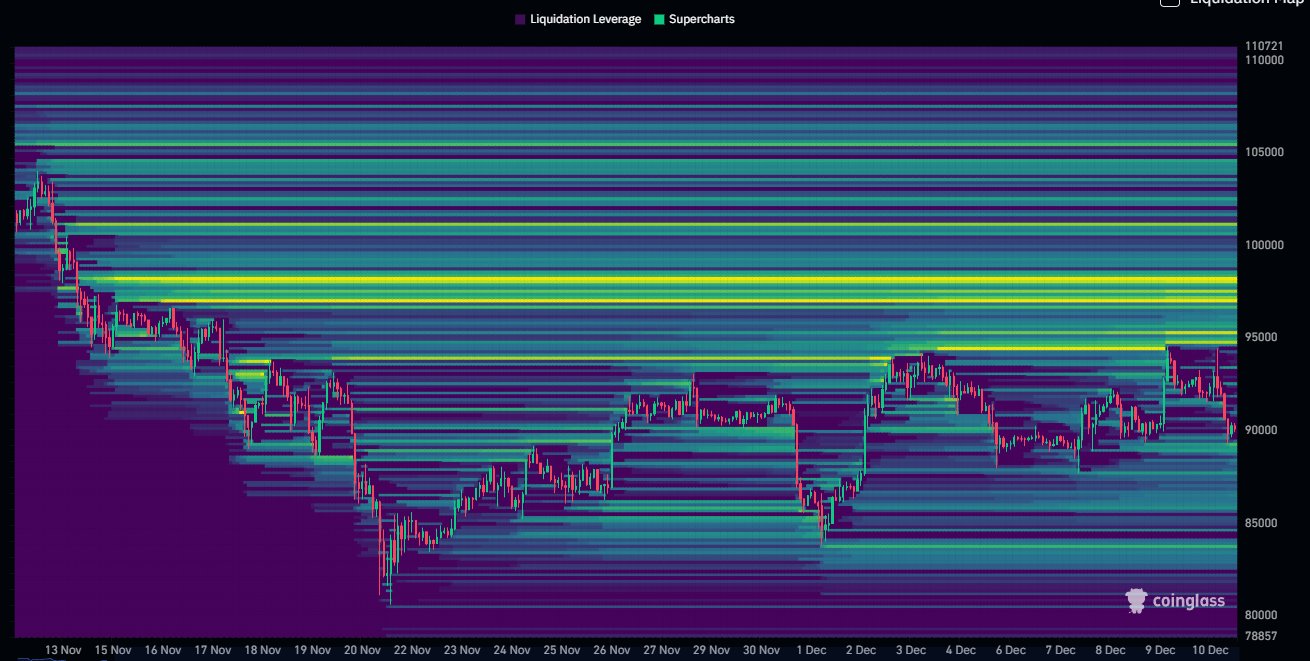
Bitcoin liquidation analysis by Daan. Source: X

Related: Prediction markets bet Bitcoin won’t reach $100K before year’s end

BTC nears key breakdown threshold near $90,000

From a structural standpoint, Bitcoin has now failed three consecutive attempts to break the $93,000 level. The latest rejection formed a clean swing failure pattern (SFP) after the FOMC meeting, signaling exhaustion and reinforcing the weakness in trend continuation.
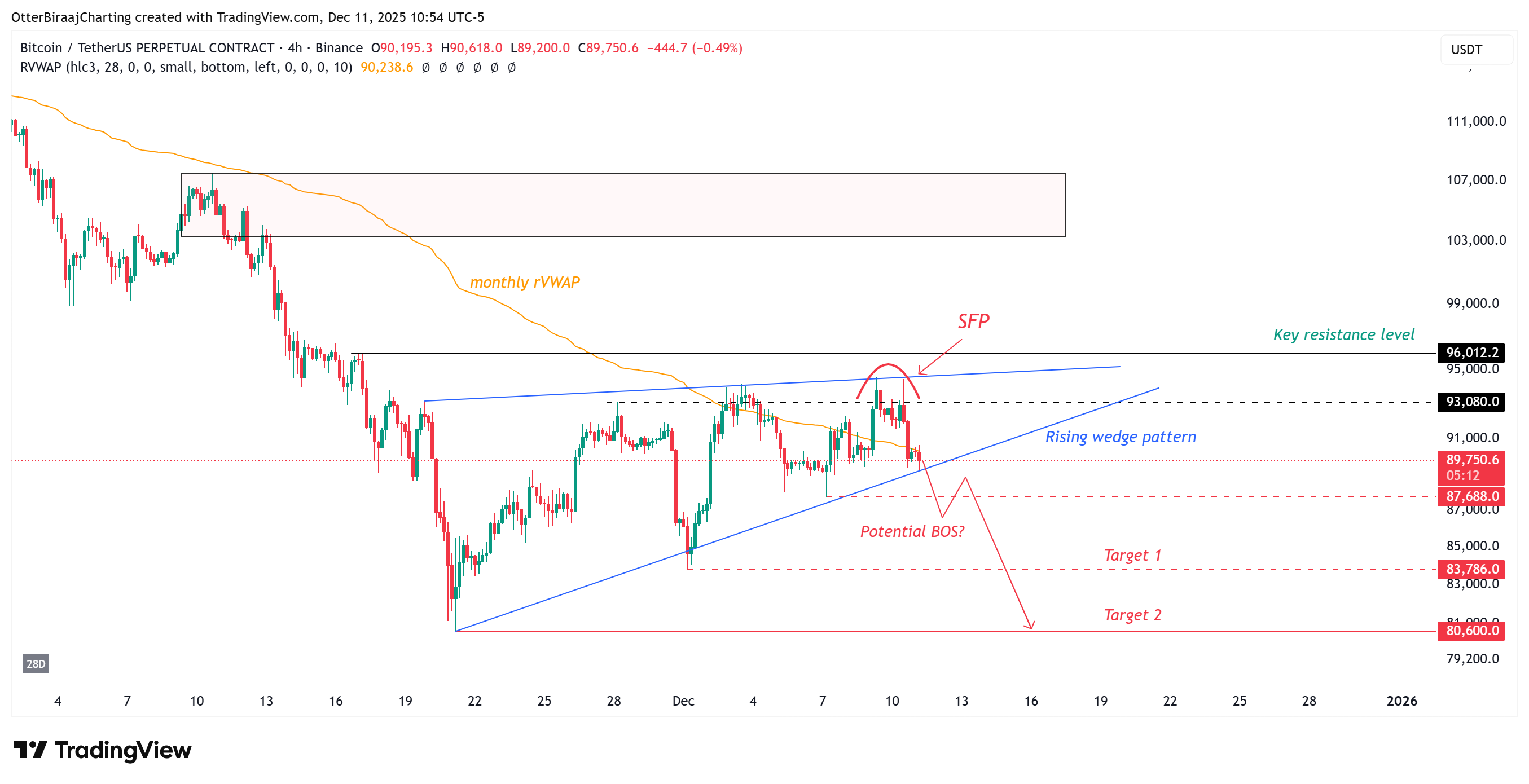
Bitcoin one-hour chart analysis. Source: Cointelegraph/TradingView

BTC is also nearing confirmation of a bearish rising wedge, which becomes active if the price falls below $88,000 and forms a bearish break of structure (BOS). A breakdown would expose an external liquidity sweep around $84,000, with deeper downside potential toward the $80,600 quarterly lows, a level that aligns with prior inefficiencies on higher-timeframe charts.

Still, bullish traders such as Captain Fabik maintained that BTC is undergoing deliberate shakeouts designed to remove weak hands. For a bullish reclaim, BTC must secure a weekly close above $90,000 and ideally near $93,000, giving bulls the structural foundation required to attack the $96,000 breakout zone, where a momentum expansion could finally unfold.
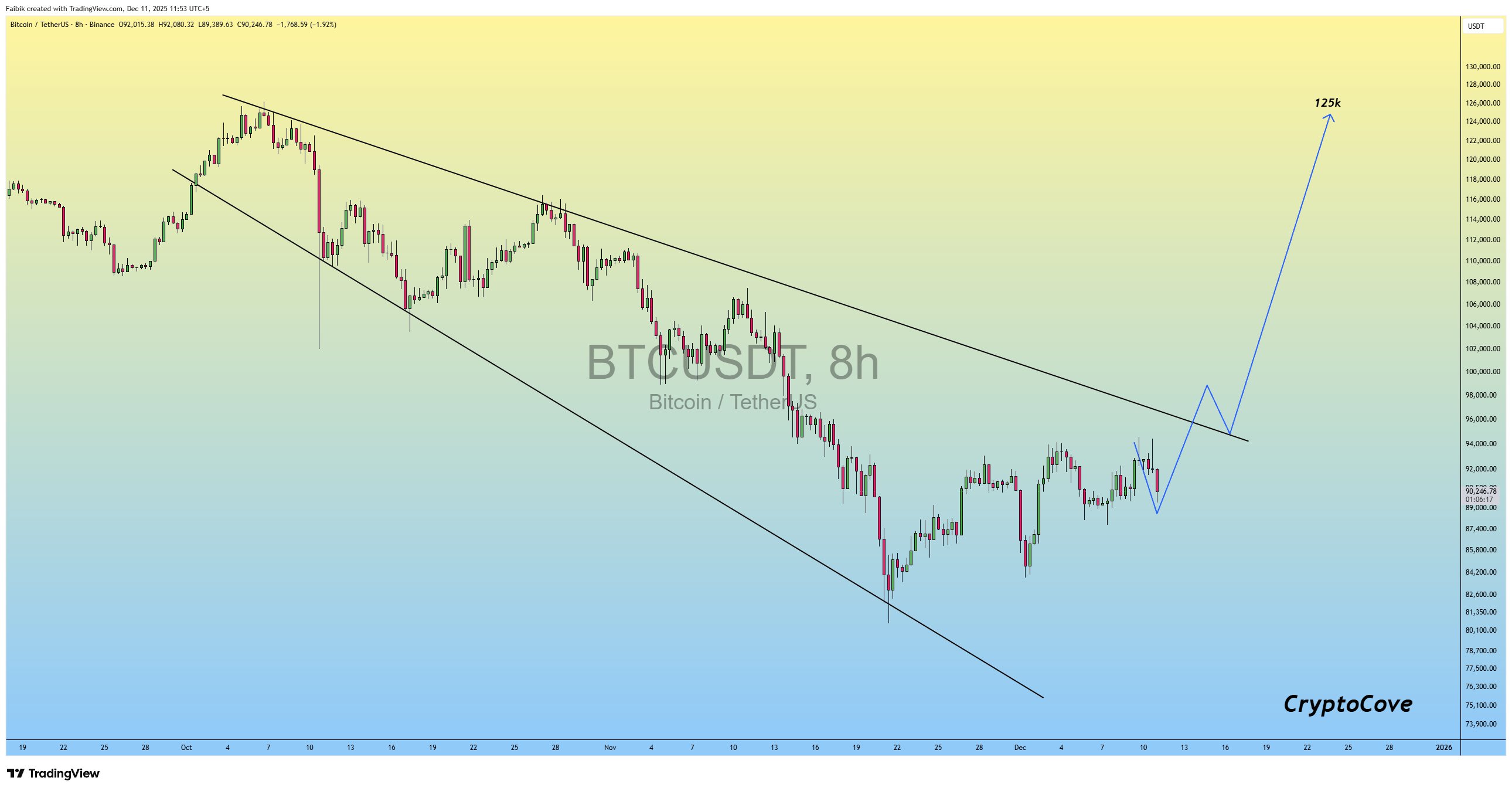
BTC 1-day analysis by Captain Fabik.

Related: Bitcoin due 2026 bottom as exchange volumes grind lower: Analysis

This article does not contain investment advice or recommendations. Every investment and trading move involves risk, and readers should conduct their own research when making a decision. While we strive to provide accurate and timely information, Cointelegraph does not guarantee the accuracy, completeness, or reliability of any information in this article. This article may contain forward-looking statements that are subject to risks and uncertainties. Cointelegraph will not be liable for any loss or damage arising from your reliance on this information.


Trending Cryptos

Related Reads

NVIDIA CPU Advances, China's RISC-V Responds: Semiconductor Deep Dive - Part Four

NVIDIA is set to launch its new Vera AI data center CPU in China as early as August, with high pricing. While this move offers a new option, it highlights China's continued dependence on foreign-controlled Arm architecture. In response, the Chinese semiconductor industry is increasingly turning to RISC-V as a strategic alternative for achieving high-performance computing autonomy. The article explores the concept of the "impossible triangle" in CPU development—balancing prosperity, control, and autonomy—and posits that RISC-V's open-source, modular nature offers a unique path to achieving all three. While RISC-V is already dominant in embedded systems, the focus is now shifting to data centers and AI workloads. China has become a global hotspot for RISC-V development, driven by AI-driven compute demand, supply chain concerns from export controls, cost benefits of open-source, and strong policy support. Multiple Chinese companies have reportedly crossed the key performance threshold of 15 SPECint per GHz, a benchmark for entering the high-performance CPU club. Progress extends beyond single-core benchmarks. Companies are developing complete computing subsystems, including commercial-grade coherent network-on-chip (NoC) technology and server processors with up to 40 cores that strictly adhere to the RVA23 standard to ensure software compatibility. Real-world applications are emerging in areas like video transcoding and edge AI. However, significant challenges remain. The RISC-V ecosystem faces fragmentation, immature toolchains and verification processes, and gaps in single-core performance and energy efficiency compared to mature x86 and Arm architectures. The formidable software moat, epitomized by NVIDIA's CUDA, is a long-term hurdle. In conclusion, while RISC-V cannot immediately replace offerings like NVIDIA's Vera, it represents a viable long-term path for China to develop a self-sufficient, high-performance CPU ecosystem. The journey is acknowledged to be long and arduous, requiring sustained effort to overcome technical and ecosystem challenges.

marsbit4h ago

NVIDIA CPU Advances, China's RISC-V Responds: Semiconductor Deep Dive - Part Four

marsbit4h ago

My Coding Betting Dashboard is Profiting, but Polymarket is Truly Not a Good Place for 'Arbitrage'

The author built a custom monitoring dashboard for Polymarket, a prediction market platform, and tested it with $1,600, achieving over 30% returns. However, the core argument is that Polymarket is not a good venue for traditional arbitrage. The dashboard has two main sections: a "Portfolio Dashboard" for tracking active positions with key metrics like total capital, P&L, and a risk-control module using a tier system (T1, T2, T3), and an "Opportunity Watchlist" for monitoring markets. The article details a critical structural trap in binary markets: a bet with a high perceived probability of success still carries a 100% loss risk if wrong. The author's T1/T2/T3 system is designed to manage this by limiting position sizes based on conviction and time horizon, emphasizing that high confidence should not equal high concentration. A key insight is the danger of "pseudo-diversification"—betting on different markets driven by the same underlying variable. The author concludes that Polymarket offers few true low-risk, arbitrage opportunities. It is instead a high-risk environment where wins can create a false sense of mastery, leading to large losses. The platform is better viewed as a training ground for honing judgment through disciplined, framework-driven betting rather than a reliable income source. The tools help transform intuition into structured, rule-based decisions to mitigate the risk of catastrophic errors.

marsbit7h ago

My Coding Betting Dashboard is Profiting, but Polymarket is Truly Not a Good Place for 'Arbitrage'

marsbit7h ago

WeChat AI Card Hands-On Guide: Has the AI Shopping Era Arrived?

**"WeChat AI Card" Practical Test Guide: Has the Era of AI Shopping Arrived?** WeChat has officially launched the "AI Exclusive Card," a feature integrated into its Workbuddy AI assistant. This card is designed to handle payments for AI-initiated purchases. Our hands-on test reveals it's not yet a tool for fully autonomous AI shopping, but rather a controlled payment layer for AI agents. The AI Card functions as an isolated sub-wallet within WeChat Pay. Users must bind the card and transfer funds into it from their main wallet. Crucially, every transaction requires explicit user confirmation via smartphone scan; AI cannot spend autonomously. Currently accessible through the Workbuddy agent, the card targets specific digital consumption scenarios: purchasing paid content (reports, data), calling paid APIs/tools, and subscribing to services. Its design prioritizes security and control by separating funds and mandating approval for each payment. We tested a real-world scenario: ordering bubble tea via Workbuddy using a "Meituan Life Assistant" skill. The process encountered multiple hurdles: high "skill" usage costs (exceeding daily free credits), and most importantly, while a payment was successfully initiated, the AI purchased an incorrect product (a mismatched group-buy coupon instead of the desired drink). This highlights the current limitation: the **AI Card only solves the payment step**. The broader challenge lies in the **AI agent's execution chain**—accurately understanding intent, navigating third-party platforms, selecting the right product, and ensuring proper fulfillment. The payment succeeded, but the purchase failed to meet the user's need. In conclusion, the WeChat AI Exclusive Card is a cautious, early-step experiment in AI commerce. It provides a secure, user-controlled payment method for agent interactions but is not yet capable of reliable, end-to-end complex purchases. For now, it's best used for low-value, low-risk digital services with careful user verification at each step. The vision of AI handling complete shopping tasks remains a work in progress.

marsbit9h ago

WeChat AI Card Hands-On Guide: Has the AI Shopping Era Arrived?

marsbit9h ago

Trading

Spot
Futures

Hot Articles

Discussions

Welcome to the HTX Community. Here, you can stay informed about the latest platform developments and gain access to professional market insights. Users' opinions on the price of S (S) are presented below.

活动图片