By | Wan Dian Research
Athena's owl takes flight at dusk, while Nolan's camera roars at noon.
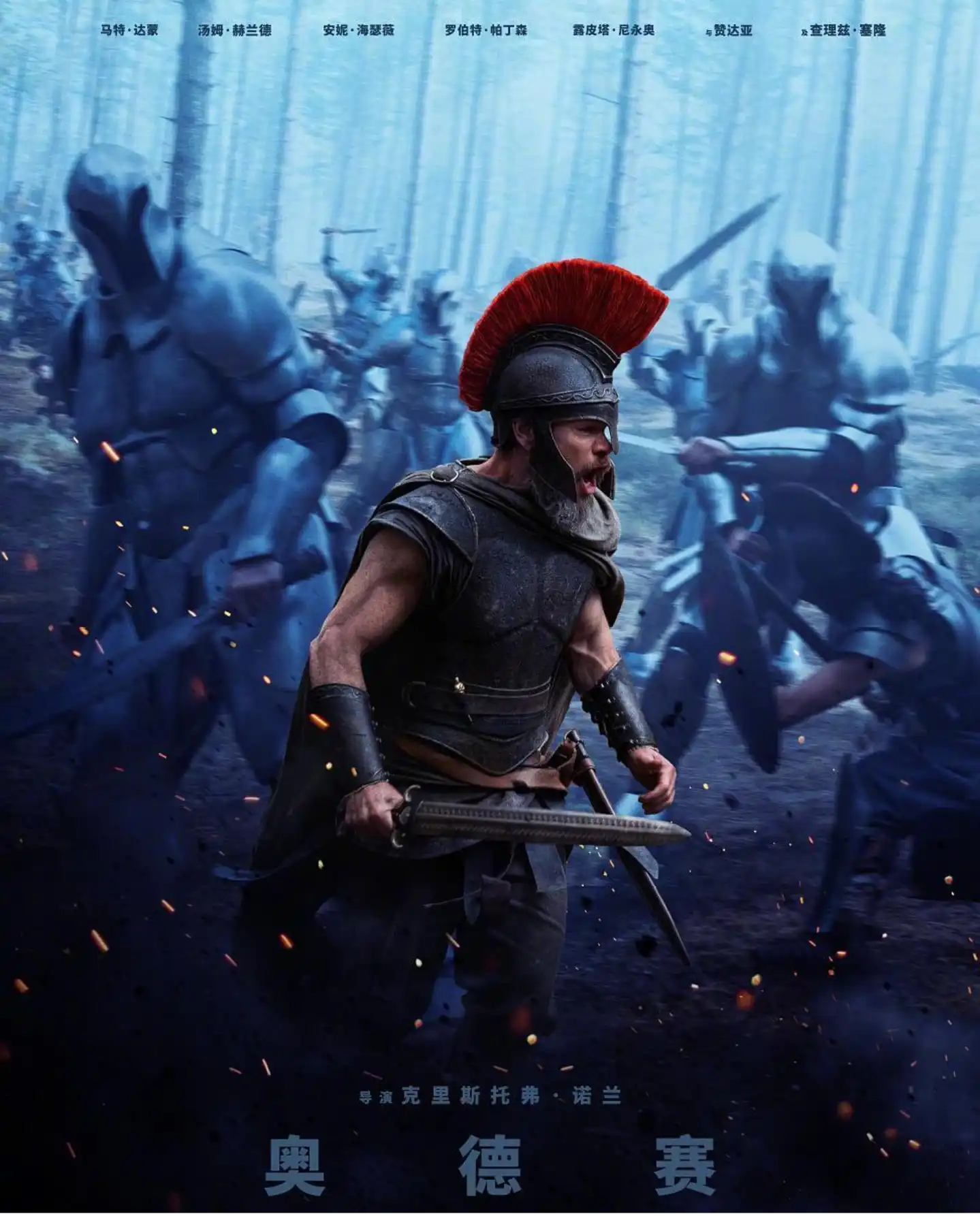
On July 17, 2026, Christopher Nolan's "Odyssey" was released in cinemas worldwide. As of August 9, this epic film with a budget of $250 million and a runtime of 172 minutes has grossed over $1.008 billion globally, becoming the director's second-highest-grossing work, second only to "The Dark Knight Rises." It opened with a global weekend box office of $264 million, setting a new personal record for Nolan. It holds a 98% fresh rating on Rotten Tomatoes and a 99% audience score, both Nolan's highest career scores. In mainland China, the film had not yet officially premiered (scheduled for August 14), but advance screenings and pre-sales had already generated over 60 million yuan. Showings with only 0.4% of the screenings accounted for over 17% of the box office, with IMAX screenings in first-tier cities reaching a 94% occupancy rate. Industry insiders predict the final box office will land between $1.2 and $1.5 billion.
Meanwhile, another version of Odysseus was quietly setting sail in the digital world. Independent studio Fountain0 released a 135-minute feature film titled "Odysseus: The Fall," with a total cost of only $50,000, generated 100% by artificial intelligence. A team of 12 people completed it in three months, with zero live-action filming, zero studio use, and zero large crew. Almost simultaneously, Elon Musk announced on the X platform that his AI platform Grok Imagine would produce an AI-generated "Odyssey" feature film "faithful to Homer's original" by the end of the year.
A 5000-fold cost difference, same subject matter, same release window. This is not just a clash of artistic genres, but a divergence in industrial philosophy. However, delving deeper into Hollywood's balance sheets reveals that Christopher Nolan's $250 million is not a consumptive "expense," but a "leveraged investment" that moves the entire industry—securing exclusive IMAX agreements, long-tail home video rights, and copyright library value for the next half-century.
In contrast, while AI's $50,000 is cheap, its training datasets exist in legal gray areas, and the generated footage cannot claim strong copyright protection. "Low cost" without property barriers is, in the eyes of capital markets, precisely a liability lacking a moat.
Nolan's filming method is almost a deliberate provocation to efficiency-first proponents.
A 91-day shoot spanned six countries: Morocco, Greece, Italy, Iceland, Scotland, and the United States. The film used over 640 kilometers (over 2.1 million feet) of IMAX film—enough to stretch from Toronto to New York—and produced 5,300 costumes. For this film, IMAX spent two years developing its first new film camera in 25 years, named "Kelly" in honor of the late Chief Quality Officer David Kelly and his wife. The camera uses carbon fiber components (sourced from Formula 1 racing) and for the first time enables IMAX film to capture dialogue and close-up shots—previously, the immense operating noise of IMAX cameras made any dialogue scene impossible.
The Cyclops scene was not CGI. The crew built a 60-foot-tall practical animatronic puppet in Greece's Psychro Cave, combining mechanical effects and string-puppet techniques. The six-headed sea monster and massive whirlpool were also filmed practically—manned speedboats circled to create a physical water vortex, providing real-time dynamic references for the visual effects team. Actors wore bronze armor while submerged in 9°C seawater. As Matt Damon put it, "This is absolutely the biggest movie I've ever made in my career. It feels like it was made the way they would have 100 years ago, just with IMAX this time."
Independent studio Fountain0's working method belongs to another civilization.
They used large language models to generate the script and video diffusion models to render the visuals. Algorithms replaced the director, cinematographer, art director, lighting technicians, and even the entire post-production team. No morning meetings, no weather delays, no actor scheduling conflicts, no workers' compensation insurance. The total cost of $50,000 is roughly equivalent to a single day's catering expenses on Nolan's set. The film rents for $9.99 per view. It proves for the first time that generating a full-length narrative film with AI is technically feasible.
The capital markets have already cast their preliminary vote.
Nolan's "Odyssey" has grossed $257 million from IMAX screenings, accounting for nearly a quarter of its global total. IMAX's stock price surged 6.61% on August 3, breaking the $50 barrier for the first time to hit a record high; it's up 37.99% year-to-date and has doubled over the past 12 months. Thanks to this film, Universal Pictures became the first film studio in 2026 to surpass $4 billion in global box office. With a $20 million advance plus 20% of the box office gross, Nolan stands to earn between $75 million and $100 million personally.
Meanwhile, Fountain0's AI feature film garnered about 1.2 million views in its first week on streaming platforms. Converted to a subscription model, this translates to direct revenue of less than $1 million. Musk's Grok Imagine version has yet to materialize, and the capital markets have reacted tepidly—Tesla's stock price showed no significant movement, and xAI's valuation hasn't been repriced as a result.
The market favors a certain narrative.
Nolan spent two decades, over ten films, and a cumulative global box office exceeding $6 billion to build a predictable brand for investors. Securing a top-tier Hollywood deal of a "$20 million advance plus 20% of the box office" as a director is extremely rare in industry history. AI filmmaking, however, has yet to establish any sustainable business model. There is no director brand premium, no theatrical window, no IMAX exclusive revenue share, no peripheral merchandise chain. It remains in the ambiguous zone between "tech demo" and "complete product." More crucially, Nolan's seemingly "inefficient" practical filming method is, in essence, a "physical performance bond" delivered to investors. In an industry with an extremely high failure rate, footage shot on film is a definite physical asset. In contrast, AI's generation of a perfect shot depends on a probability-based lottery; this black-box unpredictability would be seen as a potential budget black hole and delay bomb in production audits.
The most honest answer to whether AI can replace traditional filmmaking currently is: it depends on how you define "replace."
First, look at AI's limitations. A frame-by-frame analysis of Fountain0's final product reveals no single shot lasting longer than three seconds. The high-frequency cuts are not an avant-garde editing style but a passive compromise of the technology—current mainstream AI video models cannot support long, stable single-shot generation; the longer a shot lingers, the more obvious the loss of detail becomes. Character consistency across scenes cannot be guaranteed; the same character may appear with different facial contours in different shots. Physical simulation remains superficial, with stiff, jerky body movements lacking force logic and natural texture. The deeper constraint lies in "visual entropy": the human brain is extremely sensitive to instantaneous changes in micro-expressions, and great performances often involve actors' extreme deviations from biological randomness. However, current diffusion models are essentially about "averaging probabilities"; algorithms, for stability, automatically avoid those low-probability moments of brilliance—this condemns AI to long-term mediocrity above the mean in the core domain of emotional close-ups. These are structural issues that might be resolved through iteration in the next three to five years.
But the deeper challenge lies in the consumption experience. All 70mm film screenings at London's BFI IMAX until September 10 are sold out. Some flew halfway across the world from Atlanta, others drove 12 hours to watch a midnight screening before catching an early flight back. IMAX CEO Richard Gelfond said, "In New York, you have to wait until September to get a ticket for a 70mm showing; it's almost become a luxury brand." People are paying not just the ticket price but also their time, travel, and attention. These investments themselves become part of the experience—scarcity creates a sense of ritual, and ritual creates a premium. It's more than just ritual. In the era of infinite supply on streaming platforms, "the physical expenditure of being present" is evolving into a new marker of class distinction. This "embodied cognition" generated by physical presence creates physiological memories that no digital algorithm can encode—the social sharing value it generates has long surpassed the price of the movie ticket itself.
AI-generated content is inherently an infinite supply. As long as the servers are on, it can generate Odysseus forever, the Cyclops forever, any shot forever. But infinite supply destroys scarcity, and scarcity is precisely the foundation of the entertainment industry's premium pricing. When algorithms make images as free and limitless as air, people are instead willing to pay more for a real silver screen.
This is not to say AI will be without impact. On the contrary, its efficiency advantages will profoundly transform the middle and later stages of the film and television industry chain.
Pre-visualization (Previs) already uses AI to generate storyboards and dynamic previews; background filling, scene extensions, and dynamic fixes in post-production VFX are increasingly handled by algorithms; virtual production technology combining game engines with AI, as seen in series like "The Mandalorian," has significantly reduced location costs. These applications don't compete for the "director" title but are eroding the profit margins of repetitive, labor-intensive segments in the traditional film industry.
Oxford University economist Carl Benedikt Frey offers a noteworthy observation: technological replacement is never all or nothing; it tends to replace "tasks that can be codified," not entire professions.
AI can replace background artists, but it's difficult to replace the person who decides "why shoot this shot." It can optimize production cost structures, but it struggles to create a new narrative paradigm. Nolan's choice to shoot dialogue scenes on IMAX film—seemingly absurd from an efficiency standpoint—is precisely this "irrational" choice that creates unique value distinct from streaming content. In a content market dominated by algorithm recommendations and short-video formats, this distinction itself becomes a scarce resource.
But a colder point must be added: AI may not replace Nolan at the finish line, but it will block Nolan's apprentices at the starting line. When producers can use AI to generate "good enough" previews for medium-budget genre films, young directors who traditionally gained experience through $50-$100 million practical shooting projects will find it extremely difficult to secure budgets for green-screen shoots. AI isn't replacing masters at the endpoint; it's draining the soil for new masters to grow at the source. When the future holds only Nolan's "handcrafted luxury goods" and AI's "infinite fast-fashion products," the middle ground of cinema as a popular art will severely erode.
Interestingly, AI might reinforce the value of figures like Nolan in another dimension.
When AI-generated feature films become cheap and common, "live-action filming" itself may gain a premium label akin to "handmade." Just as after the Industrial Revolution, handmade goods didn't disappear but instead found a new market position as "artisan." Those elements irreplicable by algorithms—an actor's gaze, the light on a real set, the serendipity created by a group of people in the same physical space—might become even more precious as AI imagery proliferates.
Odysseus wandered the sea for ten years before returning home. Today's film and television industry is also adrift.
One path leads toward the infinite convenience of algorithm generation, the other toward the finite scarcity of film and giant screens. Nolan chose the latter, and the market affirmed it with $1 billion. But this is not the final verdict. AI video models are iterating monthly—perhaps in three years, an AI-generated Odysseus will have consistent facial features, realistic physics, and single-shot narratives lasting two hours. When that happens, will Nolan-style film epics become even more expensive due to increased scarcity, or will they become expensive nostalgia?
If we are honest enough, we must admit the essence of this confrontation is the incommensurability between the "logic of efficiency" and the "logic of experience." Algorithms pursue the "optimal solution"—producing the visual stimuli most aligned with audience expectations within the shortest computational power. Nolan pursues the "unique solution"—that soul-stirring moment possible only on that screen, at that instant, with that specific film grain.
While industrial capital frantically chases the certainty of algorithms, they overlook a brutal truth: humans are willing to pay a premium for "unexpected surprises" but will only pay cheap subscription fees for "precise conformity to expectations." Odysseus rejected the immortality and ease offered by Calypso, choosing instead the thorns and risks of the journey home. This is perhaps the oldest metaphor for the current predicament of film and television: what we ultimately choose are always the difficult voyages that make us truly feel "alive," not the smooth algorithmic path to nothingness.