Bitcoin perpetual open interest rises as traders bet on year-end rally

cointelegraphPublished on 2025-12-23Last updated on 2025-12-23

Abstract

Bitcoin perpetual open interest has risen from 304,000 to 310,000 BTC as its price briefly reached $90,000, signaling increased trader anticipation of a year-end rally. The funding rate also climbed from 0.04% to 0.09%, indicating growing bullish sentiment and leveraged long positioning. However, high funding rates may also suggest market overheating and potential correction risks. Bitcoin retreated to $88,200 after failing to hold above $90,000. A major year-end options expiry event on Dec. 26, with over $23 billion in contracts, could amplify volatility. Calls are concentrated at $100,000 and $120,000 strikes, while puts cluster around $85,000, with a put/call ratio of 0.37 reflecting dominant bullish bets. The max pain price is $96,000, suggesting many optimistic calls may expire worthless if prices don't rise.

Crypto derivatives markets are heating up as Glassnode reports perpetual open interest has risen in anticipation of a big move at the end of this year.

Perpetual open interest (OI) has risen from 304,000 to 310,000 Bitcoin (BTC) as its price briefly touched $90,000 on Monday, Glassnode said on Monday.

The funding rate has also “heated up” from 0.04% to 0.09%, which suggests derivatives traders are anticipating a potential market move by the end of the year.

“This combination signals a renewed buildup in leveraged long positioning, as perpetual traders position for a potential year-end move,” Glassnode said.

Bitcoin perpetuals are futures contracts that don't expire and can be held indefinitely. They track Bitcoin’s spot price through a mechanism called the funding rate, which is a periodic payment between traders holding long and short positions.

Increased funding rate signals bullishness

When funding rates are increasing, it typically means the perpetual price is rising above spot, and more traders are bullish as they are willing to pay premiums to hold long positions.

However, it can also signal potential market overheating as extremely high rates can indicate overleveraged longs and possible correction risk.

Bitcoin failed to make progress above $90,000 and had fallen back to $88,200 at the time of writing.
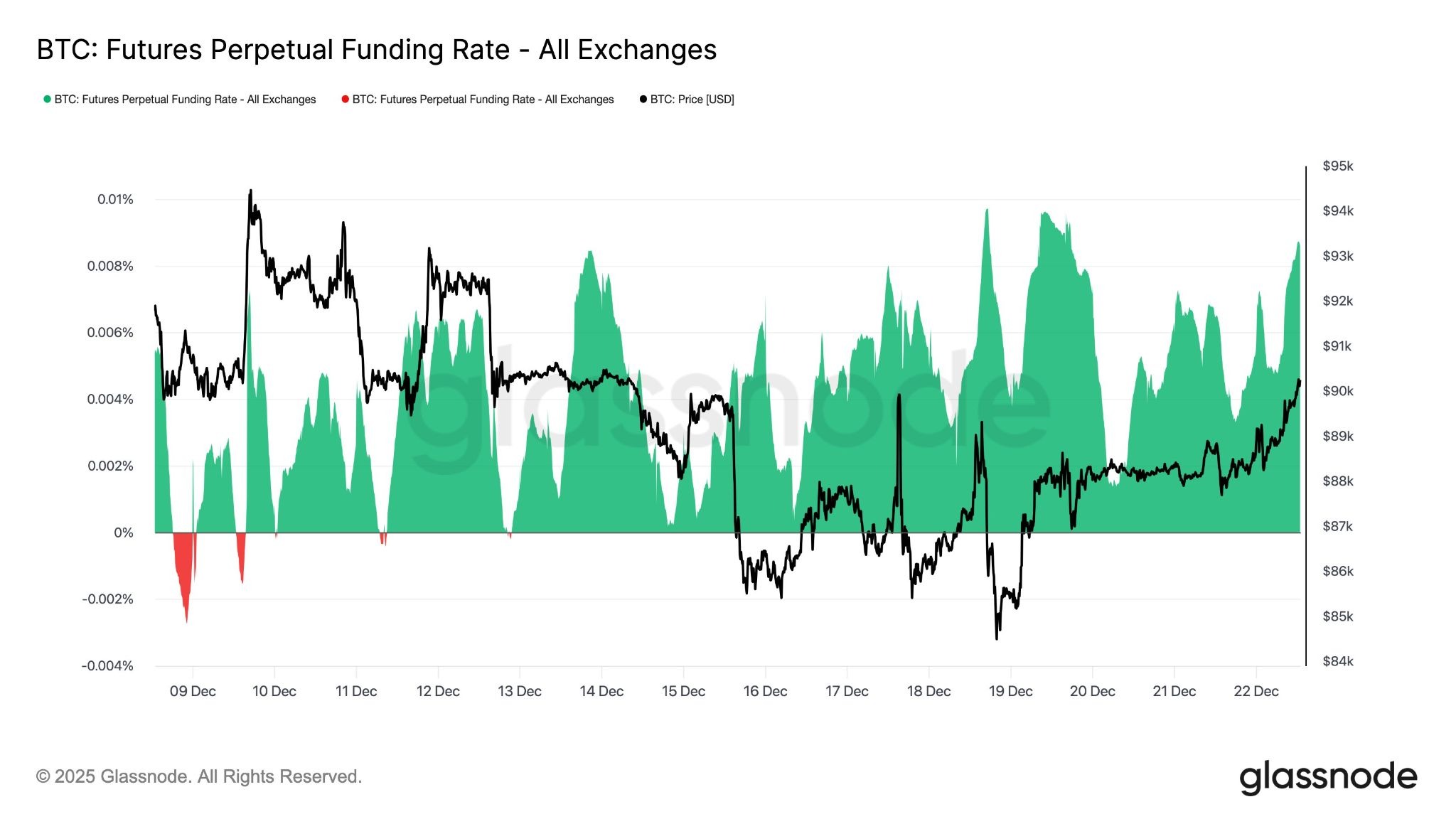
Bitcoin perp funding rates have increased recently. Source: Glassnode

Massive end-of-year options expiry

Market volatility could also be amplified by the massive end-of-year Bitcoin options expiry event on Friday, Dec. 26.

More than $23 billion in notional value Bitcoin options contracts will expire in one of the largest options expiry events of all time. End-of-quarter and end-of-year expiries are much larger than regular weekly or monthly events.

Related: Crypto has everything needed for a bull market, so why is the market down?

Calls, or long contracts, are clustered around the $100,000 and $120,000 strike prices while puts, or short contracts, are concentrated around $85,000, according to Deribit.

The put/call ratio is currently 0.37, which means there are a lot more long contracts expiring than shorts. Max pain, or the strike price at which most losses will be made, is currently $96,000, according to Coinglass.

If spot prices do not move higher, the majority of these contracts will be worthless on expiry. A $7,500 gap to max pain suggests bullish bets, or calls at higher strikes, were overly optimistic and will realize losses.
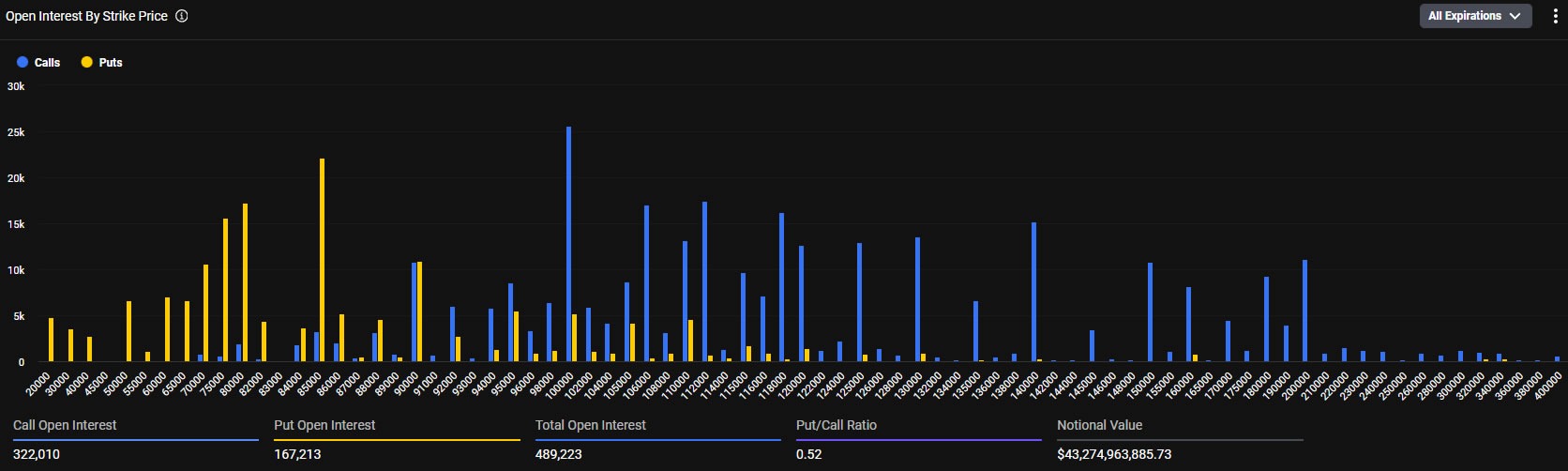
There is a lot of OI at higher strike prices. Source: Deribit

Magazine: Bitcoin’s critical level is $82.5K, Ethereum ‘not done yet’: Trade Secrets

Related Questions

QWhat has happened to Bitcoin perpetual open interest according to Glassnode's recent report?

ABitcoin perpetual open interest has risen from 304,000 to 310,000 BTC.

QWhat does an increasing funding rate typically indicate in perpetual futures markets?

AAn increasing funding rate typically means the perpetual price is rising above spot, indicating more traders are bullish as they are willing to pay premiums to hold long positions.

QWhat major event could amplify market volatility at the end of December according to the article?

AThe massive end-of-year Bitcoin options expiry event on Friday, December 26, with over $23 billion in notional value contracts expiring.

QWhat is the current put/call ratio for Bitcoin options, and what does this signify?

AThe put/call ratio is currently 0.37, which means there are significantly more long contracts (calls) expiring than short contracts (puts).

QWhat is the 'max pain' price for the upcoming Bitcoin options expiry, and what does it represent?

AThe max pain price is currently $96,000, which is the strike price at which the most losses will be realized for option holders if spot prices do not move higher.

Related Reads

$9.4 Billion: The Largest Robotics Funding This Year Has Emerged

Munich-based humanoid robotics company Neura has completed a $1.4 billion (approximately RMB 94.9 billion) Series C funding round, valuing the company at around $7 billion and positioning it among the global leaders in the sector. The investment round is notable not just for its size—reportedly the largest in robotics this year—but also for its strategic backers, which include tech giants like NVIDIA and Amazon, alongside established industrial players such as German engineering firms Bosch and Schaeffler. This mix of investors signals a significant shift in the industry's focus from technological demonstrations and general-purpose narratives toward practical, industrial deployment and commercialization. Neura's approach centers on developing humanoid robots for defined, high-value industrial tasks rather than pursuing a general-purpose model. Its early validation comes from a partnership with BMW, where its robots are being tested on actual production lines. The involvement of Bosch and Schaeffler, companies deeply embedded in global manufacturing, underscores a growing belief that humanoid robots are transitioning from labs to viable factory-floor solutions. The article highlights two converging trends driving investment: advancements in AI and large language models, which enhance robots' perception and decision-making in unstructured environments, and mounting pressure from labor shortages and rising costs in major manufacturing regions. The funding landscape is now bifurcating between companies like Figure AI, focusing on versatile general-purpose robots, and firms like Neura, targeting specific vertical industrial applications with clearer, shorter paths to ROI. While technical hurdles remain, the core challenges for widespread adoption are increasingly seen as engineering and commercial in nature: managing the high integration and customization costs for different factory environments and establishing robust, localized maintenance and service networks. The record investment in Neura, particularly from industrial capital, indicates the industry's growing confidence in moving from proving feasibility to solving the practical problems of scalability, reliability, and building sustainable business models around humanoid robots in real-world settings like automotive manufacturing and hazardous labor environments.

marsbit6h ago

$9.4 Billion: The Largest Robotics Funding This Year Has Emerged

marsbit6h ago

Trading

Spot
Futures

Hot Articles

What is $BITCOIN

DIGITAL GOLD ($BITCOIN): A Comprehensive Analysis Introduction to DIGITAL GOLD ($BITCOIN) DIGITAL GOLD ($BITCOIN) is a blockchain-based project operating on the Solana network, which aims to combine the characteristics of traditional precious metals with the innovation of decentralized technologies. While it shares a name with Bitcoin, often referred to as “digital gold” due to its perception as a store of value, DIGITAL GOLD is a separate token designed to create a unique ecosystem within the Web3 landscape. Its goal is to position itself as a viable alternative digital asset, although specifics regarding its applications and functionalities are still developing. What is DIGITAL GOLD ($BITCOIN)? DIGITAL GOLD ($BITCOIN) is a cryptocurrency token explicitly designed for use on the Solana blockchain. In contrast to Bitcoin, which provides a widely recognized value storage role, this token appears to focus on broader applications and characteristics. Notable aspects include: Blockchain Infrastructure: The token is built on the Solana blockchain, known for its capacity to handle high-speed and low-cost transactions. Supply Dynamics: DIGITAL GOLD has a maximum supply capped at 100 quadrillion tokens (100P $BITCOIN), although details regarding its circulating supply are currently undisclosed. Utility: While precise functionalities are not explicitly outlined, there are indications that the token could be utilized for various applications, potentially involving decentralized applications (dApps) or asset tokenization strategies. Who is the Creator of DIGITAL GOLD ($BITCOIN)? At present, the identity of the creators and development team behind DIGITAL GOLD ($BITCOIN) remains unknown. This situation is typical among many innovative projects within the blockchain space, particularly those aligning with decentralized finance and meme coin phenomena. While such anonymity may foster a community-driven culture, it intensifies concerns about governance and accountability. Who are the Investors of DIGITAL GOLD ($BITCOIN)? The available information indicates that DIGITAL GOLD ($BITCOIN) does not have any known institutional backers or prominent venture capital investments. The project seems to operate on a peer-to-peer model focused on community support and adoption rather than traditional funding routes. Its activity and liquidity are primarily situated on decentralized exchanges (DEXs), such as PumpSwap, rather than established centralized trading platforms, further highlighting its grassroots approach. How DIGITAL GOLD ($BITCOIN) Works The operational mechanics of DIGITAL GOLD ($BITCOIN) can be elaborated on based on its blockchain design and network attributes: Consensus Mechanism: By leveraging Solana’s unique proof-of-history (PoH) combined with a proof-of-stake (PoS) model, the project ensures efficient transaction validation contributing to the network's high performance. Tokenomics: While specific deflationary mechanisms have not been extensively detailed, the vast maximum token supply implies that it may cater to microtransactions or niche use cases that are still to be defined. Interoperability: There exists the potential for integration with Solana’s broader ecosystem, including various decentralized finance (DeFi) platforms. However, the details regarding specific integrations remain unspecified. Timeline of Key Events Here is a timeline that highlights significant milestones concerning DIGITAL GOLD ($BITCOIN): 2023: The initial deployment of the token occurs on the Solana blockchain, marked by its contract address. 2024: DIGITAL GOLD gains visibility as it becomes available for trading on decentralized exchanges like PumpSwap, allowing users to trade it against SOL. 2025: The project witnesses sporadic trading activity and potential interest in community-led engagements, although no noteworthy partnerships or technical advancements have been documented as of yet. Critical Analysis Strengths Scalability: The underlying Solana infrastructure supports high transaction volumes, which could enhance the utility of $BITCOIN in various transaction scenarios. Accessibility: The potential low trading price per token could attract retail investors, facilitating wider participation due to fractional ownership opportunities. Risks Lack of Transparency: The absence of publicly known backers, developers, or an audit process may yield skepticism regarding the project's sustainability and trustworthiness. Market Volatility: The trading activity is heavily reliant on speculative behavior, which can result in significant price volatility and uncertainty for investors. Conclusion DIGITAL GOLD ($BITCOIN) emerges as an intriguing yet ambiguous project within the rapidly evolving Solana ecosystem. While it attempts to leverage the “digital gold” narrative, its departure from Bitcoin's established role as a store of value underscores the need for a clearer differentiation of its intended utility and governance structure. Future acceptance and adoption will likely depend on addressing the current opacity and defining its operational and economic strategies more explicitly. Note: This report encompasses synthesised information available as of October 2023, and developments may have transpired beyond the research period.

363 Total ViewsPublished 2025.05.13Updated 2025.05.13

What is $BITCOIN

Discussions

Welcome to the HTX Community. Here, you can stay informed about the latest platform developments and gain access to professional market insights. Users' opinions on the price of BTC (BTC) are presented below.

活动图片