Bitcoin Is Entering A Window For A Santa Rally, Analyst Says

bitcoinistPublished on 2025-12-22Last updated on 2025-12-22

Abstract

Bitcoin is showing signs of a potential Santa rally, according to CryptoQuant analyst Axel Adler Jr. The market’s current “Regime Score” sits at +16.3, placing it in the upper neutral zone (+15 to +30), which historically has delivered average returns of +3.8% over 30 days. This suggests a tactical bullish setup without excessive optimism. Additionally, the derivatives market shows a skew toward short liquidations, creating mechanical upward pressure as forced buyers enter the market. However, Adler cautions that entering the formal Bull regime (above +30) has historically coincided with local tops. The current “bullish neutrality” offers a favorable window for upside, though a drop in the Regime Score below zero or a shift toward long liquidations would signal exhaustion. Bitcoin traded at $89,864 at the time of writing.

Bitcoin might be stumbling into a very seasonal setup, not because Santa is real, but because positioning and one of those composite “regime” dashboards are flashing the kind of “bullish, but not sweaty” signal traders love to cling to in late December.

CryptoQuant analyst Axel Adler Jr. put it bluntly on X on Monday: “BTC is entering a window for a Santa rally: the Regime Score is bullish but not overheated. Short liquidations are reinforcing the asymmetry in favor of buyers.”
That’s the headline claim. The longer version is basically: the market is in a zone that has historically had decent forward returns, and the derivatives plumbing is currently doing that annoying-but-useful thing where it mechanically pushes price higher when shorts get forced out.

Will Bitcoin See A ‘Santa Rally’ This Year?

In his Monday Substack post, Adler framed it as a tactical setup rather than some grand, end-of-year prophecy. “The BTC market is in the upper part of the Regime Score neutral zone, which has historically shown positive expected returns,” he wrote. Then he tightened the screw: “The current liquidation structure in the futures market indicates a predominance of short position closures, creating additional mechanical pressure in favor of buyers.”

So what’s this Regime Score thing, exactly? Adler describes it as a composite indicator that “combines taker imbalance, OI pressure, funding, ETF flows, exchange flows, and price trend into a single scale from −100 to +100.” The number matters less than the band it sits in. Right now, he says the score “stands at +16.3, corresponding to the upper part of the neutral zone (+15 to +30).”
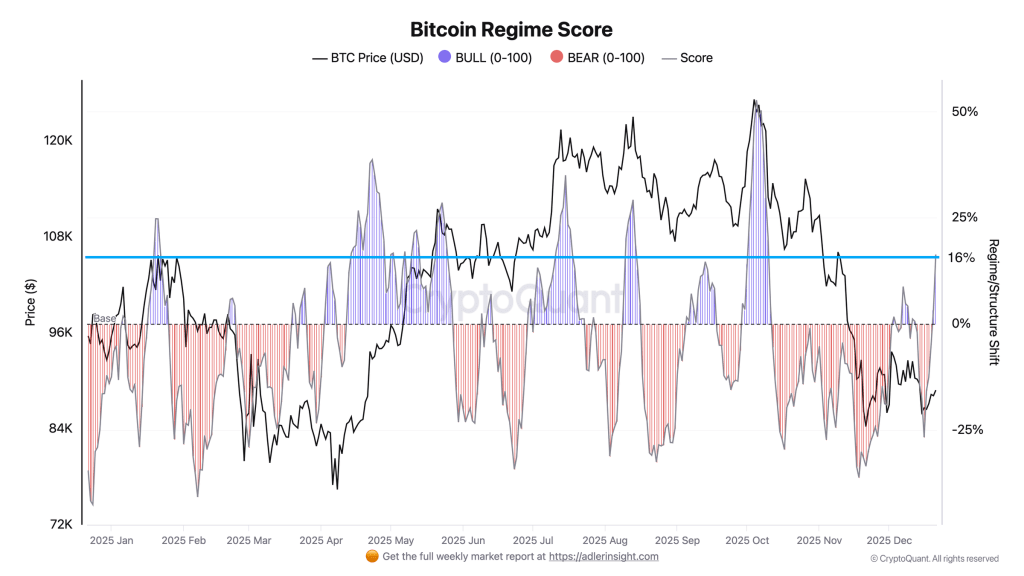
Bitcoin Regime Score | Source: Axel Adler Jr

And that particular subzone is doing the heavy lifting in his argument. “Backtesting for 2025 shows this subzone historically delivered average returns of +3.8% over 30 days,” Adler wrote, contrasting it with the weaker ranges below. He also pointed out that, “unlike the −15 to 0 subzone where expected returns were negative (−1.5% over 7d),” the +15 to +30 band tended to be a more forgiving place to put on risk.

It’s also worth noting how quickly the tape can flip, because his own charting suggests it already did. Adler says the indicator “has emerged from a recent bearish phase (score dropped to −27 a week ago) and is showing recovery.” That’s the kind of detail traders latch onto: not just where you are, but how fast you got there.

But here’s the funny part — the “most bullish” zone, in his backtest, wasn’t actually bullish for forward returns. He flags that “transition into the formal Bull regime (+30 and above) historically coincided with local tops” and that it “delivered negative average returns of −3.3% over 7 days.” In other words, if you wait for the indicator to scream “bull market,” you might be buying the exact moment everyone else is already leaning the same way.

Which is why Adler ends up with a pretty trader-ish conclusion: the current band might be the sweet spot because it’s optimistic without being euphoric.

“This means the current +15–30 zone may be optimal for tactical positions, while aggressive accumulation upon breaking +30 carries elevated risk,” he wrote.

Then there’s the derivatives side — the part that can turn a calm-looking market into a sudden wick up (or down) just because leverage is sitting in the wrong place. Adler’s liquidation dominance oscillator is currently negative, which he reads as a short liquidation skew. “The oscillator’s current value has dropped into negative territory (−11%), while the 30-day moving average remains positive (+10%). This divergence points to a recent surge in forced short position closures,” he wrote.

He doubles down with a second stat: “Long Liquidation Dominance stands at 44%, below the 50% baseline, confirming the predominance of short liquidations.” Put simply: more shorts are getting forced out than longs are getting wiped, and those forced closes are buys.
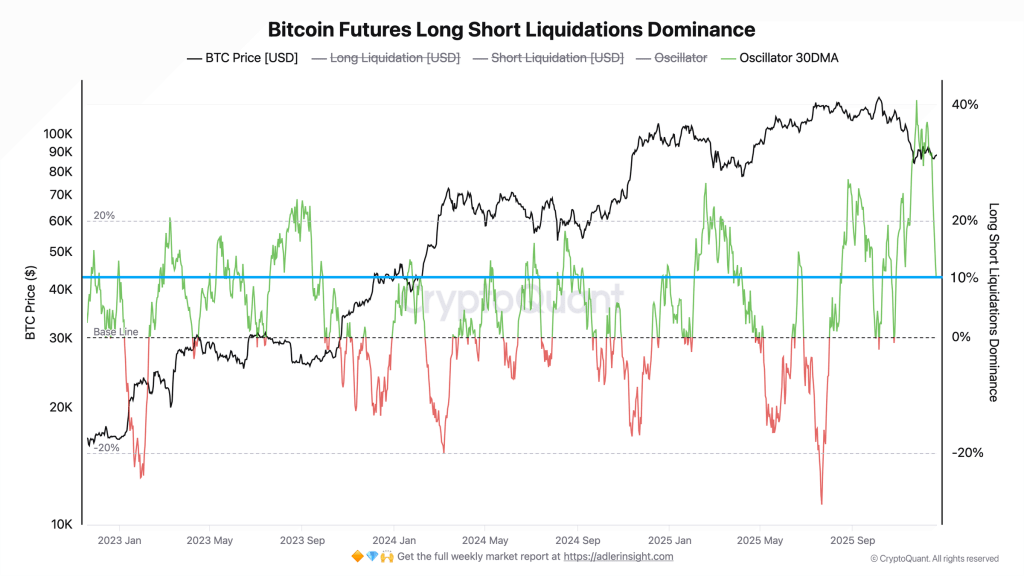
Bitcoin Futures Long Short- Liquidations Dominance | Source: Axel Adler Jr

And his takeaway is basically: this is tactical fuel. “The predominance of short liquidations creates tactical fuel for upside,” Adler wrote, adding that the setup “reinforces the positive signal from Regime Score: the market has not only entered a zone with historically positive expected returns but is also receiving additional support from derivatives structure.”

Still, this is Bitcoin, and these setups don’t last forever. Adler even lays out what would invalidate it, in pretty plain language. “A return of Regime Score below zero accompanied by a reversal of the liquidation oscillator into positive territory (rising long liquidations) would signal exhaustion of the current impulse,” he wrote. Translation: if longs start being the ones getting punished, that “asymmetry” flips.

For now, he’s calling it a “bullish neutrality” moment. Not full-blown melt-up territory, not the kind of reading that screams “local top” either. Just a window where, if the market wants to drift higher into year-end, the positioning doesn’t look like it’s going to fight it.

At press time, Bitcoin traded at $89,864.
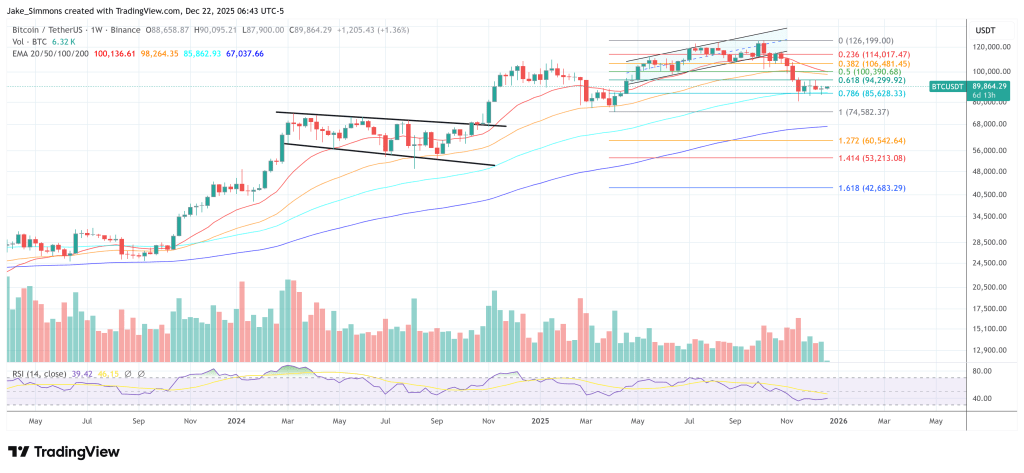
Bitcoin remains stuck between the 0.618 and 0.786 Fib, 1-week chart | Source: BTCUSDT on TradingView.com

Related Questions

QWhat is the current Bitcoin Regime Score and what does it indicate according to Axel Adler Jr.?

AThe current Bitcoin Regime Score is +16.3, which is in the upper part of the neutral zone (+15 to +30). This zone has historically shown positive expected returns of +3.8% over 30 days, indicating a 'bullish, but not overheated' market condition that is optimal for tactical positions.

QHow does the liquidation structure in the futures market currently support a potential price increase?

AThe liquidation dominance oscillator is in negative territory (-11%), indicating a predominance of short position closures. With Long Liquidation Dominance at 44% (below the 50% baseline), this confirms that more shorts are being forced out than longs. These forced short liquidations create mechanical buying pressure, reinforcing the upside for buyers.

QAccording to the analyst, what would invalidate the current bullish tactical setup?

AThe setup would be invalidated by a return of the Regime Score below zero, accompanied by a reversal of the liquidation oscillator into positive territory. This would signal a shift where long liquidations are rising, indicating exhaustion of the current bullish impulse and a flip in market asymmetry.

QWhy does the analyst consider the current 'Bull' regime (score above +30) to be less ideal for entering positions?

AHistorical backtesting shows that a transition into the formal Bull regime (score of +30 and above) has often coincided with local tops and delivered negative average returns of -3.3% over 7 days. This suggests that entering at that point might mean buying when the market is already euphoric and due for a pullback.

QWhat is the overall market condition described by the analyst, and at what price was Bitcoin trading at press time?

AThe overall market condition is described as 'bullish neutrality' or a 'bullish, but not sweaty' signal. It is a tactical setup where the market is optimistic without being euphoric, providing a window for a year-end rally. At press time, Bitcoin was trading at $89,864.

Related Reads

Wall Street Capital Enters ARC, Circle Sparks a System-Level Competition for Stablecoins

Wall Street Capital Enters the ARC Arena as Circle Launches a System-Level Battle for Stablecoin Dominance On May 11, Circle successfully raised $222 million in a pre-sale funding round for its new blockchain and native token, ARC, giving the network a fully diluted valuation of $3 billion. The investor lineup, featuring Wall Street giants like BlackRock and Intercontinental Exchange alongside top-tier venture capital firms such as a16z and ARK Invest, signaled a collective strategic bet on future financial infrastructure. This move marks Circle's significant evolution from a stablecoin issuer (notably USDC) to a designer of financial systems. While USDC operates on external blockchains like Ethereum, making Circle dependent on their performance, ARC aims to create a dedicated infrastructure for the circulation, payment, and clearing of stablecoins. This would integrate currency issuance and circulation into one system, potentially shifting Circle's business model from asset management to infrastructure provision. The convergence of traditional finance and crypto-native capital in this funding round underscores a broader industry shift: stablecoins are transitioning from being mere trading tools to becoming core components of financial infrastructure. By controlling both the issuance (via USDC) and the流通 pathway (via ARC), Circle could establish a closed-loop system from issuance to settlement. If successful, this infrastructure could optimize costs, lower barriers for institutional adoption, and promote standardization in on-chain finance. Ultimately, it has the potential to challenge traditional systems like SWIFT in areas such as cross-border payments, representing a possible step toward the重构 of global financial infrastructure.

marsbit1h ago

Wall Street Capital Enters ARC, Circle Sparks a System-Level Competition for Stablecoins

marsbit1h ago

Circle's Three-Dimensional Valuation Framework: Where Is the Bottom, Where Is the Top

"Circle's 3D Valuation Framework: Where is the Bottom, Where is the Top?" - Article Summary The article analyzes Circle's valuation following its Q1 2026 earnings. While its core business generates substantial interest income from USDC reserves ($6.53B in Q1, up 17% YoY), this revenue is highly sensitive to interest rates and shared significantly with Coinbase. The author proposes a three-dimensional valuation framework: 1. **Interest Business (The Floor):** Valued like a bank (8-15x P/E) on net interest income after Coinbase's share. This provides a conservative valuation baseline. 2. **Payment & Platform Business (The Inflection Point):** Includes CPN (Circle Payments Network) and "Other Revenue" (transaction, integration services). This high-growth segment, not shared with Coinbase, is valued on a platform/network model (higher P/S multiples), similar to Visa/Mastercard. It represents Circle's shift beyond pure interest income. 3. **Arc Network & ARC Token (The Future / Optionality):** Arc is an institutional-focused, EVM-compatible L1 blockchain where USDC is the native gas token. A $222M ARC token pre-sale at a $3B FDV attracted major traditional finance players (BlackRock, Apollo, ICE). While Circle holds 25% of ARC tokens, their value is separate from CRCL equity. This dimension represents the long-term, high-upside bet on Circle becoming an "economic operating system." Current market cap (~$30B) prices in significant future growth beyond the sum-of-the-parts valuation derived from current earnings. The investment thesis hinges on believing in Circle's transition from a "stablecoin issuer" to a broader financial infrastructure and network platform. Key variables for the future include USDC adoption growth, CPN network effects, Arc's success, and potential renegotiation of the Coinbase revenue-sharing agreement.

marsbit2h ago

Circle's Three-Dimensional Valuation Framework: Where Is the Bottom, Where Is the Top

marsbit2h ago

Trading

Spot
Futures

Hot Articles

What is GENIUS

I. Project Introduction1. What Is Genius?Genius (GENIUS) is positioned as the “ultimate on-chain terminal,” a decentralized trading platform focused on privacy and speed. By integrating top-tier privacy technology, it aims to build a next-generation privacy trading infrastructure across networks such as BNB Chain, enabling users to interact on-chain with a seamless experience comparable to centralized exchanges.2. How Does Genius Work?Genius's core technical architecture is structured as follows:(1) Chain-invisible: Users do not need to manually handle multi-step approvals for cross-chain operations, asset wrapping, or complex gas management.(2) Signatureless Trading: Through integrations such as Turnkey, Genius enables instant trading without pop-up confirmations or per-transaction authorization.(3) Aggregator of Aggregators: Genius is powered by a best-in-class aggregation stack integrated with more than 150 DEXs, claiming superior quote efficiency compared with competing products.(4) Account Management: The platform adopts a non-custodial architecture and leverages Turnkey and Lit Protocol for key management, allowing users to securely access their accounts through passkeys.3. Who Created Genius?According to its official Terms of Service, Genius was developed by Shuttle Labs, Inc. Based on the project’s official X account, Ryan Myher is one of the key contributors driving product iteration, including developments such as the rollout of the Ghost protocol, as well as broader community engagement.Binance founder CZ has officially joined the project as an advisor, with the goal of helping the team build a faster and more privacy-preserving on-chain trading experience.In addition, the project has received strong backing from YZi Labs, which has invested in Genius and works alongside the Genius Foundation, responsible for maintaining the core Genius Bridge Protocol (GBP).4. Genius TokenomicsGENIUS is the native token of the Genius ecosystem. As of now, the project has not released a full tokenomics document.Based on the latest official disclosures, Genius incorporates a deflationary mechanism, and 4.6% of the total token supply had already been burned during the early launch phase.Genius Points (GP) System:(1) Trade-to-Earn: The platform has established a reward pool of 200 million Genius Points, and users earn GP for every trade executed through the terminal.(2) Tiering and Badges: Genius features a progression-based badge system ranging from Smart to God, with higher levels unlocking additional perks and benefits.(3) Native Yield: Users holding designated assets such as usdGG in the dashboard can earn native yield directly without going through complex staking.(4) Referral Incentives: Referrers can earn fee rebates of over 45% paid in USDC, along with additional GP.5. Timeline & Key MilestonesMarch 2020: The project’s official X account was created, marking the beginning of its early preparation phase.January 13, 2026: Genius announced a multi-million-dollar investment from YZi Labs and simultaneously confirmed CZ as an advisor to accelerate the buildout of its privacy trading infrastructure.April 18, 2026: The project announced that the Ghost privacy protocol would be launching soon.April 29, 2026: The Ghost protocol officially opened to its first 50 testers, marking the beginning of a new era for privacy trading on BNB Chain. At the same time, the team confirmed 4.6% of tokens have been burnt.​II. Token Information1) Basic InformationToken name: GENIUS (Genius)III. Related LinksWebsite:https://www.tradegenius.com/homeExplorers:https://bscscan.com/address/0x1f12b85aac097e43aa1555b2881e98a51090e9a6Socials:https://x.com/GeniusTerminalNote: The project introduction comes from the materials published or provided by the official project team, which is for reference only and does not constitute investment advice. HTX does not take responsibility for any resulting direct or indirect losses.

1.0k Total ViewsPublished 2026.04.29Updated 2026.05.11

What is GENIUS

How to Buy GENIUS

Welcome to HTX.com! We've made purchasing Genius (GENIUS) simple and convenient. Follow our step-by-step guide to embark on your crypto journey.Step 1: Create Your HTX AccountUse your email or phone number to sign up for a free account on HTX. Experience a hassle-free registration journey and unlock all features.Get My AccountStep 2: Go to Buy Crypto and Choose Your Payment MethodCredit/Debit Card: Use your Visa or Mastercard to buy Genius (GENIUS) instantly.Balance: Use funds from your HTX account balance to trade seamlessly.Third Parties: We've added popular payment methods such as Google Pay and Apple Pay to enhance convenience.P2P: Trade directly with other users on HTX.Over-the-Counter (OTC): We offer tailor-made services and competitive exchange rates for traders.Step 3: Store Your Genius (GENIUS)After purchasing your Genius (GENIUS), store it in your HTX account. Alternatively, you can send it elsewhere via blockchain transfer or use it to trade other cryptocurrencies.Step 4: Trade Genius (GENIUS)Easily trade Genius (GENIUS) on HTX's spot market. Simply access your account, select your trading pair, execute your trades, and monitor in real-time. We offer a user-friendly experience for both beginners and seasoned traders.

2.3k Total ViewsPublished 2026.04.29Updated 2026.05.11

How to Buy GENIUS

Discussions

Welcome to the HTX Community. Here, you can stay informed about the latest platform developments and gain access to professional market insights. Users' opinions on the price of A (A) are presented below.

活动图片